
 Alex Tamm
Table of Contents
The Markets in Crypto-Assets Regulation — MiCA — is the largest regulatory change in European crypto history and the most-misunderstood story in the asset class right now. Half the headlines treat it as the end of European crypto. The other half treat it as a coronation of a properly regulated industry. The reality, as usual, is more boring than either narrative and more useful to actually understand.
This is the user’s guide. It is not a lawyer’s guide. We’re not going to walk through the licensing requirements for someone trying to operate a CASP — there are entire compliance firms publishing fifty-page memos on that. We’re going to walk through what MiCA actually changed for you, what it didn’t change, where the licensed exchanges sit, what happened to privacy coins, and what the practical options are for European crypto users in 2026 who want to keep transacting without giving up the parts of crypto they came here for.
The TL;DR, for readers who want it before the long version: every centralized exchange that wants to keep operating in the EU now runs full KYC, the privacy coins have been or are being delisted from those venues, and the non-custodial and self-custody paths — the ones that were always best for privacy — are explicitly outside the scope of the new rules. The middle ground is mostly gone. The fork is clearer than it was in 2020. Both branches are legal. Pick the one that matches what you actually want to do.
What MiCA Actually Is (And Isn’t)
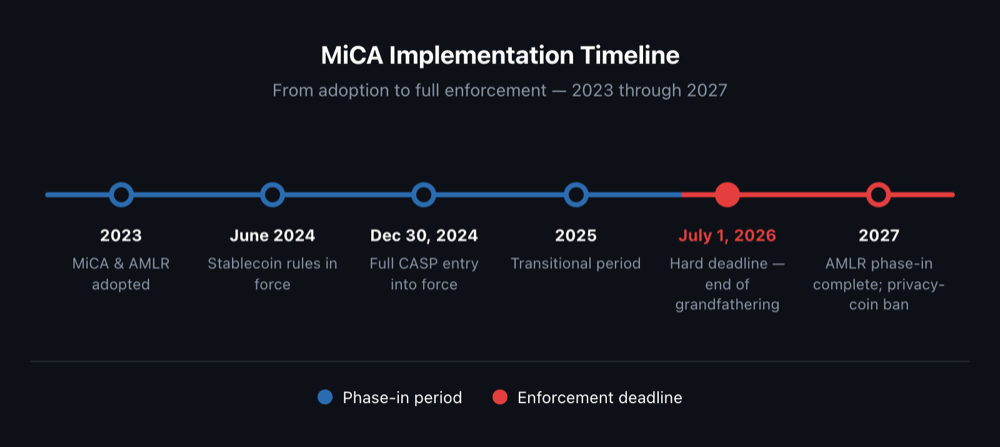
MiCA is the Markets in Crypto-Assets Regulation. It was adopted by the EU in 2023, the stablecoin rules came into force in June 2024, and the full regime for crypto-asset service providers (CASPs) entered into force on December 30, 2024. The 18-month transitional phase for existing operators ends on July 1, 2026, which is the date you’re going to see referenced everywhere as the hard deadline. After that, no more grandfathering. Every CASP serving European users must hold a MiCA license issued by an EU member state, or it must stop serving European users.
What MiCA covers: licensing, capital requirements, governance, transparency obligations, market abuse rules, and the issuance of stablecoins (specifically, asset-referenced and e-money tokens). It also brings in obligations around the travel rule, customer due diligence, and a uniform set of rules for crypto-asset service providers across the entire EU. Until MiCA, every member state had its own approach; now there’s one rulebook.
What MiCA does not cover, and this is the part that gets lost in the news cycle: self-custody, wallet software, non-custodial protocols, peer-to-peer trade between individuals, and decentralized exchange protocols where no centralized operator is providing a service. The regulation has a clear scope, and that scope is intermediaries. If you hold your own keys, the regulation does not apply to you. If you send crypto from one wallet you control to another wallet you control, the regulation does not apply to you. If you swap crypto through a service that never custodies your funds and never opens an account in your name, the regulation does not apply to that service in the way it applies to a Bitvavo or a Coinbase.
For the user, the one-line summary is: MiCA regulates intermediaries, not users. Holding crypto is not a regulated activity. Sending crypto is not a regulated activity. Using a non-custodial protocol is not a regulated activity. Using a licensed exchange now is — to the same degree your bank account is regulated, which is to say, fully.
The capital requirements for CASPs, for context: €50,000 for advisory services, €125,000 for custody and exchange, €150,000 for trading platforms. These thresholds shaped the 2024–2025 race for licensing — who could meet them, who couldn’t, and who decided to exit the EU rather than pay the cost.
The 2026 Timeline at a Glance
For readers who like dates (most German readers do), here is the chronology:
- 2023 — MiCA adopted. AMLR (Anti-Money Laundering Regulation) adopted.
- June 2024 — Stablecoin rules enter force. The first regulated stablecoin issuers begin operating.
- December 30, 2024 — Full MiCA entry into force for CASPs.
- 2025 — Transitional period for existing operators. Country-specific timelines vary widely.
- July 1, 2026 — Hard deadline. End of grandfathering. Full EU-wide enforcement.
- 2027 — AMLR phase-in completes. Planned full prohibition on privacy-coin offerings by licensed CASPs.
The transitional periods varied dramatically by member state, and the variance is worth understanding because it shaped which exchanges existed in which countries through 2025:
- Germany, Austria, Ireland chose 12-month transitional periods, ending around the close of 2025.
- Netherlands and Poland went shorter, with windows expiring mid-2025.
- France, Malta, Luxembourg, and Estonia adopted the full 18-month windows, running all the way to July 2026.
The practical consequence: an exchange that was operating in the Netherlands in early 2025 might be gone by mid-year, while the same operator in Malta would still be authorized. The patchwork is now flattening as the deadline approaches.
Who’s Licensed in 2026
As of early 2026, several dozen CASPs are fully authorized under MiCA across EU member states (the count is growing month over month — check the ESMA register or the relevant national regulator for the current number). The geographic distribution of those licenses tells a clearer story than the raw count.
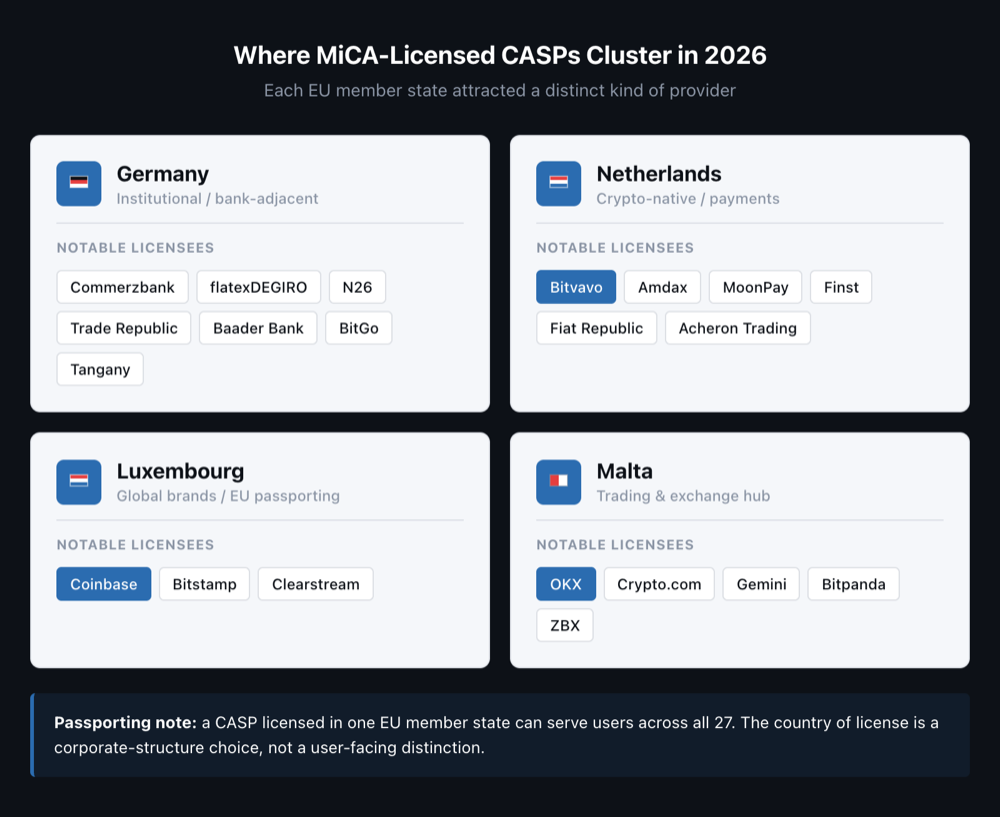
Germany has emerged as the institutional cluster. The licensed providers here include regulated banks and broker-banks (Commerzbank, flatexDEGIRO Bank, Baader Bank, N26, Trade Republic), institutional custodians (BitGo, Tangany), and the Boerse Stuttgart group’s crypto arm. The German profile is bank-adjacent — these are providers that look more like financial institutions than crypto-native startups. For users, that means German-licensed venues feel like banks with crypto products, not exchanges with banking features.
Netherlands has the crypto-native and payments mix. Bitvavo, Amdax, MoonPay, Finst, Fiat Republic, and Acheron Trading are among the licensed providers, with profiles concentrated in on/off-ramp, brokerage-style trading, and payment infrastructure. The Dutch transitional period was one of the shortest in the EU, which means the licensing dust settled here earlier than in most other member states.
Luxembourg has positioned itself as the home for global brands moving fast on EU passporting. Coinbase, Bitstamp, and Clearstream are among the licensees. The Luxembourg profile is capital-markets-friendly — a comfortable home base for providers that want to serve the entire EU through passporting from a single license, which is exactly what MiCA enables.
Malta has the trading-and-exchange-hub profile. OKX, Crypto.com, Gemini, ZBX, and Bitpanda are among the licensees there. Malta’s longstanding crypto-friendliness predates MiCA and gave it a head start in attracting larger exchange operators.
France, Ireland, Spain, and Estonia round out the licensing geography with smaller but growing CASP populations.
What this means in practice for a European user:
A Bitvavo, Bitpanda, or Coinbase EU account in 2026 is a fully KYC’d, fully reportable, fully regulated banking-adjacent product. There is no privacy story on these venues, by design. The licensing rules require it. The capital structure of the providers requires it. The regulatory posture requires it.
Passporting matters too. A CASP licensed in one EU country can serve users in all EU countries. The country of license is a corporate-structuring choice for the provider; it is not, in most cases, a user-facing distinction. A German user opening a Luxembourg-licensed Coinbase account gets the same product they would get from a Luxembourg user opening the same account.
A handful of global names did not pursue MiCA licensing within the transitional window. They’ve either restricted services for EU users or exited the EU market entirely. The public list of MiCA-licensed CASPs is maintained by national regulators and the European Securities and Markets Authority (ESMA); users who want to verify a specific provider’s status can check directly.
The Privacy Coin Situation
This is the part that affects the readers who came here for privacy reasons most directly, and it’s worth being precise about.
The Anti-Money Laundering Regulation (AMLR) — adopted in 2024 alongside MiCA, with phase-in continuing through 2027 — prohibits licensed CASPs from offering anonymity-enhancing tokens. In practical terms, that means Monero, Zcash, Dash, and similar privacy assets cannot be listed on a MiCA-licensed European exchange.
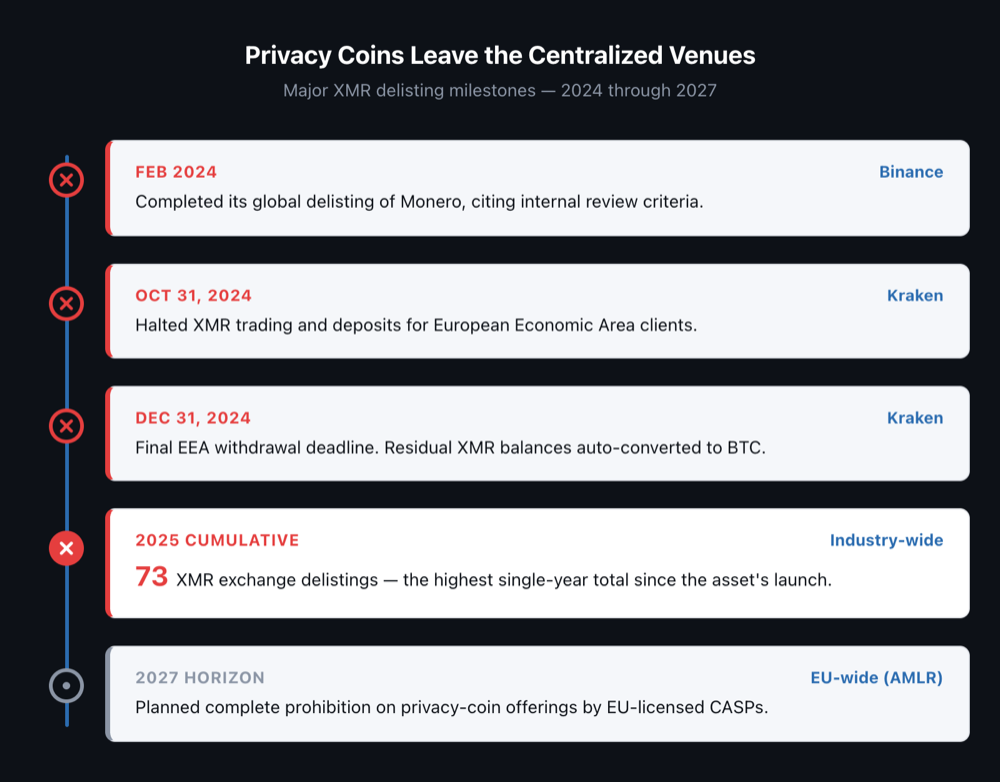
The practical effect rolled out across 2024 and 2025:
- February 2024 — Binance completed its global delisting of Monero, citing internal review criteria.
- October 31, 2024 — Kraken halted XMR trading and deposits for European Economic Area clients, citing the regulatory environment.
- December 31, 2024 — Kraken set the final EEA withdrawal deadline; residual XMR balances were auto-converted to BTC.
- 2025 (cumulative) — the privacy-coin space saw 73 exchange delistings of XMR across the calendar year, the highest single-year total since the asset’s launch.
- 2027 horizon — a planned complete prohibition on privacy-coin offerings by EU-licensed CASPs takes full effect.
What this does and doesn’t mean is the part that gets distorted in headlines.
It does mean: licensed European exchanges will not offer privacy coins by 2027. The regulatory direction is unambiguous and the implementation is well underway.
It does not mean: holding privacy coins is illegal for EU users. The regulations target providers, not holders. There is no rule that makes it unlawful for a German, Dutch, or French citizen to own Monero. The rule is that licensed European intermediaries cannot offer it to them.
It does not mean: non-custodial swap services that operate outside the licensed CASP framework are required to delist anything. The legal vehicle of those services and the legal vehicle of a licensed European exchange are different, and the regulation that targets one does not automatically catch the other.
It does not mean: Monero stops working. The asset, the network, the wallets, and the non-custodial routes for acquiring and trading XMR are all unaffected by anything in MiCA or AMLR. What stopped working is the path of “buy XMR on a licensed European exchange.” That path has narrowed to nothing. Every other path is intact.
For a deeper analytical look at where Monero goes from here in a post-delisting environment, see our companion piece: Monero (XMR) Price Prediction 2026–2030.
What Stayed the Same
The often-overlooked half of the MiCA story.
Self-custody is unaffected. Holding cryptocurrency in your own wallet, on your own hardware, has always been and remains legal in every EU member state. MiCA does not regulate wallets, wallet software, or the act of being your own bank. Trezor and Ledger are not CASPs. A self-hosted Sparrow or Electrum installation is not a CASP. A Cake Wallet, Feather, or Monero GUI installation is not a CASP. The regulation has no jurisdiction over any of these tools.
Non-custodial swap services — services that exchange one crypto for another without ever taking custody of user funds and without opening accounts in user names — sit outside the CASP definition for the most relevant regulatory purposes. They don’t custody. They don’t operate order books. They don’t hold balances on behalf of users. The legal analysis here is more nuanced than this paragraph can capture, and the regulatory environment continues to evolve, but as of April 2026 these services remain available to EU users without account creation or KYC.
Decentralized exchanges — atomic swap protocols, AMM-based pool DEXs, peer-to-peer escrow protocols — remain outside the scope of MiCA as long as no centralized operator is providing the service. If there’s nobody to license, there’s nobody to regulate. This is the design of the regulation, not a loophole; the EU lawmakers explicitly chose to focus the framework on intermediaries and to leave purely decentralized activity outside it.
Wallet-to-wallet transactions. Sending crypto from one self-custodied wallet to another is unregulated activity for individuals. There is no MiCA requirement that you identify yourself when you send funds from your own wallet.
The travel rule is the one place to be careful. It does apply to transfers between licensed CASPs, and to transfers from CASPs to identified self-hosted wallets above certain thresholds. It does not apply to user-to-user wallet transactions where neither side is a regulated provider. If you’re moving funds out of a licensed exchange to a self-custodied wallet, expect the exchange to ask for the destination address and possibly other information to satisfy its own compliance obligations. After the funds reach your wallet, what you do with them from there is unregulated.
The summary: MiCA shrunk the EU’s centralized exchange surface and expanded the relative importance of non-custodial alternatives. For users who want financial privacy, the practical consequence is that the methods which were always best for privacy — non-custodial, decentralized, self-custodied — are now the only methods for privacy. Privacy migrated out of the centralized venues. The venues themselves are loud about their compliance; the migration is quieter.
Where Privacy Still Lives in EU Crypto
The practical section. This is where the article earns its rewrite.
Non-custodial instant swap services are the cleanest path for most users. The model: you send one cryptocurrency to a swap service, the service exchanges it at the current rate, and you receive the target cryptocurrency at a wallet address you control. No account creation. No email. No identity profile stored anywhere. The service never custodies your funds in any meaningful sense — they pass through.
Godex.io is one of these services and remains available to EU users in 2026 without registration. The specifics worth knowing: 934+ supported coins (including the privacy assets that have been delisted from MiCA-licensed venues), a fixed-rate option that locks the rate at the moment you initiate the swap so the volatility doesn’t bite you mid-transaction, no volume caps (the same anonymity profile applies whether you’re swapping €100 or €100,000), processing in 3–15 minutes after the deposit confirms, and an operating history dating to approximately 2017. There is no tiered KYC trigger; the no-KYC posture is unconditional.
Atomic swap DEXs like Haveno (Tor-native, BTC↔XMR specialty, the spiritual successor to LocalMonero) and THORChain (cross-chain native swaps) are the trustless option for technically comfortable users. No account, fully decentralized execution, higher learning curve.
Pool DEXs like Uniswap, PancakeSwap, and Curve work cleanly within their respective ecosystems. No KYC at the platform layer. Best for users already operating inside a DeFi environment. Note that on-chain traceability is high — these are not the privacy choice for users whose wallets have any history of touching KYC sources.
Peer-to-peer platforms. The current P2P landscape after LocalBitcoins (shut down February 2023) and LocalMonero (shut down November 2024) is smaller and more technical than it used to be, but still operating. Bisq handles both crypto-to-crypto and fiat-to-crypto via multi-sig escrow. Robosats runs Lightning-based BTC P2P over Tor with disposable robot avatars. Hodl Hodl offers non-custodial multi-sig escrow for BTC. Peach Bitcoin is a mobile P2P focused on European users.
Self-custody hardware and software wallets. Trezor, Ledger, Sparrow, Electrum, Cake Wallet, Feather, Monero GUI. None of these are CASPs. None require KYC. All work in every EU jurisdiction.
For a deeper walk-through of these methods with honest tradeoffs, see How to Exchange Crypto Anonymously in 2026.
What This Means for German, Dutch, and UK Users Specifically
The three biggest user bases inside Europe each have a slightly different practical reality, and it’s worth touching each one directly.
Germany. The largest cluster of MiCA-licensed CASPs, mostly bank-adjacent. German users have the most centralized options inside the country, all of them fully KYC’d, all of them reportable to BaFin and the tax authority. For German users who want privacy, the non-custodial route is the practical answer — and German users have historically been among the most privacy-aware in Europe. Self-custody and non-custodial swap are well-established practices in the German crypto community, and the German tax framework has clear treatment for individual crypto holdings (private sales after one year of holding remain tax-free under current rules). The practical stack for a privacy-conscious German user in 2026 looks like: hardware wallet for storage, non-custodial swap service for trades, occasional licensed CASP only when fiat on/off-ramp is unavoidable.
Netherlands. Centralized options are concentrated in crypto-native exchanges (Bitvavo is the largest household name). The Dutch transitional period was one of the shortest, ending mid-2025, so the licensing landscape settled earlier here than elsewhere. Dutch users generally have a clean choice between licensed centralized venues with full KYC and non-custodial alternatives with no KYC. The Dutch tax framework treats crypto as box 3 wealth for individuals and is comparatively straightforward.
United Kingdom. Outside MiCA — the UK left the EU before MiCA was finalized — but with parallel FCA rules that have tightened crypto promotion and registration through 2024 and 2025. UK users face a similar landscape in practice: licensed venues run KYC; non-custodial and self-custody methods remain available. The UK does not run an equivalent to MiCA’s pan-EU CASP register, but the FCA maintains its own list of registered firms. UK tax treatment of crypto follows the broader CGT framework with annual allowances, and HMRC has ramped up reporting expectations in line with global trends.
For all three jurisdictions, the practical bottom line is the same: KYC at licensed centralized venues is the new default; non-custodial alternatives remain available for users who prefer them; the methods that work in 2026 work consistently across all three.
The Bottom Line for European Crypto Users
The 2026 European crypto market is more regulated than ever, more clearly mapped than ever, and — for users willing to think about their tools — has more honest options than the headlines suggest.
If you want a fully compliant, fully KYC’d, bank-adjacent crypto experience, the MiCA-licensed CASPs in Germany, Netherlands, Luxembourg, and Malta now offer exactly that. The product is more polished than it was in 2020. The customer-protection rules are more comprehensive. The legal status is unambiguous. For a substantial portion of the European crypto user base, this is exactly what they wanted.
If you want privacy, self-custody, and the ability to swap without an account, the non-custodial alternatives are not only legal — they’re the only honest path, because the centralized venues no longer offer privacy at all. The middle ground (a centralized exchange that doesn’t quite KYC) is mostly gone. What remains is a clean fork: regulated and watched, or non-custodial and quiet. Both are legal. Both work. Pick the one that matches what you’re actually trying to do.
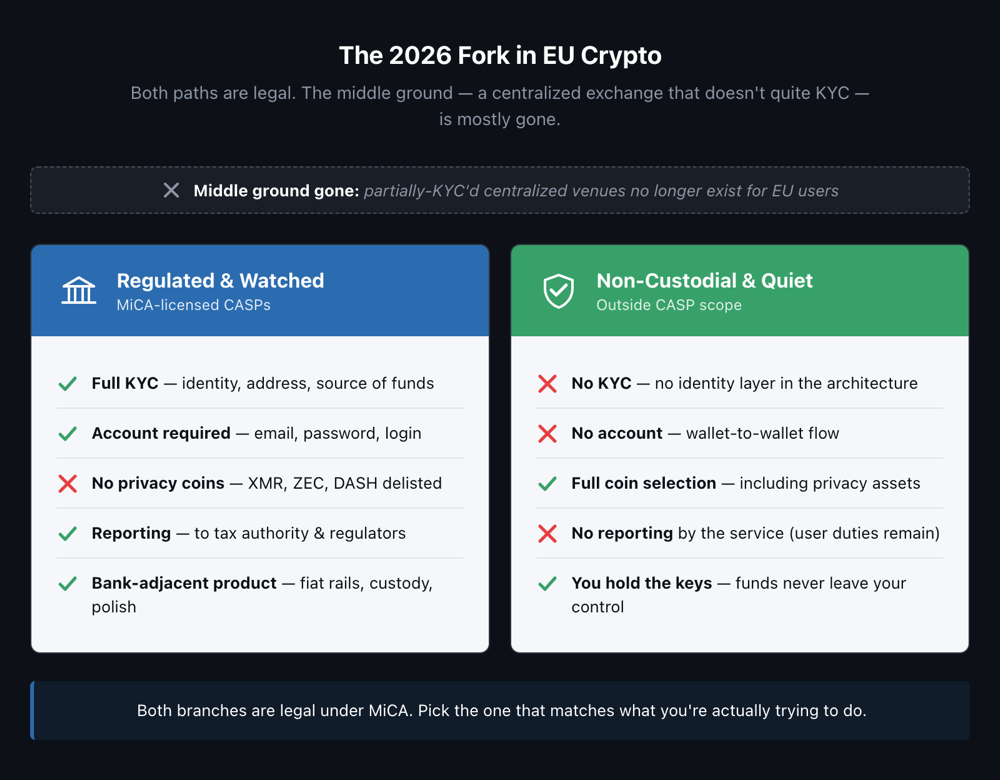
The choice is clearer in 2026 than it was in 2020. That clarity is the underrated story of MiCA.
Closing
MiCA is the largest regulatory change in European crypto history, and it’s also more boring than the news cycle would suggest. The practical effects on most users are: bigger KYC walls at familiar venues, fewer privacy coins on those venues, and a growing relative importance of the non-custodial alternatives that were always the best privacy option anyway. The asset class is not banned. Crypto users are not at risk. The path forward, for anyone who values financial privacy as a feature rather than an inconvenience, is the path that’s been there the entire time.
If you’re ready to act on a privacy-conscious workflow inside the EU, start with self-custody, learn the non-custodial swap services, and treat any centralized exchange as a temporary host rather than a home for your assets. The regulation drew a clearer line. Now it’s easier to know which side of it you want to be on.
Last updated: April 8, 2026. Regulatory milestones, licensed CASP counts, and country-specific timelines reflect the publicly available information at the time of writing. This article is informational and is not legal, financial, or tax advice. Verify the regulatory status of any specific provider directly with national regulators or ESMA before making decisions, and consult a qualified professional for jurisdiction-specific legal or tax questions.
Start a Cryptocurrency exchange
Try our crypto exchange platform
Disclaimer: Please keep in mind that the content of this article is not financial or investing advice. The information provided is the author’s opinion only and should not be considered as direct recommendations for trading or investment. Any article reader or website visitor should consider multiple viewpoints and become familiar with all local regulations before cryptocurrency investment. We do not make any warranties about reliability and accuracy of this information.
Read more
In this article we will talk about Ripple (XRP) and its price prediction. What is Ripple (XRP) Ripple is a San Francisco-based startup that was launched in 2012 by Ripple Labs as a global network both for cross-currency and gross payments. Ripple history began in 2004 with the discussions around the digital coin in the […]
You may well think that an article dedicated to a Tether price prediction or the Tether price in general is a little bit strange — it is a stablecoin after all. However, the price of Tether does fluctuate significantly, although it is nowhere near as volatile as non-stablecoin cryptos. This means that staying up to […]
In the article we share our vision at Zcash cryptocurrency main features and add several price predictions. As cryptocurrencies gain global acceptance and decentralisation slowly enters our lives, privacy becomes the main concern when talking about blockchain adoption. It is no secret that distributed ledger is by far the most secure and transparent technology ever […]
Chiliz coin (CHZ) offers a compelling opportunity for traders interested in the intersection of blockchain technology and sports. By enabling fans to influence team decisions through the Socios app, Chiliz directly monetizes fan engagement and connects with major sports teams like Juventus and Paris Saint-Germain. These partnerships not only enhance the platform’s visibility but also […]
The exponential growth of Bitcoin Satoshi Vision (BSV) against the general bear trend on the cryptocurrency market in autumn 2019 has impressed the community. Due to the increasing market capitalization, the newly emerged altcoin was ranked 5th on CoinMarketCap and managed to maintain its high position at the beginning of 2020. In the article we […]
EOS is definitely on the list of the strongest and most stable projects in the crypto world. Despite the fact that the currency entered the market less than 3 years ago, it consistently occupies one of the top 10 places in the rating for project capitalization. it is often called the “main competitor of Ethereum”. […]