
 Linda Larsen
Table of Contents
Kraken delisted Monero in Canada and India in April 2026 — the latest in a 2024–2026 wave that already removed XMR from OKX, Binance, Kraken’s EEA region, and Exodus wallet. Owning and swapping XMR remains legal in most jurisdictions. Non-custodial, no-account swap services — Godex, StealthEX, ChangeNOW — and decentralized atomic-swap protocols (Haveno, Bisq) still support XMR without KYC. This article covers why the delistings are happening, where to swap XMR now, and how to complete a swap on Godex step by step.
Godex.io is a non-custodial instant cryptocurrency exchange operating since 2017. It supports 934+ coins, requires no registration or KYC at any transaction size, and offers both fixed-rate and floating-rate swap modes. Processing time is 3–15 minutes after deposit confirmation.
Why Has Monero Been Delisted from Major Exchanges?
Monero has been delisted from regulated exchanges because three regulatory frameworks make XMR’s traceability profile incompatible with KYC, AML, and Travel Rule obligations: MiCA Title V (which sets EU rules for crypto-asset service providers), the EU’s Anti-Money Laundering Regulation (AMLR), and the FATF Travel Rule. The trend is regulatory and structural, not commercial.
MiCA Title V CASP rules apply to any “crypto-asset service provider” operating in the EU and reached full effect in late 2024 (ESMA / European Commission overview of MiCA{:target=”_blank” rel=”noopener”}). CASPs are required to identify counterparties, maintain transaction records, and respond to regulator inquiries on flows. XMR’s ring signatures and stealth addresses make that compliance posture difficult-to-impossible to maintain without strong off-chain identity tracking — which most exchanges are unwilling to build for a single asset.
The AMLR (EU Anti-Money Laundering Regulation) — Regulation (EU) 2024/1624{:target=”_blank” rel=”noopener”} — reaches full effect on July 1, 2027. The regulation prohibits CASPs from servicing anonymity-enhancing crypto-assets that obscure transaction history (covered in industry analysis by CoinGeek{:target=”_blank” rel=”noopener”} and others). That is the bright-line rule that makes XMR untenable for any EU CASP after that date — and it is why EU-licensed venues have been pulling XMR pairs ahead of the deadline rather than running into it.
The FATF Travel Rule is the global standard requiring originator and beneficiary information transmission for crypto transactions over a threshold (typically USD/EUR 1,000). Non-custodial wallets and privacy coins create implementation gaps that regulated exchanges resolve by delisting rather than by engineering custom Travel Rule rails for assets that resist them by design.
The concrete consequence: privacy tokens saw 60+ delistings in 2024 alone (per Coinspeaker{:target=”_blank” rel=”noopener”}), the highest annual count since 2021.
Owning, holding, and swapping Monero remains legal in most jurisdictions. What is restricted is regulated CASPs handling it within their licensed perimeter. The platforms still supporting XMR are the ones structured outside that perimeter — non-custodial, no account, no fiat rail.
Where Godex sits in this picture. Godex’s swap engine operates as a non-custodial service that does not custody fiat or maintain user accounts, which places it outside the EU CASP perimeter that triggers MiCA and AMLR obligations. Godex is not a registered EU CASP. Not a loophole claim — a description of which obligations attach to which architectures.
Which Exchanges Have Delisted XMR? Timeline
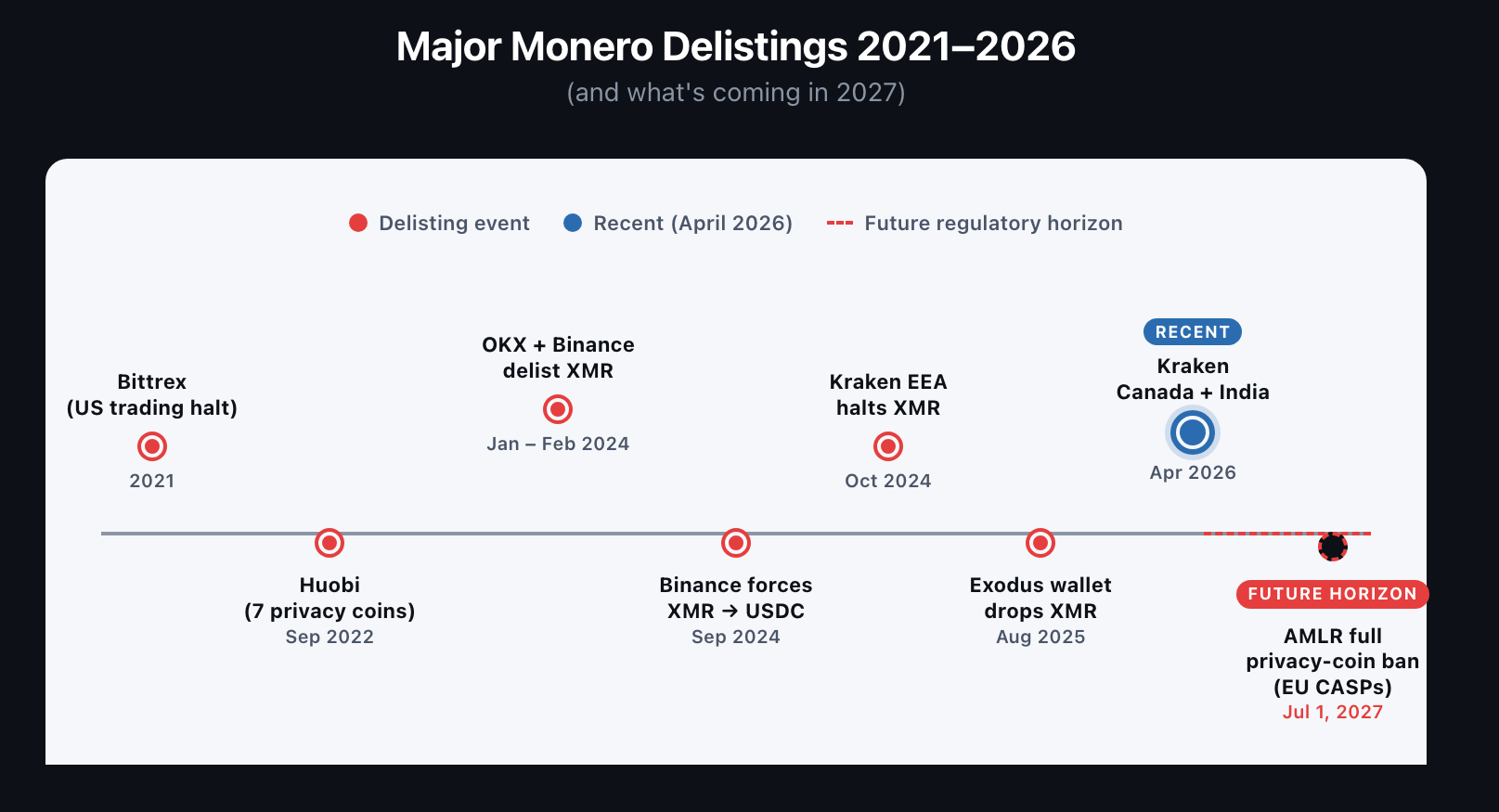
The major XMR delistings since 2021, in chronological order, are below. The list grows as new jurisdictions pull licenses or face new regulator pressure.
| Exchange / Wallet | Action | Date |
|---|---|---|
| Bittrex | Stopped XMR trading in U.S. | 2021 |
| Huobi | Removed 7 privacy coins including XMR | September 2022 |
| OKX | Delisted XMR + ZEC + DASH + ZEN{:target=”_blank” rel=”noopener”} | January 5, 2024 |
| Binance | Announced XMR delisting (effective Feb 20){:target=”_blank” rel=”noopener”} | February 6, 2024 |
| Binance | Forced XMR → USDC conversion of remaining balances{:target=”_blank” rel=”noopener”} | September 2, 2024 |
| Kraken (EEA) | Halted XMR trading and deposits{:target=”_blank” rel=”noopener”} | October 31, 2024 |
| Kraken (EEA) | Withdrawal deadline; auto-conversion of residual balances | December 31, 2024 → January 6, 2025 |
| Exodus wallet | Dropped XMR support | August 10, 2025 |
| Kraken (Canada, India) | Scheduled XMR delistings | April 2026 |
Data verified April 2026. Each entry is sourced to the platform’s official announcement.
A few notes on common reader questions:
- Coinbase never listed XMR. It is not a delisting — it is an absence.
- Bitstamp and Bitvavo: as of April 2026, neither lists XMR on their public asset pages.
- Pattern: every entry on this list traces to a regulatory or compliance trigger, not a commercial one. Expect more between now and AMLR full effect on July 1, 2027.
What Does “Soft KYC” Mean and Why It Matters After a Delisting
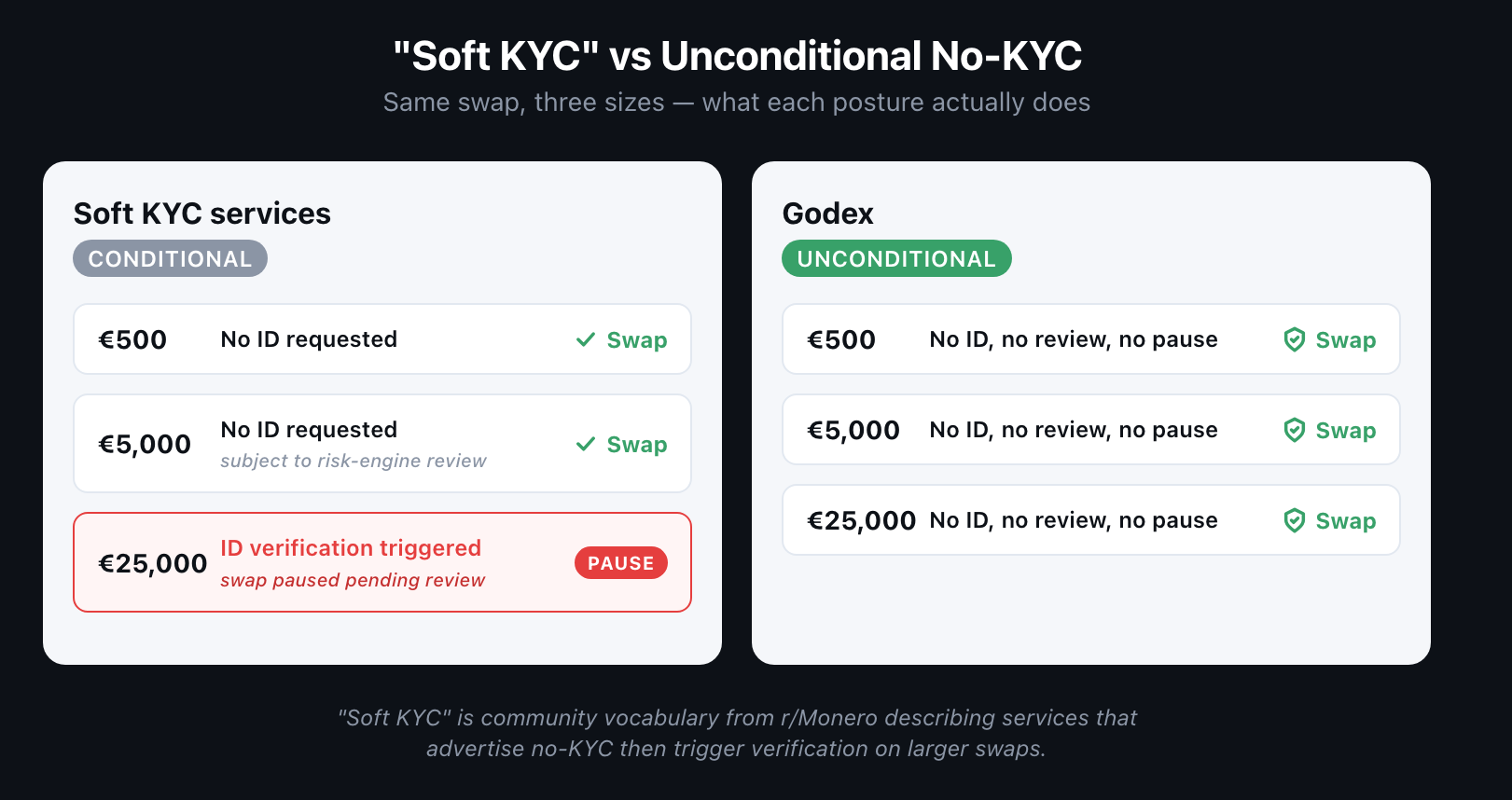
“Soft KYC” is community vocabulary from r/Monero{:target=”_blank” rel=”noopener”} and similar privacy-focused subreddits — it describes services that advertise no-KYC then trigger identity verification on larger swaps, flagged addresses, or internal risk-score alerts. The user starts a swap expecting no verification, gets through the deposit, then sees the swap pause for “additional review.” For users who left a CEX specifically to escape KYC, soft KYC is the same wall in a different location.
Soft KYC (community term, originating in r/Monero and broader privacy-coin discussion): a crypto swap service that advertises as no-KYC but enforces identity verification on a conditional basis — typically by transaction size, address heuristics, or algorithmic risk scoring. The verification triggers mid-swap, after the user has already deposited funds, and access to the deposit is paused until the user complies.
Why it happens. Most no-KYC aggregators are themselves licensed entities or partner with licensed liquidity providers, which means they inherit AML/KYC obligations under MiCA, FinCEN, or equivalent regimes. They handle compliance by triggering verification on flagged transactions rather than gating every transaction at the front door.
What triggers it (per documented patterns across StealthEX, ChangeNOW, FixedFloat, SimpleSwap, and Changelly user reports): transaction sizes above roughly €1,000–€10,000 depending on platform; addresses appearing on Chainalysis or TRM Labs risk lists; deposits from mixer addresses; multiple swaps from the same source within a short window; or unusual swap patterns flagged by internal heuristics.
The user experience. Swap pauses. Funds are held by the platform pending KYC verification — typically photo ID plus a selfie holding the ID, sometimes a source-of-funds declaration. Verification “usually takes a few hours to a day” per most platforms’ published SLAs. Documented user reports describe waits of one to several weeks in flagged cases.
Why Godex has no documented soft-KYC trigger surface. Godex operates without an account model. No email, no login, no profile, no per-user history. Each swap is a one-off with a single-use deposit address; order data is retained only as long as needed to support the swap and any post-swap customer service follow-up, then removed. There is no risk-scoring algorithm in the path because there is no persistent account for an algorithm to score. KYC is not requested at $1,000, $10,000, or $100,000. Godex has operated under this posture since 2017; its published KYC/AML policy states the no-account stance directly, and the structural absence of an account layer is verifiable against the service’s behavior.
The right question for a post-delisting swap path isn’t “does this platform require KYC?” but “under what conditions does it require KYC?” Platforms that answer “none” are structurally different from platforms that answer “above a threshold.” For a deeper breakdown, see our overview of non-KYC crypto exchanges in 2026.
Where to Swap Monero Without KYC in 2026
Three categories still support XMR swaps without account-level KYC in 2026: non-custodial instant swap aggregators (Godex, StealthEX, ChangeNOW, SimpleSwap, FixedFloat), decentralized P2P protocols (Haveno, Bisq), and atomic swap protocols (BTC↔XMR directly between wallets). Each has trade-offs.
| Category | Examples | Strengths | Trade-offs |
|---|---|---|---|
| Non-custodial instant swap | Godex, StealthEX, ChangeNOW, SimpleSwap, FixedFloat | Fast (3–15 min), no account, large coin coverage, fixed-rate options | Soft-KYC triggers at most platforms above thresholds; Godex is the exception (unconditional at any volume) |
| Decentralized P2P | Haveno, Bisq | Most private (no central operator), trustless | Slower (hours), liquidity depends on counterparties, technical setup |
| Atomic swap (BTC↔XMR) | UnstoppableSwap, COMIT | Most private, fully trustless, mainstream-ish for $10K+ holders | Technically demanding, multiple block confirmations, BTC↔XMR pair only |
Godex is the recommended starting point for users who want fast, fixed-rate, unconditional no-KYC swaps at any volume. 934+ coins, fixed and floating rate options, no account model, 3–15 minute settlement after deposit confirmation, operating since 2017. The Godex bundle for a post-delisting user is policy consistency: a $1,000 swap and a $100,000 swap follow the same flow, and there is no per-account aggregation to flag. Very large XMR swaps may take longer to route or partial-fill depending on liquidity-provider depth at execution — for $50K+ tickets, plan for slightly extended settlement windows.
StealthEX advertises lower per-swap fees on small XMR swaps (around 0.40%). Honest concession — for a small swap of a familiar pair, that is a real win. Documented user reports describe soft-KYC triggers on larger swaps and on flagged addresses.
ChangeNOW, SimpleSwap, FixedFloat, GhostSwap are viable for small swaps. Each has documented per-transaction caps or occasional verification triggers. A full per-platform comparison is out of scope here — see our guide to FixedFloat and StealthEX alternatives for the side-by-side.
Haveno is the closest direct replacement for the now-defunct LocalMonero and the gold standard for fully decentralized P2P XMR. Non-custodial, peer-to-peer, no central operator. The most private option, even if more technically demanding than instant-swap aggregators.
Bisq’s XMR/BTC market is the long-running decentralized alternative with a multi-year track record. Slower than instant swap, more private than any aggregator.
Atomic swaps (BTC↔XMR) via tools like UnstoppableSwap and COMIT are now established but technically demanding — mature for advanced users moving $10K+ in XMR, no longer experimental. Protocol-level and fully trustless. Godex is the convenience-tier alternative for users who want execution in minutes rather than the multi-confirmation timeline of an atomic swap.
For most users — especially those holding XMR balances they need to move quickly after a delisting — instant non-custodial swap is the right tool. The next two sections walk through Godex’s flow in both directions. For the broader privacy-coin landscape across XMR, ZEC, and DASH, see our companion guide to privacy-coin exchanges.
How to Swap BTC, USDC, or ETH to XMR on Godex
A swap from BTC, USDC, or ETH into XMR on Godex completes in approximately 3–15 minutes after the deposit confirms on-chain. The process requires no account, no email, and no identity verification. The only thing the user needs is a Monero receive address from a wallet they control.
- Open godex.io. No registration step. No email confirmation.
- Select the swap pair. Choose the input asset (BTC, USDC on Ethereum or Tron, ETH, or any of 934+ supported coins) and XMR as the output. Enter the amount.
- Choose fixed or floating rate. Fixed rate locks the XMR amount at the rate quoted at swap initiation. Floating rate gives whatever the market is at execution. For a slow-confirming chain (BTC under congestion) or a volatile pair, fixed rate is usually the right call — the rate is locked for the full duration of the transaction.
- Enter the XMR receive address. Paste a Monero address from a wallet under user control (Cake Wallet, Monero GUI, Feather Wallet — see the next section). Verify the first and last six characters. Godex never has access to that address — funds settle directly to it.
- Send the input asset to the deposit address Godex generates. The deposit address is single-use and specific to that swap.
- Wait for confirmations. Most swaps complete within 3–15 minutes after the deposit confirms. BTC under congestion is the slowest input chain; Tron and Solana are the fastest.
- Verify the XMR arrived in the receiving Monero wallet.
The same flow works for USDC → XMR (a common path for users whose Binance balance was force-converted in September 2024) and BTC → XMR (a common path for users whose Kraken EEA balance was auto-converted to BTC in January 2025). For the BTC-pair-specific deeper dive, see our BTC to XMR exchange overview.
How to Swap XMR to BTC, USDC, or ETH on Godex
The XMR→output flow follows the same no-account, single-use-deposit-address model as the section above, but three XMR-specific details matter:
- Integrated address. Godex’s deposit address for an XMR-input swap is a Monero integrated address — XMR’s optional payment-ID-equivalent system, which encodes the routing identifier directly into the address rather than requiring a separate memo field. Send XMR to that address as-is; do not attempt to add a manual payment ID.
- 10-block confirmation. XMR requires 10 confirmations on most platforms. At Monero’s 2-minute block time that is roughly 20 minutes, longer under network load — slower than most chains. Plan accordingly. Fixed rate is usually preferred for XMR-input swaps because the confirmation wait creates a meaningful market-exposure window on a volatile pair.
- Stranded-balance scenario (most common XMR→output use case). If a CEX force-converted your balance to BTC or USDC (Binance USDC in September 2024, Kraken EEA BTC in January 2025), the rotation back into XMR — or out of a stranded XMR balance withdrawn just before a wallet’s deadline — is the same flow: from your self-custody Monero wallet (Cake, Feather, Monero GUI) → to the Godex integrated address → settling to your target chain. No account, no KYC at any size.
For the procedural specifics on XMR-to-BTC — confirmation timing, fee dynamics, route reliability — see the XMR to BTC exchange overview.
What If Your Wallet Has XMR You Can’t Move?
If a wallet dropped XMR support (Exodus removed it in August 2025) or a CEX is in a withdrawal-only or auto-conversion window, the priority is to get a working Monero wallet that can receive XMR before the platform’s deadline. Then withdraw, then swap or hold as needed.
Open-source Monero wallets that still support XMR fully (no specific endorsement — neutral list):
- Cake Wallet — mobile and desktop, easy onboarding, integrated swap providers. Note: integrated swap providers inside wallet UIs are aggregators that may have their own soft-KYC triggers. Using Godex via godex.io directly avoids that path.
- Feather Wallet — desktop, lightweight, privacy-focused, no integrated swap aggregator (a deliberate design choice).
- Monero GUI / CLI — official wallet from getmonero.org. Heavier setup, full node optional.
CEX withdrawal scenario. If a CEX is in the withdrawal-only window, withdraw to one of the wallets above before the platform’s deadline. Don’t wait — auto-conversion to BTC or USDC happens at the platform’s chosen rate, which is rarely favorable to the user.
Auto-converted balance scenario. If a CEX has already converted the XMR balance to USDC or BTC (Binance USDC conversion in September 2024; Kraken EEA BTC auto-conversion in January 2025), the user holds BTC or USDC, not XMR. Withdraw it to a self-custody wallet, then use the swap flow above to rotate back into XMR via Godex. The original XMR price exposure is not recoverable, but the position can be re-established.
Frequently Asked Questions
Why is Monero being delisted from exchanges?
MiCA Title V CASP rules, the EU Anti-Money Laundering Regulation (AMLR), and the FATF Travel Rule make XMR’s privacy properties incompatible with regulated exchange obligations. Privacy tokens saw 60+ delistings in 2024 alone. The trend is regulatory and structural, not commercial — and it accelerates through July 1, 2027, when AMLR takes full effect for EU CASPs.
Is Monero banned in the EU?
No. Owning, holding, and swapping XMR remains legal for individuals in the EU. What is restricted is regulated crypto-asset service providers handling XMR within their licensed perimeter — fully so after AMLR full effect on July 1, 2027. Non-custodial swap services and decentralized P2P protocols operate under different frameworks and continue to support XMR.
Where can I still buy or swap Monero without KYC in 2026?
Non-custodial instant swap services (Godex, StealthEX, ChangeNOW, SimpleSwap), decentralized P2P protocols (Haveno, Bisq), and atomic swap protocols. Godex offers unconditional no-KYC at any transaction size — no thresholds, no flagged-address triggers. Other aggregators may trigger verification on larger swaps or flagged addresses.
What is “soft KYC”?
A no-KYC service that triggers identity verification under specific conditions — transaction size, flagged addresses, or internal risk-scoring alerts. The verification fires mid-swap, after the user has already deposited, and access to the deposit is paused until verification completes. The term originates in r/Monero and broader privacy-coin community usage.
Can I still recover my XMR after Binance converted it to USDC?
The original XMR price exposure is not recoverable — the conversion happened at Binance’s chosen rate in September 2024. The position itself can be re-established: withdraw the USDC to a self-custody wallet (Trust Wallet, MetaMask, Ledger), then use a non-custodial swap service to rotate USDC back into XMR.
What replaced LocalMonero after it shut down?
Haveno is the closest direct replacement for fully decentralized P2P XMR trading. Bisq’s XMR/BTC market is a long-running alternative with a multi-year track record. Instant non-custodial swap services (Godex, StealthEX, ChangeNOW) cover the convenience tier for users who want execution in minutes rather than hours.
How long does a Godex XMR swap take?
Approximately 3–15 minutes after the deposit confirms on-chain. XMR confirmation typically takes around 20 minutes on the Monero side; total wall-clock time for an XMR-input swap is usually 25–35 minutes. For users coming from a fiat starting point rather than an existing crypto position, see our guide to buying Monero without KYC.
Start a Cryptocurrency exchange
Try our crypto exchange platform
Disclaimer: Please keep in mind that the content of this article is not financial or investing advice. The information provided is the author’s opinion only and should not be considered as direct recommendations for trading or investment. Any article reader or website visitor should consider multiple viewpoints and become familiar with all local regulations before cryptocurrency investment. We do not make any warranties about reliability and accuracy of this information.
Read more
You may well think that an article dedicated to a Tether price prediction or the Tether price in general is a little bit strange — it is a stablecoin after all. However, the price of Tether does fluctuate significantly, although it is nowhere near as volatile as non-stablecoin cryptos. This means that staying up to […]
In the article we share our vision at Zcash cryptocurrency main features and add several price predictions. As cryptocurrencies gain global acceptance and decentralisation slowly enters our lives, privacy becomes the main concern when talking about blockchain adoption. It is no secret that distributed ledger is by far the most secure and transparent technology ever […]
Chiliz coin (CHZ) offers a compelling opportunity for traders interested in the intersection of blockchain technology and sports. By enabling fans to influence team decisions through the Socios app, Chiliz directly monetizes fan engagement and connects with major sports teams like Juventus and Paris Saint-Germain. These partnerships not only enhance the platform’s visibility but also […]
The exponential growth of Bitcoin Satoshi Vision (BSV) against the general bear trend on the cryptocurrency market in autumn 2019 has impressed the community. Due to the increasing market capitalization, the newly emerged altcoin was ranked 5th on CoinMarketCap and managed to maintain its high position at the beginning of 2020. In the article we […]
EOS is definitely on the list of the strongest and most stable projects in the crypto world. Despite the fact that the currency entered the market less than 3 years ago, it consistently occupies one of the top 10 places in the rating for project capitalization. it is often called the “main competitor of Ethereum”. […]
XRP price prediction 2026-2027: bear, base, and bull scenarios with ranges and named sources, the resolved SEC case, live spot ETFs, and can XRP reach $10?