
 Linda Larsen
Table of Contents
Singapore doesn’t just tolerate crypto — it has built one of the most deliberately structured regulatory frameworks for digital assets in the world. With over 2,300 crypto and blockchain companies now operating in the city-state, and the Monetary Authority of Singapore (MAS) having issued proper licenses to 33 companies as of June 2025, the question for locals isn’t whether to trade crypto. It’s where to do it smartly.
This guide cuts through the noise. Whether you’re swapping assets instantly without the friction of account setup, buying your first Bitcoin with SGD via PayNow, or actively trading altcoins, Singapore’s exchange landscape in 2026 has an option for you — and a few important caveats to understand before you deposit a single cent.
Why Singapore’s Crypto Scene Is Different in 2026
The best crypto exchange in Singapore isn’t just about fees or coin selection — it’s about operating in a regulated environment that’s tighter than almost anywhere else in Asia.
Since June 30, 2025, every crypto service provider operating in Singapore — including those previously serving only overseas clients — must hold a license under the Payment Services Act (PSA) or the Financial Services and Markets Act (FSMA). The deadline came with no transitional period, and penalties for non-compliance reach up to SGD 250,000 and three years’ imprisonment. Retail investors are now required to pass a mandatory Risk Awareness Quiz before trading on licensed platforms. Customer assets must be segregated in trust accounts, with at least 90% held in cold storage.
What this means practically: the wild-west era is over for Singapore-facing platforms. The exchanges that remain are more accountable — but also fewer in number, and in some cases more restrictive on leverage and speculative products for retail users. Non-custodial instant swap services, which operate outside the custodial model entirely, have become an increasingly popular complement — offering speed and asset breadth that registered custodial exchanges rarely match.
The 6 Best Crypto Exchanges for Singapore Users in 2026
1. Godex — Best for Instant Swaps Across the Widest Asset Selection
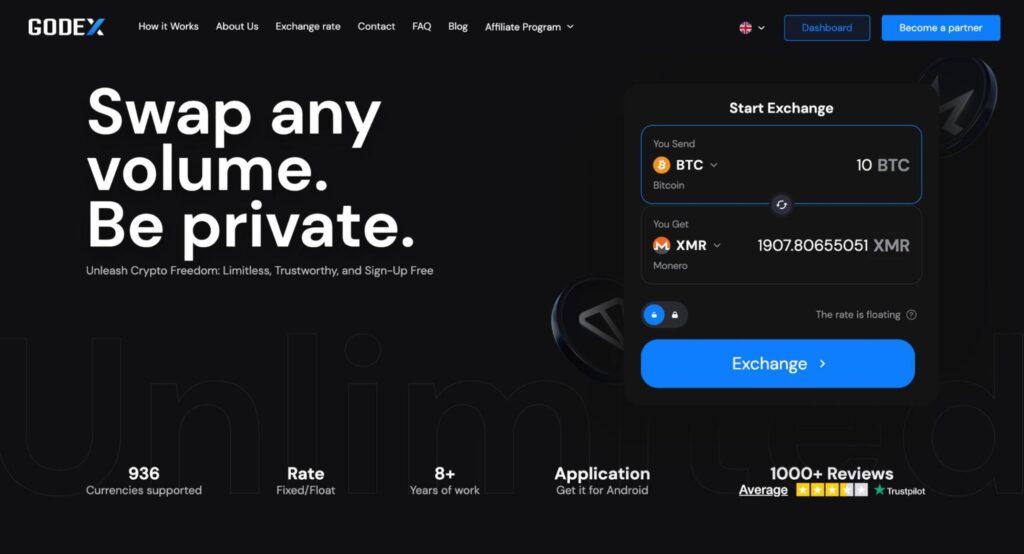
When it comes to sheer breadth of what you can swap and how fast you can do it, Godex stands out from every other platform on this list. Founded in 2018, it operates as a non-custodial exchange supporting 936+ cryptocurrencies — a selection that dwarfs most licensed custodial platforms — with no account required, no registration, and no waiting for KYC approval. You arrive, set your swap, send funds to a one-time deposit address, and receive the exchanged coins in 5–30 minutes directly to a wallet you control.
What makes Godex particularly well-suited to Singapore’s crypto-savvy user base is the combination of speed and rate certainty. The fixed-rate option locks your exchange rate for 30 minutes — so the price you see when you initiate the swap is the price you get, regardless of market movement during the transaction window. There are no volume limits, which means the same seamless experience applies whether you’re swapping $500 or $500,000. Order data is deleted automatically after two weeks, and the platform has maintained a strict no-data-collection policy since launch.
Key features:
- 936+ cryptocurrencies available for instant swap, including major assets, altcoins, and privacy coins
- Fixed-rate option locks exchange rate for 30 minutes
- Non-custodial: funds go directly to your wallet, never held on the platform
- No registration, no account, no personal data collected
- No transaction volume limits — same experience at any size
- Order data automatically deleted after two weeks
Best for: Traders and portfolio managers who want instant access to the widest asset selection, rate certainty, and full control of their funds at every step.
2. Crypto.com — Best All-in-One App for Everyday Singapore Traders
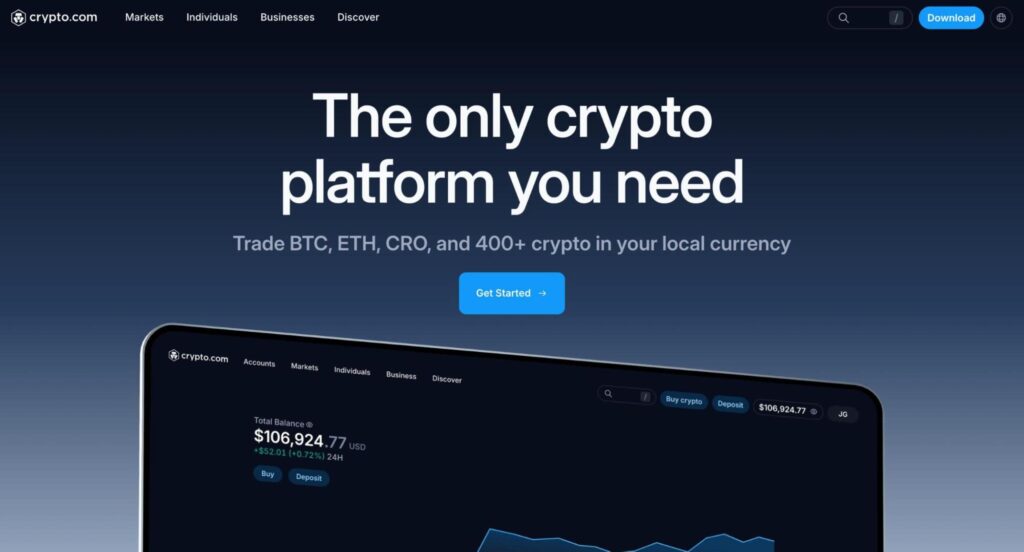
Crypto.com holds a full Major Payment Institution (MPI) license from MAS, granted in June 2023 for Digital Payment Token services — making it one of the most firmly established options for Singapore residents. The platform supports SGD deposits and withdrawals via FAST transfers, covers over 400 cryptocurrencies, and bundles trading, staking, DeFi access, and a crypto Visa card into a single app ecosystem. For someone who wants to start buying crypto in Singapore today — open the app, verify via KYC, deposit SGD, and go — Crypto.com is hard to beat on sheer convenience.
Key features:
- Full MAS MPI license (DPT services, since June 2023)
- SGD deposits/withdrawals via FAST
- 400+ supported cryptocurrencies
- Integrated staking, DeFi, and rewards card
- Note: derivatives and leveraged trading unavailable under the Singapore entity
Best for: Beginners and everyday users who want an all-in-one experience with full regulatory backing.
3. Coinhako — Best for SGD Trading Pairs and Local Support
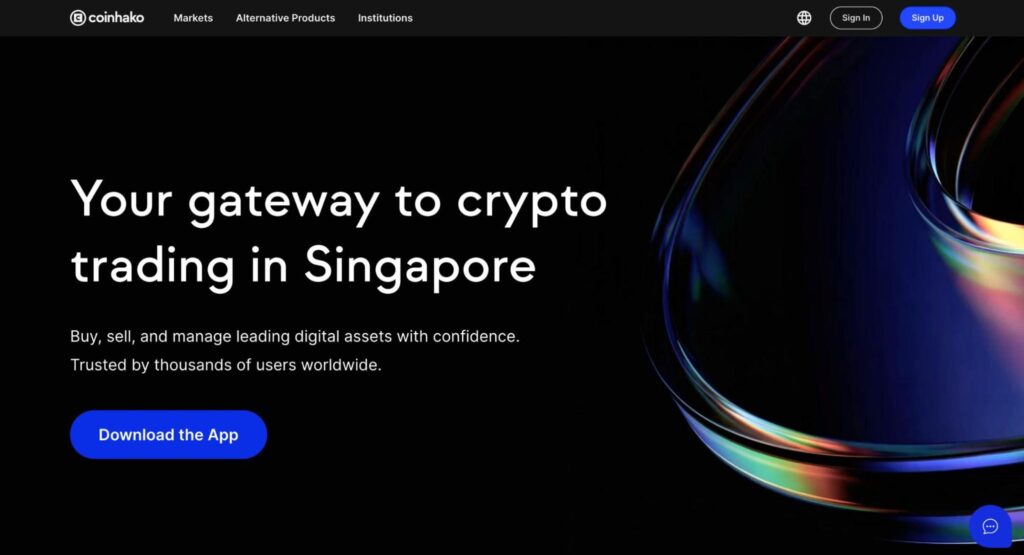
Founded in Singapore in 2014, Coinhako was there before most of the competition and has earned a reputation as the home-ground choice for local traders. It holds a full MPI license from MAS, supports direct SGD deposits via PayNow and FAST, and keeps the interface deliberately simple — a feature that matters to traders who don’t want to navigate a platform designed for professional derivatives desks.
The focus is on the basics done well: spot trading, clear fee structures, and local customer support that understands Singapore’s regulatory context. For users who want a platform that speaks their language, figuratively and literally, Coinhako remains a top choice.
Key features:
- Singapore-founded and MAS MPI-licensed
- PayNow and FAST deposits in SGD
- Clean, beginner-friendly interface
- Strong compliance track record
- Narrower coin selection than global platforms
Best for: Singapore residents who want a local exchange with familiar deposit rails and SGD-native trading pairs.
4. OKX — Best for Active Traders Wanting Low Fees and Deep Liquidity
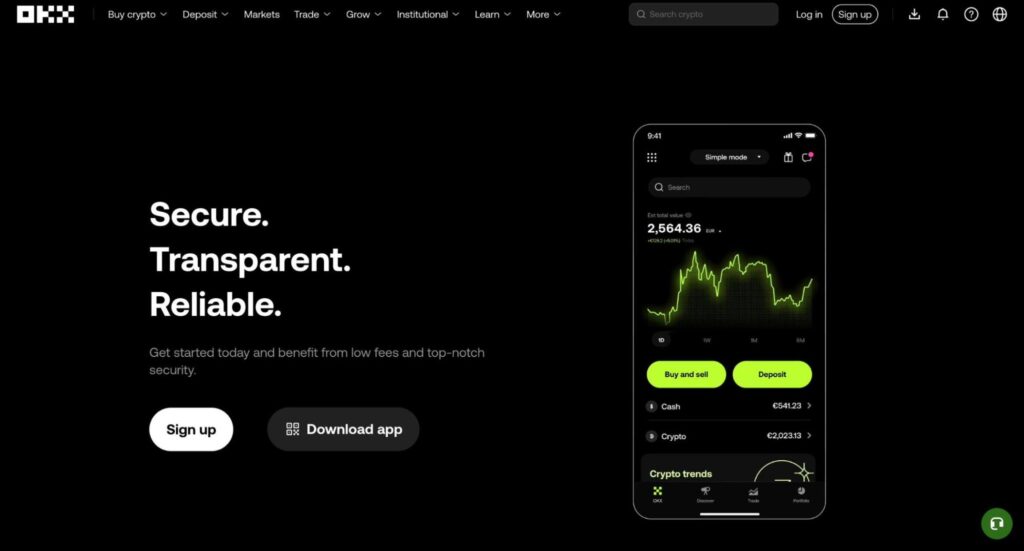
OKX‘s Singapore entity (OKX SG Pte. Ltd.) received a full MPI license from MAS in September 2024, after in-principle approval in February 2024. Spot fees start from approximately 0.08% maker / 0.10% taker, with tiered discounts that can push maker rates close to zero for high-volume traders. The platform supports a broad asset list, advanced charting tools, copy trading, a peer-to-peer marketplace, and SGD deposit connectivity.
Where OKX stands apart is liquidity. Deep order books mean less slippage for traders moving larger positions — a real advantage when swapping between altcoins or making time-sensitive entries. For the actively trading Singapore user who has outgrown simpler platforms, OKX is where many level up.
Key features:
- Full MAS MPI license (granted September 2024)
- Competitive fee structure (0.08% maker, 0.10% taker at base tier)
- Spot, P2P marketplace, copy trading, and advanced tools
- SGD deposit support
- Broad altcoin selection
Best for: Active traders and intermediate-to-advanced users who prioritize low fees and trading tool depth.
5. Coinbase — Best for Beginners Who Want to Start Simple
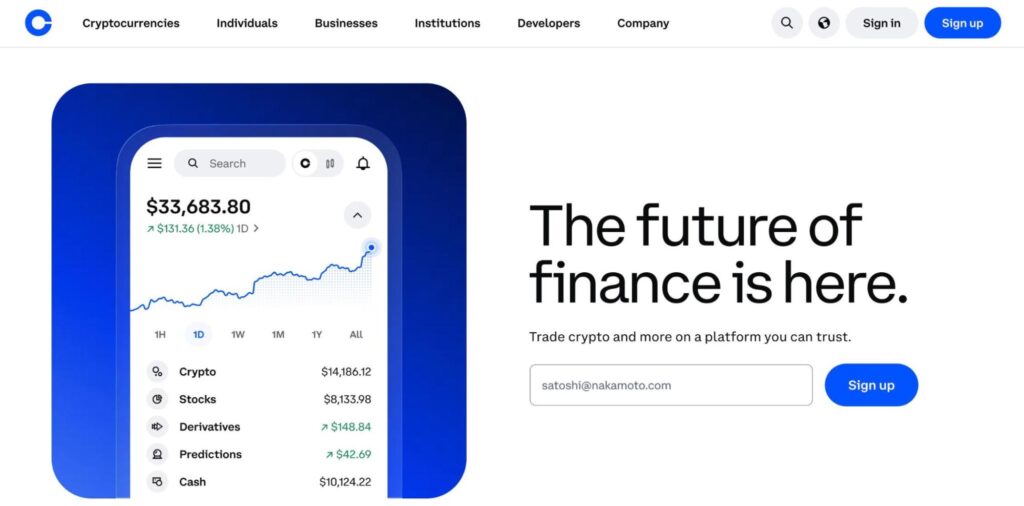
Coinbase Singapore holds a full MPI license from MAS, granted in October 2023. Singapore users benefit from SingPass-compatible verification, PayNow and FAST funding options, and a no-fee USDC purchase offer in SGD. The interface is built around approachability — clean design, educational prompts, and a straightforward buy-and-hold workflow.
Coinbase also integrates a Web3 wallet, enabling direct access to DeFi applications and multi-chain asset management for users ready to graduate beyond the basic buy-and-hold model. The main trade-off is fees: Coinbase’s all-in costs are higher than specialist trading platforms, and serious traders typically migrate elsewhere once they get comfortable.
Key features:
- Full MAS MPI license (since October 2023)
- SingPass-compatible KYC and PayNow/FAST deposits
- Beginner-optimized interface with educational resources
- Integrated Web3 wallet for DeFi access
- Multi-chain support (Ethereum, Solana, Polygon, Optimism)
- Higher fees than dedicated trading exchanges
Best for: First-time crypto buyers in Singapore who want a frictionless, fully MAS-licensed entry point.
6. Kraken — Best for Security-First Traders with a Global Portfolio
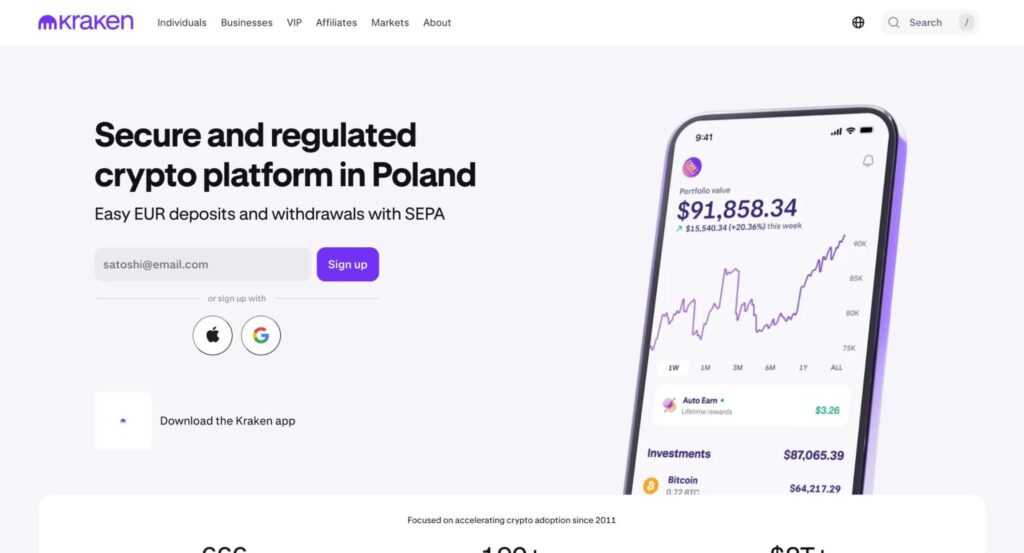
Kraken has operated since 2011 — making it one of the longest-running exchanges in the world — and has built its reputation almost entirely on security, transparency, and institutional-grade reliability. It is not MAS-licensed for Singapore, operating instead as an international exchange accessible to Singapore residents, but its track record speaks for itself: over a decade without a major platform breach, regular proof-of-reserves publications, and SOC 2 Type 2 compliance achieved in 2025.
For Singapore users who hold or trade in multiple fiat currencies, Kraken’s support for USD, EUR, GBP, CAD, AUD, CHF, and JPY makes it a natural fit — particularly for those who already operate internationally or prefer USD as their base currency. Kraken Pro’s tiered fee structure starts at 0.25% maker / 0.40% taker and drops significantly at higher volumes, with advanced charting, margin trading, and staking available to eligible accounts.
Key features:
- Operating since 2011; no major platform breach in over a decade
- 530+ supported cryptocurrencies
- Proof-of-reserves program; SOC 2 Type 2 certified (2025)
- Tiered fees: 0.25% maker / 0.40% taker at base, lower with volume
- Supports USD, EUR, GBP, CAD, AUD, CHF, JPY — no SGD
- Not MAS-licensed; operates as international exchange for Singapore users
Best for: Security-conscious traders with international portfolios who are comfortable operating in USD or EUR and value platform longevity above local regulatory packaging.
Side-by-Side Comparison: Best Crypto Exchanges in Singapore 2026
| Exchange | Type | SGD Support | Coins | Base Spot Fees | KYC Required | Best For |
| Godex | Non-custodial instant swap | Crypto deposits | 936+ | ~0.5% embedded | No | Instant swaps, widest asset range |
| Crypto.com | ✅ Full MPI license | ✅ FAST | 400+ | ~0.075% | Yes | All-in-one beginners |
| Coinhako | ✅ Full MPI license | ✅ PayNow/FAST | 100+ | ~0.2% | Yes | SGD-native local trading |
| OKX | ✅ Full MPI license | ✅ SGD deposits | 300+ | 0.08%/0.10% | Yes | Active traders |
| Coinbase | ✅ Full MPI license | ✅ PayNow/FAST | 200+ | ~0.6% | Yes | Beginners, Web3 access |
| Kraken | International exchange | USD, EUR, GBP + more | 530+ | 0.25%/0.40% | Yes | Security-first, global traders |
How to Choose: Matching Exchange Type to Your Actual Needs
The right crypto exchange in Singapore isn’t one-size-fits-all. Here’s a practical framework:
If you want instant access to the widest range of assets with no sign-up friction: Godex is the fastest path from intent to executed swap. No account creation, no KYC queue — select your pair, enter your receiving wallet address, and the exchange is done in minutes. With 936+ supported assets and no volume limits, it covers use cases most custodial platforms simply can’t match.
If you’re new to crypto and want to buy with SGD: Start with Coinhako or Crypto.com. Both hold full MPI licenses from MAS, support PayNow/FAST deposits, and keep the experience manageable. Complete KYC upfront — it’s a regulatory requirement on all licensed Singapore platforms.
If you’re an active trader who cares about fees: OKX gives you the combination of full MAS licensing, competitive fees, and the trading tools you’ll actually use.
If you prioritize platform security and trade in USD or multiple fiat currencies: Kraken’s decade-plus track record, proof-of-reserves program, and 530+ asset selection make it a strong choice for security-conscious traders who don’t need a local SGD on-ramp.
What Changed in Singapore’s Crypto Landscape in 2025–2026
Understanding context helps you make better exchange decisions. Several significant shifts shaped the current landscape:
The June 2025 licensing deadline was real. MAS required all digital token service providers — including those serving only overseas customers from a Singapore base — to hold a license or cease operations by June 30, 2025. There was no grace period. Platforms that didn’t comply shut down or exited the market.
Retail protections tightened. Retail investors must now complete a mandatory Risk Awareness Quiz before trading on licensed platforms. Credit card purchases of crypto are banned for retail users. Leverage and derivatives products face restrictions.
Customer asset segregation is mandatory. Licensed exchanges must hold customer assets in trust, separate from operational capital, with at least 90% in cold storage. This directly reduces the kind of counterparty risk that led to industry collapses between 2022 and 2024.
The FATF Travel Rule applies to transactions over SGD 1,500. Every qualifying transfer must include sender and recipient information — one reason some users prefer non-custodial swap services for certain transaction types.
Instant Swap in Asia: Why Non-Custodial Platforms Are Gaining Ground
Across Asia’s crypto markets, a growing share of experienced users are choosing non-custodial instant swap services as their primary trading tool — not as a workaround, but as a deliberate preference. The reasons are practical: no account to manage, no KYC queue to clear, and full custody of funds at every step of the transaction.
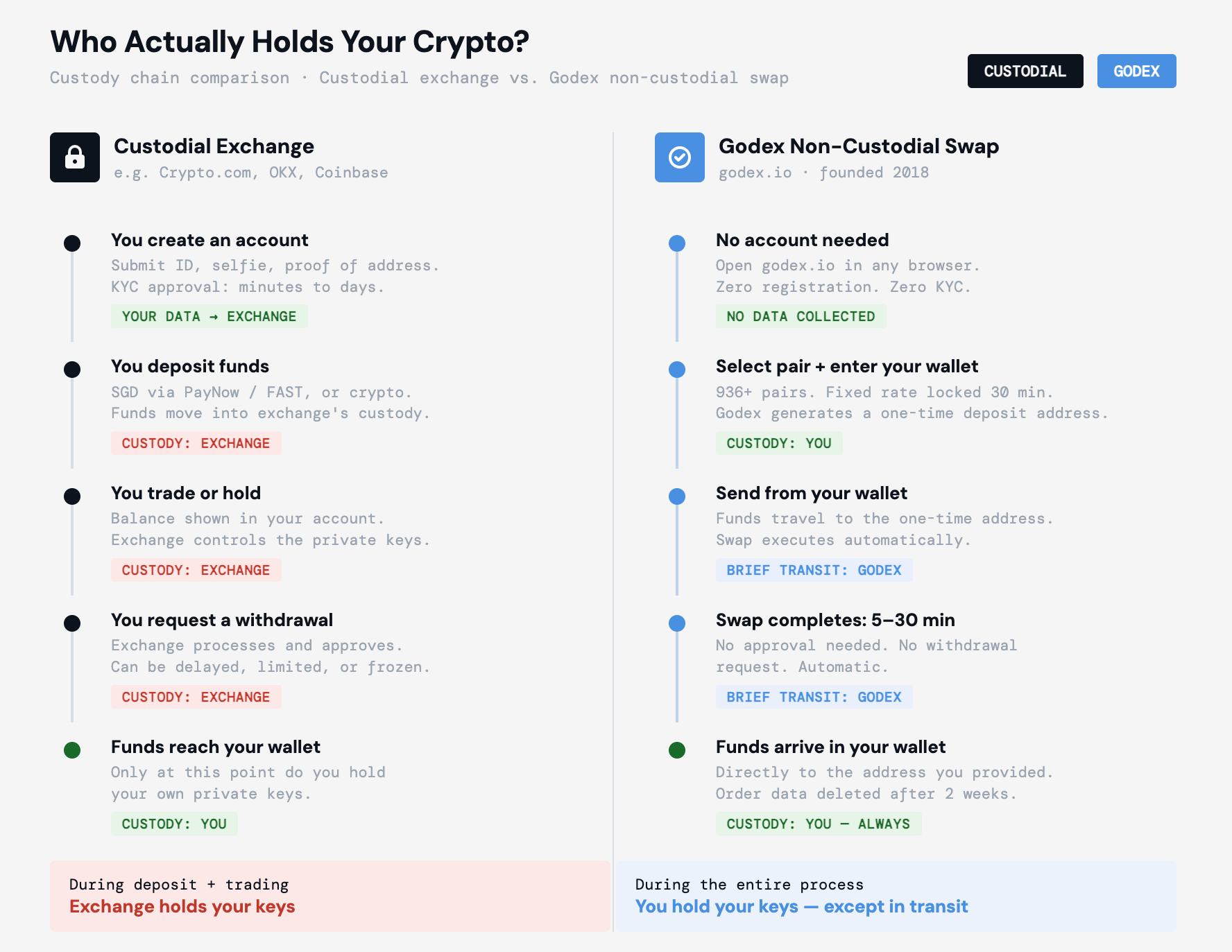
Godex sits at the front of this category. Its non-custodial architecture means your funds go directly from your wallet to a one-time deposit address and back out to a wallet you control — the platform never holds a balance on your behalf beyond the execution window of the swap itself. Combine that with support for 936+ assets, a fixed-rate option that eliminates rate slippage during the transaction, and no volume ceiling, and you have a platform that outperforms most custodial exchanges on flexibility and speed.
For Singapore’s self-custody community, the practical setup in 2026 often looks like this: one licensed exchange for SGD on-ramps, self-custody hardware wallets for long-term holdings, and Godex for moving between assets quickly — without each step creating a new account relationship or adding to a compliance data trail.
Key Takeaways for Singapore Crypto Users in 2026
The best crypto exchange in Singapore depends entirely on what you’re actually trying to do:
- Instant swaps across the widest asset range: Godex supports 936+ cryptocurrencies with no registration, no volume limits, and a fixed-rate option that locks your rate for 30 minutes — the fastest path to executing a swap while keeping full custody of your funds.
- Regulated, SGD-native, custodial trading: Crypto.com, Coinhako, and Coinbase all hold full MPI licenses and support PayNow/FAST. OKX leads on trading tools and fees among fully licensed options.
- Active trading with lower fees: OKX (MAS-licensed) is the strongest option, with deep liquidity and fees that drop close to zero for high-volume traders.
- Security-first trading with global fiat support: Kraken has operated since 2011 with no major breach, publishes regular proof-of-reserves, and supports 530+ assets across USD, EUR, GBP, and more — ideal for traders who operate across multiple currencies.
Singapore’s framework in 2026 rewards preparation. Know which type of service fits your actual trading behavior, complete KYC on the licensed platforms you use, understand your IRAS reporting obligations, and keep the lion’s share of your holdings in a wallet you control.
FAQ
Is it legal to trade crypto in Singapore in 2026? Yes. Crypto trading is fully legal under the Payment Services Act, regulated by MAS. Exchanges must be licensed, client assets must be segregated, and there’s no capital gains tax on personal crypto investments.
Do I need KYC to swap crypto in Singapore? On MAS-licensed custodial exchanges, KYC is mandatory — you’ll need a valid ID and proof of address, plus a Risk Awareness Quiz before trading. Non-custodial instant swap services like Godex require no registration, no ID, and no account creation whatsoever.
What is a non-custodial crypto exchange? A platform where you never hand over custody of your funds to a third party. Godex routes swaps wallet-to-wallet — it holds your crypto only during the brief execution window of the transaction itself, never in an account balance it controls.
Is Godex available in Singapore? Yes. Godex is fully accessible in Singapore with no account, no KYC, and no registration required. You swap directly from your own wallet. Singapore residents remain responsible for their own tax reporting obligations under IRAS rules regardless of which platform they use.
What crypto exchange has the most coins in Singapore? Godex supports 936+ cryptocurrencies — significantly more than any MAS-licensed custodial exchange — with no registration required, no volume limits, and a fixed-rate option that locks your exchange rate for 30 minutes.
Are crypto gains taxed in Singapore? Singapore has no capital gains tax, so profits from personal crypto investment are generally not taxed. However, trading conducted as a business, or crypto received as income or payment for services, may be subject to income tax under IRAS guidelines. When in doubt, consult a local tax adviser.
Start a Cryptocurrency exchange
Try our crypto exchange platform
Disclaimer: Please keep in mind that the content of this article is not financial or investing advice. The information provided is the author’s opinion only and should not be considered as direct recommendations for trading or investment. Any article reader or website visitor should consider multiple viewpoints and become familiar with all local regulations before cryptocurrency investment. We do not make any warranties about reliability and accuracy of this information.
Read more
You may well think that an article dedicated to a Tether price prediction or the Tether price in general is a little bit strange — it is a stablecoin after all. However, the price of Tether does fluctuate significantly, although it is nowhere near as volatile as non-stablecoin cryptos. This means that staying up to […]
In the article we share our vision at Zcash cryptocurrency main features and add several price predictions. As cryptocurrencies gain global acceptance and decentralisation slowly enters our lives, privacy becomes the main concern when talking about blockchain adoption. It is no secret that distributed ledger is by far the most secure and transparent technology ever […]
Chiliz coin (CHZ) offers a compelling opportunity for traders interested in the intersection of blockchain technology and sports. By enabling fans to influence team decisions through the Socios app, Chiliz directly monetizes fan engagement and connects with major sports teams like Juventus and Paris Saint-Germain. These partnerships not only enhance the platform’s visibility but also […]
The exponential growth of Bitcoin Satoshi Vision (BSV) against the general bear trend on the cryptocurrency market in autumn 2019 has impressed the community. Due to the increasing market capitalization, the newly emerged altcoin was ranked 5th on CoinMarketCap and managed to maintain its high position at the beginning of 2020. In the article we […]
EOS is definitely on the list of the strongest and most stable projects in the crypto world. Despite the fact that the currency entered the market less than 3 years ago, it consistently occupies one of the top 10 places in the rating for project capitalization. it is often called the “main competitor of Ethereum”. […]
XRP price prediction 2026-2027: bear, base, and bull scenarios with ranges and named sources, the resolved SEC case, live spot ETFs, and can XRP reach $10?