
 Alex Tamm
Table of Contents
Most Australians pick a crypto exchange the same way they pick a bank: go with the one they’ve heard of, set it up once, and never look at it again. That works fine, until it doesn’t. The exchange you’re already using may be the most expensive decision you’ve made in crypto without realising it, and the reason has nothing to do with trading fees.
By the end of this guide, you’ll understand exactly what to look for, and what most Australian comparisons quietly skip over, before trusting a platform with your money.
This guide compares eight platforms actively serving Australian traders in 2026, examined across the criteria that actually matter: coin selection, fee structure, AUD on-ramp reliability, rate transparency, and account requirements. One platform that appears in almost none of the local roundups stands out on asset breadth, swap speed, and simplicity, because it doesn’t work like a custodial exchange at all.
Here’s how they compare.
Why Choosing a Crypto Exchange in Australia Is More Complicated Than It Looks
The best crypto exchange in Australia depends almost entirely on what you’re trying to do. That said, every Australian user needs to think through three layers before picking a platform.
Layer 1: AUSTRAC Registration
AUSTRAC (Australian Transaction Reports and Analysis Centre) requires every crypto exchange serving Australians that handles fiat currency to be registered as a Virtual Asset Service Provider. Using an unregistered platform isn’t just a compliance grey area — it’s a sign that the platform operates without the oversight, audit requirements, and AML/CTF controls that protect Australian users. Before opening an account anywhere, search the AUSTRAC Virtual Asset Service Provider Register directly.
Note that non-custodial, crypto-to-crypto platforms that never touch fiat currency operate outside AUSTRAC’s registration requirements by design — a separate category from the exchanges discussed here.
Layer 2: ASIC Considerations
AUSTRAC registration doesn’t answer every legal question. The Australian Securities and Investments Commission (ASIC) has jurisdiction over some crypto-related services — particularly staking structures, token offerings, and certain custodial arrangements — depending on how they’re designed. The practical upshot: a platform can be AUSTRAC-registered and still offer some products that sit outside traditional consumer protections.
Layer 3: ATO Reporting Integration
This is where things get genuinely complex for Australian users in 2026 — and where most exchange reviews barely scratch the surface.
The ATO Has Your Transaction History. Here’s What That Means
Every crypto swap, trade, or sale you make in Australia is a potential tax event. The ATO’s data-matching program already holds records on approximately 1.2 million Australian crypto investors, sourced directly from AUSTRAC-registered exchanges. When you lodge your tax return, the ATO cross-references your declared gains against that data.
The ATO classifies crypto as property, not currency, meaning most transactions trigger CGT events. Here are three real-world examples:
Scenario A: BTC → AUD (the obvious one) You bought 0.5 BTC in January 2025 for AUD $25,000. You sell in March 2026 for AUD $42,000. That’s a capital gain of AUD $17,000. Because you held for more than 12 months, you qualify for the 50% CGT discount — meaning only AUD $8,500 is added to your taxable income.
Scenario B: BTC → ETH (the one people miss) You swap Bitcoin for Ethereum. This isn’t a “hold” — it’s a disposal of BTC and an acquisition of ETH. The ATO has confirmed this is a CGT event. Your cost base for the new ETH position is its AUD market value at the time of the swap.
Scenario C: Stablecoin purchases (the one people ignore) Using USDC to buy goods or load a crypto debit card triggers a CGT event. Even if the stablecoin is pegged at $1.00, you calculate the gain or loss between your original cost base and its AUD value at the moment of use.
What’s changing in 2026: Australia has committed to implementing CARF (Crypto Asset Reporting Framework) and CRS 2.0, with legislation expected to commence on 1 January 2027. This means Australian exchanges are already collecting detailed transaction records that will flow directly to the ATO — making accurate self-reporting more essential than ever.
Practical implication for choosing an exchange: Platforms with integrated tax reporting tools — or API connections to tax calculators like Koinly, Summ, or Syla — save significant compliance headaches.
The 2026 Australia Crypto Exchange Landscape: Post-Swyftx Reckoning
It’s worth acknowledging that Australian crypto users carry institutional memory from the turbulence of 2022–2024. The FTX collapse rippled directly into Australia: Brisbane-based Swyftx cut 35% of its workforce in late 2022, followed by further redundancies, a reported AUD $135 million loss in FY2023, and another round of layoffs and CEO changes in early 2026. Meanwhile, Digital Surge halted customer withdrawals entirely.
None of this means Australian exchanges are unsafe. It does mean Australian users have learned — sometimes the hard way — to look beyond slick interfaces and marketing budgets. Trust, now, is earned through transparency, regulatory standing, and verifiable proof-of-reserves rather than NRL sponsorships.
With that context in place, here’s how the major platforms compare.
Best Crypto Exchanges in Australia 2026: Head-to-Head Comparison
| Exchange | Sign-Up / KYC | Assets Supported | Rate Lock Option | Platform Fees | AUD On-Ramp | Best For |
|---|---|---|---|---|---|---|
| Godex | None required | 937 coins | Fixed + Float | No explicit fees (revenue via spread) | Crypto-to-crypto | Instant swaps, full privacy, no account |
| CoinSpot | KYC required | 490–537 | Market rate only | 0.10% (Markets) / 1.00% (Instant) | PayID, card, bank transfer | Beginners, altcoin variety |
| Kraken | KYC required | 450+ | Market rate only | Pro: 0.25–0.40%; Standard: 1–1.5% | PayID, bank transfer | Security-focused traders |
| Binance AU | KYC required | 440–500 | Market rate only | 0.10% | PayID, bank transfer (restored Jan 2026) | Volume, advanced tools |
| Independent Reserve | KYC required | ~37 | Market rate only | 0.02–0.50% (volume-tiered) | PayID, bank transfer | Institutional, OTC |
| CoinJar | KYC required | 67+ | Market rate only | 1% (instant) / 0.10% (Exchange) | PayID, bank transfer | Ease of use, crypto card |
| BTC Markets | KYC required | 35+ | Market rate only | 0.85% → 0.10% (volume-tiered) | PayID, bank transfer | ATO compliance focus |
| Pepperstone Crypto | KYC required | 5 assets (BTC, ETH, SOL + stablecoins) | Market rate only | 0.10% flat | Bank transfer | Simple AUD-native trading |
Platform-by-Platform Breakdown
Godex — The Instant Swap Platform With No Sign-Up and 937 Coins
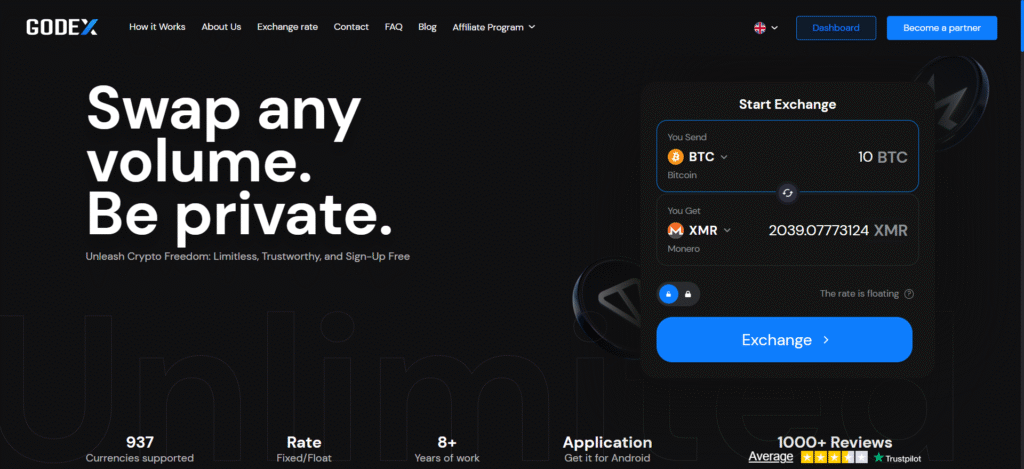
Godex stands apart from every other platform in this comparison in one immediately practical way: you can execute a crypto swap in under five minutes with zero account creation, zero identity documents, and zero platform fees. That’s not a workaround — it’s the design. Godex is a non-custodial instant exchange that has operated for over eight years, supporting 937 digital assets across a single, clean interface.
The mechanics are straightforward. Select the asset you’re sending and the asset you want to receive, enter your destination wallet address, and send your deposit. Godex locates the best available rate across liquidity sources and sends the swapped asset directly to your wallet — typically within minutes. There are no accounts to protect, no passwords to lose, and no KYC data stored on a server.
Two features deserve particular attention for anyone doing meaningful volume:
- Fixed-rate swaps: Godex locks your exchange rate for 30 minutes from order creation. On a volatile day, this is genuinely valuable — you know exactly what you’re receiving before you send anything. Most custodial exchanges execute at the market price at the moment your order fills, which can shift materially during periods of congestion.
- No volume caps: Godex imposes no upper limit on swap size. Whether you’re moving $500 or $500,000 in crypto, the process is identical. Many competing swap services quietly cap transaction sizes or require additional verification above certain thresholds.
On transparency: Godex earns revenue through the spread between its sourced rate and the rate it quotes users. There are no explicit platform fees, no withdrawal fees, and no subscription tiers — the spread is the only cost, and for major pairs it is typically tight.
For ATO record-keeping, Godex swaps are no different from any other crypto-to-crypto exchange: record the date, both assets, and the AUD value of each at the time of the transaction. Blockchain explorers and wallet export tools make this straightforward, and Godex provides an order summary page on completion.
Best for: Experienced holders rebalancing across assets, privacy-conscious users who’d prefer not to create another KYC’d account, and anyone needing to swap a less common altcoin that custodial Australian exchanges simply don’t list.
CoinSpot — Australia’s Homegrown Stalwart
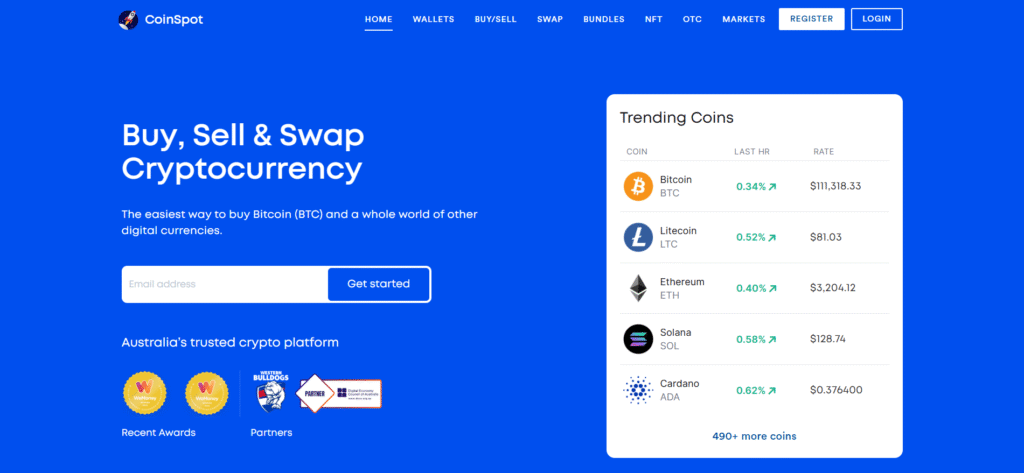
CoinSpot is the most recognisable domestic exchange, founded in Melbourne in 2013 and now serving over 3 million Australians. AUSTRAC-registered, audited externally, and with PayID support for instant AUD deposits, it’s the default recommendation for newcomers for good reason.
The caveat: instant buys carry fees up to 1%, which compounds quickly for active traders. For long-term holders making occasional purchases, the user experience is genuinely excellent — particularly the SMSF account support, which is rare in the Australian market.
- 490–537 cryptocurrencies supported
- PayID, card, and bank transfer for AUD
- Integrated tax reporting
- No margin or derivatives trading
Best for: Beginners and long-term investors who value local support and broad asset selection.
Kraken — The Security Standard
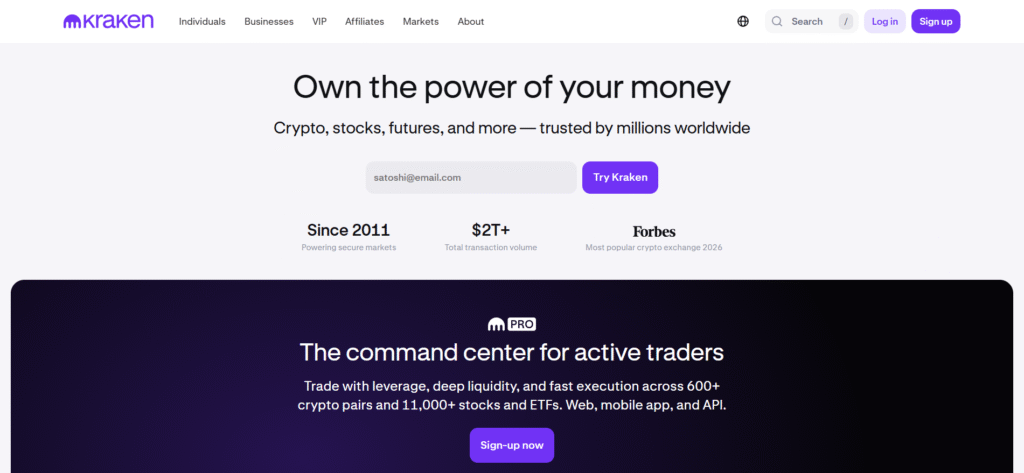
Kraken consistently sits at the top of security rankings globally, and its Australian operations have earned a strong trust profile. It entered Australia through the acquisition of Bit Trade in 2020 and has maintained AUSTRAC registration since. Proof of Reserves documentation, cold storage disclosures, and transparent fee structures give it an edge over competitors where security is the priority.
Active traders should note the Kraken Pro interface, which provides TradingView integration and significantly lower fees than the standard platform.
- 450+ cryptocurrencies
- Kraken Pro maker/taker fees from 0.25%/0.40%; standard interface 1–1.5%
- On-chain staking for intermediate-verified accounts
- No derivatives for Australian retail investors
Best for: Security-focused intermediate and advanced traders.
Binance Australia — Scale and Restored Access
Binance Australia (Investbybit Pty Ltd) remains AUSTRAC-registered, and the global platform delivers unmatched liquidity and trading depth. AUD deposits and withdrawals via PayID and bank transfer were restored in January 2026, following a two-and-a-half-year suspension that left many Australian users locked out of their fiat on-ramps. That episode is worth remembering as a reminder that global platforms operate under global pressures — banking relationships can shift without warning. AUSTRAC also ordered an external audit of Binance’s AML/CTF controls in August 2025, which remains a live compliance consideration.
Best for: Advanced traders who want the broadest asset selection and highest liquidity, with full AUD on-ramp access now restored.
Independent Reserve — For Serious Capital

Sydney-based Independent Reserve is one of the oldest Australian exchanges, with a strong reputation in the institutional and high-net-worth segment. OTC desk access, full reserves operation, and integrated tax reporting make it a strong choice for larger positions.
Best for: Investors moving larger amounts who prioritise local operations and compliance depth.
BTC Markets — The Compliance Purist’s Pick
Another long-standing Australian player, BTC Markets has built its identity around regulatory rigour and transparent operations. Integrated tax reporting and a clean AUD trading interface make compliance straightforward. The coin selection is narrower, focused on established assets.
Best for: Users for whom ATO reporting integration is the top priority.
CoinJar — Low-Fee Exchange with a Crypto Spending Card
CoinJar is one of Australia’s oldest exchanges, founded in Melbourne in 2013 and AUSTRAC-registered. It operates two distinct products: the main app, which charges 1% on instant buys and conversions; and the CoinJar Exchange order book, where maker fees start at 0.10% — one of the lowest rates available to Australian retail traders. The practical catch is that most users default to the app, not the Exchange, so understanding which interface you’re using matters.
The standout feature is the CoinJar Card — a Mastercard that lets users spend any of their 67+ supported cryptocurrencies directly at merchants, with Apple Pay and Google Pay integration. For users who want real-world crypto utility beyond trading, this is a genuine differentiator.
- 67+ cryptocurrencies
- 1% (app) / 0.10% maker (Exchange)
- Free PayID and bank transfer deposits
- No staking, no derivatives
Best for: Users who want low-fee order book trading via CoinJar Exchange, or everyday crypto spending via the CoinJar Card.
Pepperstone Crypto — Bare-Bones but Broker-Grade
Pepperstone Crypto launched in February 2026, making it the newest platform in this comparison. Built in-house by the Melbourne-based CFD broker Pepperstone, it offers a flat 0.10% fee on all spot trades — matching the most competitive rates in the market. The interface is clean, the AUD bank transfer integration is straightforward, and the underlying infrastructure benefits from Pepperstone’s existing relationships with institutional liquidity providers.
The limitation is significant: at launch the platform lists only five assets — BTC, ETH, SOL, USDC, and USDT. This makes it unsuitable for anyone looking beyond the major coins. It is also brand-new to the spot market, with no long-term track record on the exchange side specifically.
- 5 assets (BTC, ETH, SOL, USDC, USDT)
- 0.10% flat fee
- AUD via bank transfer
- No staking, no altcoins beyond the initial listing
Best for: Users who only want to trade major coins in AUD at a competitive flat rate, and who value Pepperstone’s established brokerage reputation.
How to Choose the Right Platform for Your Situation
Rather than ranking exchanges by a single metric, here’s a practical decision framework based on what actually matters to Australian users:
If you’re buying crypto for the first time with AUD: CoinSpot or CoinJar. Both are AUSTRAC-registered, have been operating since 2013, and accept free AUD deposits via bank transfer and PayID. CoinSpot offers the broader coin selection; CoinJar has a simpler fee structure on the standard app and is particularly useful if you also want a crypto spending card.
If you’re an active trader focused on minimising fees: CoinJar Exchange or Kraken Pro. Both offer maker fees at 0.10% or below on the order book, with API integration for major Australian crypto tax tools.
If you’re managing a self-managed super fund (SMSF): CoinSpot and Independent Reserve both offer dedicated SMSF account structures — a niche that genuinely matters, since most crypto tax specialists don’t hold SMSF capability.
If you want to swap crypto instantly without creating an account: Godex. No registration, no KYC, no custody — your assets go directly from your wallet to your wallet. Use fixed-rate mode to lock in the price before you send, and keep your order confirmation for ATO records.
If you need a coin that Australian exchanges don’t list: Godex again. With 937 supported assets, it covers the long tail of altcoins, DeFi tokens, and emerging projects that AUSTRAC-registered platforms rarely carry. For Australian traders who discovered an asset on a global exchange and want to rebalance into it without opening yet another account overseas, Godex is the most direct path.
If you’re moving significant capital: Independent Reserve’s OTC desk or Kraken’s institutional services. Slippage on large orders through standard exchange interfaces can significantly erode value.
What to Check Before Opening Any Account
Beyond the platform comparisons above, five practical checks apply regardless of which exchange you choose:
- Verify AUSTRAC registration at austrac.gov.au before depositing any funds. The public register is searchable and authoritative.
- Understand the fee structure fully. Maker/taker headline rates rarely tell the whole story — check deposit fees, withdrawal fees, spread on instant buy/sell, and any inactivity fees.
- Check AUD banking compatibility. Some Australian banks have at various points flagged or blocked transactions to certain crypto exchanges. Confirm your bank supports the deposit method the exchange uses before you need to act quickly.
- Test withdrawal before you need it. The most common complaint in every exchange review is withdrawal delays. Make a small test withdrawal early to confirm the process works as expected.
- Record every transaction in real time. The ATO requires records of every crypto transaction for a minimum of five years. A spreadsheet or a purpose-built tool like Summ or Koinly connected to your exchange via API is significantly easier than reconstructing transaction history from memory at tax time.
The Bottom Line
There is no single “best crypto exchange in Australia” — there are best exchanges for specific needs. For most first-time buyers, CoinSpot or CoinJar offer the clearest path in. For active traders, Kraken’s fee structure and security track record are difficult to argue against. And for anyone wanting to swap crypto instantly — 937 coins, no account, no KYC, locked-in rate, and funds sent directly to your own wallet — Godex is the platform that genuinely does what the others won’t.
What all these choices have in common: they’re platforms that have something verifiable to stand on. In a market where the first four Google results are ads and most “independent” roundups run on affiliate commissions, verifiable track records — AUSTRAC registration numbers, published fee schedules, transparent reserve disclosures — are the only metrics worth trusting.
The ATO already has your transaction history. The only variable is whether your records match.
FAQ
Is Binance actually safe for Australians now? Wasn’t it basically banned for a while?
Binance Australia (Investbybit Pty Ltd) remains AUSTRAC-registered and AUD deposits via PayID were restored in January 2026, after a two-and-a-half-year suspension following its payment processor cutting ties in May 2023. That episode matters because it shows a global platform’s local banking access can evaporate overnight — not because of anything users did wrong. AUSTRAC also ordered an external audit of Binance’s AML/CTF controls in August 2025, which is still ongoing. If you use Binance, keep a smaller float there and treat it as your trading platform, not your crypto custody solution.
If I swap BTC for ETH on Godex with no account, does the ATO still expect me to report it?
Yes — the ATO doesn’t care which platform you used. A crypto-to-crypto swap is a CGT event regardless of whether you used a KYC’d exchange or a non-custodial service. What changes with a platform like Godex is that the ATO receives no automatic data from them (Godex isn’t an AUSTRAC-registered DCE because it never handles AUD). That puts the reporting obligation entirely on you. Record the date, both assets, their AUD values at the time of the swap, and keep your order confirmation. The blockchain explorer provides the on-chain proof if you’re ever asked.
What happened to Swyftx? Is it still worth using?
Swyftx had a rough run: a 35% staff cut in late 2022 following FTX’s collapse, an AUD $135 million loss in FY2023, further redundancies in early 2026, and CEO turnover. The platform is still operational and AUSTRAC-registered. Whether it’s worth using comes down to your risk tolerance for operational instability — a platform shedding staff and leadership across multiple years is a different proposition from one with stable operations. If you do use it, treat it as a trading platform and move your crypto to self-custody rather than leaving significant holdings on the platform.
Why use a no-KYC swap like Godex instead of just DEX on Uniswap or similar?
Godex handles cross-chain swaps that a single DEX can’t — you can swap Bitcoin (native, not wrapped) for Solana or Monero without bridging assets, creating wallets on multiple chains, or paying gas fees across networks. Uniswap and similar DEXs only operate within their own ecosystem. Godex also quotes you a fixed rate before you send funds, so you know what you’re getting. The tradeoff is that Godex is still a centralised intermediary — you’re trusting them to execute the swap honestly. For assets that exist on a single chain, a DEX where you hold your own keys throughout is genuinely more trustless. For cross-chain or for coins not on Ethereum/Solana, Godex fills a real gap.
Can Australian banks block transfers to crypto exchanges?
Some Australian banks have flagged or blocked transfers to certain exchanges, particularly Binance during its regulatory turbulence in 2023. As of 2026, the situation has largely normalised for major AUSTRAC-registered platforms, but individual banks still apply their own risk policies. The practical move is to test a small deposit before you need to act in a hurry — do this when you open any new exchange account. PayID is generally the most reliable AUD deposit method; direct bank transfer via BSB/account is a backup. If your bank blocks a transfer, you’re not breaking any law — the bank is applying its own discretion.
Is an instant swap service like Godex reliable for large amounts? Any volume cap?
Godex imposes no published upper cap on swap size — the process for a $500,000 swap is identical to a $500 one. The fixed-rate mode locks your exchange rate for 30 minutes from order creation, which matters for large amounts where a rate shift during processing would be costly. The practical consideration for very large amounts is liquidity: for major pairs (BTC, ETH, SOL) at institutional sizes, the spread will be tighter than for smaller altcoins. For genuinely large positions, also look at Independent Reserve’s OTC desk, which offers direct broker access and same-day AUD settlement.
This article is for informational purposes only and does not constitute financial or tax advice. Cryptocurrency investments carry significant risk, including the potential loss of principal. Consult a registered tax agent for guidance on your individual ATO obligations.
Start a Cryptocurrency exchange
Try our crypto exchange platform
Disclaimer: Please keep in mind that the content of this article is not financial or investing advice. The information provided is the author’s opinion only and should not be considered as direct recommendations for trading or investment. Any article reader or website visitor should consider multiple viewpoints and become familiar with all local regulations before cryptocurrency investment. We do not make any warranties about reliability and accuracy of this information.
Read more
You may well think that an article dedicated to a Tether price prediction or the Tether price in general is a little bit strange — it is a stablecoin after all. However, the price of Tether does fluctuate significantly, although it is nowhere near as volatile as non-stablecoin cryptos. This means that staying up to […]
In the article we share our vision at Zcash cryptocurrency main features and add several price predictions. As cryptocurrencies gain global acceptance and decentralisation slowly enters our lives, privacy becomes the main concern when talking about blockchain adoption. It is no secret that distributed ledger is by far the most secure and transparent technology ever […]
Chiliz coin (CHZ) offers a compelling opportunity for traders interested in the intersection of blockchain technology and sports. By enabling fans to influence team decisions through the Socios app, Chiliz directly monetizes fan engagement and connects with major sports teams like Juventus and Paris Saint-Germain. These partnerships not only enhance the platform’s visibility but also […]
The exponential growth of Bitcoin Satoshi Vision (BSV) against the general bear trend on the cryptocurrency market in autumn 2019 has impressed the community. Due to the increasing market capitalization, the newly emerged altcoin was ranked 5th on CoinMarketCap and managed to maintain its high position at the beginning of 2020. In the article we […]
EOS is definitely on the list of the strongest and most stable projects in the crypto world. Despite the fact that the currency entered the market less than 3 years ago, it consistently occupies one of the top 10 places in the rating for project capitalization. it is often called the “main competitor of Ethereum”. […]
XRP price prediction 2026-2027: bear, base, and bull scenarios with ranges and named sources, the resolved SEC case, live spot ETFs, and can XRP reach $10?