
 Linda Larsen
Table of Contents
Canada used to be the quiet achiever of North American crypto regulation — progressive enough to attract global exchanges, strict enough to keep bad actors out. Then came 2023, and the country’s regulatory framework shifted decisively. Binance left. Bybit left. OKX, Paxos, dYdX, and Bittrex followed. Today, the Canadian crypto landscape looks fundamentally different from what it was three years ago — and many traders are still finding their footing.
This guide cuts through the noise. Whether you’re a Canadian investor trying to understand which platforms are still operating legally, an active trader hunting for the best rates, or someone who simply needs to swap altcoins that registered exchanges don’t carry, here’s a clear-eyed look at what’s actually available in 2026 — and what each option does and doesn’t do well.
2026 Platform Comparison: At a Glance
| Exchange | Coins Available | Typical Fee | KYC Required | Custody | CAD Deposits | Best For |
|---|---|---|---|---|---|---|
| Godex | 936+ | ~0.5% all-in (spread, no hidden fees) | No | Non-custodial | No (crypto only) | Altcoin swaps, privacy, no-account trading |
| Kraken | 175+ (Canada) | 0.25%–0.40% (Pro) | Yes | Custodial | Yes (Interac) | Advanced traders, professional tooling, strong liquidity |
| Coinbase | 200+ (Canada) | Up to 1.99% (Simple); 0%–0.60% (Advanced) | Yes | Custodial | Yes (Interac, EFT) | Beginners, simplicity |
| Bitbuy | 60+ | 0.10%/0.20% maker/taker (Pro Trade); 0.5%–1.85% spread (Express) | Yes | Custodial | Yes (Interac) | CAD-native investors, OTC |
| Newton | 70+ | 1.0%–1.6% spread (1.0–1.15% BTC/ETH; 1.5–1.6% others) | Yes | Custodial | Yes (Interac, EFT) | Beginners; free CAD deposits/withdrawals |
| NDAX | 40–55+ | 0.20% flat | Yes | Custodial | Yes (Interac) | Transparent, low-cost |
| Wealthsimple Crypto | 140+ | 1.5%–2.0% spread (Core tier); lower for Premium/Generation | Yes | Custodial | Yes (Interac, bank transfer) | All-in-one portfolio investors |
Note: Fees and coin counts are approximate and subject to change; always verify current terms on each platform. Kraken’s Canada coin count reflects assets available under its Canadian restricted dealer registration.
The table makes a clear structural point. Every registered Canadian exchange is custodial, requires full identity verification, and tops out at around 200 coins for Canadian users — even the broadest registered platform on the list. Godex sits at the opposite end of nearly every axis: 936+ coins, no KYC, non-custodial. The trade-off is equally clear — no CAD on-ramp, no account infrastructure, no fiat conversion. These aren’t flaws in either model; they’re the natural outcomes of the regulatory environments each type of platform operates within. Understanding that distinction is what makes it possible to use both effectively.
What Actually Happened: The CSA Pre-Registration Undertaking Shake-Up
The Canadian regulatory framework for crypto is more complex than a simple “ban or allow” toggle — and that complexity is exactly what drove the 2023 exodus. Canada’s crypto oversight sits across multiple bodies: the Canadian Securities Administrators (CSA) for securities law, the Financial Transactions and Reports Analysis Centre of Canada (FINTRAC) for anti-money laundering compliance, and the Canadian Investment Regulatory Organization (CIRO) for dealer registration.
Starting in 2022, the CSA introduced the Pre-Registration Undertaking (PRU) framework: a formal commitment that unregistered crypto trading platforms had to sign in order to keep operating in Canada while their full registration applications were reviewed. The PRU wasn’t just paperwork. A PRU typically required platforms to segregate client funds from company funds, prohibit margin trading without the appropriate licence, custody client assets only with a qualified custodian, and provide clear risk disclosures to users.
Then in early 2023, the CSA added a critical new condition: platforms would be prohibited from allowing the purchase or deposit of stablecoins without prior written consent from regulators, and exchanges would be banned from offering any form of leverage — including margin or credit.
For global giants built around perpetuals, stablecoin trading pairs, and leverage products, this wasn’t a bureaucratic inconvenience — it was an existential constraint. Binance announced it was exiting Canada, stating that the new stablecoin and investor limit guidance made the Canadian market no longer viable for its operations. Bybit followed weeks later, citing the same regulatory developments, and stopped accepting new Canadian accounts on May 31, 2023. Notable exits included Binance, OKX, Paxos, dYdX, and Bittrex — a lineup representing a huge share of global crypto liquidity.
What remained wasn’t the scraps. It was a smaller, more deliberately structured set of platforms that had either built compliance into their DNA from the start or had the infrastructure to adapt. Understanding those platforms — and their limitations — is the foundation for any Canadian trader in 2026.
Best Crypto Exchanges in Canada in 2026: Full Comparison
The best crypto exchanges available to Canadians in 2026 fall into two distinct categories — and understanding the difference between them is half the job. The first is regulated custodial platforms: registered with FINTRAC and aligned with CSA requirements, they accept CAD deposits, hold assets on your behalf, and require identity verification. The second is non-custodial instant swap services: they carry no registration requirement, never hold your funds, and access a far broader universe of assets — but they work coin-to-coin, not fiat-to-crypto. Most active traders will eventually need both. Here’s how the key players in each category compare.
Godex
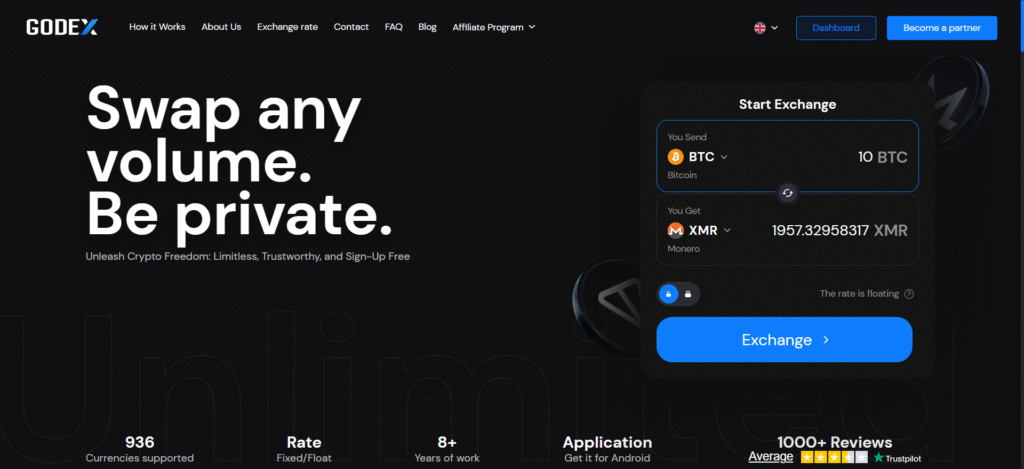
Godex supports 936+ cryptocurrencies for instant exchange — more than five times the asset coverage of any individual registered Canadian platform — including the long-tail altcoins, cross-chain tokens, and emerging DeFi protocols that no regulated Canadian exchange carries. That number alone sets it apart, but the deeper differentiator is the operating model.
Unlike every other platform in this comparison, Godex requires no account, no registration, and no identity verification at any point. The process is entirely non-custodial: you select a trading pair from a choice of fixed or floating rate, send your crypto to the deposit address generated for your order, and receive the exchanged asset directly to your destination wallet. No credentials to create, no documents to upload. The platform’s stated policy is to delete all order information after two weeks. With eight years of operation and more than 1,000 reviews on Trustpilot, Godex has built a track record that’s genuinely uncommon in a category where services appear and disappear regularly.
The rate flexibility is a practical edge that registered exchanges rarely match. A fixed rate locks in the exchange price the moment the order is created — critical when markets are moving fast and you need certainty on what you’ll receive. A floating rate tracks the live market and can deliver a better outcome when conditions are stable. Choosing between the two at execution time gives traders a degree of control that most custodial platforms simply don’t offer.
The key constraint to understand: Godex is a crypto-to-crypto swap service, not a CAD on-ramp. You need existing cryptocurrency to use it — you can’t fund a transaction from a bank account. This makes it a complementary tool rather than a starting point. The practical workflow for a Canadian trader looks like this: buy BTC or ETH through a registered exchange using Interac → withdraw to a personal non-custodial wallet → swap via Godex → destination wallet receives the output. That flow gives you CAD access, regulatory accountability, and access to 936+ assets — more than any single platform alone can provide.
Best for: Privacy-conscious traders; anyone needing assets outside the registered Canadian listing universe; traders who already hold crypto and want instant, no-registration swaps with no transaction size limits.
Kraken
Kraken is widely regarded as the strongest all-around option for experienced Canadian traders in 2026. Kraken received CSA restricted dealer approval in April 2025 and holds FINTRAC registration, offering 175+ cryptocurrencies to Canadian users alongside competitive fees on Kraken Pro and a security record that has never involved a major breach. It offers both a beginner-friendly interface and a professional trading terminal (Kraken Pro) with advanced charting, multiple order types, and API access. Staking is available for assets including ETH, DOT, and ADA. Note that margin and derivatives trading are not available to Canadian clients under the current restricted dealer registration. For active traders who want global-grade liquidity and advanced tooling inside a Canadian-compliant wrapper, Kraken is the benchmark.
Best for: Experienced traders; those wanting advanced trading tools and strong liquidity.
Coinbase
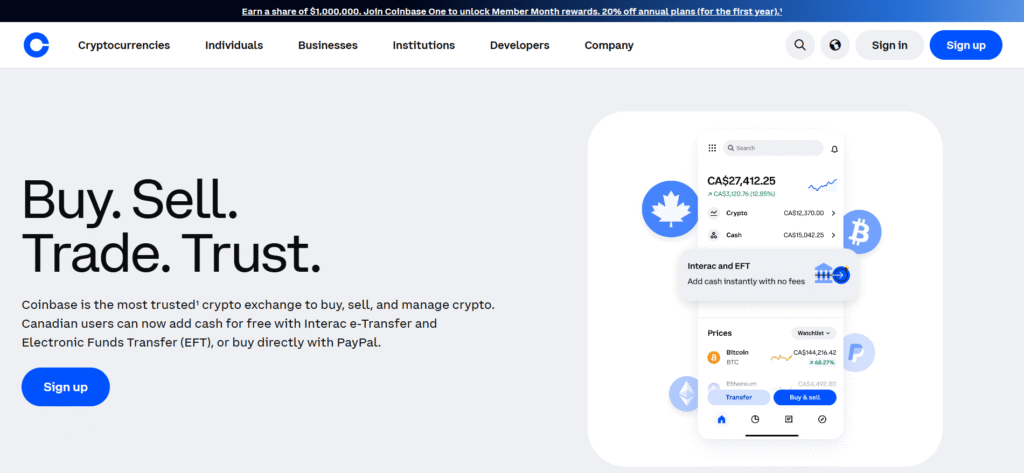
Coinbase occupies a particular sweet spot for Canadians who are new to crypto or who prioritise simplicity above all. Coinbase has regulatory approval as a Restricted Dealer through the CSA and FINTRAC registration, offering 200+ cryptocurrencies — the broadest selection of any registered Canadian exchange — with industry-leading security features including 98% of customer assets held in offline cold storage. The platform’s Learn & Earn programme and clean interface make it one of the most approachable entry points for first-time buyers. The trade-off is cost: the standard Simple interface charges up to 1.99% per trade, though Advanced Trade reduces this to 0%–0.60% maker/taker, and subscribing to Coinbase One waives Simple fees on up to $10,000 in monthly volume.
Best for: Beginners; casual buyers of major coins.
Bitbuy
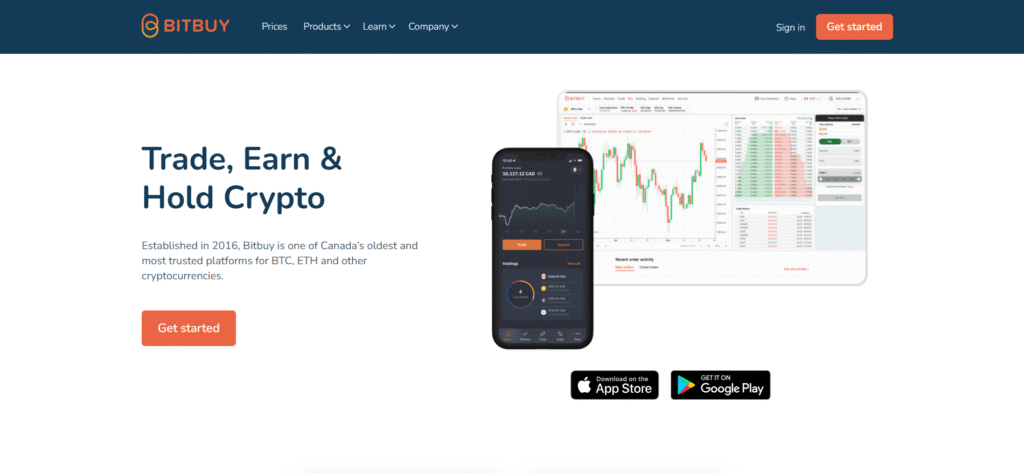
For traders who want the most deeply domestic Canadian experience, Bitbuy is the natural choice. Bitbuy was the first exchange to be fully regulated by the Ontario Securities Commission (OSC) and the first Canadian exchange to achieve CIRO membership, offering uniquely fast CAD withdrawals that often land in a bank account in under 30 minutes. It holds around 60 cryptocurrencies. Pro Trade fees are 0.10% maker / 0.20% taker — among the lowest of any registered Canadian exchange — while the simpler Express Trade interface uses a spread of 0.5%–1.85%. OTC services for high-volume trades and institutional-grade custody through a partnership with Bitgo round out the offering, with the majority of assets held in cold storage.
Best for: Investors who want a fully domestic, CAD-native platform; institutional OTC traders.
Newton
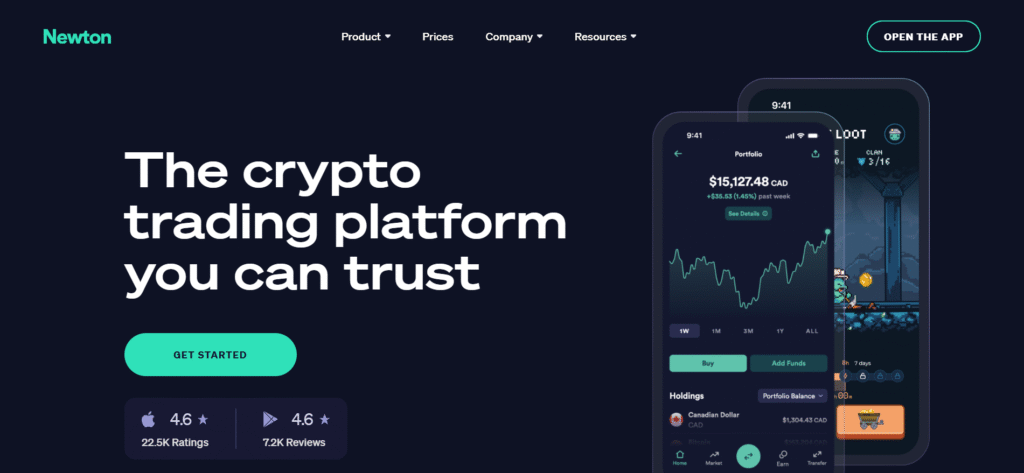
Newton is a homegrown Toronto-based platform registered with FINTRAC, CSA, and OSC, offering 70+ cryptocurrencies. It doesn’t charge a commission — instead it applies a spread to buy and sell prices: 1.0%–1.15% for Bitcoin and Ethereum, 1.25%–1.45% for assets such as Litecoin and Solana, and 1.5%–1.6% for everything else. CAD deposits and withdrawals via Interac are free, and Newton covers the first $5 of network fees on one crypto withdrawal per day, which meaningfully offsets on-chain costs. Staking is available on select assets. The interface is deliberately simple and well-suited to first-time buyers.
Best for: Beginners who want free CAD deposits and withdrawals; casual buyers of major coins.
NDAX
NDAX (National Digital Asset Exchange) is a Calgary-based platform that has quietly built a reputation as one of the most technically rigorous options in Canada. NDAX charges a flat 0.2% trading fee — currently the lowest flat rate of any registered Canadian exchange — alongside strict FINTRAC registration and the use of cold storage for the majority of client assets. It supports 40–55+ digital assets and offers staking and OTC trading for high-net-worth users, with Interac e-Transfer deposits and fixed, transparent withdrawal fees. It’s not the flashiest platform, but for traders who value competitive costs and predictable pricing, it punches above its weight.
Best for: Cost-focused traders; users who want a simple, flat-fee structure with predictable pricing.
Wealthsimple Crypto
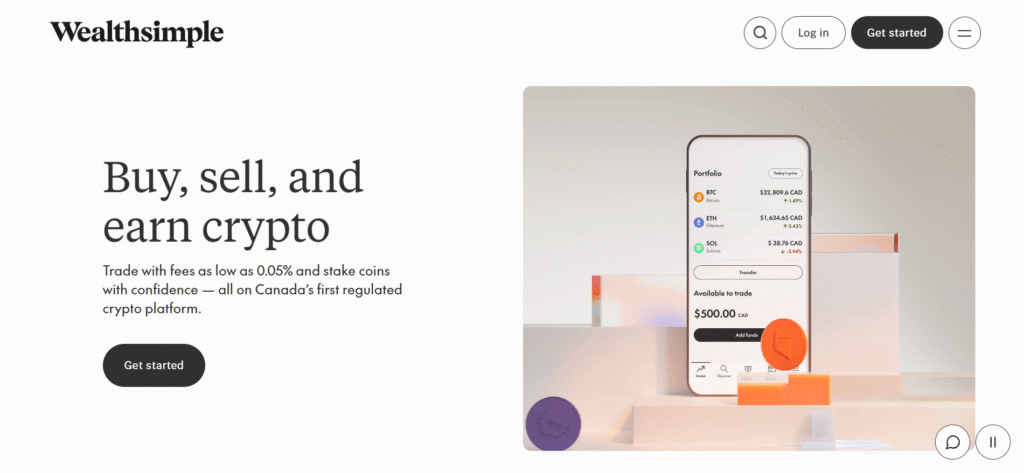
Wealthsimple sits in a category of its own: it’s not a crypto-first platform but a comprehensive Canadian fintech that added cryptocurrency trading to its broader investing and savings ecosystem. Wealthsimple Crypto is FINTRAC, CSA, and OSC registered, and received CSA approval to operate across all provinces in May 2025, now supporting 140+ cryptocurrencies. The appeal is integration — buying Bitcoin in the same app you use for your TFSA or RRSP — but the fee structure is among the highest of any regulated Canadian platform: Core tier clients pay a 1.5%–2.0% spread per trade, with lower rates available at the Premium and Generation tiers. Active traders will generally find better pricing elsewhere.
Best for: Passive investors already using Wealthsimple for stocks and ETFs.
How to Choose the Right Tool for Your Situation
There’s no single best crypto exchange in Canada in 2026 — the right platform depends entirely on what you’re trying to do. In practice, most active traders end up using more than one.
If you’re buying crypto for the first time with Canadian dollars, a registered exchange is the correct starting point. Coinbase and Wealthsimple are the most frictionless entry points; Bitbuy and Newton offer lower fees for those willing to spend a bit more time on the interface.
If you’re an active trader who wants a wide coin selection within a registered framework, Kraken is the strongest option for advanced tooling and liquidity in Canada, with 175+ assets and a professional trading terminal. Coinbase leads on coin count at 200+, making it the better choice if breadth of selection is the primary criterion.
If you need a specific altcoin not listed on any Canadian registered exchange, Godex is the practical answer — provided you already hold crypto to use as the input currency. With 936+ supported assets and no registration required, it covers the ground that even the broadest registered Canadian platform doesn’t reach.
If privacy or self-custody is a primary concern, Godex addresses both by design. No account means no identity data stored on a platform; non-custodial architecture means your assets are never held by a third party — they go directly to the wallet you specify. Every registered Canadian exchange is custodial and requires KYC by law; Godex operates on an entirely different model.
If you need both CAD access and altcoin breadth, the two-platform workflow is the most practical approach: buy on a registered exchange via Interac, withdraw to your own wallet, and swap to the target asset via Godex. Neither platform alone does everything — together, they cover the full spectrum.
If you’re focused on minimising fees on registered platforms, NDAX’s flat 0.2% is currently the most cost-efficient structure in Canada. Bitbuy Pro Trade (0.10%/0.20% maker/taker) is the cheapest for higher-volume trading. Newton’s spread (1.0%–1.6%) is higher than both but comes with no CAD deposit or withdrawal fees, which partially offsets the difference for smaller or less frequent traders. For larger trades, Bitbuy’s OTC desk may offer tighter effective pricing than any retail interface.
A few practical principles apply regardless of which platform you use:
- Always verify a registered platform’s current status on the CSA’s official list before depositing significant funds — the list is live and updated regularly.
- For any custodial exchange, consider transferring longer-term holdings to a self-custody hardware wallet after purchase.
- When using an instant swap service for the first time, test with a small transaction before committing larger amounts and always double-check wallet addresses before sending.
- Be aware of blockchain confirmation times — execution speed on any non-custodial swap platform depends partly on network load, which is outside the platform’s control.
The Broader Picture: Canada’s Crypto Framework in 2026
The regulatory shake-up of 2023 was disruptive in the short term but has produced a more stable foundation. Canada has integrated digital assets into the existing financial system: anti-money laundering compliance is supervised by FINTRAC, crypto exchanges and tokens fall under the jurisdiction of the CSA, dealer licensing is regulated by CIRO, and banking oversight is handled by OSFI. This layered approach makes Canada’s framework more complex than a single-agency model but also more durable.
With FINTRAC registration and CSA alignment now the baseline expectation for platforms serving Canadians, traders have the ability to prioritise user experience — whether that’s the low-cost trading of NDAX, the localised service of Bitbuy, or the advanced tooling of Kraken — without compromising the safety of CAD deposits.
The departure of Binance and Bybit removed leverage and perpetuals from the registered Canadian market, which was the explicit intent of the regulations. What it also removed, as a side effect, was the breadth of spot altcoin listings those platforms carried. That gap is real, and it’s what has made the instant swap category more relevant for Canadian traders than it might otherwise be.
The Bank of Canada’s 2025 Bitcoin Omnibus Survey found approximately 10% of Canadians now own Bitcoin — a figure that has climbed steadily despite the regulatory turbulence. The market didn’t contract; it restructured. The exchanges that remain are smaller in number but more accountable. The services that complement them — non-custodial swap platforms, hardware wallets, self-custody tools — have become a more visible part of the Canadian trader’s toolkit.
Key Takeaways
- Canada’s 2023 CSA Pre-Registration Undertaking requirements drove major global exchanges including Binance, Bybit, and OKX out of the market, fundamentally reshaping the domestic landscape.
- The regulated market in 2026 is led by Kraken (175+ coins for Canadian users), Coinbase (200+), Bitbuy (60+), Newton (70+), NDAX (40–55+), and Wealthsimple (140+) — all FINTRAC-registered and CSA-aligned, offering CAD on-ramp capabilities with mandatory KYC and custodial asset holding.
- Godex stands apart from every registered platform in the comparison: 936+ cryptocurrencies, no account or KYC required, non-custodial architecture, and both fixed and floating rate options — the widest access to altcoins available to Canadian traders from any single service.
- The structural difference is clear: registered exchanges excel at CAD on-ramping, regulatory accountability, and fiat integration; Godex excels at breadth, privacy, and instant coin-to-coin conversion without transaction size limits.
- For most active traders, the optimal approach is to use both: registered exchanges for buying with Canadian dollars, Godex for converting into assets outside the regulated listing universe.
- Always check the CSA’s current registration list before using any custodial platform, and keep long-term holdings in self-custody where possible.
FAQ
Why did Binance and Bybit leave Canada — and can I still access them somehow?
Binance and Bybit left Canada in 2023 because the CSA added rules banning leverage and restricting stablecoin trading — products those platforms were built around. They didn’t leave because of enforcement action; they left because compliance would have gutted their core business. You technically can’t open new Canadian accounts on either, and using a VPN to work around this puts you outside any regulatory protection if something goes wrong. The Canadian exchanges that stayed are smaller but registered; the workaround most active traders use for altcoin breadth is a non-custodial instant swap service like Godex, not offshore access.
Why can’t Canadian exchanges list the altcoins I want? Is it a regulatory thing?
Yes, it’s largely regulatory. Every registered Canadian exchange must assess each token for securities law compliance before listing it, which is slow, expensive, and creates liability. Global platforms like Binance handled hundreds of tokens without that scrutiny — which is partly why they left. The practical ceiling for regulated Canadian spot exchanges is around 60–200 coins. For anything outside that — long-tail DeFi tokens, cross-chain assets, new launches — no Canadian registered exchange will carry them. The gap is real, and it’s why non-custodial instant swap services with 900+ assets exist as a parallel layer for Canadian traders.
What’s the actual difference between custodial and non-custodial — does it matter for me?
With a custodial exchange like Bitbuy or Kraken, the platform holds your crypto on your behalf, just like a bank holds your dollars. If the platform is hacked, exits the market, or freezes withdrawals, your funds are at risk until resolved. With a non-custodial service like Godex, your crypto goes directly from your wallet to the destination wallet — the platform never holds it. The tradeoff is that you need to already own crypto to use a non-custodial swap; you can’t deposit CAD. For long-term holdings, non-custodial is safer by design. For buying with Canadian dollars, custodial is the only option.
Why would I use Godex instead of just using a DEX?
A DEX requires you to know which blockchain your tokens are on, have gas fees in the native token, understand wallet connections, and navigate smart contract risk. Godex is a fixed interface — you pick two coins, send to an address, receive the output. No wallet connection, no gas management, no liquidity pool slippage to navigate. For cross-chain swaps (say, BTC to SOL), most DEXs can’t do it at all without bridging, which adds steps and risk. Godex handles cross-chain natively. The tradeoff is that you’re trusting a swap service rather than a trustless protocol — which is why checking their track record matters.
Do I need KYC for instant crypto swaps — and what happens if I don’t do it?
Instant swap platforms like Godex are non-custodial and have no registration requirement, KYC simply isn’t part of the model. They never hold your funds, so there’s no account infrastructure to attach identity verification to. You’re not “avoiding” KYC in a legal grey area; the platform’s architecture means it doesn’t apply. The tradeoff is that there’s no account to recover if something goes wrong — no support ticket tied to your identity, no login to restore. You send crypto, you receive crypto, order info is deleted after two weeks. That’s the full scope of the relationship.
Why not just use a DEX for everything and skip Canadian exchanges entirely?
You can’t buy crypto with Canadian dollars on a DEX — there’s no fiat on-ramp. DEXs are coin-to-coin only. To fund a DEX wallet, you need crypto first, which means you need a fiat-to-crypto on-ramp somewhere. Registered Canadian exchanges are that on-ramp: Interac deposit → buy BTC or ETH → withdraw to your wallet → use DEXs or swap services from there. The registered exchange isn’t competing with DEXs; it’s the entry point that makes self-custody and decentralized tools accessible in the first place.
This article is for informational purposes only and does not constitute financial or investment advice. Cryptocurrency markets carry significant risk. Always do your own research.
Start a Cryptocurrency exchange
Try our crypto exchange platform
Disclaimer: Please keep in mind that the content of this article is not financial or investing advice. The information provided is the author’s opinion only and should not be considered as direct recommendations for trading or investment. Any article reader or website visitor should consider multiple viewpoints and become familiar with all local regulations before cryptocurrency investment. We do not make any warranties about reliability and accuracy of this information.
Read more
You may well think that an article dedicated to a Tether price prediction or the Tether price in general is a little bit strange — it is a stablecoin after all. However, the price of Tether does fluctuate significantly, although it is nowhere near as volatile as non-stablecoin cryptos. This means that staying up to […]
In the article we share our vision at Zcash cryptocurrency main features and add several price predictions. As cryptocurrencies gain global acceptance and decentralisation slowly enters our lives, privacy becomes the main concern when talking about blockchain adoption. It is no secret that distributed ledger is by far the most secure and transparent technology ever […]
Chiliz coin (CHZ) offers a compelling opportunity for traders interested in the intersection of blockchain technology and sports. By enabling fans to influence team decisions through the Socios app, Chiliz directly monetizes fan engagement and connects with major sports teams like Juventus and Paris Saint-Germain. These partnerships not only enhance the platform’s visibility but also […]
The exponential growth of Bitcoin Satoshi Vision (BSV) against the general bear trend on the cryptocurrency market in autumn 2019 has impressed the community. Due to the increasing market capitalization, the newly emerged altcoin was ranked 5th on CoinMarketCap and managed to maintain its high position at the beginning of 2020. In the article we […]
EOS is definitely on the list of the strongest and most stable projects in the crypto world. Despite the fact that the currency entered the market less than 3 years ago, it consistently occupies one of the top 10 places in the rating for project capitalization. it is often called the “main competitor of Ethereum”. […]
XRP price prediction 2026-2027: bear, base, and bull scenarios with ranges and named sources, the resolved SEC case, live spot ETFs, and can XRP reach $10?