
 Alex Tamm
Table of Contents
Monero just survived 73 exchange delistings in a single year. The European Union has set 2027 as the hard date for banning privacy coins on licensed platforms. Binance is gone. Kraken is gone in the EEA. OKX has continued trimming pairs through early 2026.
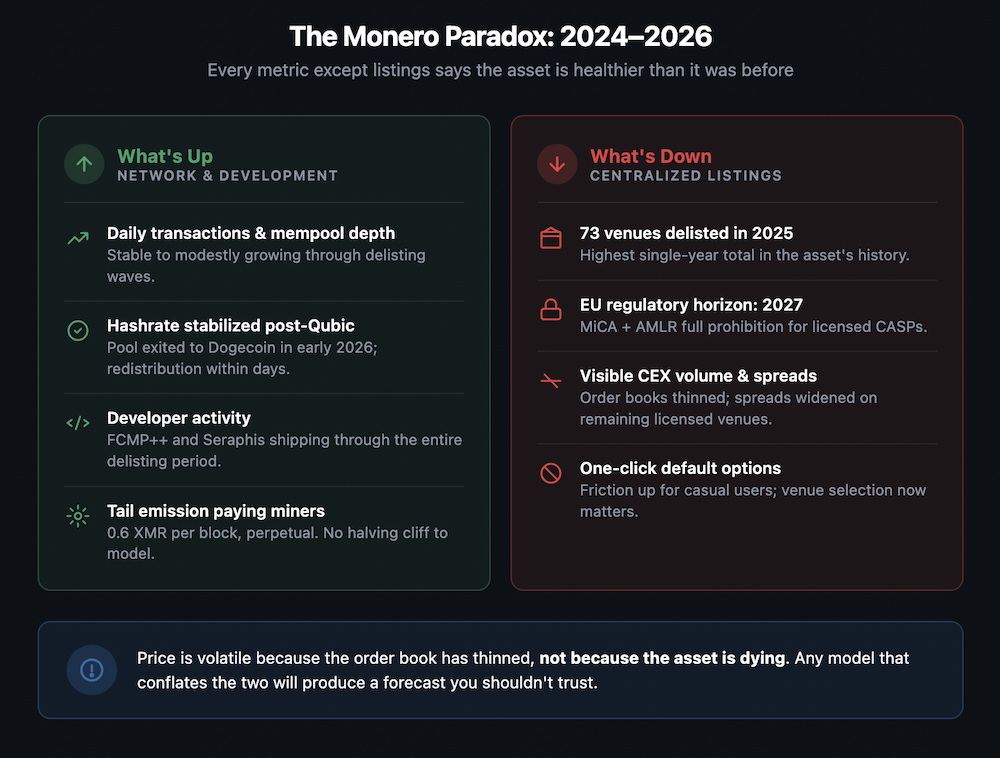
And yet — network activity is up. Developer activity is up. Price is up off its 2024 lows. The asset that the regulated financial system spent 2024 and 2025 trying to push into the sea is, by every metric except listings, healthier than it was before the campaign began.
That paradox is the only honest starting point for any forecast through 2030. Most XMR prediction articles in 2026 are still recycled 2021 templates with the dates updated. They model price as if liquidity migration weren’t happening. They ignore the regulatory horizon. Or they go the other way and treat MiCA as a death sentence, forgetting that Monero was never a creature of centralized exchanges in the first place.
This forecast takes both sides of the paradox seriously. We’ll cover where XMR stands today, what the delisting story actually means for price, what the network is doing under the hood, and three scenarios — bull, base, and bear — with the reasoning that gets you to each. Numbers are at the bottom. The reasoning is what matters.
Where Monero Stands in April 2026
XMR is trading in the $326–$342 band as of early April 2026, with a market cap hovering around $6.0–6.3 billion. Circulating supply sits near 18.4 million coins, with the tail emission adding 0.6 XMR per block — a perpetual issuance rate that was baked into the protocol in 2022 and has been paying miners ever since.
The hashrate has stabilized after a brief mid-2025 disruption, when a mining pool called Qubic accumulated more than half of the network’s hashrate before redirecting its resources to Dogecoin in early 2026. The pool’s exit removed an immediate centralization concern, though it served as a useful reminder that “ASIC-resistant” doesn’t mean “centralization-proof.”
Most importantly: on-chain activity has held up. Daily transactions, mempool depth, and unique address counts have either remained stable or grown modestly through the delisting waves. The price is volatile because the order book has thinned, not because the asset is dying. Those are very different things, and any model that conflates them will produce a forecast you shouldn’t trust.
A one-line refresher for readers new to the asset: Monero is private at the protocol layer. Every transaction is opaque by default — sender, receiver, and amount are all obscured through ring signatures, RingCT, and stealth addresses. Bitcoin is pseudonymous; Monero is the only major asset that is genuinely private on the wire. That property is the entire investment thesis.
The 2024–2026 Delisting Story (and Why It Matters for Price)
The chronology is short and worth committing to memory:
- February 2024 — Binance completed its global XMR delisting, citing internal review criteria. This was the largest single liquidity exit in the asset’s history.
- October 31, 2024 — Kraken halted Monero trading and deposits for European Economic Area clients, citing regulatory pressure tied to MiCA and the incoming AMLR.
- December 31, 2024 — Kraken set the final EEA withdrawal deadline. Residual XMR balances were auto-converted to BTC at market rates and distributed by January 6, 2025.
- 2025 (cumulative) — the privacy-coin space saw 73 exchange delistings of XMR across the calendar year, the highest single-year total since the asset’s launch.
- April 2026 — OKX published notices removing additional XMR spot pairs.
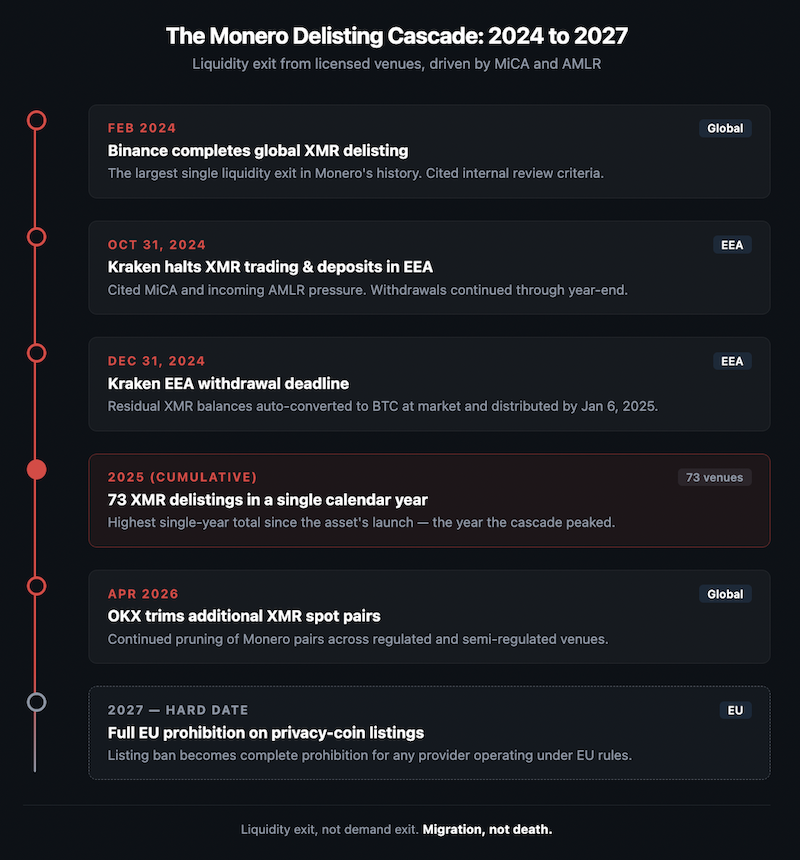
The driver behind almost all of this is European. The Markets in Crypto-Assets regulation (MiCA) reached full effect in late 2024 for licensed crypto-asset service providers, and the Anti-Money Laundering Regulation (AMLR) added rules that effectively prohibit licensed CASPs from offering anonymity-enhancing coins. The 2027 hard date — when the listing ban becomes a complete prohibition for any provider operating under EU rules — is now the most-discussed regulatory horizon in the privacy-coin world.
Here is the analytical move that almost every prediction article gets wrong: this is liquidity exit, not demand exit. The two are different and they have very different implications for price.
When liquidity exits a centralized venue, the order book on that venue thins or disappears. Spreads widen. Visible volume falls. To a casual observer, it looks like the asset is dying. But the underlying demand — the number of people who want to send, receive, or hold the asset — is unchanged. That demand has to find a new venue, and in Monero’s case, it has.
It’s gone to non-custodial swap services like Godex, ChangeNOW, SimpleSwap, StealthEX, and FixedFloat. It’s gone to atomic-swap DEXs like Haveno, the Tor-native successor to LocalMonero. It’s gone to the offshore CEXs that still operate XMR pairs in jurisdictions where they’re permitted. The net effect on the user is friction — fewer one-click options, smaller default order sizes, more careful venue selection. The net effect on the asset is consolidation: the people still trading XMR in 2026 are the people who actually wanted Monero, not speculators who wanted something to flip.
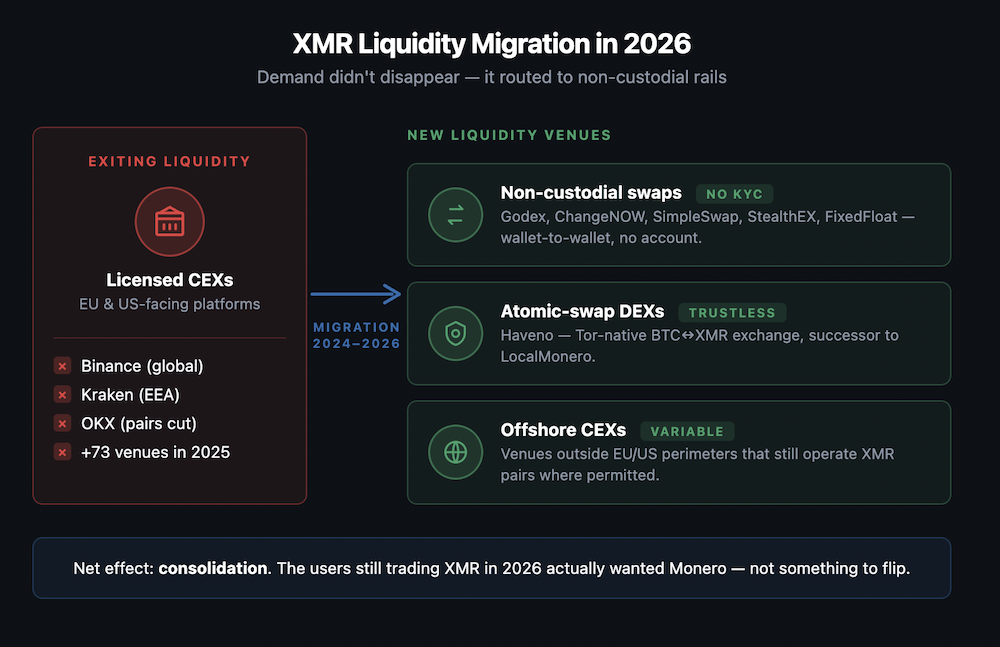
Migration, not death. Keep that distinction in mind for the rest of this forecast.
The Network Itself — What’s Actually Happening Under the Hood
While exchanges debated whether to list XMR, the developers shipped.
Tail emission is the unsung hero of the Monero security budget. Every block — roughly every two minutes — produces 0.6 XMR for whichever miner finds it. This emission is permanent. Unlike Bitcoin, which will eventually pay miners only through transaction fees and faces a long-running debate about whether that’s enough, Monero has a fixed minimum subsidy forever. From a forecasting perspective, that means miner incentives don’t break on a halving cycle and there’s no cliff to model around.
RandomX — the proof-of-work algorithm — is built to favor general-purpose CPUs and resist ASIC development. The Qubic episode in 2025 showed that “ASIC-resistant” doesn’t mean “centralization-proof.” A pool with deep pockets and access to cloud CPU capacity can briefly dominate the hashrate. But the same property that makes it possible — anyone with a CPU can mine — also made the situation reversible. When Qubic redirected to Dogecoin in early 2026, the hashrate redistributed within days. The network’s response was instructive: no rollback, no emergency hard fork, no panic. The protocol absorbed the stress test and moved on.
FCMP++ — Full-Chain Membership Proofs — is the next privacy upgrade currently in development. Without diving into the cryptography: it expands the anonymity set of every Monero transaction from the current ring size of 16 to effectively the entire UTXO set. That’s a step-change improvement. When it ships, the privacy guarantees of older Monero transactions become retroactively stronger, because the ambiguity available to any future analyst trying to deanonymize past activity grows with the new anonymity set.
Seraphis is the longer-horizon protocol redesign — a full rewrite of Monero’s transaction format that consolidates a decade of cryptographic improvements. It’s not shipping in 2026, but its existence in the development pipeline matters for any forecast that runs to 2030.
These are not vaporware. The Monero Research Lab has been delivering through the entire delisting period. If you were trying to assemble a bear case based on “the project is dying,” the development cadence is the first thing that breaks your thesis.
Bull Case — Why XMR Could Outperform Through 2030
The bull case for Monero between now and 2030 doesn’t depend on a meme cycle or an ETF. It depends on whether financial privacy becomes more valuable as the surveilled alternative becomes less so.
Hardening of the surveilled stack is the primary driver. MiCA, AMLR, 1099-DA, and their international counterparts have made the centralized crypto experience indistinguishable from the traditional banking experience for compliance purposes. Every transaction is reportable. Every user is identifiable. Every account is freezable. For users who originally came to crypto for financial sovereignty, that’s a complete inversion of the value proposition. Some of that demand will leave the space entirely. Some will route to self-custody Bitcoin and accept pseudonymity as the best they can get. And some — the segment that actually understands what’s been lost — will find Monero.
State-level reserve discussions in the United States are early data points worth tracking. Arizona’s proposal to hold seized cryptocurrencies, including XMR, in a strategic reserve was a small story that hints at a larger one: governments that want optionality on confidential transactions have a reason not to ban every privacy tool outright, even if their consumer-facing posture is restrictive.
Tail emission as a stability anchor matters for long-horizon holders in a way that fee-only models don’t. Miners are paid forever. Security budget is bounded below. There’s no halving panic to time around. For a five-year forecast, that’s one less variable to worry about.
FCMP++ delivery is the technical catalyst. If Monero ships full-chain membership proofs in this forecast window, the asset’s anonymity set expands by orders of magnitude and the privacy thesis hardens at exactly the moment the regulatory pressure peaks. The narrative writes itself: “The harder they push, the better Monero gets.”
Institutional and enterprise privacy demand is the slow-burn case. Lawyers protecting client identity, healthcare entities handling reimbursement flows, journalists protecting sources, researchers handling dual-use materials — none of these use cases are going away, and none of them are well-served by surveilled rails. Adoption here is invisible until it isn’t.
Regulatory clarity, even hostile clarity, is bullish for survivors. When the rules are uncertain, the discount on a regulatory-risk asset is large because the worst case is unbounded. When the rules become explicit — “centralized European venues will not list this” — the worst case is bounded and the discount can compress. The 2027 horizon, paradoxically, may be a point of relief for the asset rather than a death event.
In the bull case, XMR ends 2026 trading meaningfully above the current band, prints higher highs into 2027 as the ban news cycle peaks and the migration completes, and grinds through 2028–2030 as the privacy thesis matures. Bull-case price band at the bottom of this article.
Base Case — The Most Likely Path
The base case is less dramatic than either tail and is, by construction, where most outcomes live.
In the base case, Monero remains the dominant privacy coin by network usage, developer attention, and brand. No competitor displaces it in the forecast window — the closest candidates (Zcash, the various zk-rollup privacy projects, newer entrants) either lack network effects or solve a different problem. XMR keeps its category.
Price tracks Bitcoin with a privacy premium that expands during regulatory news cycles and compresses during quiet periods. This is the pattern we already see in the data: every major delisting headline produces a short-term sell pressure, followed by a recovery as the people who actually want privacy buy the dip from the people who were holding XMR for the wrong reasons. Over a multi-year horizon, the recoveries add up.
Liquidity continues migrating from centralized to non-custodial rails. By 2027, the share of XMR volume that flows through non-custodial swap services, atomic-swap DEXs, and the remaining offshore CEXs is meaningfully higher than the share through licensed European or US-facing platforms. Spreads on the centralized side are wider than they were in 2023; spreads on the non-custodial side are competitive with anything else in the asset’s history.
Tail emission absorbs miner sell pressure without drama. There’s no halving cliff because there’s no halving. Mining centralization concerns don’t recur in a more dangerous form than the Qubic episode.
The 2027 EU listing ban happens roughly on schedule. It removes a tier of liquidity from the visible order book and produces a price wobble around the announcement. By the second quarter of 2027, the wobble has been priced in and the asset is trading on its underlying demand again.
In the base case, XMR is meaningfully higher than current levels by 2030, driven less by speculative inflow and more by a steady compounding of the privacy thesis. It’s not a moonshot. It’s the asset doing what it was designed to do and being valued accordingly.
Bear Case — What Would Break Monero
The bear case is the responsibility of every honest forecast. If you can’t articulate the bear case for an asset you hold, you don’t actually understand the position.
Coordinated regulatory action is the largest bear-case lever. The EU’s 2027 ban is mostly priced in. What is not priced in is a US joining the EU posture in a way that goes beyond “exchanges proactively delist” and into “holding XMR is a reportable event.” That outcome is not the most likely, but it’s not impossible, and it would meaningfully shift the cost of acquiring and holding the asset for a large pool of users.
A successful protocol attack has never happened in Monero’s history. Ring signatures, RingCT, and stealth addresses have all been subjected to sustained academic and adversarial scrutiny. The privacy guarantees have held. But “has held” is not “cannot fail.” A novel attack — particularly one that retroactively deanonymizes historical transactions — would be a category-five event for the asset.
Mining centralization in a less benign form than Qubic is a risk that the network has shown it can handle once but shouldn’t be expected to handle indefinitely. If a state actor or a well-capitalized mining operation decided to attack rather than briefly arbitrage, the response would be more difficult.
Liquidity fragmentation reaching a price discovery failure point is the most plausible market-structure bear case. If the 2027 ban triggers a cascade of secondary venues following the EU lead, the remaining order books could thin to the point where price quotes become unreliable across venues and sophisticated market participants exit. That’s a self-reinforcing problem and would compound any other negative event.
A technically and legally superior competitor is the long-tail bear case. There’s no current candidate. Zcash is still optional-privacy. The zk-rollup projects target different problems. The various memecoin “privacy” assets are not privacy assets. But a five-year window is long enough for a credible alternative to emerge, and any honest forecast has to leave space for that possibility.
We don’t think the bear case is the most likely outcome. The base case is. But anyone holding XMR through 2030 should be able to articulate every paragraph above without flinching, and should size their position accordingly.
Year-by-Year Forecast (2026–2030)
The numbers below are scenarios derived from the reasoning in the previous three sections. They are not predictions. They are not financial advice. They exist to give the reasoning concrete form so that readers can decide whether they agree with the logic.
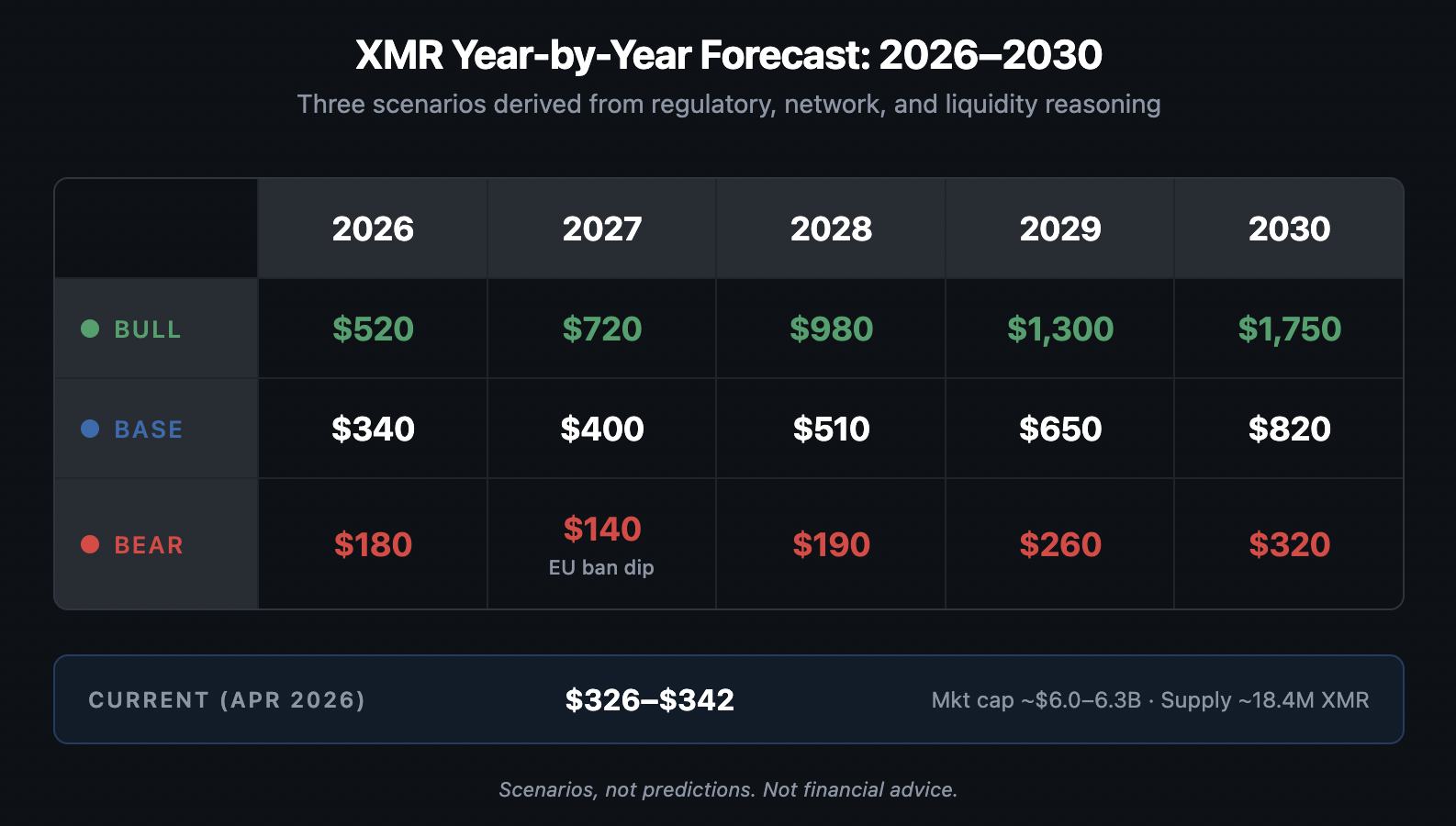
| Year | Bear | Base | Bull |
|---|---|---|---|
| 2026 | $180 | $340 | $520 |
| 2027 | $140 | $400 | $720 |
| 2028 | $190 | $510 | $980 |
| 2029 | $260 | $650 | $1,300 |
| 2030 | $320 | $820 | $1,750 |
A few notes on how to read this table:
- The bear-case 2027 dip reflects the EU ban event and the secondary effects we discussed above. The recovery from that low is the core question of the forecast — if you don’t believe the recovery, you should be in the bear-case column for the entire window.
- The base case is approximately a 2.4× increase from current levels by 2030 — modest by crypto standards, ambitious by traditional-asset standards, and consistent with an asset whose narrative is “slow compounding of a real use case.”
- The bull case requires the privacy thesis to harden faster than the regulatory pressure can respond. It’s plausible but not guaranteed. Treat it as the upside if you believe the FCMP++ catalyst lands and the regulatory horizon stops moving against the asset.
If you want more granular monthly or quarterly forecasts, every other site on the internet will sell you one. We don’t think they’re useful. The reasoning above is what should drive your position; the numbers are just illustration.
Where to Actually Buy Monero in 2026
Forecasting XMR is one problem. Acquiring it in a post-delisting environment is another. They’re both worth solving.
The centralized exchange list keeps shrinking. Don’t assume yesterday’s venue is today’s. Before you visit any large exchange to buy XMR, check the current pair status — it can change between research and execution.
Non-custodial swap services are the cleanest path for most users in 2026. The model is simple: you send one cryptocurrency to a swap service, the service executes a market exchange, and you receive XMR at a wallet address you control. No account. No KYC. The service never custodies your funds in a meaningful sense — they pass through. Godex.io is one of these services. It supports 934+ cryptocurrencies (XMR included), offers a fixed-rate option that locks the rate for the full duration of the swap, has no volume caps, processes transactions in 3–15 minutes after the deposit confirms, and has been operating since around 2017. It does not require registration or identity verification at any volume. For users who already hold any cryptocurrency and want XMR without an account, this is the obvious route.
Atomic-swap DEXs like Haveno offer trustless BTC↔XMR exchange. The Tor-native architecture inherits much of the LocalMonero spirit and is the right choice for users who want maximum operational privacy and are comfortable with a steeper learning curve.
Offshore CEXs that still operate XMR pairs in jurisdictions where they’re permitted remain an option. The list is volatile. Treat any centralized venue as a temporary host, not a custody solution.
The operational rule that applies regardless of venue: receive XMR directly to a Monero wallet you control. Cake Wallet, Feather Wallet, and the Monero GUI are all reasonable options. Don’t park XMR on an exchange where it could be delisted next week. The whole point of the asset is that you don’t need permission to hold it — exercise that property.
Risks Every XMR Holder Should Acknowledge
The Monero thesis is not free of risk and any forecast that pretends otherwise is not worth reading. The risks we’d actually flag, in the order we’d flag them:
- Regulatory. The 2027 EU listing ban is a known event. What’s unknown is whether the US, UK, or Asian regulators follow suit, and whether the next round of rules targets holding rather than offering.
- Liquidity. Thin order books mean volatile execution. The price you see on an aggregator is not always the price you’ll get.
- Custody. Self-custody is non-negotiable for an asset whose entire thesis is “you cannot freeze it.” Leaving XMR on any exchange, even a friendly one, is a contradiction.
- Mining. ASIC resistance has held but is not guaranteed forever. A serious centralization event would be a problem the network has never had to solve at scale.
- Information quality. Bad data on price aggregators is more common in thin markets. Verify before you act on it.
None of these is a reason to avoid the asset. All of them are reasons to size positions intentionally and to take operational hygiene seriously.
The Bottom Line
The Monero story for 2026–2030 isn’t about whether the chart goes up. It’s about whether the asset’s use case survives — and on that question, the data is unambiguous. Demand is up. Network activity is up. Developer activity is up. The only thing that’s down is centralized listings, which were never the point of the asset to begin with.
XMR holders who survive 2027 will hold a smaller, harder-to-reach asset that does exactly what it claims to do. Whether that’s bullish or bearish for you depends on your time horizon and what you actually need from a financial instrument. For anyone who values financial privacy as a feature rather than an inconvenience, it’s a question worth answering before the next regulatory news cycle, not after.
If you’re ready to act on the thesis, the practical path is straightforward: hold XMR in a wallet you control, acquire it through a service that doesn’t require an account, and ignore the headlines that confuse migration with death.
Last updated: April 8, 2026. Price data and regulatory milestones reflect the state of the asset as of this date. Nothing in this article is financial advice. Do your own research, size your positions to your risk tolerance, and verify XMR pair availability at your chosen venue before sending funds — the list of venues that still offer Monero changes faster than most aggregators update.
Start a Cryptocurrency exchange
Try our crypto exchange platform
Disclaimer: Please keep in mind that the content of this article is not financial or investing advice. The information provided is the author’s opinion only and should not be considered as direct recommendations for trading or investment. Any article reader or website visitor should consider multiple viewpoints and become familiar with all local regulations before cryptocurrency investment. We do not make any warranties about reliability and accuracy of this information.
Read more
You may well think that an article dedicated to a Tether price prediction or the Tether price in general is a little bit strange — it is a stablecoin after all. However, the price of Tether does fluctuate significantly, although it is nowhere near as volatile as non-stablecoin cryptos. This means that staying up to […]
In the article we share our vision at Zcash cryptocurrency main features and add several price predictions. As cryptocurrencies gain global acceptance and decentralisation slowly enters our lives, privacy becomes the main concern when talking about blockchain adoption. It is no secret that distributed ledger is by far the most secure and transparent technology ever […]
Chiliz coin (CHZ) offers a compelling opportunity for traders interested in the intersection of blockchain technology and sports. By enabling fans to influence team decisions through the Socios app, Chiliz directly monetizes fan engagement and connects with major sports teams like Juventus and Paris Saint-Germain. These partnerships not only enhance the platform’s visibility but also […]
The exponential growth of Bitcoin Satoshi Vision (BSV) against the general bear trend on the cryptocurrency market in autumn 2019 has impressed the community. Due to the increasing market capitalization, the newly emerged altcoin was ranked 5th on CoinMarketCap and managed to maintain its high position at the beginning of 2020. In the article we […]
EOS is definitely on the list of the strongest and most stable projects in the crypto world. Despite the fact that the currency entered the market less than 3 years ago, it consistently occupies one of the top 10 places in the rating for project capitalization. it is often called the “main competitor of Ethereum”. […]
XRP price prediction 2026-2027: bear, base, and bull scenarios with ranges and named sources, the resolved SEC case, live spot ETFs, and can XRP reach $10?