
 Alex Tamm

Yes, you can still buy bitcoin without ID verification in 2026. But the landscape looks nothing like it did two years ago. The EU’s MiCA framework now requires KYC for licensed crypto service providers. The US introduced 1099-DA reporting for centralized exchanges. Bitcoin ATMs have added verification requirements across the board.
What remains is a smaller, more focused set of options, each with real tradeoffs. This guide covers every method that still works, what kind of identification each actually requires, and where the privacy limits are. No method here delivers complete anonymity. Some get close.
The 2026 Reality: What’s Changed for Anonymous Bitcoin Purchases
The regulatory environment for buying bitcoin anonymously has tightened significantly since 2020. Understanding what changed, and what those changes actually mean in practice, matters more than any list of platforms.
MiCA (Markets in Crypto-Assets Regulation) is now fully effective in the EU. Licensed crypto asset service providers (CASPs) must perform KYC on all customers. This doesn’t eliminate no-KYC options; it pushes them toward decentralized, unlicensed tools that fall outside the regulation’s scope.
In the US, 1099-DA reporting now requires centralized exchanges to report transactions to the IRS. If you’re using Coinbase, Kraken, or any regulated exchange, assume the government has a record of it.
Bitcoin ATMs, once a reliable cash-to-BTC pipeline, have been hit hard. Post-2023 enforcement actions pushed most operators to require phone number verification at minimum. Many now demand government ID for transactions above $250–500.
One more thing worth stating plainly: “no-KYC” does not mean “anonymous.” Bitcoin operates on a public blockchain. Every transaction is recorded permanently. Privacy is a spectrum, not a switch. The methods below sit at different points on that spectrum.
Method 1: Peer-to-Peer (P2P) Platforms
Peer-to-peer platforms connect buyers and sellers directly, cutting out the centralized middleman that would otherwise collect your ID. They remain the most viable path for buying BTC with fiat currency and no identity verification. But each platform makes different engineering decisions about privacy, and those differences matter.
Bisq
Bisq is the standard-bearer for decentralized P2P exchange. It’s fully open-source, requires no registration, and uses 2-of-2 multisig escrow to protect both parties. No central server holds your data because there is no central server. Trade data stays on your machine.
The tradeoffs are real. Bisq is desktop-only software, with no mobile or web interface. You need a small BTC security deposit to trade, which means you need bitcoin to buy bitcoin (a catch-22 for first-time buyers). Liquidity is lower than centralized alternatives, so large orders may take time to fill, and you might need to split them across multiple trades. The interface is functional, not friendly. But for users who value sovereignty over convenience, Bisq remains the gold standard in P2P trading.
Robosats
Robosats takes a different approach: Lightning Network-based trades, Tor-native by default, and disposable robot avatars instead of accounts. It’s designed for smaller, faster trades with strong privacy defaults.
The learning curve is steeper. You’ll need a Lightning wallet set up before you can trade. Order sizes tend to be smaller. But for users who already have Lightning infrastructure, Robosats delivers strong privacy with minimal friction.
Hodl Hodl and Peach Bitcoin
Hodl Hodl offers non-custodial escrow without mandatory KYC, operating through a web interface. Liquidity is modest, and the user base is smaller than Bisq’s, but it lowers the barrier to entry for users who don’t want to install desktop software.
Peach Bitcoin is a mobile-first P2P platform with no KYC and no registration. It’s focused primarily on European markets and supports a limited set of payment methods. For users in supported regions, it’s the most accessible mobile P2P option available.
If you’re looking for LocalBitcoins, it shut down in 2023 and is no longer an option. The four platforms above are what’s available now.
All four share a common limitation: since these are peer-to-peer trades, you’re dependent on available counterparties. Prices can deviate from market rates, and settlement times vary based on who’s online and willing to trade. Payment method also matters: bank transfers leave a paper trail even if the platform doesn’t collect your ID, while cash-by-mail or cash-in-person trades preserve more privacy at the cost of speed and convenience.
Method 2: Bitcoin ATMs
There are tens of thousands of Bitcoin ATMs installed worldwide, and they remain one of the few ways to convert physical cash directly into BTC. The appeal is straightforward: walk up, insert cash, receive bitcoin to your wallet. No bank account, no wire transfer, no waiting.
The privacy reality in 2026 is less straightforward. Most ATM operators now require phone number verification for any transaction. Many require government-issued ID for purchases above $250–500, depending on the operator and jurisdiction. Cameras record every transaction. And the bitcoin you receive goes to a wallet address that’s permanently linked to that ATM session on the blockchain.
Then there are the fees. Bitcoin ATM operators typically charge 6–10% or more above spot price. For a $500 purchase, that’s $30–50 in fees, and you’re being filmed while you pay it.
ATMs still have a place. If you need small amounts of BTC quickly, have cash on hand, and accept that a phone number and camera footage create some identification trail, they work. But the combination of rising verification requirements, high fees, and physical surveillance makes them a much weaker privacy option than they were even three years ago. They are no longer the go-to method for anyone serious about buying bitcoin anonymously.
Method 3: Non-Custodial Crypto-to-Crypto Swaps
Here’s where the math changes. Every method above involves converting fiat currency (dollars, euros, cash) into bitcoin. That fiat on-ramp is where identity verification enters the picture: banks report transfers, ATMs have cameras, even P2P sellers can see your payment method.
A crypto-to-crypto swap sidesteps that problem entirely. If you already hold any cryptocurrency (ETH, XRP, stablecoins, altcoins from mining, airdrops, or prior purchases) you can swap it for BTC without touching the fiat banking system at all.
Non-custodial swaps work simply: you send one cryptocurrency to a swap address, and you receive BTC at your wallet. No account creation. No registration. No personal data collected. The exchange never takes custody of your funds; they pass through an automated process and land in your self-custody wallet.
Godex.io operates on this model and has since 2017, over eight years without introducing KYC thresholds. If you’ve used other swap services that claim “no KYC” but suddenly ask for your passport on a $2K transaction, you already know why that track record matters. Some services start no-KYC and add verification later as they scale or face regulatory pressure. Godex’s no-KYC policy is unconditional: no registration, no account, no identity verification at any transaction size. That has not changed in eight years of operation.
Here’s what a typical swap looks like in practice. Say you hold ETH from a 2021 DCA and want to rotate into BTC without creating a record on a centralized exchange. You go to Godex, select ETH→BTC, choose the fixed-rate option (which locks in your exchange rate for the full duration of the swap, with no slippage from market moves while the transaction processes), enter your BTC wallet address, and send your ETH. In 3–15 minutes, BTC arrives in your self-custody wallet. No bank involved, no identity disclosed, no custodial risk. Godex supports 934+ cryptocurrencies, so the same process works whether you’re swapping stablecoins, mining rewards, or privacy coins.
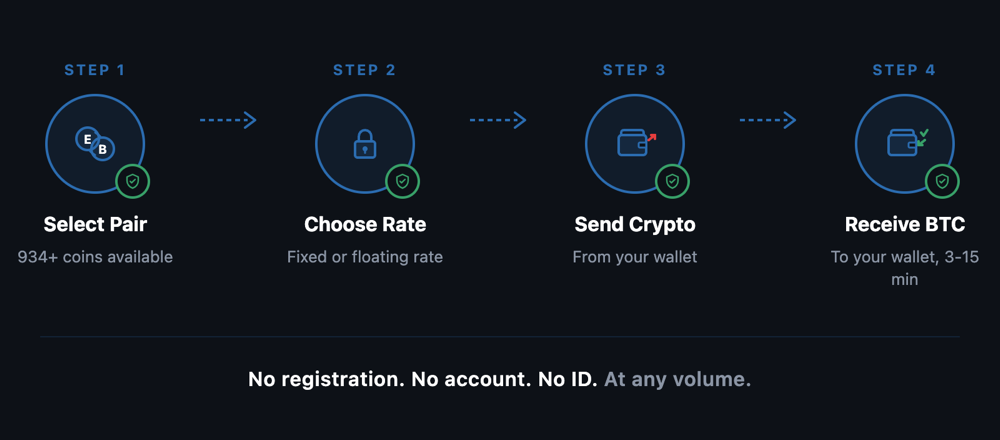
The swap fee is built into the quoted exchange rate: what you see is what you receive. There’s no separate service fee line item. This is a different model from P2P platforms that charge a flat percentage. If a transaction runs into issues, Godex offers 24/7 support with transaction tracking, so you’re not left wondering where your funds are.
The honest tradeoff: this method requires you to already own crypto. It doesn’t solve the initial fiat-to-BTC problem.
But here’s the practical workaround: use a P2P platform (Method 1) to acquire any cryptocurrency with cash, even a small amount, then swap it to BTC through Godex. This two-step path (fiat → P2P → crypto-to-crypto swap) is arguably the strongest privacy workflow available in 2026. The fiat purchase happens peer-to-peer with no centralized records, and the BTC conversion happens through a non-custodial swap with no identity layer. Each step is private, and there’s no single service that holds both your identity and your transaction history.
For users who already hold crypto assets, the path is even simpler. No fiat trail. No bank records. No custodial risk. If you want to understand more about why exchanges ask for your ID in the first place, that context helps explain why avoiding the fiat system matters so much for privacy.
Method 4: Decentralized Exchanges (DEXs)
Decentralized exchanges deserve mention for completeness, though they come with significant caveats for bitcoin buyers specifically.
THORSwap supports native cross-chain swaps, including native BTC, not wrapped tokens. It operates without registration or KYC. But gas fees can be substantial, slippage on larger orders is a real concern, and the interface assumes you know what you’re doing with cross-chain transactions. One caveat: THORSwap’s frontend has historically implemented sanctions screening, blocking certain addresses under OFAC pressure. Access may depend on which frontend interface you use.
Uniswap, PancakeSwap, and similar DEXs are ERC-20 or BEP-20 ecosystems. They offer WBTC (Wrapped Bitcoin), not native BTC. WBTC is an Ethereum token backed by bitcoin held in multi-institutional custody, which introduces custodial trust assumptions you might be trying to avoid. You’d then need to unwrap it through a centralized service, potentially reintroducing KYC.
DEXs carry inherent risks: smart contract vulnerabilities, impermanent loss for liquidity providers, and gas costs that can spike unpredictably during network congestion. You’re also trusting that the smart contracts have been properly audited, and history has shown that’s not always the case. For most users seeking no-KYC bitcoin, the other methods in this guide are more practical and involve fewer technical moving parts.
Method Comparison: At a Glance
|
Method |
ID Required? |
Privacy Level |
Speed |
Fee Model |
Volume Viability |
|
P2P — Bisq |
None |
High |
30 min to hours |
0.1% + payment method fees |
Low to mid (liquidity limited) |
|
P2P — Robosats |
None |
Very High |
Minutes (Lightning) |
~0.2% |
Small trades only |
|
Bitcoin ATM |
Phone + often gov’t ID |
Low to Moderate |
Minutes |
6–10%+ above spot |
$250–500 before ID required |
|
Crypto Swap — Godex |
None, any volume |
High |
3–15 min |
Built into exchange rate |
Unlimited, no caps |
|
DEX — THORSwap |
None (frontend screening possible) |
High |
10–60 min |
Gas + swap fees |
Slippage risk on large orders |
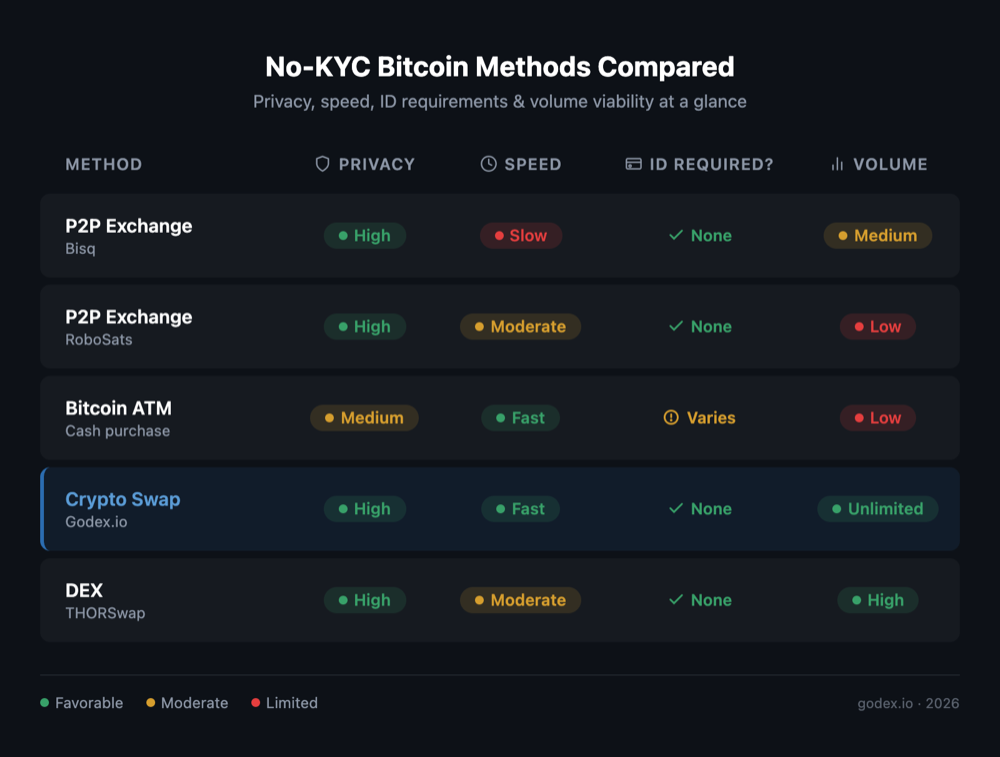
Note: P2P and swap fees work differently. P2P platforms charge a flat percentage on top of the market price. Non-custodial swap services like Godex build their margin into the quoted exchange rate; there’s no separate fee line. Compare the total amount received, not the fee label.
How to Maximize Your Privacy When Buying Bitcoin
Acquiring BTC without ID is only half the equation. What you do afterward determines whether that privacy holds.
Use a dedicated wallet for no-KYC purchases. Don’t mix these coins with bitcoin from KYC exchanges; that links your anonymous holdings to your verified identity through on-chain analysis.
Consider the Monero bridge. Some privacy-focused users acquire Monero (XMR) first, via P2P, mining, or payment, then swap XMR to BTC through a non-custodial service like Godex. Monero’s privacy features obscure the transaction history before the swap, adding a layer of on-chain obfuscation that Bitcoin alone cannot provide. This is one of the most common high-privacy paths to BTC among experienced users.
Use CoinJoin implementations to break the on-chain link between your receiving and spending addresses. JoinMarket remains an active option for users willing to run the software. The CoinJoin landscape has evolved; verify that any specific tool or coordinator is currently operational before relying on it.
Use a VPN or Tor when transacting. Your IP address can be logged by services and correlated with transactions. Robosats enforces Tor by default; that’s intentional.
Move to self-custody immediately. Every minute your BTC sits in any third-party system is a minute something could go wrong. Transfer to a wallet where you control the private keys.
Never send no-KYC bitcoin to a KYC exchange. This is the single most common way people undo their own privacy. The moment those coins hit a verified account, the entire chain of prior transactions becomes attributable to you.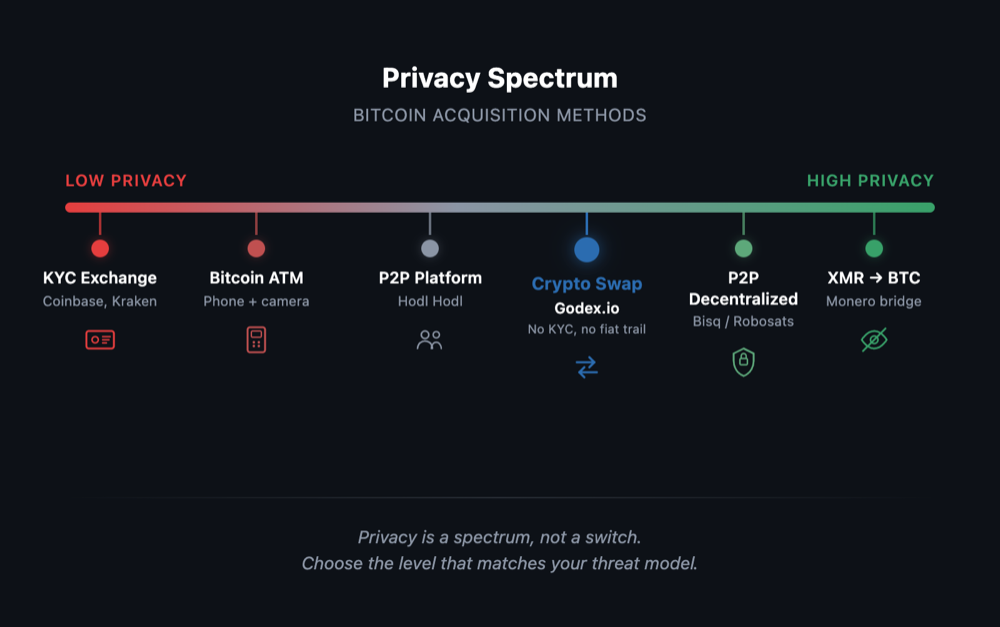
One final note: buying bitcoin without KYC does not remove your tax reporting obligations. In most jurisdictions, you are responsible for reporting crypto transactions regardless of whether a platform collects your identity. Privacy and compliance are separate questions; treat them that way.
The Bottom Line
The methods for buying bitcoin without ID verification have narrowed since 2020, but they haven’t disappeared. Peer-to-peer platforms like Bisq and Robosats still offer genuine no-KYC fiat-to-BTC paths for users willing to handle the setup. Bitcoin ATMs have lost most of their privacy advantage. Decentralized exchanges work but add complexity.
For anyone already holding cryptocurrency, a non-custodial swap through a service like Godex.io is the most direct route: no fiat on-ramp, no registration, no identity verification at any volume. It won’t solve the cold-start problem of acquiring your very first crypto. But once you have any digital assets, it’s the simplest and most private way to convert them to BTC.
No single method here delivers perfect anonymity. That’s not a failure; it’s the honest reality of a public blockchain in a tightening regulatory environment. The right approach depends on where you’re starting from: fiat-only users should look at P2P platforms first, while anyone holding existing crypto can skip the fiat system entirely with a non-custodial swap. Pick the method that matches your actual threat model, layer your privacy practices, and take custody of your own keys. For a broader look at how to buy crypto without KYC across multiple assets, we’ve covered that separately. And if you’re evaluating anonymous bitcoin exchanges more broadly, that comparison may help narrow your options.
Your bitcoin. Your keys. Your business.
Start a Cryptocurrency exchange
Try our crypto exchange platform
Disclaimer: Please keep in mind that the content of this article is not financial or investing advice. The information provided is the author’s opinion only and should not be considered as direct recommendations for trading or investment. Any article reader or website visitor should consider multiple viewpoints and become familiar with all local regulations before cryptocurrency investment. We do not make any warranties about reliability and accuracy of this information.
Read more
XRP price prediction 2026-2027: bear, base, and bull scenarios with ranges and named sources, the resolved SEC case, live spot ETFs, and can XRP reach $10?
In this article we will talk about Ripple (XRP) and its price prediction. What is Ripple (XRP) Ripple is a San Francisco-based startup that was launched in 2012 by Ripple Labs as a global network both for cross-currency and gross payments. Ripple history began in 2004 with the discussions around the digital coin in the […]
You may well think that an article dedicated to a Tether price prediction or the Tether price in general is a little bit strange — it is a stablecoin after all. However, the price of Tether does fluctuate significantly, although it is nowhere near as volatile as non-stablecoin cryptos. This means that staying up to […]
In the article we share our vision at Zcash cryptocurrency main features and add several price predictions. As cryptocurrencies gain global acceptance and decentralisation slowly enters our lives, privacy becomes the main concern when talking about blockchain adoption. It is no secret that distributed ledger is by far the most secure and transparent technology ever […]
Chiliz coin (CHZ) offers a compelling opportunity for traders interested in the intersection of blockchain technology and sports. By enabling fans to influence team decisions through the Socios app, Chiliz directly monetizes fan engagement and connects with major sports teams like Juventus and Paris Saint-Germain. These partnerships not only enhance the platform’s visibility but also […]
The exponential growth of Bitcoin Satoshi Vision (BSV) against the general bear trend on the cryptocurrency market in autumn 2019 has impressed the community. Due to the increasing market capitalization, the newly emerged altcoin was ranked 5th on CoinMarketCap and managed to maintain its high position at the beginning of 2020. In the article we […]