
 Alex Tamm
Table of Contents
Cryptocurrency was built on a promise: financial sovereignty without intermediaries watching every move. But in 2026, that promise is under pressure. With over $3.4 billion stolen from crypto platforms in 2025 alone, including the record-shattering $1.5 billion Bybit hack, it’s clear that choosing the wrong exchange doesn’t just cost you money. It can cost you your identity.
The uncomfortable truth is that most privacy failures in crypto aren’t caused by sophisticated hackers. They’re caused by traders who unknowingly hand over the very data they’re trying to protect. A misconfigured wallet here, a careless KYC upload there, and suddenly the “anonymous” trade you thought you made is traceable back to your front door.
This guide breaks down the seven most common, and most costly, crypto exchange privacy mistakes traders are making right now, and what to do instead.
Mistake #1: Assuming “No KYC” Means “No Data Collection”
The most dangerous assumption in crypto trading is that skipping KYC verification means an exchange isn’t collecting your data. Many platforms that market themselves as “no-KYC” still log IP addresses, track browser fingerprints, associate swap histories with identifiable session profiles, and transmit metadata to third-party analytics providers.
This distinction matters more than ever. Blockchain analytics firms like Chainalysis, Elliptic, and TRM Labs have developed increasingly sophisticated tools to correlate on-chain transactions with off-chain identity signals. A 2025 research paper demonstrated that attackers can match a user’s IP address to their blockchain pseudonym with over 95% accuracy simply by monitoring RPC traffic patterns — without spending a single transaction fee.
Here’s what to look for when evaluating whether a “no-KYC” exchange is genuinely private:
- Registration layer: Does it require an email, phone number, or account creation of any kind?
- Transaction layer: Does it log IP addresses or associate swap history with identifiable profiles?
- Custody layer: Does it hold your funds during the swap, creating a custodial relationship that regulators can compel to disclose?
A truly anonymous crypto exchange handles all three layers: no account, minimal logging, and non-custodial architecture. If even one layer leaks, so does your identity.
Mistake #2: Ignoring How Custodial Exchanges Create Honeypots for Hackers
Custodial exchanges, platforms that hold your private keys on your behalf, are the single largest target for crypto theft. In 2025, centralized platforms accounted for roughly 80% of all reported exchange breaches, with hot wallet exploits driven by poor key management being the most common attack vector.
When you deposit crypto on a custodial platform, you’re not just trusting its trading engine. You’re trusting its entire security infrastructure: its employee access controls, its cold storage procedures, its vulnerability patching cadence, and the integrity of every third-party vendor it works with.
The data tells a sobering story. Private key compromises accounted for 88% of the total value stolen in Q1 2025. Phishing attacks were responsible for 48% of all breaches. Internal threats, employees with unauthorized access, enabled 11% of exchange hacks. These aren’t hypothetical risks. They’re the documented failure modes of a model that concentrates both assets and identity data in a single point of failure.
Non-custodial exchanges work differently. Instead of holding your funds in platform-controlled wallets, they act as swap facilitators. You send cryptocurrency from your personal wallet to a temporary address; the exchanged asset is delivered directly to your destination wallet. At no point does the platform take custody. There’s no hot wallet to hack, no account to freeze, and no centralized database of personal documents waiting to be breached.
Mistake #3: Overlooking the KYC Data Breach Multiplier
Most traders think of KYC as an inconvenience — a few minutes uploading a passport photo before they can start trading. But from a privacy perspective, KYC documents represent the most dangerous data you can hand over to any online service. Unlike a password, you can’t reset your passport number after a breach.
Consider the cascade effect. When a KYC-compliant exchange is breached, attackers don’t just get wallet addresses. They get government-issued IDs, proof-of-address documents, selfies, full legal names, dates of birth, and in many cases, tax identification numbers. This information enables identity theft, SIM-swapping attacks, targeted phishing, and, in extreme cases, physical violence.
The crypto kidnapping threat is no longer theoretical. In 2024 alone, multiple incidents were reported where victims were identified through a combination of on-chain data and leaked personal information, then physically coerced into transferring funds. The reputational damage to exchanges that suffer these breaches is temporary. The damage to individual victims is permanent.
| Risk Factor | Custodial + KYC Exchange | Non-Custodial, No-KYC Exchange |
|---|---|---|
| ID document exposure | High — stored on centralized servers | None — no documents collected |
| Wallet address linked to identity | Yes — tied to verified account | No — unique deposit addresses per swap |
| Hot wallet breach risk | High — concentrated fund storage | None — funds never held by platform |
| Regulatory asset freeze | Possible — platform can comply with orders | Not applicable — platform never has custody |
| Post-breach identity theft | Full personal data available to attackers | Minimal data footprint to exploit |
| Physical targeting risk | Elevated — real name and address on file | Significantly reduced |
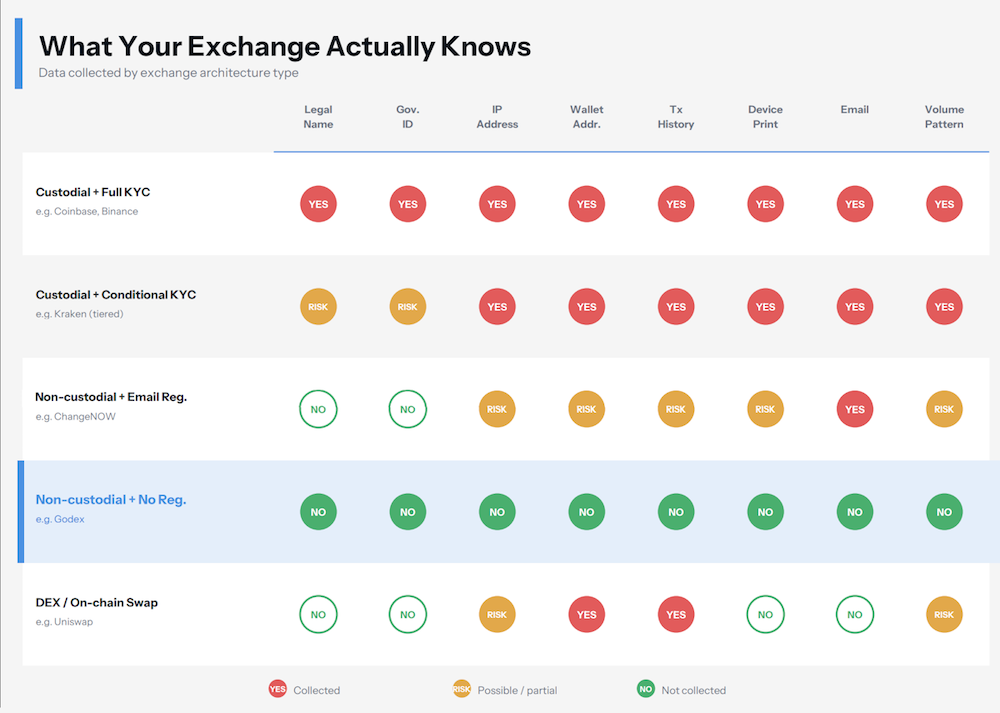
The takeaway isn’t that KYC is inherently evil, regulated exchanges serve real purposes. The mistake is submitting KYC documents to every platform without weighing the long-term data exposure risk against the actual benefit you’re getting in return.
Mistake #4: Using One Wallet Address for Everything
Address reuse is one of the most common and most underestimated privacy mistakes in crypto. Every time you use the same wallet address across multiple transactions, exchanges, or platforms, you’re building a traceable graph of your entire financial activity on an immutable public ledger.
Blockchain analytics platforms exploit this aggressively. If just one of those transactions is linked to your identity — through a KYC exchange, a merchant purchase, or even a social media post — every other transaction connected to that address becomes deanonymized retroactively. Research from Eötvös Loránd University showed that behavioral patterns like transaction timing and gas fee preferences can serve as “quasi-identifiers” that narrow the anonymity set of Ethereum users down to individuals.
Platforms that generate unique deposit addresses for each transaction add an important layer of separation. Godex, for example, creates a fresh deposit address for every swap, meaning there’s no persistent address linking your activity across trades. This architectural choice makes clustering analysis significantly harder, though it works best when combined with your own wallet hygiene practices.
Practical steps to break the chain of address reuse:
- Use a new receiving address for every transaction. Most modern wallets (both hardware and software) support automatic address rotation.
- Separate your wallets by purpose. Keep a distinct wallet for exchange activity, one for long-term storage, and another for everyday spending.
- Avoid linking wallets through a common “gas station” address. On networks like Ethereum and Tron where native tokens are needed for fees, a single funding address can cluster otherwise separate wallets.
Mistake #5: Forgetting That Your Internet Connection Is a Fingerprint
You’ve chosen a no-KYC exchange and rotated your wallet addresses. But if you’re conducting swaps from your home IP address without any network-level protection, much of that effort is wasted.
Every time your wallet connects to a blockchain node to broadcast a transaction, it transmits your real IP address along with metadata like timestamps and device type. Many nodes on public networks are operated by analytics firms or, in worse cases, malicious actors. Once your IP is correlated with a wallet address, your physical location becomes linkable to your on-chain activity.
This isn’t a theoretical concern. Deanonymization research presented at USENIX in 2025 demonstrated that the peer-to-peer networking layer of major blockchains is a significant privacy vulnerability, allowing attackers to correlate transactions with specific IP addresses by analyzing propagation patterns. Separate research showed that even users connecting through RPC services, the standard gateway for most wallet apps, can be deanonymized through timing analysis of their transaction status queries.
Mitigation requires a layered approach:
- Use a reputable VPN when accessing any exchange or broadcasting transactions. Be aware, however, that VPN provider databases have been leaked in the past.
- Consider Tor for sensitive transactions, keeping in mind that Tor can introduce latency and is occasionally blocked by blockchain nodes.
- Avoid transacting on public Wi-Fi networks, which are trivially easy to monitor.
- Disable wallet “always-on” syncing when not actively transacting, to reduce the metadata footprint of your device.
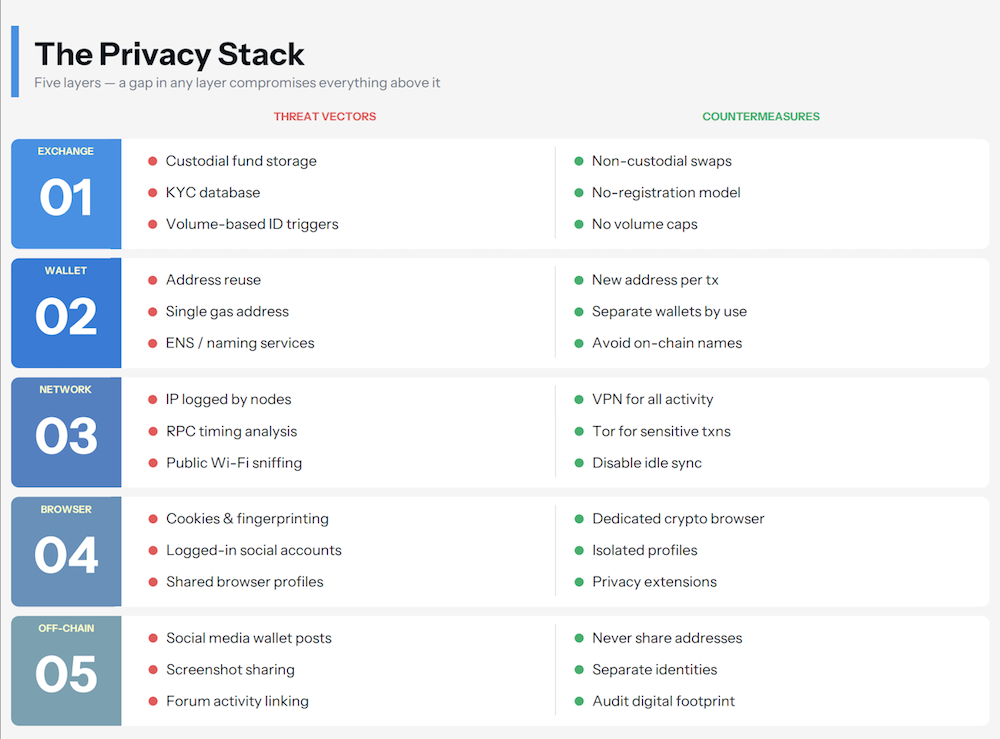
The broader principle: network-level privacy and transaction-level privacy are two different problems. Solving one without the other leaves you partially exposed.
Mistake #6: Trusting Exchange Privacy Claims Without Checking the Architecture
Marketing copy is not a security audit. Many exchanges describe themselves as “private” or “anonymous” based on their front-end experience — no registration form, no ID upload — while the back-end architecture tells a different story.
The critical question isn’t whether an exchange asks you for documents. It’s whether its technical design could be compelled to reveal your activity later. A platform that processes swaps through its own custodial wallets, even briefly, creates a chokepoint where transaction data can be subpoenaed. A platform that routes all traffic through a centralized API without IP obfuscation creates a logging surface. A platform that relies on a single liquidity provider exposes swap patterns that can be correlated across users.
When evaluating an exchange’s privacy architecture, focus on verifiable design choices rather than marketing language:
- Non-custodial execution: Do funds pass through platform-controlled wallets, or are they routed directly between user wallets?
- Volume-independent no-KYC: Does the privacy policy hold at your actual swap volume, or only below an arbitrary threshold? Some platforms remain verification-free for small amounts but introduce KYC triggers at higher tiers.
- Operational track record: Has the platform maintained its privacy model through multiple regulatory pressure cycles? Longevity matters. An exchange like Godex, which has operated since 2018 with a consistent no-registration, no-limits model through successive waves of global regulatory tightening, demonstrates a structural commitment that newer entrants haven’t yet been tested on.
- Transparent fee structure: “No fee” claims often disguise a spread built into the exchange rate. Hidden spreads aren’t just a cost issue, they indicate a lack of transparency that may extend to data practices.
Mistake #7: Treating Privacy as a One-Time Setup Instead of Ongoing Operational Security
This is the mistake that undoes everything else, and it’s the one almost nobody talks about. Even traders who choose the right exchange, rotate addresses, and use VPNs regularly sabotage their own privacy through seemingly innocent off-chain behavior.
Privacy in crypto is not a product you buy or a box you check. It’s an operational discipline. And the weakest link is almost always the human layer, not the technology.
Here’s how it breaks down. Blockchain analytics firms don’t rely solely on on-chain data. They increasingly correlate off-chain signals — social media posts, forum comments, ENS names, GitHub commits, Telegram activity, Discord messages — with on-chain transaction patterns. One careless mention of a wallet address in a public channel, one screenshot of a transaction confirmation shared in a group chat, and the entire privacy chain you’ve built can unravel backward through your transaction history.
The concept of “operational security” (OpSec) in crypto means treating every interaction as potentially linkable:
- Never publicly discuss specific transactions, amounts, or wallet addresses. This includes “humble brag” posts about gains and screenshots of portfolio balances.
- Use separate browser profiles or devices for crypto activity. Browser cookies, extensions, and logged-in social media accounts can create cross-site tracking vectors that connect your exchange activity to your real identity.
- Be cautious with ENS domains and on-chain naming services. A human-readable name like “yourname.eth” is a permanent, public link between your identity and your wallet.
- Treat past transactions as permanently exposed. If you used a KYC exchange three years ago and then moved funds to a “private” wallet, those funds may still be traced forward by analytics platforms. Privacy isn’t retroactive on a transparent ledger.
- Audit your digital footprint periodically. Search for your known wallet addresses across blockchain explorers and social media. You may be surprised at what’s publicly linked to your identity already.
As one blockchain privacy researcher noted in a 2025 CoinDesk interview, privacy must be “structural, not cosmetic.” Systems that look private on the surface but leak metadata, or that collapse when a device is compromised, provide false confidence that’s ultimately more dangerous than no privacy at all.
The Privacy Checklist: Putting It All Together
Making good privacy decisions when choosing and using a crypto exchange isn’t about achieving perfect anonymity, it’s about reducing your attack surface systematically. Here’s a consolidated framework:
- Evaluate exchanges on architecture, not marketing. Non-custodial design, no registration, no volume-based KYC thresholds.
- Generate a new wallet address for every transaction. Automate this through wallet settings wherever possible.
- Layer your network privacy. VPN at minimum; Tor for high-sensitivity transactions.
- Never reuse identities across platforms. Different email addresses (if required), different wallet addresses, different browser profiles.
- Treat off-chain behavior as on-chain exposure. Social media, forums, and messaging apps are the most underestimated deanonymization vectors.
- Understand that privacy degrades over time. As analytics tools improve, transactions that seem private today may be traceable tomorrow. Minimize what you expose at the source.
Final Thought
The crypto industry in 2026 sits at a crossroads. Regulatory frameworks like Europe’s MiCA and the expanding FATF Travel Rule are pushing centralized exchanges toward maximum data collection, while the technology for privacy-preserving transactions, from zero-knowledge proofs to non-custodial swap architecture, is more mature than it’s ever been.
The traders who will protect their financial sovereignty aren’t necessarily the most technically sophisticated. They’re the ones who understand that privacy isn’t a feature you toggle on. It’s a set of choices you make every time you interact with a blockchain, starting with which exchange you trust with your next swap.
Frequently Asked Questions
Why use a no-KYC swap service over just using a DEX? DEXs and no-KYC swap exchanges solve different problems. DEXs are poor at cross-chain swaps and expose all activity on a public ledger. Non-custodial services like Godex handle cross-chain swaps without an account and generate a fresh deposit address per trade, making clustering analysis significantly harder.
I reused the same wallet address across multiple exchanges. How bad is that? Address reuse builds a traceable graph that analytics firms exploit retroactively. If one of those exchanges had KYC, every connected transaction — including your “private” swaps — can be deanonymized. Enable automatic address rotation in your wallet and treat the existing exposure as fixed.
Is a VPN actually enough for crypto privacy? A VPN is necessary but not sufficient. It blocks ISP and exchange-level IP logging, but timing analysis attacks can still correlate transactions at the network layer. Meaningful privacy requires layers: VPN plus address rotation plus non-custodial exchange plus wallet separation by purpose.
What’s the real risk of uploading my passport to a crypto exchange? KYC documents are permanent liability — unlike a password, you cannot reset a passport number after a breach. When exchanges are hacked, attackers get government IDs, selfies, and tax numbers: everything needed for identity theft and SIM-swapping. Submit KYC only where the regulatory benefit clearly outweighs the long-term data exposure.
What’s the point of privacy opsec if Chainalysis can deanonymize everything anyway? Blockchain analytics depends on identity anchors — a KYC deposit, a leaked IP, a social media post. Remove those anchors and clustering analysis stops. Non-custodial swaps with fresh addresses and no account creation make tracing exponentially harder. Privacy is about raising the cost of surveillance, not eliminating it entirely.
Someone posted their wallet balance on Twitter. How bad is that for privacy? Posting wallet data on social media is one of the most effective self-deanonymization vectors. Analytics firms actively scrape ENS names, forum posts, and screenshots to link off-chain identity signals to on-chain activity. A single post can retroactively expose an entire transaction history that cannot be deleted from the blockchain.
Disclaimer: This article is for informational purposes only and does not constitute financial, legal, or investment advice. Cryptocurrency trading involves significant risk. Readers should conduct their own research and consult with qualified professionals before making any financial decisions. Privacy tools and practices should always be used in compliance with applicable laws in your jurisdiction.
Start a Cryptocurrency exchange
Try our crypto exchange platform
Disclaimer: Please keep in mind that the content of this article is not financial or investing advice. The information provided is the author’s opinion only and should not be considered as direct recommendations for trading or investment. Any article reader or website visitor should consider multiple viewpoints and become familiar with all local regulations before cryptocurrency investment. We do not make any warranties about reliability and accuracy of this information.
Read more
You may well think that an article dedicated to a Tether price prediction or the Tether price in general is a little bit strange — it is a stablecoin after all. However, the price of Tether does fluctuate significantly, although it is nowhere near as volatile as non-stablecoin cryptos. This means that staying up to […]
In the article we share our vision at Zcash cryptocurrency main features and add several price predictions. As cryptocurrencies gain global acceptance and decentralisation slowly enters our lives, privacy becomes the main concern when talking about blockchain adoption. It is no secret that distributed ledger is by far the most secure and transparent technology ever […]
Chiliz coin (CHZ) offers a compelling opportunity for traders interested in the intersection of blockchain technology and sports. By enabling fans to influence team decisions through the Socios app, Chiliz directly monetizes fan engagement and connects with major sports teams like Juventus and Paris Saint-Germain. These partnerships not only enhance the platform’s visibility but also […]
The exponential growth of Bitcoin Satoshi Vision (BSV) against the general bear trend on the cryptocurrency market in autumn 2019 has impressed the community. Due to the increasing market capitalization, the newly emerged altcoin was ranked 5th on CoinMarketCap and managed to maintain its high position at the beginning of 2020. In the article we […]
EOS is definitely on the list of the strongest and most stable projects in the crypto world. Despite the fact that the currency entered the market less than 3 years ago, it consistently occupies one of the top 10 places in the rating for project capitalization. it is often called the “main competitor of Ethereum”. […]
XRP price prediction 2026-2027: bear, base, and bull scenarios with ranges and named sources, the resolved SEC case, live spot ETFs, and can XRP reach $10?