
 Alex Tamm
Table of Contents
You were mid-swap. Pair selected, amount entered, wallet address pasted. Then a popup: verification required. Upload a passport. Take a selfie. Provide proof of address.
You signed up precisely because this exchange didn't require any of that. No registration. No KYC. That was the pitch. And until ten minutes ago, that was your experience.
Here's what happened: you hit an invisible threshold. The exchange's compliance system flagged your transaction, and the "no-KYC" policy you relied on turned out to have conditions buried in terms of service you likely never read. This is not a glitch. It's a pattern — and it's worth understanding before your next swap.
Swap frozen right now? Your immediate options are typically to comply with the request, cancel and have your funds returned, or contact that platform's support. For your next swap — read on.
The "No-KYC" Promise — What It Actually Means
When a crypto exchange advertises "no KYC," most users read that as a guarantee. No identity verification, period. But that's not what it means in practice.
"No KYC" is not a legal classification. It's a policy decision — one the platform can change at any time, for any user, without notice. What most non-custodial exchanges actually offer is conditional no-KYC: no verification required unless something triggers their compliance system.
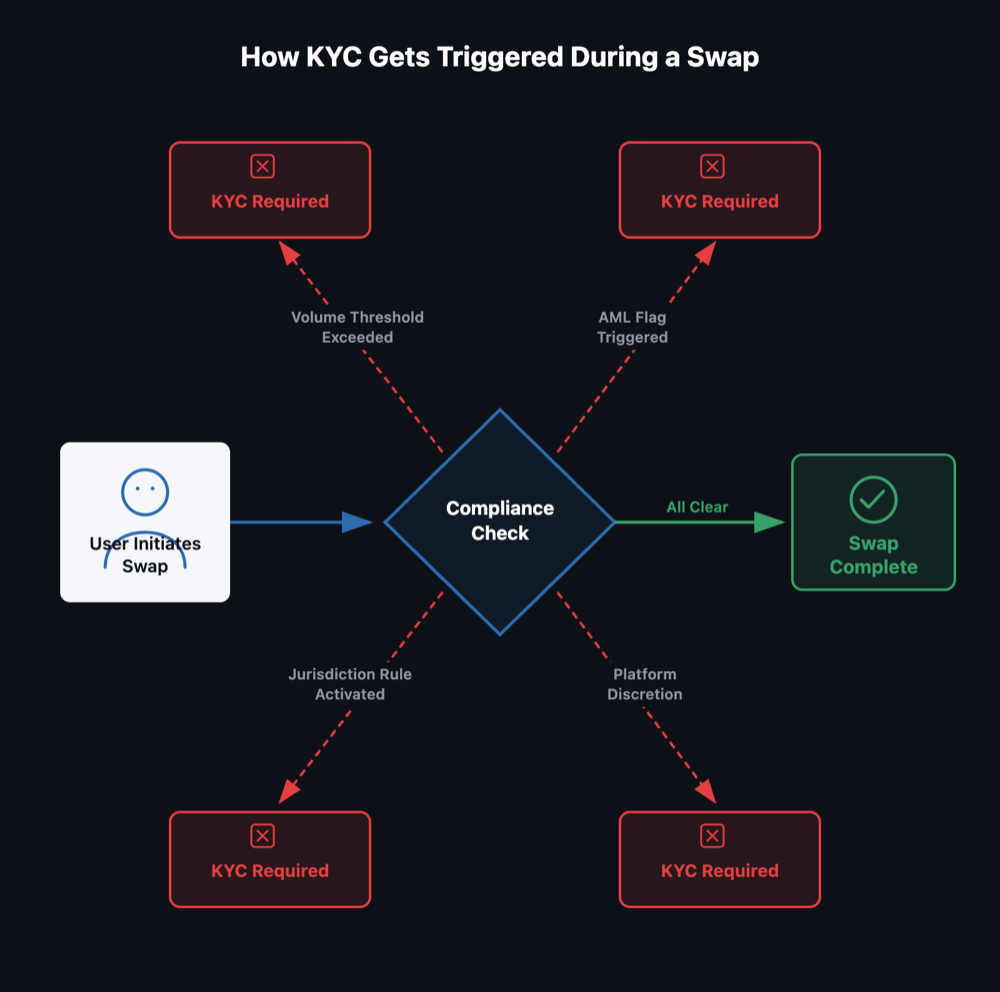
Common triggers include:
- Volume thresholds — Some platforms flag transactions above a set amount. One well-known exchange reportedly triggers identity checks around the equivalent of EUR 10,000 within 48 hours. Others set the bar lower, with user reports on community forums and review sites suggesting flags at amounts as low as $2,000.
- AML risk scoring — Automated systems evaluate transaction patterns in real time. If the source wallet interacted with a mixer, a flagged address, or certain privacy coins, the swap gets held.
- Jurisdiction-based rules — EU Anti-Money Laundering directives, FATF Travel Rule requirements, and country-specific regulations force exchanges operating in those jurisdictions to implement verification triggers.
- Platform discretion — During audits, funding rounds, or banking partner reviews, some exchanges quietly tighten compliance. Users find out when their transaction gets frozen.
None of these triggers are visible to you before they activate. The terms-of-service page might mention them — buried in paragraph 14 of a document no one reads.
Why This Keeps Happening Even on "Privacy-Friendly" Exchanges
The pattern is consistent enough to be predictable: a crypto exchange launches with minimal friction. No registration. No identity checks. Users arrive because the onboarding is fast and private. The platform scales.
Then the compliance layers appear.
This is not dishonesty — it's a business model. The regulatory landscape has materially shifted since 2020. MiCA in the EU, tightened AML directives in the UK, and expanded FATF Travel Rule requirements have all raised the compliance bar. Exchanges that want to partner with banking institutions, process fiat currencies, or operate legally in these jurisdictions now need AML controls. Some added KYC proactively in response to new legal requirements. Others followed the easier path: start without controls, build a user base, then add verification selectively.
KuCoin operated without mandatory KYC until August 2023. The platform had over 1.5 million U.S. customers trading freely before a federal investigation prompted them to implement identity verification — retroactively, and incompletely. The result was a guilty plea and roughly $297 million in fines and forfeitures.
TradeOgre, a smaller exchange that marketed anonymous trading with no KYC requirements, was shut down by Canadian authorities in September 2025. The RCMP seized approximately $40 million in crypto assets. The exchange had never registered as a money services business — a requirement under Canadian law.
The trajectory is often the same: acquire users with privacy promises, grow until regulators notice, then either add KYC or face enforcement. Several platforms that once positioned themselves as no-KYC — including OKX, Bybit, and Kraken — now require mandatory identity verification.
The exchanges that survive long-term in the no-KYC space are the ones that were architecturally built for it from the start — not the ones that bolted it on as a marketing angle.
Conditional vs. Unconditional No-KYC — The Distinction That Matters
This is the part most "no-KYC exchange" listicles skip: not all no-KYC models are the same.
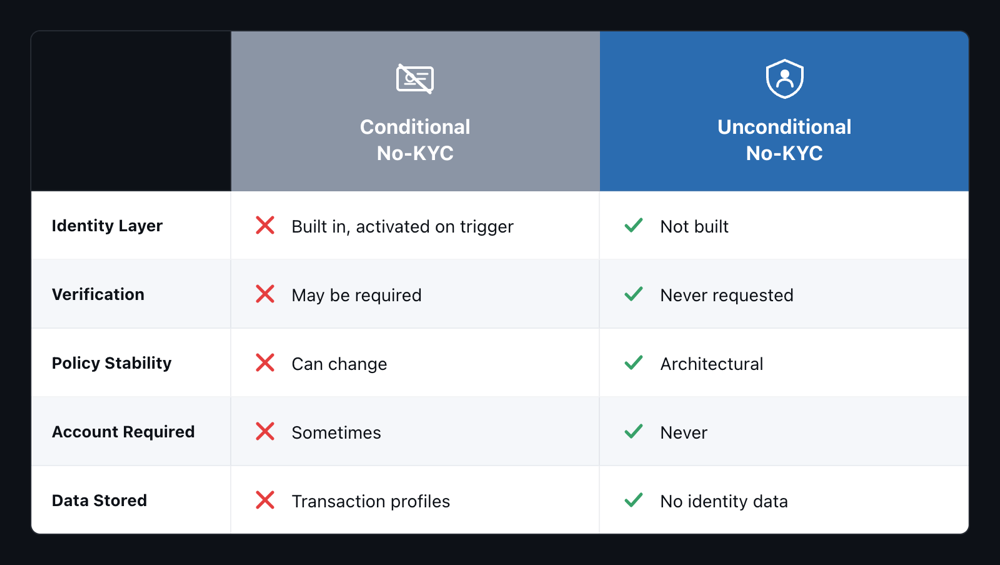
Conditional no-KYC means the platform doesn't ask for your identity unless a threshold, algorithm, or regulatory trigger fires. The policy can change. Your transaction can be held mid-swap. You have no guarantee that the rules today will be the rules tomorrow. If the platform uses a third-party compliance provider — and many do — your transaction data is being evaluated against external risk databases whether you know it or not.
Unconditional no-KYC means the platform was designed without an identity collection layer. No account means no profile. No profile means no data to hand over — to anyone. On-chain DEXs like Uniswap and THORSwap achieve this through smart contracts, though they come with their own friction — slippage on large swaps, gas fees, limited cross-chain pairs, and a steeper learning curve. Non-custodial instant exchanges offer the same architectural privacy without those tradeoffs.
Godex.io operates on the second model. It is a non-custodial exchange — operational for over eight years — that processes crypto-to-crypto swaps without registration, without accounts, and without identity verification at any transaction volume. As a crypto-to-crypto-only service with no fiat gateway, Godex operates in a different regulatory category than exchanges that handle government currencies. There is no compliance toggle waiting to flip — no identity collection layer was built into the platform's architecture.
This is not an ideological stance presented as a feature. It's an architectural decision. A swap on Godex requires a destination wallet address and a deposit. That's it. No email, no phone number, no selfie, no document upload — regardless of whether you're swapping $500 or $50,000.
What to Look for in a Genuinely No-KYC Exchange
Before your next swap, run the platform through this checklist:
- No registration required to initiate a swap — If you need an email address to start, there's an account. If there's an account, there's a data profile.
- No account creation at any point in the flow — Some exchanges let you swap without signing up but create a "guest account" in the background. Check the terms.
- No stored transaction history linked to your identity — If you can log in and see past swaps, the platform is linking transactions to you.
- Fixed-rate option available — A fixed rate locks your exchange rate for the full transaction duration (typically 3-15 minutes). On a 2 BTC swap at $85,000 per coin, a 3% market swing means a $5,100 difference. Rate certainty matters at volume.
- Clear policy language — If the privacy policy says "we may request identity verification under certain circumstances," that's conditional KYC with a polite label.
- Privacy coin support — Monero (XMR), Zcash (ZEC), and other privacy-focused assets are supported — some exchanges have quietly delisted these under regulatory pressure, which tells you where their compliance model is heading.
- No retroactive KYC history — Has the platform operated for years without adding identity requirements? Track record matters more than marketing copy.
Godex checks every box on this list. But don't take the marketing at face value — verify it yourself. The swap flow is public. Try it. For a step-by-step walkthrough, see our [guide to swapping crypto without creating an account][LINK PENDING — Article #5]. For a direct comparison of how this model differs from Changelly's conditional approach, see [Godex vs. Changelly][LINK PENDING — Article #2].
How to Swap Crypto Without Being Asked for Your ID
If you've read this far, here's the practical part:
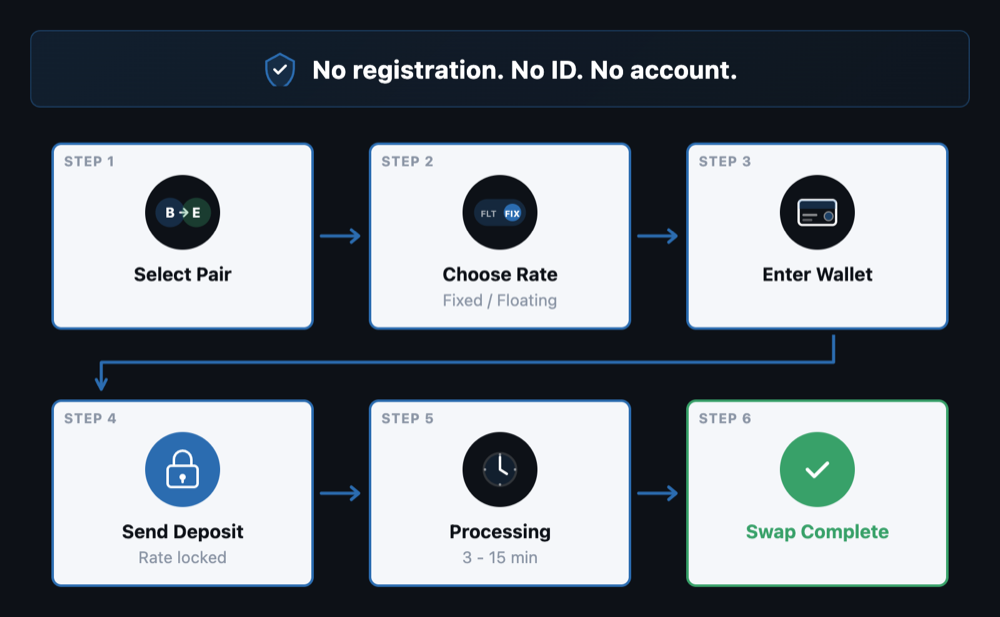
- Go to godex.io
- Select your exchange pair — 934+ cryptocurrencies are supported
- Choose Fixed rate (rate locked for the transaction) or Floating rate (market-dependent)
- Enter your destination wallet address
- Send your crypto to the one-time deposit address provided
- Receive your swap — typically within 3-15 minutes after deposit confirmation
No account. No registration. No verification. No ID upload. The process is the same whether it's your first swap or your hundredth, and whether the amount is $50 or $50,000.
If anything goes wrong, 24/7 support is available — and you don't need to "log in" to access it.

The KYC Prompt Was Not a Bug
The verification request you received was not a technical error. It was a policy — one that existed in the platform's terms before you ever used it, and one that activated the moment your transaction crossed an invisible line.
That's the nature of conditional privacy. It works until it doesn't. And you only find out which kind you had when it stops working.
If you'd rather not find out the hard way again, Godex is built on a different premise: the swap completes, you stay anonymous, and no one asks for your passport. Not because of a policy decision that could change next quarter — but because the platform was architected without an identity collection layer — and has operated that way for over eight years.
That's not a marketing promise. It's infrastructure.
Start a swap on Godex.io — no registration required
Illustration Plan
Illustration 1: KYC Trigger Flowchart
- Placement: After "The 'No-KYC' Promise" section
- Type: Process flow
- Description: A horizontal flow diagram showing a user initiating a swap. The flow splits at a diamond decision node labeled "Compliance Check." Four branches lead out of it — "Volume threshold exceeded," "AML flag triggered," "Jurisdiction rule activated," "Platform discretion" — each ending in a red stop icon with "KYC Required." One path bypasses all checks and ends at a green "Swap Complete" node. Use the anonymous silhouette motif for the user figure. Dark Navy (#0D1117) background, Godex Blue (#2B6CB0) for the main flow path, Warning Red (#E53E3E) for the stop endpoints, Success Green (#38A169) for the clear path.
- Alt text: Flowchart showing how a crypto swap can be interrupted by four types of KYC triggers: volume thresholds, AML flags, jurisdiction rules, or platform discretion, each stopping the transaction and requiring identity verification.
- Design notes: Maximum 7 elements. Transparent background with subtle Light Gray (#F5F7FA) borders for dark-mode compatibility. Use crossed-out ID card icon at each red endpoint. 720px wide.
Illustration 2: The No-KYC Lifecycle Pattern
- Placement: After "Why This Keeps Happening" section
- Type: Process flow (timeline)
- Description: A horizontal timeline showing the typical exchange lifecycle in four stages: (1) "Launch" — shield icon, label "No KYC, fast onboarding"; (2) "Scale" — upward arrow, label "User base grows"; (3) "Pressure" — building icon, label "Banking partners / regulators"; (4) "Compliance" — ID card icon, label "KYC added." Below the timeline, a contrasting single bar labeled "Godex (since 2017)" with a shield icon and "No KYC" that runs the full width, visually showing unbroken no-KYC operation. Dark Navy background. Stages 1-3 in Medium Gray (#8B95A5), Stage 4 in Warning Red (#E53E3E). Godex bar in Godex Blue (#2B6CB0) with Success Green shield.
- Alt text: Timeline showing the typical crypto exchange lifecycle: launch without KYC, scale the user base, face regulatory pressure, then add KYC. Below, a contrasting bar shows Godex maintaining no-KYC status continuously since 2017.
- Design notes: Flat design, icon-based. Each stage represented by a simple icon inside a circle. The Godex bar should visually contrast by being uninterrupted. 720px wide, transparent background.
Illustration 3: Conditional vs. Unconditional No-KYC
- Placement: After "Conditional vs. Unconditional No-KYC" section
- Type: Comparison matrix
- Description: A two-column comparison. Left column header: "Conditional No-KYC" (Medium Gray). Right column header: "Unconditional No-KYC" (Godex Blue). Rows compare: (1) Identity layer — "Built in, activated on trigger" vs. "Not built"; (2) Verification — "May be required" vs. "Never requested"; (3) Policy stability — "Can change" vs. "Architectural"; (4) Account required — "Sometimes" vs. "Never"; (5) Data stored — "Transaction profiles" vs. "No identity data." Use Warning Red checkmarks for the conditional column negative items and Success Green checkmarks for the unconditional column positive items. Anonymous silhouette motif at the top of the unconditional column. Crossed-out ID card at the top of the conditional column.
- Alt text: Comparison table contrasting conditional no-KYC exchanges, which may require identity verification when triggered, with unconditional no-KYC exchanges like Godex, which have no identity verification layer built into their architecture.
- Design notes: Clean grid layout. White (#FFFFFF) cell backgrounds with Light Gray (#F5F7FA) alternating rows. Subtle borders. 720px wide, transparent outer background. Text at 14px equivalent minimum.
Illustration 4: Godex Swap Flow
- Placement: After "How to Swap Crypto Without Being Asked for Your ID" section
- Type: Process flow
- Description: A six-step horizontal process flow showing the Godex swap: (1) Select pair — coin icons with arrow between them; (2) Choose rate — toggle showing "Fixed / Floating"; (3) Enter wallet — wallet icon with cursor; (4) Send deposit — wallet-to-wallet arrow with lock icon at the rate-lock step; (5) Processing — clock icon, "3-15 min"; (6) Receive swap — Success Green checkmark with wallet icon. Above the entire flow, a banner reads "No registration. No ID. No account." with the "No data collected" shield motif. All steps connected by Godex Blue (#2B6CB0) arrows. Dark Navy (#0D1117) step labels on Light Gray (#F5F7FA) step backgrounds.
- Alt text: Six-step process flow showing how to swap crypto on Godex: select a trading pair, choose fixed or floating rate, enter your wallet address, send your deposit, wait 3 to 15 minutes for processing, and receive your swapped cryptocurrency. No registration or identity verification at any step.
- Design notes: Locked flow pattern motif — the lock icon appears specifically at the rate-lock step. Wallet-to-wallet arrows for the non-custodial flow. 720px wide. Transparent background. Each step in a rounded rectangle. Success Green for the final checkmark.
Start a Cryptocurrency exchange
Try our crypto exchange platform
Disclaimer: Please keep in mind that the content of this article is not financial or investing advice. The information provided is the author’s opinion only and should not be considered as direct recommendations for trading or investment. Any article reader or website visitor should consider multiple viewpoints and become familiar with all local regulations before cryptocurrency investment. We do not make any warranties about reliability and accuracy of this information.
Read more
You may well think that an article dedicated to a Tether price prediction or the Tether price in general is a little bit strange — it is a stablecoin after all. However, the price of Tether does fluctuate significantly, although it is nowhere near as volatile as non-stablecoin cryptos. This means that staying up to […]
In the article we share our vision at Zcash cryptocurrency main features and add several price predictions. As cryptocurrencies gain global acceptance and decentralisation slowly enters our lives, privacy becomes the main concern when talking about blockchain adoption. It is no secret that distributed ledger is by far the most secure and transparent technology ever […]
Chiliz coin (CHZ) offers a compelling opportunity for traders interested in the intersection of blockchain technology and sports. By enabling fans to influence team decisions through the Socios app, Chiliz directly monetizes fan engagement and connects with major sports teams like Juventus and Paris Saint-Germain. These partnerships not only enhance the platform’s visibility but also […]
The exponential growth of Bitcoin Satoshi Vision (BSV) against the general bear trend on the cryptocurrency market in autumn 2019 has impressed the community. Due to the increasing market capitalization, the newly emerged altcoin was ranked 5th on CoinMarketCap and managed to maintain its high position at the beginning of 2020. In the article we […]
EOS is definitely on the list of the strongest and most stable projects in the crypto world. Despite the fact that the currency entered the market less than 3 years ago, it consistently occupies one of the top 10 places in the rating for project capitalization. it is often called the “main competitor of Ethereum”. […]
XRP price prediction 2026-2027: bear, base, and bull scenarios with ranges and named sources, the resolved SEC case, live spot ETFs, and can XRP reach $10?