
 Alex Tamm
Table of Contents
Privacy and taxes rarely sit comfortably in the same conversation. For crypto users who prefer non-custodial platforms, anonymous swaps, or exchanges that skip identity checks, a pressing question has grown sharper in 2026: does using a no-KYC exchange keep you off the IRS radar? And if it does, does that make your tax obligation disappear, too?
The short answer is no. A no-KYC exchange not reporting your trades to the IRS does not exempt you from reporting them yourself. But the full picture is more nuanced, and understanding where the real risks lie is genuinely useful for anyone navigating the intersection of privacy-oriented crypto and U.S. tax law.
This guide breaks it all down: what exchanges are now legally required to report, what the IRS can actually see, and what responsible compliance looks like in 2026.
What the IRS Now Requires From Crypto Exchanges
Starting with the 2025 tax year (reported in 2026), U.S.-based centralized crypto exchanges must file Form 1099-DA, Digital Asset Proceeds From Broker Transactions, directly with the IRS and furnish copies to users by mid-February. This is the crypto equivalent of the Form 1099-B that stock brokers have long sent for equity trades.
Form 1099-DA has no general minimum reporting threshold. Every sale, swap, or disposal counts. (A narrow exception exists: per IRS Notice 2024-57 and the 2025 Form 1099-DA instructions, brokers may use optional aggregate reporting methods with de minimis thresholds for certain stablecoin and NFT transactions, but this is a broker-side accommodation, not a taxpayer exemption.) For 2025, exchanges report gross proceeds; beginning with 2026 transactions, they are also required to report cost basis for covered assets, creating an even tighter match against what you declare on your return.
The rule applies to custodial brokers: centralized exchanges that hold your assets on your behalf and facilitate fiat-to-crypto on- and off-ramps. Platforms like Coinbase, Kraken, and Gemini are unambiguously in scope. When you sell Bitcoin on one of these platforms, the transaction is tied to your Social Security number through the exchange’s KYC records. The IRS receives a copy of your 1099-DA. If your Form 8949 doesn’t match, an automated CP2000 notice can follow.
Key takeaway: U.S.-regulated centralized exchanges are now functioning like traditional financial brokers for tax purposes. There is no gray area left here.
So Where Do No-KYC Exchanges Fit In?
No-KYC exchanges, including non-custodial swap platforms, decentralized exchanges (DEXs), and offshore services that don’t collect verified identity, are a different story when it comes to IRS reporting requirements. They generally do not submit Form 1099-DA to the IRS. But this doesn’t mean they operate invisibly.
Here’s how different platform types stack up:
| Platform Type | KYC Required? | Reports to IRS? | Your Tax Obligation |
|---|---|---|---|
| U.S. Centralized Exchange (Coinbase, Kraken) | Yes | Yes — Form 1099-DA | Report all gains/losses; form pre-fills most data |
| Foreign Centralized Exchange (not serving U.S. users) | Usually yes | No — outside IRS jurisdiction | Self-report all worldwide income |
| Decentralized Exchange (Uniswap, PancakeSwap) | No | No — excluded from broker rules | Self-report all gains/losses |
| Non-Custodial Swap Platform (no custody, no KYC) | No | No | Self-report all gains/losses |
| P2P Trading Platform | Varies | Generally no | Self-report all gains/losses |
The regulatory distinction matters: Congress passed a joint resolution of disapproval under the Congressional Review Act (H.J.Res.25), signed into law by President Trump on April 10, 2025, removing the requirement for DeFi brokers, platforms operating entirely on blockchain smart contracts without custodying assets or offering fiat on-ramps, from 1099-DA reporting rules. The CRA mechanism also bars the IRS from issuing substantially similar rules in the future without new legislation, making this a durable, not merely temporary, carve-out. But it doesn’t create a tax exemption; it shifts the reporting burden entirely to the user.
The IRS Can See More Than You Think
This is where many crypto users underestimate their exposure. The absence of a 1099-DA from a platform does not equal invisibility.
Blockchain transparency is structural. Bitcoin, Ethereum, and virtually every major public blockchain record every transaction on an openly readable ledger. No exchange is needed to see these movements: anyone, including the IRS, can query them directly through a block explorer.
The IRS has invested heavily in blockchain analytics. The agency has partnered with firms like Chainalysis, Palantir, and TRM Labs to analyze on-chain data at scale. Chainalysis alone maps more than 65,000 entities to over a billion blockchain addresses, using address clustering and machine learning to link pseudonymous wallets to real identities. The IRS Criminal Investigation unit has spent millions on these tools and uses them for ongoing transaction monitoring, not just reactive audits.
The KYC link problem. Here’s where most “anonymous” strategies break down. If you’ve ever:
- Bought or sold crypto through a KYC-verified exchange
- Moved funds between a no-KYC wallet and a KYC-verified account
- Used a bank card linked to your identity to fund a wallet
…then blockchain analytics can potentially connect your “anonymous” wallet activity back to your verified identity. As one blockchain forensics professional puts it: once one address in a cluster is identified, the entire cluster becomes suspect.
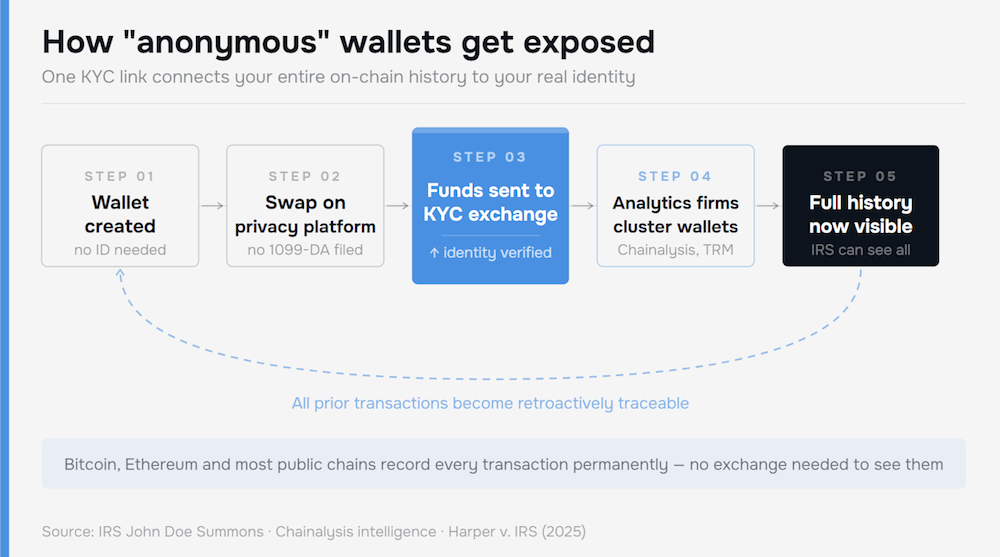
John Doe Summonses. The IRS has previously compelled exchanges, including Coinbase and Kraken, to hand over customer data through court-authorized “John Doe Summonses.” In 2025, the Supreme Court declined to review a challenge to this authority (Harper v. IRS), leaving intact the First Circuit’s ruling in favor of the IRS and effectively preserving the agency’s right to demand records without notifying individual users.
Operation Hidden Treasure. The IRS’s dedicated task force within the Office of Fraud Enforcement specifically targets taxpayers who underreport crypto income. It is active, well-funded, and increasingly data-driven.
The “No Report = No Tax” Myth, And Why It’s Dangerous
One of the most costly misconceptions in crypto is that tax liability only exists when an exchange generates a 1099. It does not work that way.
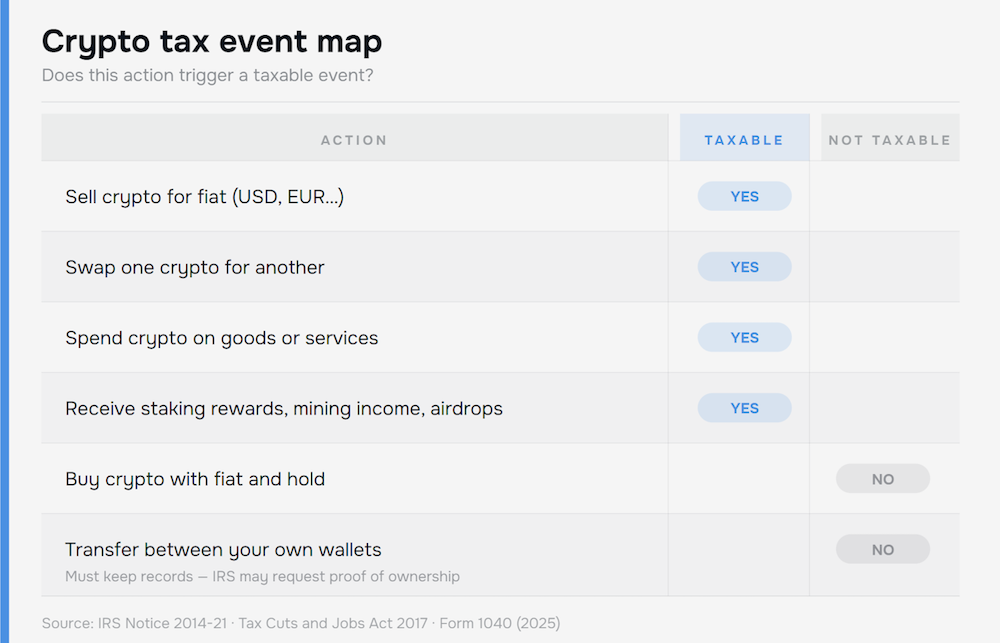
The IRS treats cryptocurrency as property, not currency. This has been true since IRS Notice 2014-21 and has been consistently reaffirmed. Every time you:
- Sell crypto for fiat
- Swap one cryptocurrency for another
- Use crypto to purchase goods or services
- Receive crypto as income, staking rewards, or mining proceeds
…a potentially taxable event occurs. The obligation to report it is yours, regardless of whether any platform sends a form to the IRS.
Form 1040 now includes a mandatory digital asset question: “At any time during 2025, did you receive, sell, exchange, or otherwise dispose of a digital asset?” Answering “No” falsely when you’ve made trades — even on platforms that don’t report — exposes you to charges of tax fraud, not merely oversight.
What Penalties Look Like
Failing to report crypto income in 2026 is not a minor administrative misstep:
- Late payment penalties: 0.5% of unpaid tax per month
- Accuracy-related penalties: 20% of the underpayment
- Fraud penalties: up to 75% of the tax underpaid
- Criminal exposure: In willful cases, criminal prosecution for tax evasion
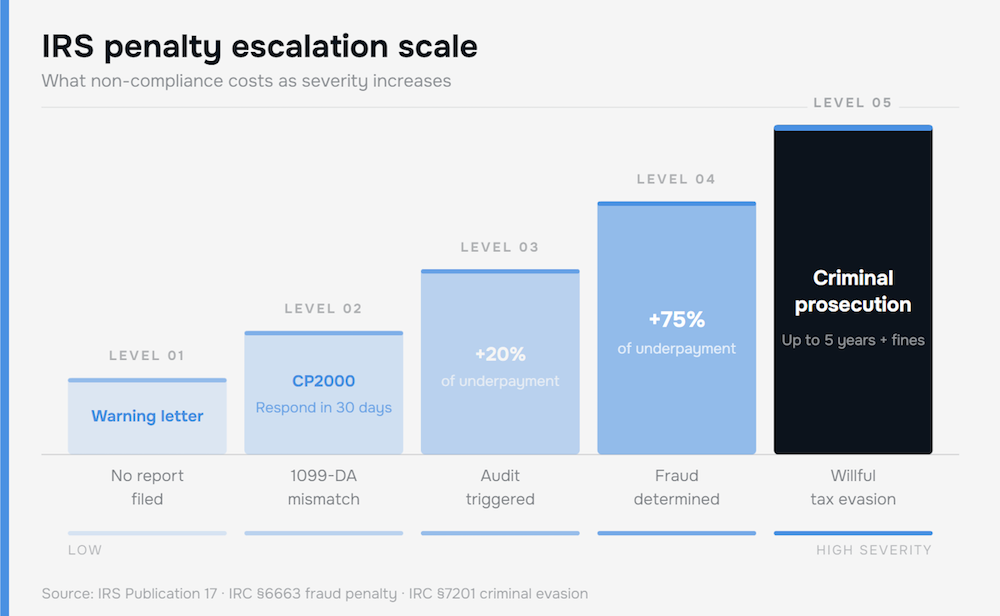
The IRS has already sent thousands of enforcement letters (Letters 6173, 6174, and CP2000 notices) to crypto investors throughout 2025. The trajectory is only toward more enforcement, not less.
How Godex Works, and What It Means for Tax
Godex is a non-custodial, privacy-focused crypto swap platform. Rather than functioning as a traditional centralized exchange, it operates as an instant-access intermediary: it never holds user funds, enables swaps without requiring users to create an account, and does not submit transaction data to the IRS.
From a regulatory standpoint, Godex operates as a non-custodial intermediary, it facilitates the swap but never takes custody of assets. This puts it outside the scope of the 1099-DA broker reporting mandate, which applies specifically to custodial brokers.
Two practical implications stand out for users:
- No 1099-DA will arrive from Godex. If you swap Bitcoin for Ethereum through a non-custodial platform, no tax form is generated on your behalf. This means there is no automated match between exchange-reported data and your tax return, but it also means you carry the full burden of tracking and self-reporting the transaction.
- Every swap is still a taxable event. When you exchange one cryptocurrency for another, the IRS treats it as a disposal of the first asset at its fair market value on the date of the swap. If you held that asset at a gain, capital gains tax applies. The absence of a form doesn’t change the underlying tax math.
This is why even users of privacy-oriented, non-custodial platforms need to maintain detailed transaction records. The swap may be discreet from an identity standpoint, but the tax calculation still needs to be done.
7 Common Mistakes No-KYC Crypto Users Make at Tax Time
Understanding the rules is step one. Avoiding the recurring errors that trip up even experienced users is step two.
Mistake 1: Treating swaps as non-taxable. A crypto-to-crypto exchange is not a “like-kind exchange” under current IRS guidance. The Tax Cuts and Jobs Act of 2017 eliminated that treatment for personal property. Every swap crystallizes a gain or loss.
Mistake 2: Losing track of cost basis. When you buy crypto, its purchase price becomes your cost basis. When you sell or swap, you calculate gain/loss against that basis. Without records, you may default to a $0 basis — meaning 100% of proceeds appear as taxable gain.
Mistake 3: Assuming offshore platforms are invisible. U.S. taxpayers are required to report worldwide income. The fact that a foreign exchange doesn’t report to the IRS doesn’t eliminate your obligation, it just means you have no 1099 to reference when filing.
Mistake 4: Forgetting the Form 1040 digital asset question. Answering “No” to this question while having made trades, even on no-KYC platforms, is a false statement on a federal tax return. The exposure from this is qualitatively different from a simple underreporting mistake.
Mistake 5: Believing privacy coins solve the tax problem. Monero and similar privacy coins do make on-chain tracking harder, but they don’t eliminate tax liability. Critically, Monero has been delisted from most major exchanges. Tornado Cash is a useful illustration of how quickly the regulatory ground shifts: OFAC sanctioned it in 2022, making it off-limits for U.S. persons, then officially lifted those sanctions on March 21, 2025, after the Fifth Circuit ruled in November 2024 that immutable smart contracts cannot be classified as “property” under IEEPA. Criminal charges against co-founder Roman Storm, however, remain pending. The takeaway isn’t that any particular tool is permanently safe or permanently banned, it’s that using privacy mechanisms primarily to avoid reporting creates legal exposure that the underlying technology doesn’t protect against.
Mistake 6: Mixing no-KYC and KYC wallets without documentation. If funds move from a no-KYC wallet to a KYC-verified exchange account, even once, blockchain analytics can potentially link the two. This is precisely how many “anonymous” strategies unravel during an audit.
Mistake 7: Thinking small transactions are below the IRS’s notice. Form 1099-DA carries no minimum reporting threshold. But more importantly: blockchain data is permanent. A $200 swap you made in 2023 on a non-custodial platform still exists on-chain. The IRS audit window can extend up to six years for substantial underreporting, and that on-chain record doesn’t expire.
How to Stay Compliant Using No-KYC Platforms
None of the above means no-KYC platforms are legally problematic to use. Choosing a non-custodial platform for privacy reasons is a legitimate preference, the regulatory framework simply requires that you manage your own tax obligations carefully when you do.
Here’s a practical compliance framework:
Step 1 — Track every transaction as it happens. Record the date, amount, asset, fair market value in USD at time of swap, and resulting asset. Waiting until tax season to reconstruct this from memory rarely works well.
Step 2 — Use crypto tax software. Platforms like Koinly, CoinLedger, or TokenTax can import transaction histories via CSV export or API (where available) and calculate gains, losses, and income automatically. They generate the Form 8949 entries you’ll need.
Step 3 — Identify your cost basis method early. The IRS allows specific identification, FIFO (first-in, first-out), and HIFO (highest-in, first-out) among others. HIFO can reduce taxable gains when you have multiple lots acquired at different prices. Establishing your method before selling is essential to using it legally.
Step 4 — Keep records for at least six years. The standard IRS audit window is three years, extending to six for substantial underreporting. Export your full transaction history from every platform you’ve used and store it securely.
Step 5 — Answer the Form 1040 digital asset question accurately. If you made any crypto transactions during the year, even through no-KYC platforms, the answer is “Yes.” This is not optional or negotiable.
Step 6 — Consult a crypto-experienced tax professional if your situation is complex. If you’ve used multiple wallets, DeFi protocols, staking, or have significant transaction volumes, professional guidance is worth the cost. The landscape has changed significantly, and generic tax advice often doesn’t account for crypto-specific rules.
The Global Picture: CARF Is Coming
The U.S. is not acting in isolation. The OECD’s Crypto-Asset Reporting Framework (CARF) — currently being adopted by dozens of countries — creates a cross-border automatic exchange of crypto transaction data between participating tax authorities, similar to how FATCA works for traditional financial accounts. The U.S. joined the CARF joint statement in November 2023 and is currently targeting first data exchanges in 2029.
To put adoption in context: as of late 2025, 75 jurisdictions have committed to implementing CARF. Separately, on FATF’s virtual asset standards — a related but distinct compliance framework — only 40 out of 138 assessed jurisdictions were rated fully compliant, though that number is rising. Both data points point in the same direction: the regulatory net is expanding and tightening across borders.
The practical implication for U.S. taxpayers using international platforms today is clear: information-sharing infrastructure is already being built, and the window during which offshore privacy-friendly platforms operate in a regulatory vacuum is narrowing year by year.
The Bottom Line
The question “do no-KYC exchanges report to the IRS?” has a clear answer: generally, no. Non-custodial platforms, most DEXs, and offshore exchanges outside U.S. jurisdiction are not currently filing Form 1099-DA on your behalf.
But the follow-on question — “does that mean I don’t owe taxes?” — has an equally clear answer: absolutely not. The IRS explicitly requires U.S. taxpayers to self-report all crypto income and capital gains regardless of whether a form arrives from an exchange. Every swap, sale, or earning event is a taxable event. The blockchain is public and permanent. The IRS has sophisticated analytics tools. And the penalties for willful non-compliance are severe.
Privacy and compliance are not mutually exclusive. You can use non-custodial, no-KYC platforms for legitimate privacy reasons and still meet your tax obligations. The key is maintaining your own records, using tax software to calculate your liability, and reporting accurately — even when no one else does it for you.
The era of crypto tax ambiguity is closing. The era of personal responsibility for crypto tax compliance is fully here.
Frequently Asked Questions
If a no-KYC exchange doesn’t send me a 1099, do I still owe taxes? Yes. The 1099 is how the IRS catches you — not what creates your obligation. You owed taxes the moment the trade happened. Self-reporting is required regardless of what the exchange sends.
How would the IRS even know? The whole point of no-KYC is anonymity. The blockchain is public and permanent. Every transaction is on-chain forever. One KYC-verified on- or off-ramp — even a single transfer to Coinbase — is enough for blockchain analytics to link your “anonymous” wallet to your identity.
Is there a minimum threshold? Do I really need to report a $50 swap? No minimum exists for crypto gains. The $10,000 threshold applies to cash transactions under Form 8300 — it has nothing to do with capital gains reporting. A $50 profitable swap is a taxable event.
What if I just answer “No” to the crypto question on my 1040 and stay quiet? Answering “No” while having made trades is a false statement on a federal tax return. That upgrades the situation from tax oversight to potential fraud — with penalties up to 75% of unpaid tax and criminal exposure.
What about Monero or mixers — that’s real anonymity, unlike ETH. Privacy tools reduce traceability but don’t eliminate tax liability. Using them specifically to avoid reporting converts a tax problem into a criminal one — the legal risk is in the intent, not just the technology.
I haven’t reported for years. Should I stay quiet or try to fix it? Fix it. Voluntary correction through amended returns consistently produces better outcomes than getting caught. The IRS’s Operation Hidden Treasure actively targets crypto underreporters, and its analytics improve every year. A crypto-experienced CPA can assess your exposure and options.
This article is for informational purposes only and does not constitute tax or legal advice. U.S. tax law is complex and subject to change; consult a qualified tax professional for guidance specific to your situation.
Start a Cryptocurrency exchange
Try our crypto exchange platform
Disclaimer: Please keep in mind that the content of this article is not financial or investing advice. The information provided is the author’s opinion only and should not be considered as direct recommendations for trading or investment. Any article reader or website visitor should consider multiple viewpoints and become familiar with all local regulations before cryptocurrency investment. We do not make any warranties about reliability and accuracy of this information.
Read more
You may well think that an article dedicated to a Tether price prediction or the Tether price in general is a little bit strange — it is a stablecoin after all. However, the price of Tether does fluctuate significantly, although it is nowhere near as volatile as non-stablecoin cryptos. This means that staying up to […]
In the article we share our vision at Zcash cryptocurrency main features and add several price predictions. As cryptocurrencies gain global acceptance and decentralisation slowly enters our lives, privacy becomes the main concern when talking about blockchain adoption. It is no secret that distributed ledger is by far the most secure and transparent technology ever […]
Chiliz coin (CHZ) offers a compelling opportunity for traders interested in the intersection of blockchain technology and sports. By enabling fans to influence team decisions through the Socios app, Chiliz directly monetizes fan engagement and connects with major sports teams like Juventus and Paris Saint-Germain. These partnerships not only enhance the platform’s visibility but also […]
The exponential growth of Bitcoin Satoshi Vision (BSV) against the general bear trend on the cryptocurrency market in autumn 2019 has impressed the community. Due to the increasing market capitalization, the newly emerged altcoin was ranked 5th on CoinMarketCap and managed to maintain its high position at the beginning of 2020. In the article we […]
EOS is definitely on the list of the strongest and most stable projects in the crypto world. Despite the fact that the currency entered the market less than 3 years ago, it consistently occupies one of the top 10 places in the rating for project capitalization. it is often called the “main competitor of Ethereum”. […]
XRP price prediction 2026-2027: bear, base, and bull scenarios with ranges and named sources, the resolved SEC case, live spot ETFs, and can XRP reach $10?