
 Alex Tamm
Table of Contents
You opened Coinbase, hit “verify identity,” and found yourself uploading a passport scan, a selfie, and proof of address — only to wait 48 hours for approval while the market moved without you. If that scenario sounds familiar, you’re not alone. Millions of crypto traders globally are actively searching for Coinbase alternatives that skip the paperwork and get straight to the swap.
In 2026, the demand for no-KYC exchanges with instant swaps has never been stronger. A YouGov/Consensys survey found that 83% of people worldwide consider data privacy a top priority — yet Coinbase and most major centralized platforms treat that priority as a compliance checkbox rather than a genuine commitment. The result? A growing ecosystem of non-custodial, verification-free platforms where you swap crypto in minutes, not days.
This guide reviews six of the best Coinbase alternatives that require zero identity verification, offer genuinely instant swaps, and don’t store your personal data on servers you can’t control. Whether you’re a privacy-conscious trader, someone in a jurisdiction partially blocked from major platforms, or simply tired of document queues, there is a better way.
Quick Comparison: 6 Coinbase Alternatives at a Glance
| Exchange | Type | KYC Requirement | Assets | Swap Speed | Custody |
|---|---|---|---|---|---|
| Godex | Instant Swap | Anonymous | 900+ | Instant | Non-custodial |
| GhostSwap | Instant Swap | None — ever | 1,500+ | 5–30 min | Non-custodial |
| MEXC | CEX | Optional (up to 10 BTC/day) | 1,300+ | Instant | Custodial |
| CoinEx | CEX | Optional (standard tiers) | 1,300+ | Instant | Custodial |
| dYdX | DEX (Derivatives) | None (wallet-based) | 35+ perps | Instant | Non-custodial |
| Bisq | P2P | None (by design) | BTC + fiat pairs | Minutes to hours | Non-custodial |
Why Coinbase Requires KYC — and Why That’s a Problem
Coinbase requires full KYC for every user. No exceptions. To trade even a single dollar’s worth of cryptocurrency on the platform, you must submit government-issued ID, a facial scan, and in many cases a proof of address. This is a legal requirement under U.S. financial regulations — Coinbase is a publicly listed company operating as a regulated money service business, which means it must comply with Bank Secrecy Act and FinCEN rules.
That compliance posture has real consequences for users:
- Speed: Identity verification typically takes 24–72 hours, and manual reviews can extend that window further. In a market that moves by the minute, that delay has a measurable cost.
- Privacy exposure: Your passport scan, selfie, and address now live in a corporate database. History hasn’t been kind to those databases — data breaches at Ledger (270,000+ records in 2020), KuCoin (2020), and FTX’s bankruptcy administrator Kroll (2023) all exposed sensitive user data with little recourse for victims.
- Geographic restrictions: Coinbase is unavailable or severely limited in dozens of countries. Users in restricted regions have no path to verification even if they wanted to comply.
- Account freezes: Coinbase, like most regulated CEXs, can freeze accounts during compliance reviews — sometimes for weeks, sometimes longer. Funds become inaccessible during that period.
None of this means Coinbase isn’t a useful on-ramp for first-time fiat-to-crypto purchases. It is. But for crypto-to-crypto swaps, portfolio rebalancing, and any use case where speed and privacy matter, there are significantly better options in 2026.
What to Look for in a No-KYC Exchange
Not every platform advertising “no KYC” actually delivers on that promise. Some use “optional KYC” that kicks in above invisible thresholds. Others freeze swaps mid-transaction and demand verification retroactively. Before choosing a Coinbase alternative, evaluate any platform across five key dimensions:
- True no-KYC policy: Does the platform ever request verification, or is the no-KYC commitment absolute? Check the terms of service, not just the marketing copy.
- Custodial vs. non-custodial: Non-custodial platforms never hold your funds — the swap goes directly wallet-to-wallet. Custodial platforms introduce counterparty risk.
- Swap speed: Instant swaps should complete in 5–30 minutes depending on blockchain confirmation times. Anything advertised as “instant” but regularly taking hours warrants scrutiny.
- Coin coverage: A platform with 100 assets is meaningfully different from one supporting 900+, especially for altcoin swaps or privacy coin transactions.
- Rate transparency: Fixed-rate swaps lock your quoted price. Floating-rate swaps follow market movements. Know which you’re using before you send funds.
With those criteria in mind, here are the six strongest Coinbase alternatives available in 2026.
The 6 Best No-KYC Coinbase Alternatives With Instant Swaps
1. Godex — Best Overall Privacy-Focused Instant Swap Platform
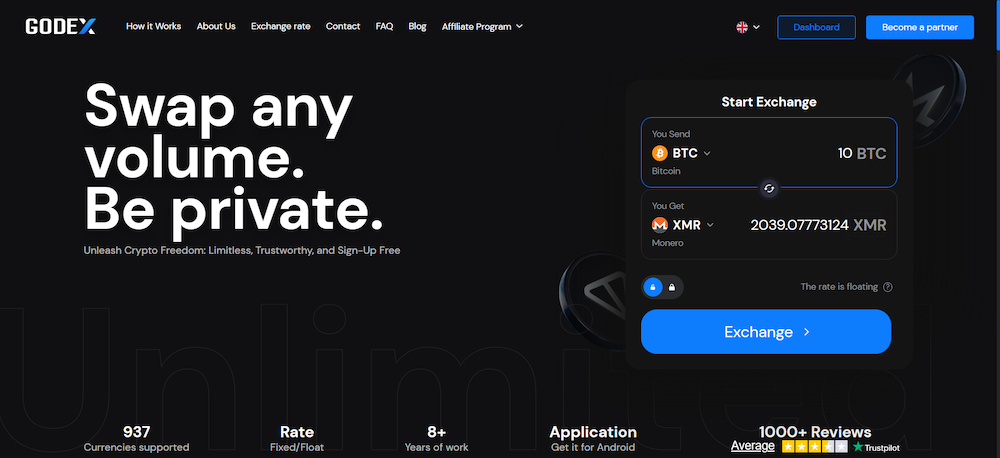
Godex is the strongest privacy-friendly Coinbase alternative for crypto-to-crypto swaps: no account creation, no email, no registration, and minimal data collection by design. Founded in 2017, the platform has quietly built one of the most consistent non-custodial swap services in the market, earning the #1 privacy-focused exchange ranking from Coinpedia for 2025 and maintaining official integrations with Trezor, Edge Wallet, and Monero.
The operational model is deliberately minimal: choose the coins you want to swap, enter your receiving wallet address, send your crypto, receive the exchange. No login screen exists to freeze, and the platform never holds your funds mid-swap — it routes directly between wallets.
- Supports 900+ cryptocurrencies, including privacy coins like XMR that most regulated exchanges delist
- Both fixed and floating rate options — the fixed rate locks your quoted amount, protecting against volatility during confirmation time
- High-volume swaps supported — unlike platforms that quietly trigger verification above $1,000–$2,000, Godex is built for uninterrupted, high-value exchanges
- Non-custodial architecture — funds never sit in platform wallets
- Tor-compatible for users who want IP-level anonymity on top of private swaps
- Minimal data footprint — no email required, no transaction history tied to a personal identity
The critical differentiator in 2026 isn’t just the privacy-friendly positioning — it’s that Godex has maintained its confidential trading architecture across multiple compliance cycles and regulatory pressure points where other platforms quietly introduced verification tiers. For traders who’ve been surprised by a mid-swap KYC demand on competing platforms, that consistency is worth more than it sounds.
Website: godex.io
2. GhostSwap — Best for Maximum Anonymity

GhostSwap is a fully non-custodial instant swap platform that requires no account, no email, and no identity check — ever. Launched as a privacy-first alternative, it has rapidly gained traction in 2025–2026 among traders who want the broadest possible coin coverage without any data footprint.
The platform supports over 1,500 cryptocurrencies across 25+ blockchains, which is among the widest selections of any no-KYC service. It uses encrypted smart contracts to secure transactions, meaning that even if GhostSwap’s servers were compromised, funds in transit would remain protected by the contract’s cryptographic guarantees.
- 1,500+ cryptocurrencies, cross-chain swap support
- No account, no email, zero personal data collected
- Encrypted smart contract architecture
- Automatic deletion of transaction records within two weeks
- Supports BTC→XMR swaps, making it a useful tool for privacy coin conversion
GhostSwap is particularly well-suited for traders who want the widest asset coverage and a clean transaction trail. The automatic record deletion policy adds a layer of operational privacy that few instant swap services match.
Website: ghostswap.io
3. MEXC — Best No-KYC CEX for High-Volume Traders
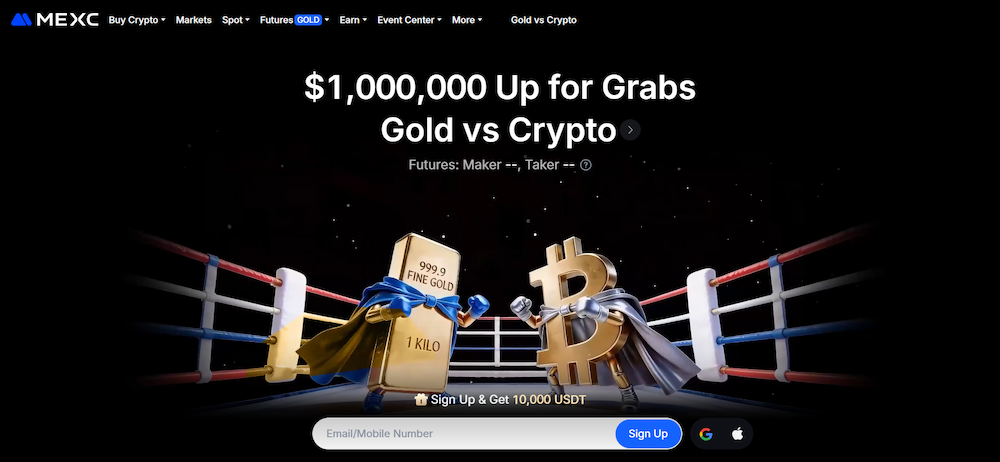
MEXC is one of the largest centralized exchanges that still offers meaningful trading access without mandatory identity verification. Unverified accounts can withdraw up to 10 BTC per day — a generous cap that exceeds most privacy-focused instant swap services — while accessing the full suite of spot trading, margin trading, and futures on over 1,300 listed assets.
Unlike pure swap services, MEXC functions as a full-featured exchange with order books, price discovery, and deep liquidity. That makes it a more direct Coinbase alternative for traders who want traditional exchange functionality without the document submission process. The platform’s tiered system means KYC remains optional at lower volumes, though users should read the fine print carefully regarding jurisdictional restrictions.
- 1,300+ cryptocurrencies available
- 10 BTC/day withdrawal limit without KYC
- Full trading suite: spot, margin, futures
- Deep liquidity across major pairs
- Competitive fees with further reductions for MX token holders
One important note: MEXC’s no-KYC status applies in many regions, but availability varies by jurisdiction. Users should verify current access rules before relying on it as a primary Coinbase alternative.
Website: mexc.com
4. CoinEx — Best No-KYC Exchange for Altcoin Trading
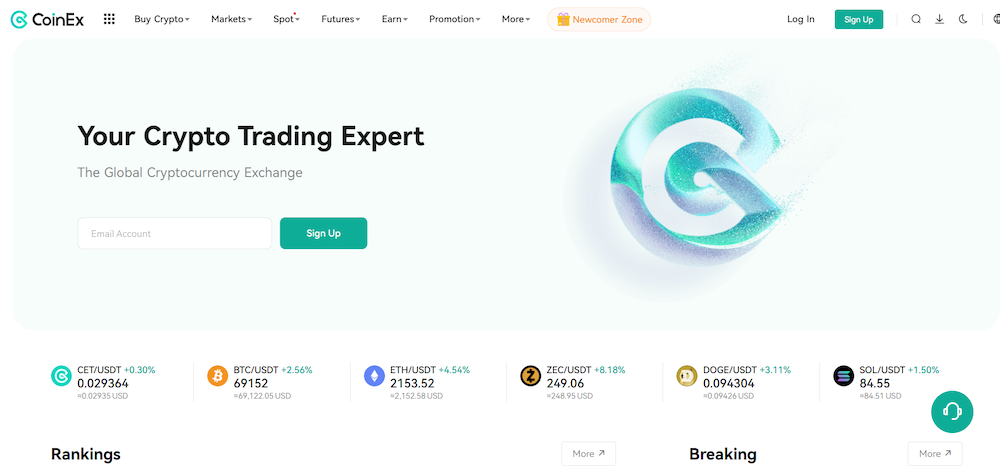
CoinEx supports over 1,300 cryptocurrencies without mandatory KYC for standard trading activity, making it one of the broader-coverage no-KYC centralized exchanges operating in 2026. Trading fees start at 0.2% and drop to 0.1% for users holding the platform’s native CET token — competitive by any measure, and well below Coinbase’s standard fee structure.
Founded in 2017, CoinEx has built a track record across multiple market cycles, which matters in a space where younger platforms come and go. The exchange offers spot trading, margin trading, futures, and earn products — a fuller feature set than most instant swap services, though with the trade-off of a centralized custody model for account balances.
- 1,300+ supported cryptocurrencies
- Fees from 0.2% (0.1% with CET token)
- Spot, margin, futures, and earn products
- No mandatory KYC for standard trading tiers
- Seven-plus year operational history
CoinEx suits traders looking for a Coinbase alternative that combines broad altcoin access with exchange functionality, without Coinbase’s mandatory verification requirements. It’s worth noting, as with all centralized no-KYC exchanges, that the no-KYC tier has limits and the platform is custodial — meaning balances sit on the exchange rather than in personal wallets.
Website: coinex.com
5. dYdX — Best No-KYC Option for Derivatives Traders
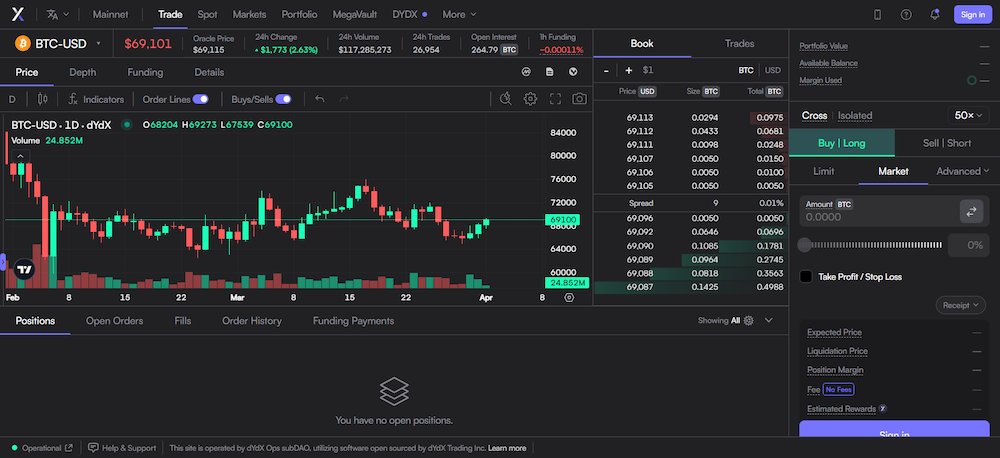
dYdX is a non-custodial decentralized exchange for perpetual contract trading that requires no KYC and no account — only a compatible crypto wallet. Connect MetaMask, Trust Wallet, or any WalletConnect-compatible wallet, and you’re trading immediately. No identity verification is possible by design, because dYdX has no account relationship with its users.
The platform currently supports perpetual contracts on over 35 cryptocurrencies with leverage, built on its own dedicated appchain. This is not a beginner’s tool — leverage amplifies both gains and losses, and derivatives trading carries materially higher risk than spot swaps. But for experienced traders seeking a fully decentralized, non-custodial Coinbase alternative with derivatives functionality, dYdX occupies a category of one.
- Non-custodial: connect wallet, trade immediately
- Perpetual contracts on 35+ cryptocurrencies with leverage
- No account creation, no identity verification by design
- Fully on-chain settlement — no platform custody of assets
- Currently unavailable in the US and Canada; check local regulations
dYdX is best understood as a specialist tool rather than a general swap platform. For spot swaps and broad coin coverage, Godex or GhostSwap serve better. For leveraged derivatives with no-KYC access, dYdX has few credible alternatives.
Website: dydx.trade
6. Bisq — Best No-KYC P2P Exchange for Bitcoin
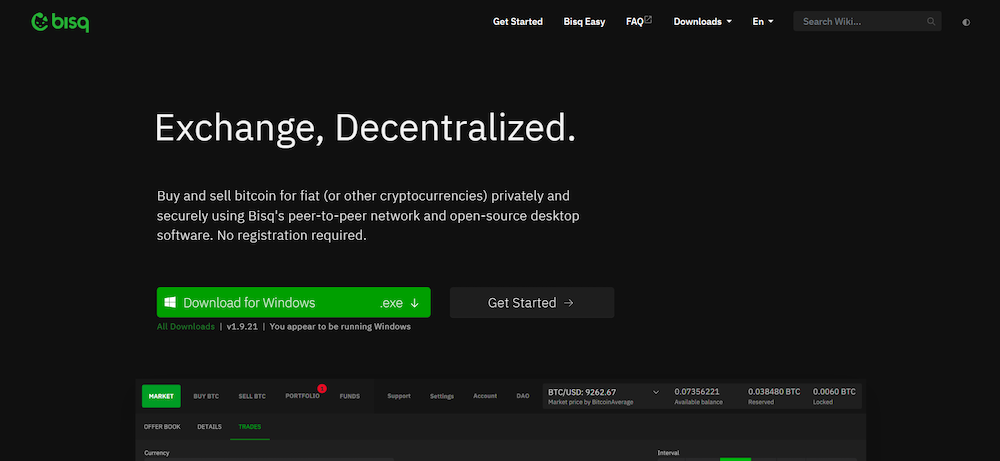
Bisq is a fully decentralized, peer-to-peer Bitcoin exchange that requires no registration, no identity verification, and no central server. It runs as an open-source desktop application using a distributed network with no company in control — which means there is no central entity to demand KYC, respond to data requests, or freeze accounts. For Bitcoin buyers and sellers who want maximum sovereignty, Bisq represents the most structurally private option on this list.
The trade-off is practicality. Bisq relies on finding a counterparty willing to trade at your price, which means liquidity is thinner than centralized platforms and settlement takes longer than instant swap services. Trades involve a security deposit to deter fraud, and dispute resolution is handled by a decentralized arbitration network.
- Fully decentralized — no company, no servers, no central KYC risk
- Bitcoin-native with fiat on-ramp options via bank transfer and other methods
- No account or identity data ever collected
- Open-source and community-audited
- Available globally with no geographic restrictions
Bisq is the right choice for privacy-maximalist Bitcoin buyers who prioritize structural decentralization over speed. For altcoin swaps or instant execution, the other platforms on this list are more practical.
Website: bisq.network
How to Use a No-KYC Exchange Safely in 2026
No-KYC doesn’t mean no risk. Choosing the right platform is the first step; using it correctly is the second. Privacy-conscious traders typically stack several practices together:
Use a dedicated wallet address for each swap. Reusing addresses creates a linkable transaction trail on the public blockchain. Hardware wallets like Ledger and Trezor make address rotation straightforward.
Consider a VPN or Tor for IP masking. The blockchain records your transaction, not your IP — but the exchange’s server does log your connection. A no-logs VPN (Mullvad, ProtonVPN) or Tor browser removes that data point. Godex and most DEX front-ends are Tor-compatible; some CEXs block Tor exit nodes.
Don’t send freshly swapped funds directly to a KYC exchange. If you swap on a non-custodial platform and immediately deposit to Coinbase, you’ve created a traceable link between your anonymous swap and your verified identity. Use an intermediate self-custody wallet if mixing no-KYC and KYC platforms.
Test with small amounts first. Before moving significant value across any platform, run a small swap to verify the output address, confirm the rate behavior, and check that funds arrive as expected.
Understand your tax obligations. Using a no-KYC exchange does not eliminate tax liability. In the US, the IRS introduced 1099-DA reporting requirements in 2026, and tax authorities globally are increasing on-chain surveillance capabilities. All cryptocurrency trades are taxable events regardless of whether the exchange collected your identity. Self-reporting is your responsibility.
The Bottom Line
Coinbase works well as a fiat on-ramp. As a long-term home for crypto-to-crypto swaps, it trades speed and privacy for compliance overhead most experienced traders don’t need — with real downside in the form of data exposure, account freeze risk, and geographic limits.
Godex is built for exactly what Coinbase isn’t: instant swaps with a minimal data footprint, a fixed-rate option that eliminates post-quote surprises, and 900+ supported assets including privacy coins that regulated platforms routinely delist. It’s been running since 2017 without pivoting toward mandatory verification — which, in an era of shrinking no-KYC options, is the most honest endorsement a platform can have.
Your crypto should live in wallets you control, not on platforms you don’t.
Frequently Asked Questions
Okay but if there’s no KYC, how do I know the platform won’t just disappear with my money? Non-custodial swap platforms never hold your funds — the exchange routes directly wallet-to-wallet, so there’s nothing to steal. Exit scam risk exists on no-KYC CEXs that hold your balance, not on instant swap services. Check one thing before using any platform: does it hold your coins between swaps, or route them through immediately?
Is using a no-KYC exchange actually legal, or am I going to get in trouble? Using a no-KYC exchange is legal in most jurisdictions — regulatory obligations fall on the operator, not the user. The real risk people miss is taxes: every crypto trade is a taxable event regardless of whether the exchange collected your identity. Keep your own records, report your gains, and you’re fine.
Can’t the IRS just trace everything on-chain anyway? What’s the actual privacy benefit? The blockchain is public, but your identity isn’t automatically attached to a wallet address unless it’s been linked through a KYC platform. The practical benefit isn’t invisibility from authorities — it’s that your passport, address, and selfie don’t sit in a corporate database waiting to be breached. The Coinbase data exposure in May 2025 immediately triggered targeted social engineering attacks on users. That’s the everyday threat no-KYC actually protects against.
What happens if my swap goes wrong and I have no account to contact support with? Reputable swap services track every transaction by ID — that’s your support reference, no account needed. On non-custodial platforms, a failed swap means delayed or returned coins, not permanent loss. The real tradeoff is no account recovery if you lose access. The risk is inconvenience, not disappearance, on established platforms.
Will depositing no-KYC swap proceeds to Coinbase flag my account? Regulated exchanges use blockchain analytics and can flag wallets linked to certain services. The standard practice is routing through an intermediate self-custody wallet — a fresh hardware wallet address — between a no-KYC swap and a KYC deposit. This breaks the direct on-chain link and reduces the chance of triggering enhanced due diligence.
Is the no-KYC space just getting smaller every year? Yes — regulatory pressure has forced KuCoin, OKX, and others to introduce mandatory KYC. What remains are DEXs (which can’t collect KYC by design), non-custodial instant swap services, and offshore CEXs with tiered systems. Platforms that have maintained their no-KYC architecture through multiple regulatory cycles without pivoting carry meaningful signal. Operational consistency over time matters more than current marketing claims.
Disclaimer: This article is for informational purposes only and does not constitute financial or investment advice. Cryptocurrency trading involves significant risk. Always research platforms independently and consult applicable local laws and tax regulations before trading.
Start a Cryptocurrency exchange
Try our crypto exchange platform
Disclaimer: Please keep in mind that the content of this article is not financial or investing advice. The information provided is the author’s opinion only and should not be considered as direct recommendations for trading or investment. Any article reader or website visitor should consider multiple viewpoints and become familiar with all local regulations before cryptocurrency investment. We do not make any warranties about reliability and accuracy of this information.
Read more
You may well think that an article dedicated to a Tether price prediction or the Tether price in general is a little bit strange — it is a stablecoin after all. However, the price of Tether does fluctuate significantly, although it is nowhere near as volatile as non-stablecoin cryptos. This means that staying up to […]
In the article we share our vision at Zcash cryptocurrency main features and add several price predictions. As cryptocurrencies gain global acceptance and decentralisation slowly enters our lives, privacy becomes the main concern when talking about blockchain adoption. It is no secret that distributed ledger is by far the most secure and transparent technology ever […]
Chiliz coin (CHZ) offers a compelling opportunity for traders interested in the intersection of blockchain technology and sports. By enabling fans to influence team decisions through the Socios app, Chiliz directly monetizes fan engagement and connects with major sports teams like Juventus and Paris Saint-Germain. These partnerships not only enhance the platform’s visibility but also […]
The exponential growth of Bitcoin Satoshi Vision (BSV) against the general bear trend on the cryptocurrency market in autumn 2019 has impressed the community. Due to the increasing market capitalization, the newly emerged altcoin was ranked 5th on CoinMarketCap and managed to maintain its high position at the beginning of 2020. In the article we […]
EOS is definitely on the list of the strongest and most stable projects in the crypto world. Despite the fact that the currency entered the market less than 3 years ago, it consistently occupies one of the top 10 places in the rating for project capitalization. it is often called the “main competitor of Ethereum”. […]
XRP price prediction 2026-2027: bear, base, and bull scenarios with ranges and named sources, the resolved SEC case, live spot ETFs, and can XRP reach $10?