
 Alex Tamm
Table of Contents
Ethereum trades near $1,800 as of June 2026 , roughly 60% below its August 2025 all-time high of about $4,954. No one can guarantee where ETH goes next — credible 2026 forecasts run from the $1,400s to over $7,500, and long-range 2040 estimates span $6,500 to $100,000. This article lays out bear, base, and bull scenarios for 2026–2040 as ranges, not guarantees. Not financial advice.
ETH is down ~60% — should I panic? That is the question most readers arrive with, so here is the calm version up front: a 60% drawdown is painful but not unprecedented for ETH, which has fallen this hard and recovered before (2018, 2022). It tells you the market is fearful right now — it does not tell you where the price goes next. Nothing below is a reason to act in a hurry; it is context to make your own decision with.
TL;DR — Ethereum Price Forecast at a Glance
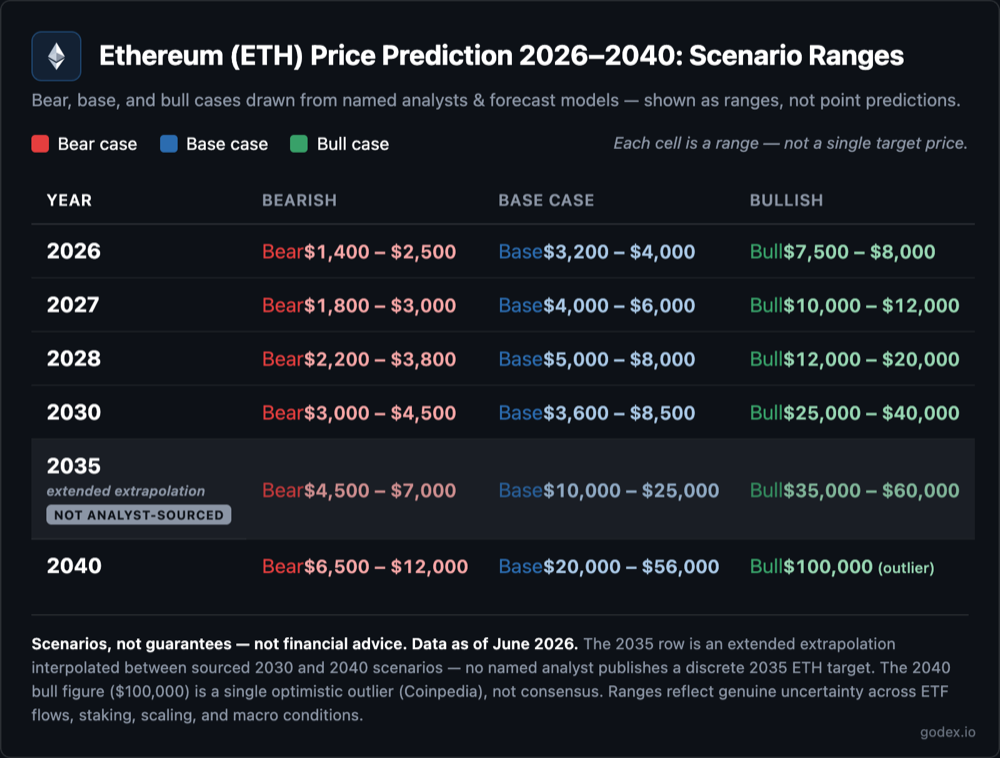

Ethereum’s outlook splits into three scenarios. The bear case assumes a prolonged risk-off macro environment, weak ETF flows, and competition from rival smart-contract chains. The base case assumes steady institutional adoption, growing staked-ETF demand, and Layer 2 scaling that compounds over time (Layer 2s are faster, cheaper networks built on top of Ethereum to handle more transactions). The bull case assumes sustained spot and staked-ETF inflows, supply tightening, and ETH cementing its role as the settlement layer for tokenized assets. The figures below are scenario ranges drawn from named analysts and forecast models — not a single “the” price for any year.
| Year | Bearish | Base case | Bullish |
|---|---|---|---|
| 2026 | $1,400 – $2,500 (bear analysts; Capital.com near-term) | $3,200 – $4,000 (Standard Chartered EOY ~$4K) | $7,500 – $8,000 (Std. Chartered high case) |
| 2027 | $1,800 – $3,000 (algorithmic model outputs, bear band) | $4,000 – $6,000 (Std. Chartered path, mid) | $10,000 – $12,000 (Std. Chartered $10K 2027; Hayes $10K–$20K by ~2028) |
| 2028 | $2,200 – $3,800 (algorithmic model outputs, bear range) | $5,000 – $8,000 (Std. Chartered $18K 2028 path, lower band) | $12,000 – $20,000 (Std. Chartered $18K; Hayes $10K–$20K by ~2028) |
| 2030 | $3,000 – $4,500 (algorithmic model outputs, bear) | $3,600 – $8,500 (Changelly/CoinCodex algorithmic model outputs, common band) | $25,000 – $40,000 (Standard Chartered ~$40K) |
| 2035 (extended extrapolation — not analyst-sourced) | $4,500 – $7,000 | $10,000 – $25,000 | $35,000 – $60,000 |
| 2040 | $6,500 – $12,000 (algorithmic model outputs, conservative) | $20,000 – $56,000 (Changelly/CoinCodex algorithmic model outputs, long-range) | $100,000 (Coinpedia outlier — not consensus) |
Data as of June 2026 — scenarios, not guarantees, not financial advice. The 2035 row is an extended extrapolation interpolated between sourced 2030 and 2040 scenarios — no named analyst publishes a discrete 2035 ETH target.
What separates the scenarios: the spread between bear and bull is driven by four variables — spot and staked-ETF inflows, the share of supply staked (and how much that tightens the liquid float), Layer 2 throughput maturity, and the macro/regulatory backdrop. The high outliers (notably Coinpedia’s ~$100,000 for 2040) assume blockchain becomes core financial infrastructure over a 14-year horizon. Treat them as the ceiling of one optimistic model, not a target.
Not Financial Advice
Every figure in this article is a scenario range built from named third-party analysts and current market data — not a prediction, recommendation, or promise. Cryptocurrency is volatile; ETH is down roughly 60% from its 2025 high, and any of these scenarios can be invalidated by a single macro or regulatory shift. Past performance does not indicate future results. Nothing here is investment advice. Do your own research and consider speaking with a qualified professional before making any decision.
Why Is Ethereum Down in 2026?
Ethereum is down roughly 60% from its August 2025 all-time high of about $4,954, trading near $1,800 in early June 2026 amid “Extreme Fear” market sentiment and a low RSI. The drawdown is the result of several pressures stacking at once, not a single failure.
The August 2025 peak was a cycle top. After a vertical run, markets tend to cool — early buyers take profit, momentum traders rotate out, and the move that looked unstoppable reverses. ETH has followed that pattern before, in 2018 and again in 2022.
Macro conditions tightened the screws. A higher-for-longer rate environment pulls capital toward yield-bearing safe assets and away from risk assets like crypto. Bitcoin slid below $66,000 in the same window , and ETH, as a higher-beta asset, fell harder.
Sentiment then becomes self-reinforcing. Oversold readings and “Extreme Fear” indicators reflect a market that has stopped pricing in good news. That is uncomfortable for holders — but it is also the condition from which past recoveries have started. Whether this is the bottom is exactly the kind of call this article will not make.
Ethereum Price and Performance: Where ETH Stands in June 2026
As of June 2026, Ethereum trades near $1,800 with a market capitalization around $215 billion, holding its position as the #2 cryptocurrency behind Bitcoin.
That price sits roughly 60% below the August 2025 all-time high of about $4,954. The 24-hour range in early June spanned roughly $1,730 to $1,890 , with the market in a consolidation phase after the multi-month decline. This is context, not a forecast — the scenarios start below.
What Drives Ethereum’s Price in 2026 and Beyond?

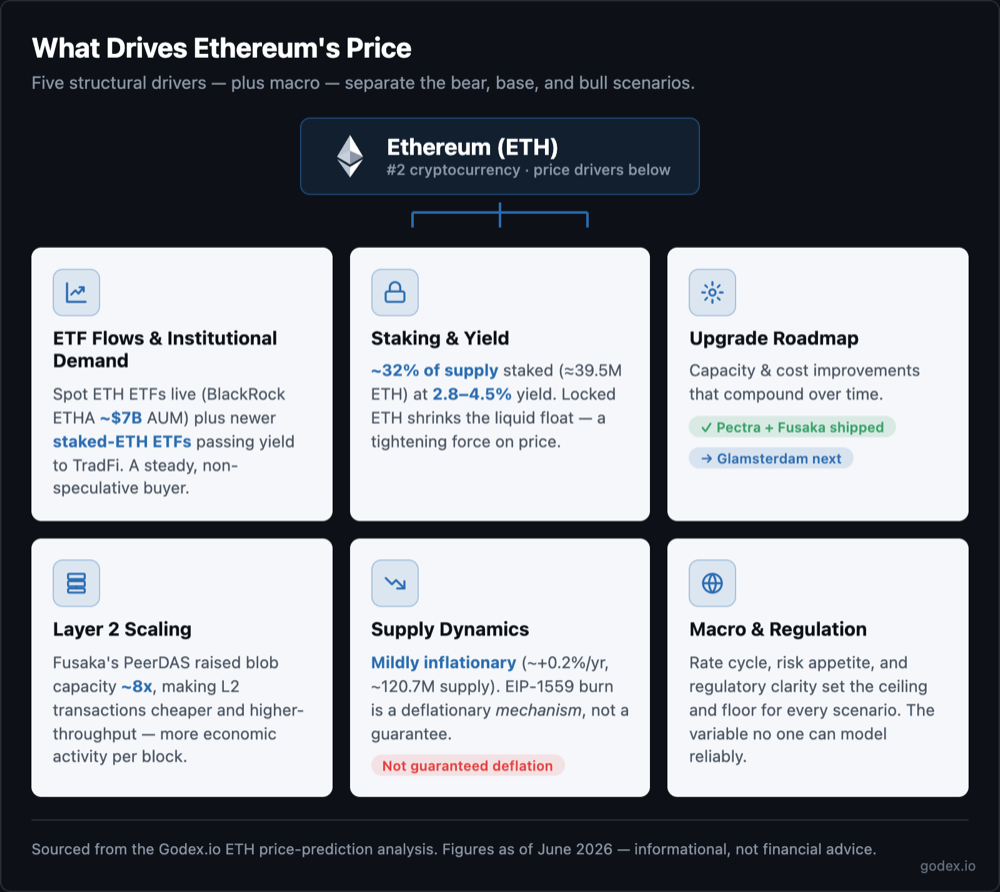
ETH’s price is not a mystery dial. Four structural drivers — plus macro — explain most of the move, and they are what separate the bear, base, and bull scenarios above.
ETF Flows and Institutional Demand
Spot Ethereum ETFs are live and material. BlackRock’s spot ETH product (ETHA) holds roughly $7 billion in assets under management. The newer development is staked-ETH ETFs: BlackRock’s iShares Staked Ethereum Trust ETF (organized November 2025, seeded January 2026) and Grayscale’s staking ETHE (around $1.4 billion) now pass staking yield through to traditional-finance investors. Institutional 13F filers holding ETH exposure rose about 66% quarter-over-quarter from Q4 2025 to Q1 2026. ETF demand adds a steady, non-speculative buyer to the order book — a structural change from previous cycles.
Staking and Yield
Staking means locking up ETH to help secure the network and earn rewards, a bit like earning interest on a deposit. Roughly 32% of all ETH — about 39.5 million coins — is staked, earning yields of approximately 2.8–4.5%. Staked ETH is locked out of immediate circulation, which reduces the liquid float (the supply freely available to sell). The staked-ETF wrappers extend that yield to investors who never touch a wallet, which broadens the buyer base. More staked supply plus more yield-seeking demand is, mechanically, a tightening force on price — though it does not override macro.
Supply Dynamics — Is ETH Still “Ultrasound Money”?
Here is where most forecast pages get it wrong. After the Merge and the EIP-1559 fee burn, ETH was marketed as “ultrasound money” — deflationary by design. That is not the situation in early 2026. ETH is mildly inflationary, at roughly +0.2% per year, with total supply around 120.7 million. Net supply has grown by approximately 950,000 ETH since the Merge.
The mechanism still works as designed: EIP-1559 burns a portion of transaction fees, and when network activity is high, the burn can exceed new issuance and turn ETH deflationary for stretches. But after Fusaka pushed more activity onto cheaper Layer 2 rollups, mainnet fee burn dropped, and issuance edged ahead. So the honest framing is: ETH has a deflationary mechanism, not a deflationary guarantee. Anyone selling you guaranteed deflation is selling 2022’s narrative.
The Upgrade Roadmap
Two major upgrades have already shipped. Pectra activated in May 2025, and Fusaka activated on December 3, 2025, introducing PeerDAS (sampled blob verification) and raising blob capacity roughly eightfold while lifting the L1 gas limit. The combined effect is cheaper, higher-throughput Layer 2 transactions — the scaling path Ethereum has committed to.
Next on the roadmap is Glamsterdam, targeted for roughly mid-2026 (Q2–Q3), which focuses on faster block processing and on-chain block building. Further out are Heze/Bogotá (targeted around end of 2026) and Verkle/stateless work on the longer horizon. The pattern matters for price: each upgrade that lowers cost and raises capacity strengthens the bull-case argument that ETH’s network can support far more economic activity than it does today.
Macro and Regulation
ETH does not trade in a vacuum. The rate environment, broad risk appetite, and regulatory clarity (or the lack of it) set the ceiling and floor for every scenario. A rate-cut cycle and clearer crypto rules tilt toward the base and bull cases; a prolonged risk-off environment tilts toward the bear. This is the variable nobody can model reliably — which is precisely why every figure here is a range.
Ethereum Price Prediction 2026–2028: The Near Term
Near-term forecasts carry the widest disagreement because they are most sensitive to macro. For 2026, bearish analysts cluster in the $1,400s to $2,500 band reflecting the current drawdown, while Standard Chartered’s base case targets roughly $4,000 by year-end and its high case stretches toward $7,500.
For 2027–2028, the base-case band rises to roughly $4,000–$8,000 across forecast models, with Standard Chartered’s reaffirmed path running $10,000 in 2027 and $18,000 in 2028, and Arthur Hayes (BitMEX co-founder) floating $10,000–$20,000 for ETH by around 2028 as the bull edge. The honest takeaway: the bear-to-bull spread for any near-term year is wide enough to drive a truck through. That is not evasion — it is what the data actually shows.
What Will Ethereum Be Worth in 2030?
Credible 2030 forecasts cluster in a base-case band of roughly $3,600–$8,500, with bears below it and one prominent institutional bull — Standard Chartered — projecting around $40,000. As always, these are scenario ranges from named sources, not a guarantee.
Over a five-year horizon, the drivers that compound matter more than this week’s price. Standard Chartered’s $40,000 case rests on ETH becoming the dominant settlement layer for tokenized real-world assets and stablecoins. The more conservative bands assume slower institutional adoption and stiffer competition from rival chains. The spread between $3,600 and $40,000 is, again, a measure of genuine uncertainty — not a hedge for its own sake.
Ethereum Price Prediction 2035 and 2040: The Long View
Decade-out forecasts are directional scenarios, not models — and any source quoting a 2040 price to the dollar is selling false precision. With that caveat: 2035 base-case extrapolations span roughly $10,000–$25,000, and 2040 estimates range from about $6,500 (conservative algorithmic aggregators) to $25,000–$56,000 (longer-range base/bull bands), up to a $100,000 outlier from Coinpedia.
That $100,000 figure is one optimistic model’s ceiling, built on the assumption that blockchain becomes core global financial infrastructure over 14 years. We cite it because it is part of the published spread — not because we endorse it. The further out the forecast, the more it reflects assumptions about technology, regulation, and the macro economy that no one can verify today.
Will Ethereum Reach $10,000?
A move to $10,000 sits within some analysts’ bull-case range for this cycle — notably Standard Chartered’s reaffirmed $10,000 target for 2027 and Arthur Hayes’ $10,000–$20,000 range by around 2028 — but it is well above the base-case estimates of roughly $3,200–$8,000 for the near term. It is possible in a specific scenario, not a prediction.
For ETH to reach $10,000, several conditions would likely need to hold at once: sustained spot and staked-ETF inflows, a tightening liquid supply as staking grows, a supportive macro backdrop (rate cuts, risk-on appetite), and continued progress on the scaling roadmap. Each is plausible. All four aligning is the bull case — which is exactly why $10,000 lives in the bull column of the table, not the base.
How High Can Ethereum Realistically Go by 2040?
The realistic long-range base-and-bull band runs from roughly $20,000 to $56,000 by 2040, with a single outlier (Coinpedia) at $100,000. The “realistic” word is doing real work here: these are not the same as the headline-grabbing numbers.
The difference between a $25,000 forecast and a $100,000 forecast is entirely in the assumptions. The higher figures assume ETH captures a large share of global tokenized finance, that staking locks up an ever-larger float, and that no competing chain or regulatory shock derails the thesis. The lower figures assume steadier, less dominant growth. Neither is wrong as a scenario — but understanding what has to be true for each is more useful than the number itself.
A note on near-term and day-trading queries: this is a long-horizon scenario piece, not a “what will ETH do tomorrow or this week” signals service. Short-term price calls are a different intent and a different risk profile, and we do not make them.
Is Ethereum a Good Investment in 2026?
Whether ETH is a good investment in 2026 depends entirely on your risk tolerance, time horizon, and thesis — and this article will not make that call for you. What it can do is lay out both sides honestly.
The bull thesis: ETH is the dominant smart-contract platform, now with spot and staked-ETF access for institutions, a roughly 2.8–4.5% staking yield, a maturing Layer 2 ecosystem, and a roadmap (Pectra and Fusaka shipped, Glamsterdam next) that keeps lowering cost and raising capacity. The ~60% drawdown means current prices are far below the 2025 high.
The bear/risk side: ETH is mildly inflationary today, faces real competition from rival smart-contract chains, carries regulatory uncertainty, and is volatile enough that a 60% drawdown happened inside a year. A low entry point is only attractive if the recovery thesis holds — and that is not guaranteed.
Both columns are real. We are not going to tell you which way to lean — see the disclaimer above, and do your own research.
How to Swap Into or Out of Ethereum Without KYC
ETH is one of the most-swapped assets in crypto, and a non-custodial, no-KYC swap is the practical way to act on either side of these scenarios without opening an account or tying your identity to the trade. If you want to move into ETH, you can swap BTC to ETH ; if the bear case has you wanting to step out of ETH into something steadier, you can swap ETH to a stablecoin like USDT . You keep control of your coins throughout, and a fixed-rate option lets you lock the rate for the duration of the swap so market movement during processing does not change what you receive.
Godex.io is a non-custodial instant cryptocurrency exchange operating since 2017. It supports 936+ coins, requires no registration or KYC at any transaction size, and offers both fixed-rate and floating-rate swap modes. Processing time is 5–30 minutes after the deposit is received.
For a wider view of where the market may head, see our broader crypto market outlook.
Frequently Asked Questions
Why is Ethereum down in 2026?
ETH is down roughly 60% from its August 2025 all-time high of about $4,954, trading near $1,800 in early June 2026. The decline reflects a post-peak cooldown, a tighter macro/rate environment that pressured risk assets broadly, and “Extreme Fear” sentiment that became self-reinforcing. It is a drawdown, not a single failure.
What will Ethereum be worth in 2030?
Credible 2030 forecasts cluster in a base-case band of roughly $3,600–$8,500, with bears below it and Standard Chartered projecting around $40,000 as an institutional bull case. These are scenario ranges from named analysts, not a guarantee, and depend on ETF flows, staking, scaling, and macro conditions over the horizon.
Will Ethereum reach $10,000?
It is possible in some bull-case scenarios for this cycle — Standard Chartered’s reaffirmed path reaches $10,000 by 2027 and Arthur Hayes has floated $10,000–$20,000 by around 2028 — but $10,000 is well above near-term base-case estimates of roughly $3,200–$8,000. Reaching it would require sustained ETF inflows, tightening supply, and a supportive macro backdrop. It is not a prediction.
Is Ethereum a good investment in 2026?
That depends on your risk tolerance and thesis, and this is not financial advice. The bull side cites ETF access, staking yield, ETH’s dominant platform position, and a ~60% discount from the 2025 high. The bear side cites mild inflation, chain competition, regulatory uncertainty, and volatility. Both are real — do your own research.
Is Ethereum still deflationary or “ultrasound money”?
No. As of early 2026, ETH is mildly inflationary at roughly +0.2% per year, with supply around 120.7 million and net supply up about 950,000 ETH since the Merge. EIP-1559 still burns fees and can turn ETH deflationary during high-activity stretches, but it is not guaranteed deflation.
Do ETFs and staking affect ETH’s price?
Yes. Spot ETH ETFs (such as BlackRock’s ETHA) and newer staked-ETH ETFs add a steady institutional buyer to the market, while roughly 32% of supply being staked (~39.5M ETH) reduces the liquid float available to sell. Both are structural, price-relevant forces — though neither overrides macro conditions.
What was Ethereum’s all-time high?
Ethereum’s all-time high was approximately $4,954, reached in August 2025. As of June 2026, ETH trades roughly 60% below that level.
Start a Cryptocurrency exchange
Try our crypto exchange platform
Disclaimer: Please keep in mind that the content of this article is not financial or investing advice. The information provided is the author’s opinion only and should not be considered as direct recommendations for trading or investment. Any article reader or website visitor should consider multiple viewpoints and become familiar with all local regulations before cryptocurrency investment. We do not make any warranties about reliability and accuracy of this information.
Read more
You may well think that an article dedicated to a Tether price prediction or the Tether price in general is a little bit strange — it is a stablecoin after all. However, the price of Tether does fluctuate significantly, although it is nowhere near as volatile as non-stablecoin cryptos. This means that staying up to […]
In the article we share our vision at Zcash cryptocurrency main features and add several price predictions. As cryptocurrencies gain global acceptance and decentralisation slowly enters our lives, privacy becomes the main concern when talking about blockchain adoption. It is no secret that distributed ledger is by far the most secure and transparent technology ever […]
Chiliz coin (CHZ) offers a compelling opportunity for traders interested in the intersection of blockchain technology and sports. By enabling fans to influence team decisions through the Socios app, Chiliz directly monetizes fan engagement and connects with major sports teams like Juventus and Paris Saint-Germain. These partnerships not only enhance the platform’s visibility but also […]
The exponential growth of Bitcoin Satoshi Vision (BSV) against the general bear trend on the cryptocurrency market in autumn 2019 has impressed the community. Due to the increasing market capitalization, the newly emerged altcoin was ranked 5th on CoinMarketCap and managed to maintain its high position at the beginning of 2020. In the article we […]
EOS is definitely on the list of the strongest and most stable projects in the crypto world. Despite the fact that the currency entered the market less than 3 years ago, it consistently occupies one of the top 10 places in the rating for project capitalization. it is often called the “main competitor of Ethereum”. […]
XRP price prediction 2026-2027: bear, base, and bull scenarios with ranges and named sources, the resolved SEC case, live spot ETFs, and can XRP reach $10?