
 Linda Larsen
Table of Contents
No one can tell you the exact price of any cryptocurrency in 2026 or 2027. What analysts can offer are scenario ranges built on macro conditions, ETF flows, regulation, and adoption narratives. This guide maps the 2026-2027 outlook for Bitcoin and the major altcoins as cited base, bull, and bear scenarios — not promises — and explains the forces driving them.
Last updated: June 2026.
The short version (TL;DR):
- Bitcoin 2026: analyst scenarios span roughly $70K–$180K — a wide spread because the outcome hinges on liquidity and ETF flows, not anyone’s crystal ball.
- Altcoin season: not here yet. Bitcoin still dominates ~56–58% of the market; a real rotation needs that below 55%.
- The big themes: regulation is getting clearer (GENIUS, CLARITY, MiCA), and money is concentrating in six narratives — tokenized real-world assets, stablecoins, AI x crypto, Layer 2 scaling, privacy, and prediction markets.
- Nobody knows the exact prices. Everything below is a cited third-party scenario — and not financial advice.
Not Financial Advice — How to Read This Outlook
This is not financial advice. Cryptocurrency markets are volatile and past performance does not indicate future results. Every number below is attributed to a named third party and dated; Godex makes no price calls of its own.
Throughout this article, projections appear as three scenarios: a base case (the assumption-neutral path most analysts treat as likely), a bull case (favorable macro and flows), and a bear case (tightening or a flow reversal). When a single source gives one number, it is labeled as that source’s view, not a consensus. Treat all of it as a map of what informed observers think could happen — not a forecast you can bank on.
The 2026 Macro Backdrop — Rates, Liquidity, and ETF Flows
The 2026 setup is modest growth plus sticky inflation plus slower central-bank easing than 2025, with liquidity as the swing factor and spot Bitcoin ETF inflows acting as a structural bid that quietly absorbs supply.
On the macro side, the mid-2026 picture is decelerating but positive global growth, inflation stubbornly above central-bank targets, and rate cuts arriving more slowly than markets priced in last year — with the US outperforming the EU and UK. According to Coinbase Institutional’s 2026 Crypto Market Outlook{target=”_blank” rel=”noopener”} and Kraken’s 2026 markets overview{target=”_blank” rel=”noopener”}, liquidity conditions — not any single catalyst — are the variable that most analysts expect to drive direction.
The structural story is the spot Bitcoin ETF bid. These funds have continued to absorb new supply at a pace that outstrips daily issuance, with exchange reserves sitting near multi-year lows — a supply-side tightness that did not exist in prior cycles.
None of this is a prediction in itself. It is the backdrop against which every coin scenario below plays out. A tightening liquidity environment compresses the bull cases; a renewed easing cycle expands them.
Will Bitcoin Go Up in 2026-2027? BTC Outlook and Scenarios
Most mainstream analyst scenarios for Bitcoin in 2026 cluster in a wide range — roughly $70,000 to $180,000 depending on the source and assumptions — with 2027 ranges generally running higher (around $120,000 to $200,000+ from major desks, with more aggressive outliers above). These are scenarios, not guarantees, and they diverge sharply on macro and flow assumptions.
The spread is the honest part. A 2026 range that runs from $70K to $180K is not a forecast — it is an admission that the outcome depends almost entirely on liquidity, ETF flows, and whether the regulatory tailwind holds. Here is how the named scenarios break down:
| Scenario | 2026 BTC range | Driver |
|---|---|---|
| Bull | Upper end / above $180K | Sustained ETF inflows, easing cycle resumes, regulatory clarity completes |
| Base | Mid-range (roughly $100K–$140K) | ETF bid offsets macro drag; range-bound to higher |
| Bear | Lower end / toward $70K | Liquidity tightens, flow reversal, risk-off macro |
These are generic analyst bands aggregated across major desk outlooks, not the published figure of any single firm.
A few points the bull-only blogs leave out. First, the halving-cycle supply mechanic that drove past runs is now partly priced through the ETF structure — the supply shock is real, but it competes with macro for control of the tape. Second, the bear case is not a fringe view: a flow reversal in the ETF complex, or a macro risk-off shock, is the scenario every serious desk models. According to Grayscale’s 2026 Digital Asset Outlook{target=”_blank” rel=”noopener”}, the institutional bid is the defining feature of this cycle — which cuts both ways, since institutional flows can leave as fast as they arrive.
If you want the full base/bull/bear breakdown with model-by-model assumptions, see Godex’s dedicated Bitcoin price prediction for 2026 and beyond.
Will There Be an Altcoin Season in 2026? Bitcoin Dominance and the Conditions
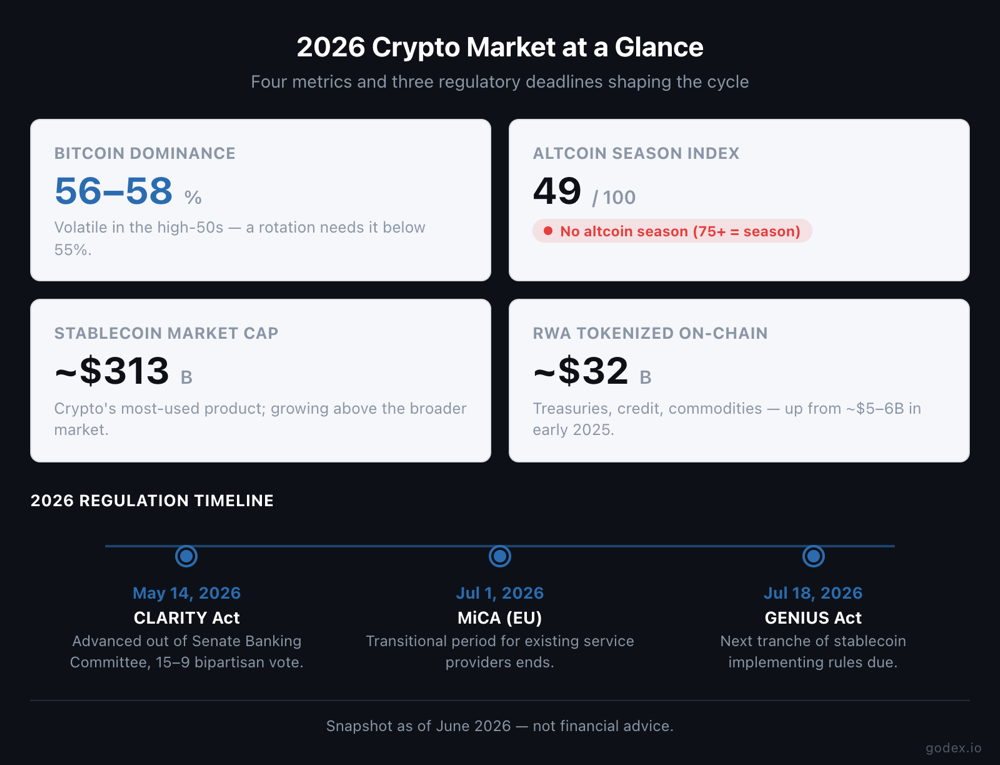
As of mid-2026, an altcoin season is not confirmed — the market is in a “probe” phase. Bitcoin dominance sits around 56–58%, and the Altcoin Season Index reads 49, well below the level that historically signals a broad rotation. A sustained altcoin season typically requires Bitcoin dominance falling and holding below 55%, an Altcoin Season Index above 75, and an expanding total altcoin market cap — none of which are firmly in place yet.
Bitcoin dominance is Bitcoin’s share of the total cryptocurrency market capitalization. When it falls, capital is rotating from Bitcoin into altcoins; when it rises, the reverse.
The Altcoin Season Index (Blockchain Center) measures the share of the top 50 altcoins that have outperformed Bitcoin over the last 90 days. A reading above 75 is the common threshold for declaring an “altcoin season.”
The conditions analysts watch, framed as a checklist:
- Bitcoin dominance breaking and holding lower. Sources tracking June 2026 conditions cite a sustained break below 55% as the trigger; dominance has been volatile in the high-50s rather than decisively rolling over.
- Altcoin Season Index above 75 — currently 49, per CoinMarketCap’s Altcoin Season Index{target=”_blank” rel=”noopener”}.
- An expanding total altcoin market cap, not just rotation within the alt complex.
Commentary from outlets including 24/7 Wall St.{target=”_blank” rel=”noopener”} and Coinpedia has tracked “early signs” across ETH, XRP, and SOL through 2026, but the data has not confirmed a full rotation. The honest read: the conditions are watch-list, not check-marked. If capital does rotate, the next section maps where the narratives point.
The 2026 Crypto Regulatory Landscape — GENIUS, CLARITY, and MiCA
Regulation is the defining crypto story of 2026. In the US, the GENIUS Act (stablecoins) has been law since July 18, 2025, with a further round of implementing rules due July 18, 2026, and the CLARITY Act / market-structure bill advanced out of the Senate Banking Committee in a 15-9 bipartisan vote on May 14, 2026. In the EU, MiCA’s transitional period ends July 1, 2026. The common direction is clearer rules for centralized, custodial venues.
GENIUS Act (stablecoins). Signed July 18, 2025, the GENIUS Act is the first comprehensive US federal framework for payment stablecoins. It directs regulators to issue additional rules on issuer licensing, reserves, custody, and anti-money-laundering provisions, with that next tranche due July 18, 2026, per DL News’s 2026 US crypto regulation calendar{target=”_blank” rel=”noopener”}.
CLARITY Act / market structure. The House passed the Digital Asset Market Clarity Act in July 2025; the bill then advanced out of the Senate Banking Committee in a 15-9 bipartisan vote on May 14, 2026, and now heads toward the Senate floor, with the White House targeting passage by summer. Alongside it, a March 17, 2026 joint SEC-CFTC interpretive release classifies 16 assets — including BTC, ETH, SOL, XRP, and LINK — as digital commodities rather than securities. This is an interpretive release, not statute, so the classification is an agency interpretation rather than settled law.
MiCA (EU). MiCA is fully in force, and its transitional period for existing crypto-asset service providers expires July 1, 2026. After that date, a firm without full MiCA authorization must wind down operations in the EU, with ESMA overseeing enforcement, per The Block’s 2026 regulation outlook{target=”_blank” rel=”noopener”}.
What this means in practice: the heaviest new obligations — licensing, KYC tiers, reserve and custody standards — fall on centralized, custodial exchanges that hold user funds and operate accounts. A non-custodial swap sits in a structurally different place. There is no account to create and no identity profile to file, because the model never takes custody of your funds in the first place. That is a description of how the architecture works, not a claim of regulatory exemption — “different legal framework” is not the same as “exempt.” If you want the distinction in detail, see Godex’s explainer on crypto exchanges that don’t require KYC.
This is general information, not legal advice. Verify the rules applicable to your location.
The Dominant Crypto Narratives for 2026-2027
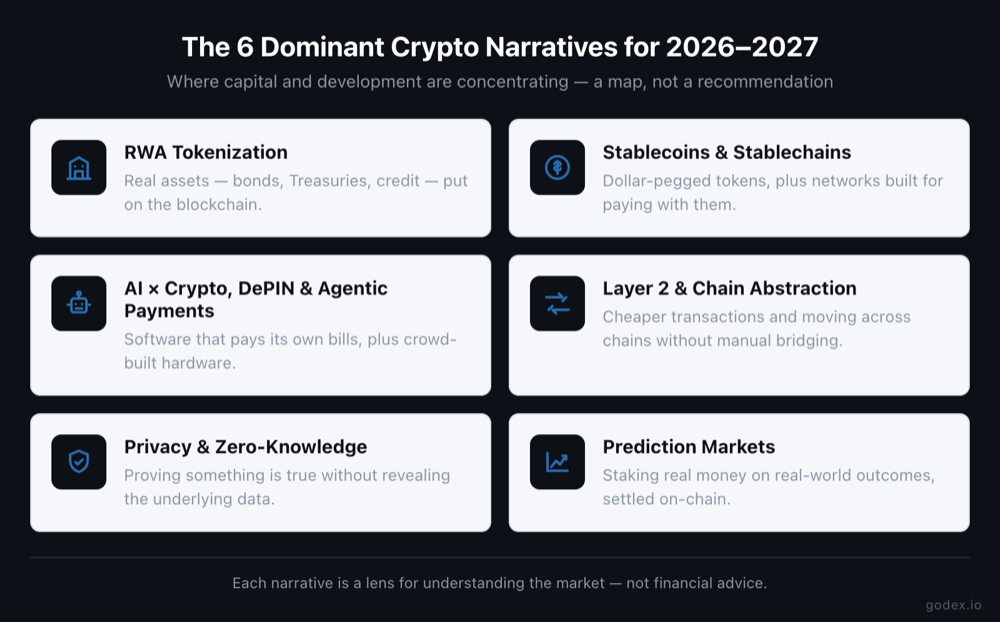
Between cycles, capital concentrates in narratives — the themes that decide where the next wave of money flows. Six are competing for attention in 2026-2027. Each is a lens for understanding the market, not a recommendation to buy anything.
Real-World Asset (RWA) Tokenization — real assets like bonds, put on the blockchain
Tokenized real-world assets — Treasuries, credit, commodities — have grown to roughly $32 billion on-chain by mid-2026, up from about $5–6 billion at the start of 2025, with the exact figure varying by methodology and whether stablecoins are counted. The story is institutional finance moving onto blockchain rails, with tokenized US Treasuries the largest single category. CoinGecko{target=”_blank” rel=”noopener”} and a16z crypto{target=”_blank” rel=”noopener”} both flag RWA as a defining 2026 trend.
Stablecoins and Stablechains
Stablecoins are the most-used product in crypto, with total market cap around $313 billion as of June 2026 (CoinGecko{target=”_blank” rel=”noopener”}) and growth running well above the broader market. The GENIUS Act gives US stablecoins a clearer legal footing, and “stablechains” — networks optimized for stablecoin payments — are an emerging sub-theme. Per a16z crypto, payments are the use case where stablecoins have found genuine product-market fit.
AI x Crypto, DePIN, and Agentic Payments — software that pays its own bills, and crowd-built hardware
The intersection of AI and crypto covers autonomous AI agents that hold and spend funds, decentralized physical infrastructure networks (DePIN — community-owned hardware like wireless hotspots or GPUs, paid for in tokens), and emerging agentic-payment standards such as x402 that let machines pay each other on-chain. The concrete version that grounds the buzzwords: Helium’s DePIN model already pays real-world hotspot operators for mobile coverage, and x402 — Coinbase’s HTTP-native payment standard revived in 2025 — lets an AI agent settle a per-call API charge in stablecoins without a human in the loop. CoinGecko lists this cluster among the top narratives for 2026. The token-level specifics remain speculative — the theme is the signal, not any single asset.
Layer 2 and Chain Abstraction
Scaling and user-experience friction remain unsolved at the edges. Layer 2 networks, modular blockchain designs, and “chain abstraction” — letting users transact across chains without manually bridging — are the 2026 answer. The thesis: whichever chains and L2s reduce friction most will capture activity. CoinGecko and Kraken both track this as a structural, not speculative, theme.
Privacy and Zero-Knowledge
Zero-knowledge cryptography has driven renewed attention to privacy in 2026, both for scaling (ZK rollups) and for transactional privacy. Privacy coins serve legitimate purposes — personal financial privacy, protection from data-breach exposure, and fungibility — and have drawn fresh interest as the technology matures. This ties directly to the Monero (XMR) outlook below.
Prediction Markets
Prediction markets moved from niche to mainstream demand signal in 2026, with platforms like Polymarket drawing significant volume and attention. Fortune{target=”_blank” rel=”noopener”} named the category among the themes to watch for the year. The signal: real money is being staked on real-world outcomes on-chain.
2026-2027 Outlook by Coin — Scenario Round-Up
Here is the one-line-per-coin map. Each links to a full Godex deep-dive for readers who want the model-by-model detail, and every range is a cited third-party scenario — never a Godex call. For the complete set, see all crypto price predictions.
Bitcoin (BTC). Covered in full above: 2026 scenarios span roughly $70K–$180K, with the ETF bid as the bull pillar and a flow reversal as the bear case. Full breakdown in the Bitcoin price prediction.
Ethereum (ETH). ETH is the anchor for two of the year’s biggest narratives — Layer 2 scaling and RWA tokenization — which is why some desks describe it as undervalued relative to the “institutional finance rails” thesis. The bear case is competition from faster L1s and execution risk on the roadmap. See the Ethereum price prediction for 2026 for cited ranges.
XRP (Ripple). XRP’s case rests on cross-border settlement and renewed institutional interest after its litigation overhang cleared, and it appears in the SEC-CFTC digital-commodity guidance. The bear case is that settlement adoption has been slow to convert into sustained demand. See the XRP price prediction for 2026 for the scenario ranges.
Solana (SOL). SOL’s bull case is throughput and network-activity expansion; the bear case is the network’s history of outages and security incidents, which remains a real risk to weigh. Cited scenario ranges are in the Solana price prediction for 2026.
Cardano (ADA). ADA’s story is its enterprise and interoperability pivot, with the honest caveat that price has consistently lagged development progress — a gap holders should price in. See the Cardano (ADA) price prediction for the full base/bull/bear view.
Monero (XMR). XMR sits at the center of the privacy/ZK narrative, and delistings from centralized exchanges have pushed liquidity toward non-custodial venues. Privacy coins have legitimate uses; the regulatory scrutiny is real and worth understanding. Cited ranges are in the Monero (XMR) prediction.
Ethereum Classic (ETC). ETC’s pitch is proof-of-work and a fixed supply cap — a “Bitcoin-like” thesis on a smart-contract chain — with the bear case being limited developer activity relative to its peers. See the Ethereum Classic (ETC) price prediction.
Chasing a narrative? Readers tracking RWA, AI/DePIN, or interoperability can follow those threads through long-tail outlooks for assets like ICP, HBAR, Quant (QNT), and AIOZ, or browse the full price predictions category.
How to Act on Any 2026-2027 Thesis Without KYC
Predictions are scenarios, not certainties — so the practical question is how you position. The part you control is execution: which assets you hold, and whether you lock your rate while the market moves. A non-custodial swap lets you rotate into whatever thesis you favor — RWA tokens, an L2, a privacy coin, or just more Bitcoin — without creating an account or handing over identity documents.
That matters more in a volatile, scenario-driven market than in a calm one. If your thesis is “rotate from BTC into ETH on a dominance break,” part of the execution risk is the rate moving against you between the moment you decide and the moment the swap settles. A fixed-rate option locks the quoted rate for the duration of the transaction, so the rate you see is the rate you get. Anonymity and a locked rate aren’t free — privacy and convenience carry a cost built into the quote, and that trade-off is worth weighing against what they’re worth to you. Non-custodial services like Godex — which has operated since 2017, supports 936+ coins, requires no registration or KYC at any volume, and offers both fixed-rate and floating-rate modes — let you act on any of these narratives directly. You can, for example, swap BTC to ETH the moment the setup you’re watching confirms.
Godex.io is a non-custodial instant cryptocurrency exchange operating since 2017. It supports 936+ coins, requires no registration or KYC at any transaction size, and offers both fixed-rate and floating-rate swap modes. Processing time is 5–30 minutes after deposit confirmation.
The point is not which narrative wins. It is that whichever one does, how you execute — anonymously, with the option to lock your quote while you act — is one part of the outcome you can actually control, regardless of whose forecast turns out right.
Frequently Asked Questions
What are the crypto predictions for 2026 and 2027?
There is no single number. Analyst scenarios for Bitcoin in 2026 span roughly $70,000 to $180,000, with 2027 ranges generally higher, and they diverge based on macro and ETF-flow assumptions. The thematic story is regulation (GENIUS, CLARITY, MiCA) plus six competing narratives: RWA tokenization, stablecoins, AI x crypto, Layer 2, privacy/ZK, and prediction markets. This is not financial advice.
Will Bitcoin go up in 2026?
Maybe — analysts cite 2026 scenario ranges of roughly $70,000 to $180,000, but the spread reflects genuine uncertainty, not consensus. The bull case rests on sustained spot-ETF inflows and a resumed easing cycle; the bear case on a liquidity tightening or a flow reversal. Both are mainstream views. No one can confirm the direction in advance.
Will there be an altcoin season in 2026?
Not confirmed as of mid-2026. The market is in a probe phase: Bitcoin dominance has hovered around 56–58% and the Altcoin Season Index reads 49, below the 75 threshold. A sustained altcoin season typically requires dominance breaking and holding below 55%, the index above 75, and an expanding total altcoin market cap — conditions that are on the watch-list, not checked off.
Which cryptocurrency will explode in 2026?
No one can name it honestly, and anyone who claims certainty is guessing. The more useful question is where capital is concentrating — the 2026-2027 narratives: RWA tokenization, stablecoins, AI x crypto and DePIN, Layer 2 and chain abstraction, privacy/ZK, and prediction markets. Those themes are where the money is rotating, not a single guaranteed winner.
What are the biggest crypto narratives for 2026?
Six dominate the 2026-2027 conversation: real-world asset (RWA) tokenization, stablecoins and stablechains, AI x crypto including DePIN and agentic payments, Layer 2 and chain abstraction, privacy and zero-knowledge, and prediction markets. Each is a lens for understanding where capital and development are concentrating between cycles — not a recommendation.
How will GENIUS, CLARITY, and MiCA affect crypto in 2026?
They bring clearer rules, mostly for centralized custodial venues. The GENIUS Act’s next implementing rules are due July 18, 2026; the CLARITY Act / market-structure bill advanced out of the Senate Banking Committee in a 15-9 bipartisan vote on May 14, 2026 and now heads toward the Senate floor; MiCA’s transitional period for EU service providers ends July 1, 2026. Non-custodial swaps sit in a structurally different place, but “different” is not “exempt.” This is general information, not legal advice.
Is now a good time to invest in crypto?
That depends on your thesis, time horizon, and risk tolerance — and this article cannot answer it for you. The honest framing is to decide what you believe about the macro backdrop and the narratives, size your exposure to what you can afford to lose, and control the part you actually control: how and when you position. This is not financial advice.
This is not financial advice. Cryptocurrency markets are volatile and past performance does not indicate future results. All figures are cited third-party scenarios, current as of June 2026; verify before acting.
Start a Cryptocurrency exchange
Try our crypto exchange platform
Disclaimer: Please keep in mind that the content of this article is not financial or investing advice. The information provided is the author’s opinion only and should not be considered as direct recommendations for trading or investment. Any article reader or website visitor should consider multiple viewpoints and become familiar with all local regulations before cryptocurrency investment. We do not make any warranties about reliability and accuracy of this information.
Read more
You may well think that an article dedicated to a Tether price prediction or the Tether price in general is a little bit strange — it is a stablecoin after all. However, the price of Tether does fluctuate significantly, although it is nowhere near as volatile as non-stablecoin cryptos. This means that staying up to […]
In the article we share our vision at Zcash cryptocurrency main features and add several price predictions. As cryptocurrencies gain global acceptance and decentralisation slowly enters our lives, privacy becomes the main concern when talking about blockchain adoption. It is no secret that distributed ledger is by far the most secure and transparent technology ever […]
Chiliz coin (CHZ) offers a compelling opportunity for traders interested in the intersection of blockchain technology and sports. By enabling fans to influence team decisions through the Socios app, Chiliz directly monetizes fan engagement and connects with major sports teams like Juventus and Paris Saint-Germain. These partnerships not only enhance the platform’s visibility but also […]
The exponential growth of Bitcoin Satoshi Vision (BSV) against the general bear trend on the cryptocurrency market in autumn 2019 has impressed the community. Due to the increasing market capitalization, the newly emerged altcoin was ranked 5th on CoinMarketCap and managed to maintain its high position at the beginning of 2020. In the article we […]
EOS is definitely on the list of the strongest and most stable projects in the crypto world. Despite the fact that the currency entered the market less than 3 years ago, it consistently occupies one of the top 10 places in the rating for project capitalization. it is often called the “main competitor of Ethereum”. […]
XRP price prediction 2026-2027: bear, base, and bull scenarios with ranges and named sources, the resolved SEC case, live spot ETFs, and can XRP reach $10?