
 Linda Larsen
Table of Contents
Converting Monero (XMR) to Tether (USDT) is straightforward when you use a wallet-to-wallet cryptocurrency swap. Instead of selling XMR for cash and buying a stablecoin again, you can exchange XMR directly for USDT in a single transaction. Most non-custodial swap services let you complete the process without creating an account, while allowing you to receive USDT directly into your own wallet — on the network you choose.

In this guide, you’ll learn how to convert XMR to USDT step by step, what you’ll need, how to choose the right USDT network so you don’t lose funds, how fixed and floating rates differ, how long it takes, what fees to expect, and the common mistakes to avoid.
Why Convert Monero to USDT?
To lock value in a dollar-pegged stablecoin or prepare to off-ramp. Monero (XMR) is a private, volatile asset; USDT is liquid and dollar-stable. Holders who want to freeze a gain in dollars, or stage funds before moving them to an exchange or bank, convert XMR to USDT to do it. That’s the honest motivation here — it’s a value-locking cash-out, not an investment call.
Monero and Tether also live on separate systems. Monero has its own private chain; USDT is a token issued on several public chains. So converting XMR to USDT is a cross-chain swap, not a wallet transfer — you can’t simply “move” Monero into a USDT wallet. Weighing whether to convert at all, or whether XMR is worth holding? That’s an investment question, not a how-to one — see the Monero outlook for that. This guide is the how.
One thing to plant up front, expanded in its own section below: Monero is private, but USDT is transparent — and freezable. Converting XMR to USDT does not carry Monero’s privacy across; it moves value onto an open, centrally-controlled ledger. That’s a fact worth knowing before you swap, not a reason not to.
Godex.io is a non-custodial instant cryptocurrency exchange operating since 2017. It supports 936+ coins, requires no registration or KYC at any transaction size, and offers both fixed-rate and floating-rate swap modes. Processing time is 5–30 minutes after deposit confirmation.
What You Need Before You Start
You need three things: the Monero you want to swap, a USDT wallet on the network you want, and a browser. No account, no email, no ID.
- Monero to swap — held in a Monero wallet you can send from (Cake Wallet, Feather, the official Monero GUI/CLI, or an exchange-managed XMR wallet).
- A USDT wallet that gives you a receiving address on a specific network — a TRC-20 wallet, an ERC-20 (Ethereum) wallet, or a Solana wallet. Most multi-chain wallets (for example, Trust Wallet, or a Ledger with the relevant network app) can hold USDT on several networks — just confirm yours supports the specific one you’ll receive on. USDT is multi-chain: the same “USDT” exists as separate tokens on separate networks, and the network you receive on must match your wallet.
- A browser — desktop or mobile works.
What you do not need: no account, no email, no phone number, no passport or selfie, and no upper volume cap — you can swap any amount. The swap itself is account-free; that’s an operational convenience, not a privacy claim (more on that below).
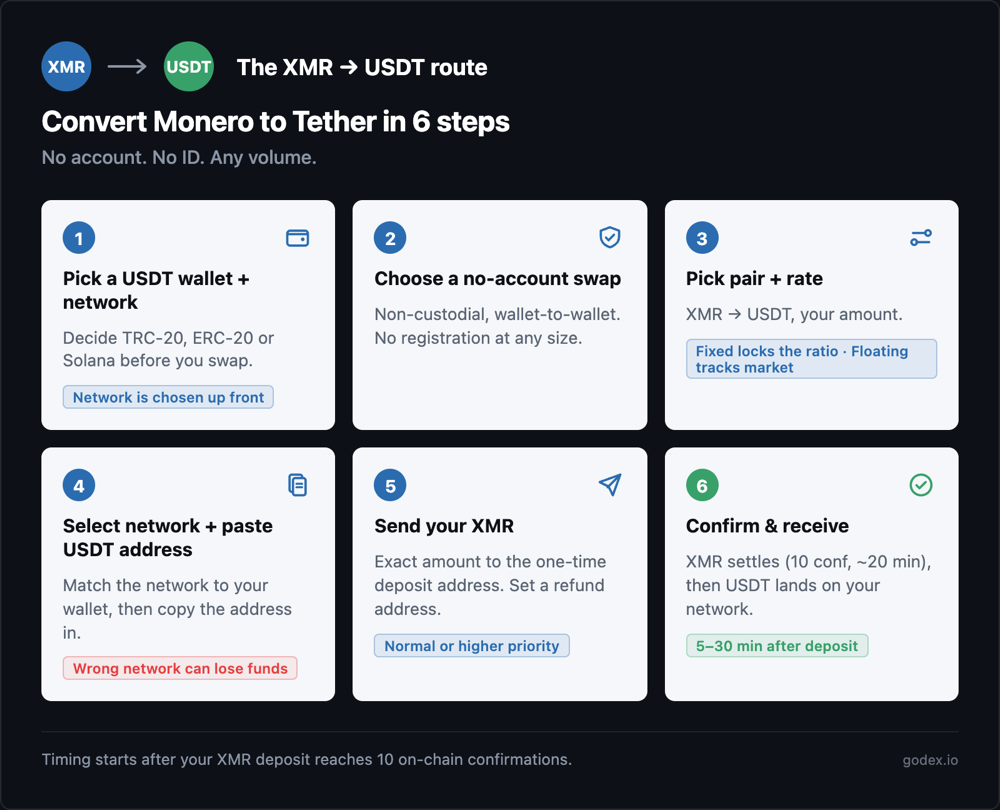
Step 1 — Pick a USDT Wallet and Decide the Network
Pick a USDT wallet you control and decide which network you want your USDT on before you swap — because your receiving wallet has to support that exact network. This is where the most important decision on this pair starts.
USDT is issued on multiple chains. The common ones for a cash-out:
- TRC-20 (Tron): lowest network fees and widely supported by exchanges — the common default for cash-outs.
- ERC-20 (Ethereum): the widest wallet and DeFi support; higher network fees.
- Solana (SPL): fast and low-fee — just confirm your downstream wallet or exchange supports it.
USDT also exists on BEP-20, TON, and Polygon, among others. The rule is simple: pick the network your receiving wallet — and any exchange you plan to send to next — actually supports. A non-custodial wallet means you hold the keys; no third party controls the funds. If you’re not sure which networks a token is issued on, Tether’s official network list is the reference.
Step 2 — Choose a Non-Custodial, No-Account Swap
Choose a non-custodial exchange that supports the XMR to USDT pair without registration. Godex.io is the path this guide uses: it has run since 2017 across 936+ coins, asks for no account or ID at any volume, and settles the swap wallet-to-wallet.
For this pair, “non-custodial, no-account” buys you something concrete: no identity attaches to the swap, no account to create, and no upper limit on the amount. You provide a receiving address; the exchange never holds your funds on a balance. That’s a convenience claim, and a true one — it does not make the USDT you receive private.
Before you start, make sure you’re actually on godex.io — bookmark it. (godex.pro is a known scam; the official platform is only at godex.io.)
Comparing providers first? See the top XMR to USDT exchanges for a side-by-side before you commit.
When you’re ready, swap XMR to USDT on Godex — that’s the page where this route happens. Prefer to see the screens first? Here’s the exact Godex walkthrough, step by step.
Step 3 — Select the Pair and Choose Fixed or Floating Rate
Set “you send” to XMR and “you get” to USDT, enter your amount, then choose your rate mode. Fixed rate locks the XMR/USDT ratio the moment you start — the USDT amount you see is the amount you receive, regardless of how the market moves while your deposit confirms. Floating rate moves with the market until the swap completes. Size doesn’t change the process — a large swap behaves exactly like a small one, with no extra verification triggered by the amount.
The swap shows a minimum XMR amount before it quotes — if you enter less, it won’t let you proceed. Note that minimum: you’ll need to send at least the quoted amount in Step 5. Sending below it manually is one of the ways a deposit fails on a no-account flow (see the refund-address note in Step 5).
Here’s the trade-off in practice:
- Fixed rate locks your quoted USDT amount and shields you from drift in the XMR/USDT ratio while the swap runs. You pay a small spread for that certainty. This matters most on larger swaps, where a few points of drift is real money.
- Floating rate stays exposed to market movement until the deposit confirms. It’s fine for small swaps, where a few minutes of drift is trivial.
One thing fixed rate does NOT do: wait forever. On Godex, a fixed-rate quote holds for 30 minutes — your XMR deposit has to arrive within 30 minutes of creating the transaction, or the swap may re-rate to the current floating rate. Monero’s ~20-minute, 10-confirmation settle eats most of that window, so this is not a formality on an XMR-input pair. The concrete rule: create the swap and send your XMR right away — within the first minute or two — and don’t fee-skimp on the send. A low-priority XMR transaction can sit in the mempool and confirm slowly, which is exactly how a fixed quote lapses. Send at normal or higher priority so your deposit confirms inside the 30-minute window. On this pair the deposit side is the slow leg, so “I chose fixed” only protects you if you move promptly.
Step 4 — Choose the USDT Network and Paste Your Receiving Address
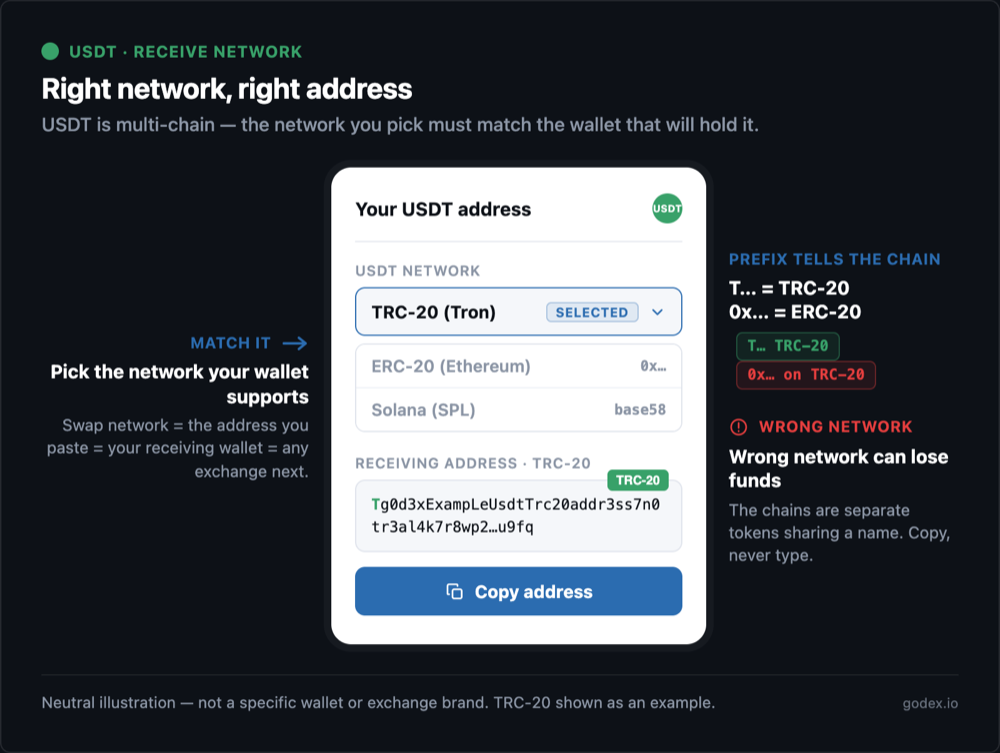
In the swap, select the USDT network that matches your receiving wallet — TRC-20, ERC-20, Solana, or whichever you chose in Step 1. Then open your USDT wallet, copy the receiving address for that exact network, and paste it into the swap’s USDT address field — then triple-check it. Use copy-paste or the QR code; never type a crypto address by hand.
This is the make-or-break step on this pair. USDT on TRC-20, ERC-20, and Solana are not interchangeable — they’re separate tokens on separate chains that happen to share a name. A TRC-20 address starts T…; an ERC-20 (and any EVM) address starts 0x…; a Solana address is a longer base58 string with no 0x prefix. The network you select in the swap must match the address you paste and the wallet that will hold it. Send USDT on a network your wallet doesn’t support and you can lose the funds permanently — this is the single most common way people lose money on this pair.
A few quick checks:
- Match the network everywhere. The network you select in the swap = the address you paste = your receiving wallet = any downstream exchange you’ll move to next. All four must agree.
- Copy, never type. A single mistyped character sends funds nowhere recoverable. Use the clipboard or scan the QR.
- Test small if this network/wallet combo is new to you. One small swap — at least the minimum XMR amount — confirms the whole route before you commit a large amount. Worth it specifically when the destination address or network is new, not on every routine swap.
- No memo or tag is needed for a standard USDT payout on TRC-20, ERC-20, or Solana in a wallet-to-wallet swap. Some exchange deposit addresses require a memo — if you’re sending onward to an exchange, check its requirements.
Step 5 — Send Your XMR to the One-Time Deposit Address
The exchange shows a one-time Monero deposit address for this specific swap. Open your Monero wallet (Cake Wallet, Feather, or the official GUI/CLI), send the exact XMR amount quoted to that address, and broadcast. The swap starts once your XMR deposit confirms on-chain.
- Always set an XMR refund address when prompted. On an account-free swap this is your only recovery path — there’s no account balance to fall back on. If the deposit fails (an underpayment below the minimum, an expired quote, or a network issue), your XMR is returned to this address. Skip it and a failed swap has nowhere to send your funds back. Don’t treat it as optional.
- Send at normal or higher priority. A low-fee XMR transaction can sit in the mempool and confirm slowly, which risks your fixed quote expiring inside the 30-minute window. Don’t cheap out on the send fee while a fixed quote is ticking.
- No memo or destination tag for the Monero send. Monero uses stealth addresses natively — every payment already goes to a one-time, unlinkable address on-chain — so there’s no separate memo or tag field the way XRP or XLM have. Leave any tag field blank.
- The deposit address is single-use and time-limited for this swap — don’t reuse it for a later one, and don’t get the address and send hours later. If you’ve been interrupted and waited too long, start a fresh swap rather than sending to a stale address.
- Send the exact amount quoted, and at least the minimum shown in Step 3. Under- or over-sending can delay the swap or trigger a re-rate.
Step 6 — Wait for Confirmations and Receive Your USDT
Monero locks each transaction for 10 confirmations — about 20 minutes at its ~2-minute block time — before the deposit is fully settled. The exchange then sends your USDT on the network you selected. On Godex the swap completes 5–30 minutes after the deposit is received.
Track the whole thing by transaction ID (txid) — no login needed — as the status moves through deposit received → exchanging → sending → complete. To verify on-chain, check the XMR deposit on a Monero block explorer, and the USDT arrival on the explorer for your chosen network — Tronscan for TRC-20, Etherscan for ERC-20, or a Solana explorer for SPL.
What’s normal versus stuck: Monero’s ~20-minute settle plus a quick USDT send means most swaps finish inside about 20–35 minutes. If the status hasn’t reached “exchanging” within ~30 minutes of your XMR getting its confirmations, or hasn’t completed within about an hour total, that’s the point to reach out — Godex support is available 24/7 and can step in with your txid.
How Long Does an XMR to USDT Swap Take?
An XMR to USDT swap usually completes in about 20–35 minutes. Monero requires 10 confirmations — roughly 20 minutes at its ~2-minute block time — to settle the deposit; then the USDT is sent on your chosen network. On Godex the swap completes 5–30 minutes after the deposit is received.
Monero’s 10-confirmation unlock is the main variable, and on this pair it’s the slow leg — an XMR deposit takes longer to settle than a fast-chain input would. The USDT send that follows is quick: TRC-20 and Solana settle in seconds, ERC-20 a little slower depending on network load. Always read swap timing as “after the deposit is received,” not from the moment you click start.
What Fees Should You Expect on an XMR to USDT Swap?
Two costs sit on an XMR to USDT swap, and neither is a separate up-front “swap fee”:
- The Monero network fee. When you send XMR to the deposit address, your wallet pays a small miner fee to the Monero network — not to the exchange. Monero fees are typically low, and your sending wallet sets the priority (which is why a normal-or-higher-priority send is worth it here — it confirms your deposit inside the fixed-rate window without costing much).
- The exchange’s spread. A non-custodial swap doesn’t bill a visible line-item fee — its margin is built into the rate you’re quoted. The “you get” USDT figure is already net of that spread, so what you see is what arrives. A fixed-rate quote carries a slightly wider spread than floating, because you’re paying for rate certainty while your deposit confirms.
One extra thing to know on this pair: the USDT payout network can carry its own cost. The network you receive on doesn’t change what Godex quotes, but it matters downstream — an ERC-20 payout can be costlier to move again later than a TRC-20 or Solana one, so pick the network that keeps your onward transfer cheap, not just the swap.
There’s no account fee, deposit fee, or withdrawal fee on a non-custodial wallet-to-wallet swap — you hold no balance to be charged on. Because a swap’s cost is baked into the rate rather than shown as a percentage, the figure that actually matters is the quoted “you get” amount: that’s your real, all-in result in a single number. Read that, not a headline fee.
Is USDT Anonymous Like Monero?
No. Monero is private — stealth addresses, ring signatures, and RingCT hide the sender, receiver, and amount on-chain. USDT is the opposite: a transparent token on public ledgers, issued and controlled by Tether Limited, which can freeze or blacklist any USDT address through a built-in addBlackList function. Converting XMR to USDT moves value from a private ledger onto a transparent, centrally-controlled one.
The numbers are public. Tether has blacklisted 7,200+ addresses and frozen roughly $4.2 billion in coordination with law enforcement over 2023–2025. What that means in practice: a non-custodial swap keeps the swap itself account-free, but it does not make your USDT private — the token you receive sits on an open, freezable ledger. That’s not a reason to avoid the swap; it’s a reason to plan your cash-out with clear eyes. Tether’s own transparency and enforcement pages document the freeze mechanism directly.
Common XMR to USDT Mistakes to Avoid
Most XMR to USDT losses come down to the network, the amount, or a misunderstanding of what USDT is — all avoidable.
- Choosing the wrong USDT network. The pasted address, the network you select in the swap, and your receiving wallet must all match (TRC-20
T…vs ERC-200x…). A mismatch can lose funds permanently — this is the big one. - Expecting USDT to be private. USDT is transparent and freezable; the swap is account-free, the token is not anonymous. Plan accordingly.
- Sending the wrong XMR amount. Under- or over-sending can delay or re-rate the swap; contact support with your txid.
- Not waiting out the 10-confirmation unlock. Monero deposits settle after ~10 confirmations (~20 minutes); the swap can’t complete before that. Slow isn’t stuck.
- Choosing floating on a large swap. Fixed locks the XMR/USDT ratio against movement during Monero’s ~20-minute confirmation window; on a big cash-out, that certainty is worth the spread.
- Not double-checking you’re on godex.io. godex.pro is a known scam. Bookmark the real one.
Frequently Asked Questions
Is it legal to convert Monero to USDT?
Yes, in most jurisdictions. Owning and swapping Monero and Tether is legal for individuals in the US, UK, and most countries — both are widely traded assets. Tax treatment varies: a crypto-to-crypto swap can be a taxable event where you live. Verify the rules for your own location before swapping.
Can I convert Monero to USDT without an account?
Yes. A non-custodial swap routes the trade wallet-to-wallet, so there’s no account, no balance held, and no ID. Godex requires no registration or KYC at any transaction size, including large swaps. You provide only your USDT receiving address on the network you chose. Note that the swap being account-free does not make the USDT itself private.
What wallet and network do I need to receive USDT?
Any USDT-capable wallet you control, on the network you choose — a TRC-20 (Tron), ERC-20 (Ethereum), or Solana wallet. Multi-chain wallets like Trust Wallet, or a Ledger with the relevant network app, hold USDT on several networks. Copy the receiving address for that exact network and paste it into the swap. The network you select must match your wallet, or the funds can be lost.
Fixed rate or floating rate for an XMR to USDT swap?
| Feature | Fixed Rate | Floating Rate |
|---|---|---|
| Exchange rate | Locked when you start the swap. | Changes with the market until the swap completes. |
| USDT received | Exactly the quoted amount (if the quote is still valid). | May be higher or lower than the initial estimate. |
| Best for | Larger swaps, given Monero’s ~20-min settle. | Small swaps or stable markets. |
| Cost | Slightly wider spread for price certainty. | Usually the current market rate. |
| Important note | Quote holds for 30 min on Godex — Monero’s ~20-min confirm eats most of it, so create the swap and send promptly at normal/higher priority. | No quote expiry, but the final USDT amount depends on market movement. |
How long does an XMR to USDT swap take?
About 20–35 minutes. Monero needs 10 confirmations — roughly 20 minutes at its ~2-minute block time — to settle the deposit, then the USDT is sent on your chosen network. On Godex the swap completes 5–30 minutes after the deposit is received. The Monero unlock is the main variable; the USDT send that follows is quick.
Can I swap any coin to USDT, or just Monero?
Any of 936+ supported coins. XMR to USDT is a common cash-out pair, but BTC to USDT, ETH to USDT, and others follow the identical flow: pick the pair, choose a rate, select your USDT network, paste the matching address, send the deposit, wait for confirmations. For the exact screens, see the Godex walkthrough.
What’s the difference between Monero and Tether?
Monero (XMR) is a private, decentralized cryptocurrency — stealth addresses, ring signatures, and RingCT hide the sender, receiver, and amount on-chain, and no company controls it. Tether (USDT) is the opposite: a transparent, dollar-pegged stablecoin issued and controlled by Tether Limited, which can freeze or blacklist any USDT address. They serve different jobs — XMR for privacy, USDT for dollar stability — and converting between them is a cross-chain swap.
Can I convert USDT back to Monero (USDT to XMR)?
Yes. The reverse works the same way: set “you send” to USDT and “you get” to XMR, select the USDT network you’re sending from, and paste a Monero receiving address. You can swap USDT to XMR on Godex directly, and our companion guide walks the whole route: how to change USDT to XMR.
What are the minimum and maximum amounts for an XMR to USDT swap?
There’s a small minimum XMR amount — a floor that varies by pair and rate — and the exchange shows the live figure before you confirm, so check it in the widget. There is no maximum: Godex places no upper cap, so any volume swaps the same way, with no extra verification triggered by size.
How many confirmations does an XMR to USDT swap need?
The swap starts once your Monero deposit reaches 10 on-chain confirmations — roughly 20 minutes at Monero’s ~2-minute block time. That’s Monero’s standard unlock window, and it’s the main reason an XMR-input swap takes longer to settle than a fast-chain deposit. Once confirmed, the USDT is sent on your chosen network.
Can I cancel or recover a failed XMR to USDT swap?
Before you send your XMR, nothing is committed — just close the swap. Once your XMR is on-chain and confirming, the swap can’t be cancelled; it will complete and send your USDT. If a deposit fails — below the minimum, or a quote that expired before confirmation — the funds return to the XMR refund address you set, which is why setting one matters. If anything stalls, 24/7 support can help using your txid.
Is converting Monero to USDT taxable?
It can be, depending on where you live. Many jurisdictions treat a crypto-to-crypto swap as a taxable disposal event, meaning a gain or loss may be reportable even though no fiat is involved. Rules vary widely by country. This isn’t tax advice — verify the treatment for your own location, and keep your txid as a record.
Does converting XMR to USDT affect who controls my funds?
During the swap, no — a non-custodial swap is wallet-to-wallet: you send from a Monero wallet you control and the USDT lands in a wallet you control. The exchange never holds your funds on a balance. But note what you now hold: USDT sits on a transparent ledger where Tether Limited can freeze an address, which Monero’s own chain cannot do. You hold the keys; the issuer holds a freeze switch.
Start a Cryptocurrency exchange
Try our crypto exchange platform
Disclaimer: Please keep in mind that the content of this article is not financial or investing advice. The information provided is the author’s opinion only and should not be considered as direct recommendations for trading or investment. Any article reader or website visitor should consider multiple viewpoints and become familiar with all local regulations before cryptocurrency investment. We do not make any warranties about reliability and accuracy of this information.
Read more
You may well think that an article dedicated to a Tether price prediction or the Tether price in general is a little bit strange — it is a stablecoin after all. However, the price of Tether does fluctuate significantly, although it is nowhere near as volatile as non-stablecoin cryptos. This means that staying up to […]
In the article we share our vision at Zcash cryptocurrency main features and add several price predictions. As cryptocurrencies gain global acceptance and decentralisation slowly enters our lives, privacy becomes the main concern when talking about blockchain adoption. It is no secret that distributed ledger is by far the most secure and transparent technology ever […]
Chiliz coin (CHZ) offers a compelling opportunity for traders interested in the intersection of blockchain technology and sports. By enabling fans to influence team decisions through the Socios app, Chiliz directly monetizes fan engagement and connects with major sports teams like Juventus and Paris Saint-Germain. These partnerships not only enhance the platform’s visibility but also […]
The exponential growth of Bitcoin Satoshi Vision (BSV) against the general bear trend on the cryptocurrency market in autumn 2019 has impressed the community. Due to the increasing market capitalization, the newly emerged altcoin was ranked 5th on CoinMarketCap and managed to maintain its high position at the beginning of 2020. In the article we […]
EOS is definitely on the list of the strongest and most stable projects in the crypto world. Despite the fact that the currency entered the market less than 3 years ago, it consistently occupies one of the top 10 places in the rating for project capitalization. it is often called the “main competitor of Ethereum”. […]
XRP price prediction 2026-2027: bear, base, and bull scenarios with ranges and named sources, the resolved SEC case, live spot ETFs, and can XRP reach $10?