
 Linda Larsen
Table of Contents
Both Godex and Changelly market themselves as no-KYC crypto exchanges. Only Godex is no-KYC at every transaction size. Changelly applies KYC verification at the EU AML threshold of €10,000 per transaction (as of April 2026) and on any account flagged by its internal risk assessment. This article compares the two platforms on KYC posture, rate stability, coin coverage, fees, and the use cases where each one is the right call.
This comparison is published on the Godex blog. Every claim about Changelly is sourced to Changelly’s own published policy or to third-party reviews. Verify independently before any large swap.
TL;DR — When Each Platform Makes Sense
Choose Godex if you:
– Need no-KYC at any volume (no €10K threshold, no risk-flag review)
– Want a fixed-rate option that locks the rate for the duration of the swap
– Trade privacy coins (XMR, ZEC, DASH) regularly
– Value 24/7 support and a multi-year operational record
Choose Changelly if you:
– Are doing small swaps (under €10K) where a lower advertised crypto-to-crypto fee matters more than KYC certainty
– Need a fiat on-ramp (buying crypto with a card)
– Want quotes integrated inside MetaMask, Trezor Suite, and other wallets
Both platforms are legitimate, multi-year operations. The decision is per-swap, not per-lifetime.
Godex vs Changelly at a Glance
The table below summarizes the structural differences. Godex sits in the first data column. Rows are ordered to surface the differentiators that matter most to a Segment A reader evaluating a non-trivial swap.
| Feature | Godex | Changelly |
|---|---|---|
| KYC at any volume | Unconditional — no threshold, no flag review | Conditional — €10K EU AML trigger, plus internal risk assessment |
| Fixed-rate option | Yes (fixed and floating both available) | Floating only |
| Volume cap | None | Documentation review at the €10K EU AML threshold |
| Privacy coin support (XMR, ZEC, DASH) | Full, operationally consistent | Available, but XMR pair availability has been intermittent |
| Coin coverage | 934+ | ~200+ headline (broader catalog via integrations) |
| Settlement time after deposit | 3–15 minutes | 5–40 minutes (per published rates) |
| Operating history | 9+ years (since 2017) | 11+ years (since 2015) — both multi-year |
| Crypto-to-crypto fee (BTC→ETH) | 1.67–2.14% all-in spread | 0.25% platform fee + LP spread (effective 0.75–1.75% on common routes) |
| Fiat on-ramp | No | Yes |
| Wallet integrations | Limited | Extensive (MetaMask, Trezor Suite, Ledger Live, others) |
| Account model | No account, no email, no profile | Optional account with order history |
| 24/7 support | Yes | Yes |
Data verified April 2026. Competitor policies and fees change — re-check before a large swap.
Godex.io is a non-custodial instant cryptocurrency exchange operating since 2017. It supports 934+ coins, requires no registration or KYC at any transaction size, and offers both fixed-rate and floating-rate swap modes. Processing time is 3–15 minutes after deposit confirmation.
Does Changelly Require KYC at Any Volume?
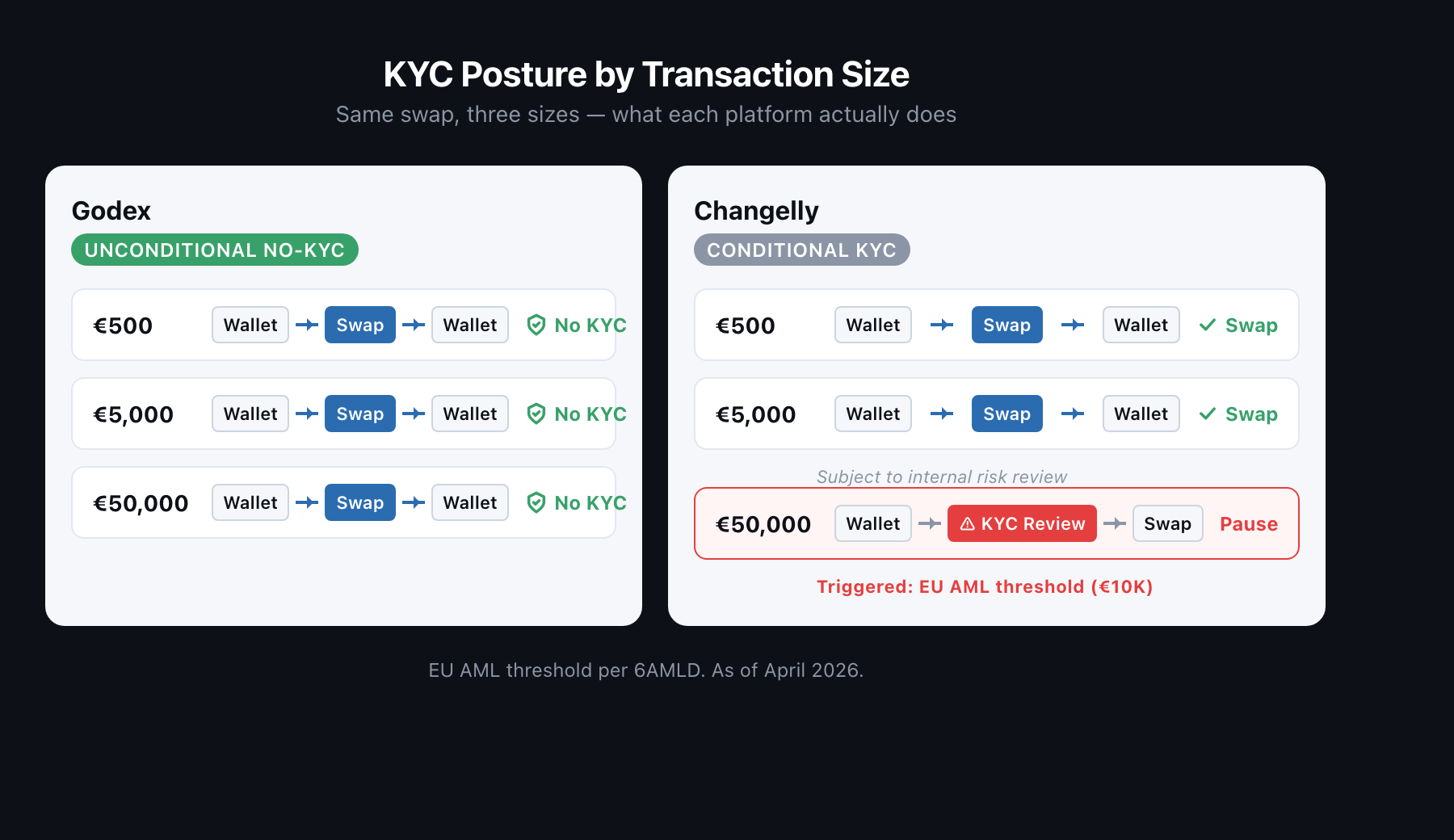
Yes, in two specific cases. Changelly enforces KYC verification on transactions at the EU AML threshold of €10,000 (as of April 2026) and on any account flagged by its internal risk assessment — a system Changelly publicly documents on its AML and KYC procedure page and its KYC FAQ. The €10K threshold derives from EU anti-money-laundering regulation, not from Changelly’s own choice — it is the cash-equivalent ceiling under 6AMLD that triggers customer due-diligence obligations across regulated EU services.
The trigger conditions Changelly publishes describe AML risk indicators: multiple accounts using disposable emails, deposits originating from mixers or coinjoin services, addresses on sanctioned lists, and “suspicious” activity patterns flagged by their internal review. These are the platform’s own words, not editorial framing.
Do multiple smaller swaps stack into a flag? Potentially yes — cumulative-volume tracking is a standard part of risk assessment on any account-based platform, and per-account aggregation can trigger review even when individual transactions sit below the per-transaction threshold. Changelly’s published policy is qualitative on stacking rules. If predictability matters, an account-less model removes the question entirely.
When a transaction is flagged, the user is asked to provide a government-issued photo ID, a selfie holding that ID, and — for some users — a source-of-funds declaration. Changelly’s documentation describes verification as “usually a few hours to a day.” Documented user complaints on third-party review platforms describe extended pending-review windows of one to several weeks (see, for example, this Trustpilot review of Changelly for a representative range of recent user experiences). The practical effect is that funds become inaccessible during that window.
Godex operates a structurally different model. There is no account on Godex — no email, no login, no profile that persists between swaps. Each swap is a one-off transaction with a deposit address generated for that swap, and order data is retained only for the period needed to support the swap and any post-swap customer service follow-up, then removed. There is no risk-scoring path because there is no persistent account to score. KYC is not requested at $1,000, $10,000, or $100,000.
The honest framing: both companies comply with the regulations they are subject to. Changelly is a registered service that processes fiat — which triggers AML and KYC obligations under MiCA and equivalent regimes. Godex’s model — non-custodial, crypto-only, no account, no fiat rail — sits outside the regulatory perimeter that triggers those obligations. This is structural, not aspirational. It is why Godex can credibly offer unconditional no-KYC and Changelly cannot.
For a deeper walkthrough of clean no-KYC swap methods, see our guide to exchanging crypto anonymously.
How Do Godex and Changelly Compare on Rate Stability?
Godex offers both fixed-rate and floating-rate swaps; Changelly is floating-rate only. For a user about to send a large or slow-confirming deposit, the fixed-rate option is the difference between a known outcome and exposure to whatever the market does in the next 30 to 60 minutes.
Fixed rate means the exchange rate is locked when the swap is initiated. Whatever Bitcoin does in the next 20 minutes while the deposit confirms, the user receives the exact ETH amount quoted. Floating rate means the rate is set at execution — market movement during confirmation is the user’s exposure, in either direction.
When the difference matters: Bitcoin-input swaps under network congestion (10–60 minute confirmation windows are routine), volatile pairs, large swaps where 1–2% of slippage equals meaningful dollars. Fixed rate eliminates the confirmation-window exposure entirely; the dollar math is worked in the fees section below. When it does not: small swaps on fast chains where confirmation is sub-minute and market movement during the swap is negligible.
Floating rate is not worse — it is a different bet. The asymmetry is that Godex offers both modes; Changelly offers only one.
How Do They Compare on Coin Coverage and Privacy Pairs?
Godex supports 934+ coins. Changelly’s headline catalog is around 200+ on its homepage, with a broader set available via wallet integrations. Both support major privacy coins (XMR, ZEC, DASH), but Godex’s broader catalog includes more long-tail privacy-adjacent assets and lesser-traded altcoins that have been delisted from larger venues.
A specific note on Monero: Changelly’s XMR pair availability has been intermittent over the past year — depending on LP routing, specific XMR pairs can disappear without notice. If a reliable Monero route matters, Godex’s privacy-coin support is operationally more consistent.
For the average reader swapping BTC, ETH, USDT, or any of the top 50 by market cap, coin coverage is effectively a tie. The difference shows up at the long tail — niche layer-1s, older altcoins, some privacy-coin forks.
For privacy pair context specifically — Monero swap routes, Zcash availability across U.S. and EU venues — see our overview of exchanges supporting Monero.
How Do They Compare on Volume Caps and Whale-Sized Swaps?
Godex has no volume cap and no tiered review threshold. Changelly’s KYC review system means swaps at the €10K EU AML threshold trigger documentation requests, and its internal risk assessment can flag any account at any size.
The practical effect at scale: a single $50,000 swap on Godex executes the same way a $500 swap executes — same flow, same deposit-address mechanic, same 3–15 minute settlement window, no per-account cumulative tracking because there is no account. A single $50,000 swap on Changelly that crosses the threshold enters review, and access to the funds in flight is paused while the documentation request is processed.
For readers who may move size on a specific schedule — estate planning, tax-year position cleanup, large rebalances after a thesis change — the operational difference matters more than the fee differential. Spending a week answering compliance questions to unfreeze a swap is a worse outcome than paying a higher spread to skip the queue entirely. There is no risk-scoring path on Godex because there is no persistent account to score — the operational reality of a swap engine with no user database.
How Do Their Fees Compare?
Changelly’s advertised crypto-to-crypto fee is 0.25%, which is genuinely lower than Godex’s spread on most pairs. Godex’s effective fee on a BTC→ETH swap is 1.67–2.14% depending on size, per Godex’s own published rate data. For a small swap of a familiar pair where fixed-rate certainty does not matter, Changelly’s lower advertised fee is a real win.
One important qualification: Changelly’s 0.25% is a platform fee layered on top of liquidity-provider spreads. The user’s effective all-in cost on common retail crypto-to-crypto routes is typically 0.75–1.75% per third-party comparisons, not the 0.25% headline. The Godex–Changelly cost gap is meaningful but not order-of-magnitude.
Worked example — same-day $10,000 BTC→ETH (representative quote, market-dependent):
- Godex: 1.67–2.14% all-in spread = roughly $167–$214 in cost. Fixed-rate option locks the receive amount when the swap is initiated.
- Changelly: 0.25% platform fee + LP spread (typical effective range 0.75–1.75%) = roughly $75–$175 in cost. Floating rate — the receive amount is set at execution, after the deposit confirms.
On a 2 BTC swap at $85,000, a 3% market swing during a 10–60 minute Bitcoin confirmation is $5,100. That exposure is the cost a floating-rate user is implicitly carrying — and it dwarfs the $100–$200 fee differential between the two platforms at that size.
The honest framing for a privacy-conscious user is total cost of swap, not the headline fee. The Godex bundle: 1.67–2.14% all-in spread, plus unconditional no-KYC at any volume, plus fixed-rate certainty, plus no risk-flag review, plus limited order-data retention. The Changelly bundle: 0.25% platform fee plus LP spread, plus conditional KYC risk at the €10K EU AML threshold or on flagged accounts, plus floating-rate exposure during confirmation, plus a fiat on-ramp (5% fee) if needed.
For a $200 swap on a familiar pair, Changelly’s lower fee almost always wins — bundled risks are negligible at that size. For a $20K privacy-pair swap on a slow-confirming chain, the bundle math favors Godex: the fixed rate alone can be worth more than the entire fee differential, and the absence of a risk-flag pathway removes a real operational risk. The fee question is not “who is cheaper” but “what am I buying with the fee.”
Verdict — Which Should You Use?
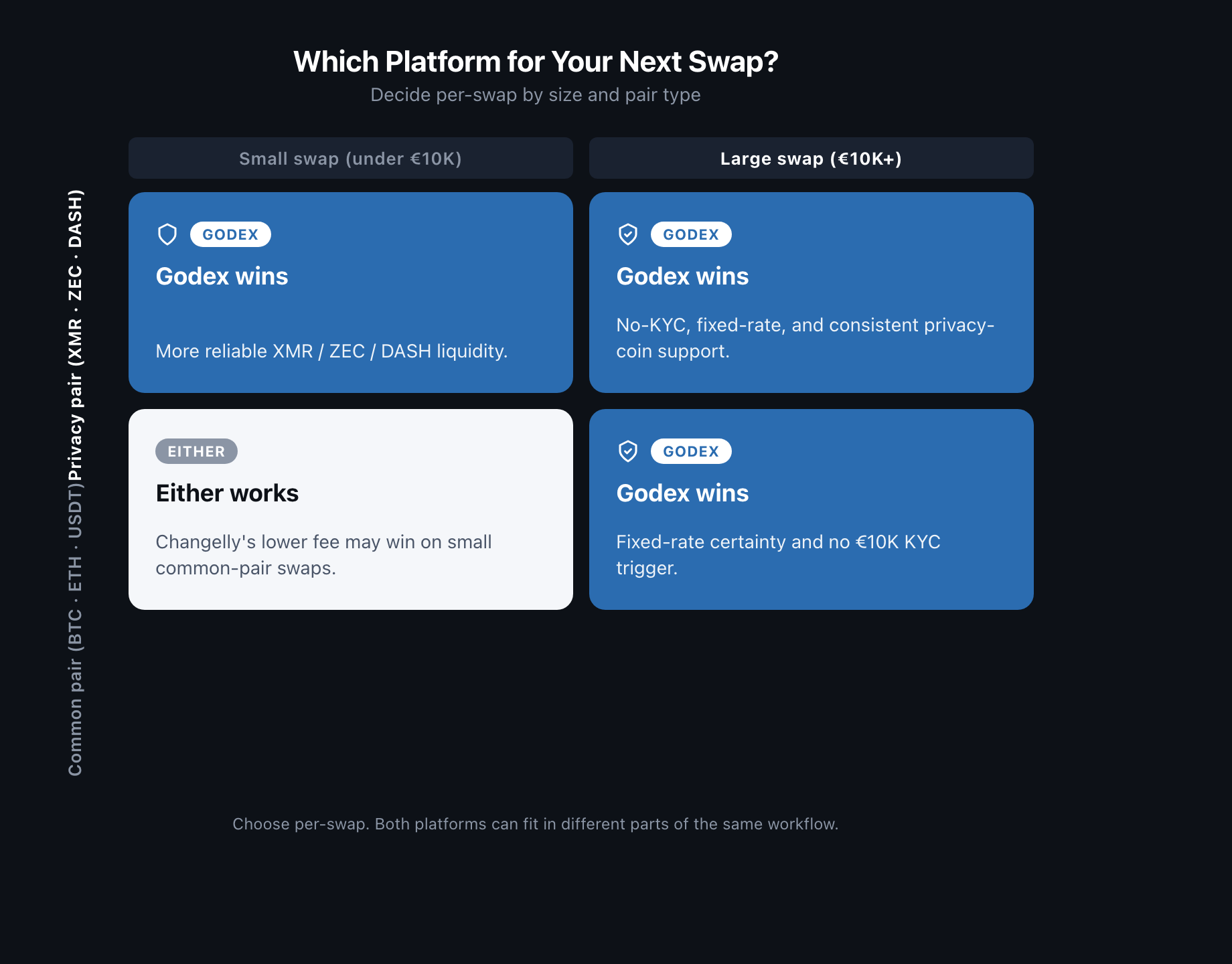
Use Godex if any of: (a) you may swap at or above the €10K EU AML threshold now or in future, (b) you want fixed-rate certainty during slow confirmations, (c) you trade privacy coins regularly, (d) you do not want a risk-assessment path in the swap, (e) you value the operational simplicity of having no account that can be flagged, frozen, or required to verify.
If your next swap fits the Godex profile — large, fixed-rate, privacy-pair, or any combination — start it on godex.io. Pick the pair, lock the rate, send the deposit. Run a swap on Godex for whichever pair you need.
Use Changelly if you are a small-volume crypto-to-crypto trader of familiar pairs and the lower advertised 0.25% fee matters more to your math than the conditional KYC exposure — and you understand the conditional pieces of the no-KYC promise.
Use both. Plenty of users do. Changelly for small swaps inside their wallet’s native quote interface; Godex for large, fixed-rate, or privacy-coin swaps. They cover overlapping but distinct jobs, and there is no rule that picks one platform forever. The decision is per-swap.
For readers exploring the broader landscape, see our guide to Changelly alternatives and the step-by-step Godex how-to.
A practical note on official domains: godex.io is the only official Godex domain. Domains like godex.pro have been confirmed as scams — verify the URL before sending any deposit.
Frequently Asked Questions
Does Changelly require KYC?
Changelly does not require KYC for typical small crypto-to-crypto swaps. Verification is enforced on transactions at the €10,000 EU AML threshold and on any account flagged by Changelly’s internal risk assessment — including accounts using disposable emails, deposits from mixers, or addresses on sanctioned lists. This is documented in Changelly’s official AML and KYC policy.
What is the KYC limit on Changelly?
The threshold is €10,000 per transaction (as of April 2026), derived from EU anti-money-laundering regulation rather than from Changelly’s own choice. Risk-flagged accounts may trigger verification at lower amounts depending on the activity pattern that produced the flag.
Do multiple smaller swaps on Changelly stack into a KYC flag?
Potentially yes. Cumulative-volume tracking is a standard component of risk assessment on any account-based platform — per-account aggregation can trigger review even when individual transactions are below the per-transaction threshold. Changelly’s published policy describes risk indicators in qualitative language and does not commit to a specific stacking rule. If you swap $5K–$20K monthly on a single account, treat any pattern approaching the €10K line as potentially aggregable.
Is Godex no-KYC at any volume?
Yes. Godex has no transaction-size threshold and no account-level risk assessment. A $1,000 swap and a $100,000 swap follow the same flow. The structural reason is that Godex has no account model — no email, no login, no profile — so there is no persistent identity for any risk system to evaluate.
Is Changelly safer than Godex?
Both are legitimate, multi-year operations — Changelly since 2015, Godex since 2017. The difference is structural: Changelly is a registered service with KYC and AML obligations; Godex’s non-custodial, crypto-only, account-less model sits outside that regulatory perimeter. “Safer” depends on what a user is optimizing for: regulatory legitimacy (Changelly’s strength) or unconditional access and privacy (Godex’s).
Can I use Changelly without ID for crypto-to-crypto swaps?
In most cases, yes — but the no-ID guarantee is conditional. The conditions are: the transaction is below the €10,000 EU AML threshold, and Changelly’s internal risk assessment does not flag the swap or the account. For users who satisfy both conditions, Changelly processes crypto-to-crypto swaps without identity verification. For users who do not, KYC is requested.
What is the fastest way to swap BTC to XMR without KYC?
A direct swap via Godex is the standard answer: fixed-rate option, unconditional no-KYC, 3–15 minute settlement after deposit confirmation, and full Monero pair coverage. For users new to Monero swaps, see the step-by-step Godex how-to and the Monero exchange overview.
Start a Cryptocurrency exchange
Try our crypto exchange platform
Disclaimer: Please keep in mind that the content of this article is not financial or investing advice. The information provided is the author’s opinion only and should not be considered as direct recommendations for trading or investment. Any article reader or website visitor should consider multiple viewpoints and become familiar with all local regulations before cryptocurrency investment. We do not make any warranties about reliability and accuracy of this information.
Read more
XRP price prediction 2026-2027: bear, base, and bull scenarios with ranges and named sources, the resolved SEC case, live spot ETFs, and can XRP reach $10?
In this article we will talk about Ripple (XRP) and its price prediction. What is Ripple (XRP) Ripple is a San Francisco-based startup that was launched in 2012 by Ripple Labs as a global network both for cross-currency and gross payments. Ripple history began in 2004 with the discussions around the digital coin in the […]
You may well think that an article dedicated to a Tether price prediction or the Tether price in general is a little bit strange — it is a stablecoin after all. However, the price of Tether does fluctuate significantly, although it is nowhere near as volatile as non-stablecoin cryptos. This means that staying up to […]
In the article we share our vision at Zcash cryptocurrency main features and add several price predictions. As cryptocurrencies gain global acceptance and decentralisation slowly enters our lives, privacy becomes the main concern when talking about blockchain adoption. It is no secret that distributed ledger is by far the most secure and transparent technology ever […]
Chiliz coin (CHZ) offers a compelling opportunity for traders interested in the intersection of blockchain technology and sports. By enabling fans to influence team decisions through the Socios app, Chiliz directly monetizes fan engagement and connects with major sports teams like Juventus and Paris Saint-Germain. These partnerships not only enhance the platform’s visibility but also […]
The exponential growth of Bitcoin Satoshi Vision (BSV) against the general bear trend on the cryptocurrency market in autumn 2019 has impressed the community. Due to the increasing market capitalization, the newly emerged altcoin was ranked 5th on CoinMarketCap and managed to maintain its high position at the beginning of 2020. In the article we […]