
 Alex Tamm
Table of Contents
The US Monero buying landscape in 2026 is narrower than it used to be and easier to navigate honestly than most articles admit. Binance completed its global XMR delisting in February 2024. Kraken halted Monero for European clients at the end of October 2024 and has continued trimming coverage elsewhere. The total count of XMR exchange delistings hit 73 across calendar year 2025 alone. If you searched “where to buy Monero in the USA” two years ago and read the first article that came up, half the platforms it recommended are no longer in business or no longer support XMR.
This is the rewrite. It’s current as of April 2026, it’s honest about what actually still works, and it skips the part most articles still do where they list ten exchanges and pretend they’re all equally good. They’re not. For the vast majority of US users in 2026, the practical answer to “where do I buy Monero” is no longer “find the best US-friendly centralized exchange.” It’s “use a non-custodial swap from any crypto you already hold.” We’ll cover the centralized options too, with honest caveats, but the order of the article reflects the order of what we’d actually recommend.
The 2026 Reality for US XMR Buyers
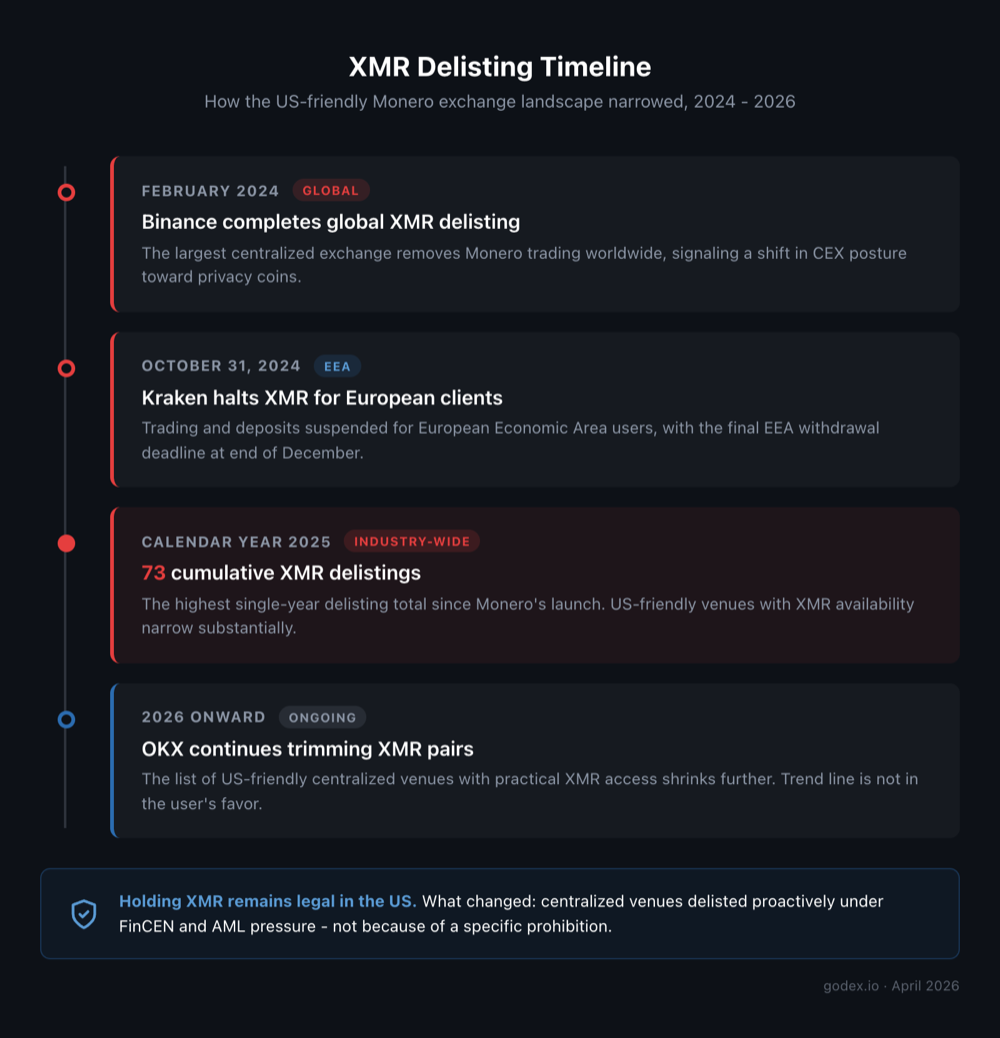
A quick chronology so the rest of the article makes sense:
- February 2024 — Binance completed its global XMR delisting.
- October 31, 2024 — Kraken halted XMR trading and deposits for European Economic Area clients, with the final EEA withdrawal deadline at the end of December.
- 2025 — 73 cumulative XMR delistings across the industry, the highest single-year total since the asset’s launch.
- 2026 onward — OKX has continued trimming pairs; the list of US-friendly venues with XMR has narrowed substantially.
The US-specific situation: there is no federal law that makes holding Monero illegal for US individuals. The asset is legal to own, legal to send, and legal to receive. What changed is that US-facing centralized exchanges have largely delisted XMR proactively under FinCEN and AML pressure, not because of a specific prohibition. The regulatory direction is unmistakable, but the legal status of the asset for the user is unchanged.
The framing for the rest of this article: it is not a list of “best exchanges.” It’s a list of methods that still work for a US user in 2026, ranked roughly by friction and privacy.
Method 1 — Non-Custodial Instant Swap (the recommended path for most users)
If you already hold any cryptocurrency — Bitcoin, Ethereum, USDT, almost anything — this is the simplest way to acquire XMR in 2026. The model: you send one crypto to a swap service, the service exchanges it at the current market rate, and you receive XMR at a Monero wallet address you control. No account creation. No KYC. No identity profile stored anywhere. The service never custodies your funds in any meaningful sense — they pass through.
The reasons this category is the recommended path for US users specifically:
- No account creation means nothing to KYC, nothing to subpoena, nothing to freeze
- No fiat banking system involved means no bank record of the purchase
- The service has no balance sitting in your name on its books
- Transactions complete in minutes instead of the hours-to-days timeline of fiat on-ramps
- Pair coverage is broader than any other non-KYC method
Godex.io is one of these services and remains available to US users in 2026. The specifics worth knowing:
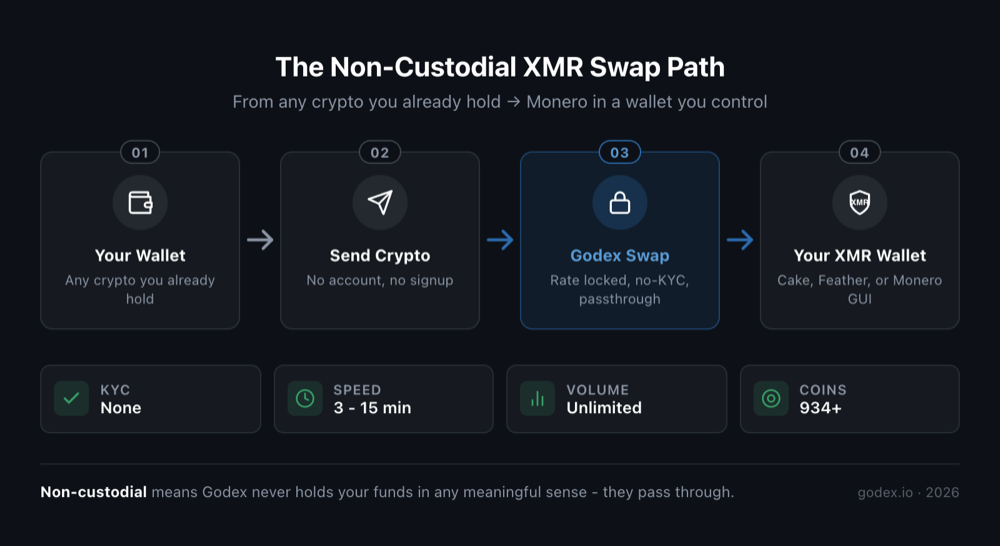
- 934+ supported coins including XMR. Almost any pair you might want.
- Fixed-rate option locks the exchange rate at the moment you initiate the swap, for the full duration. No slippage risk if the market moves while your transaction is confirming. This matters more for XMR than for most assets because XMR’s order books have thinned with the delistings, which means floating-rate execution can be unpleasant.
- No volume caps. The same anonymity profile applies whether you’re swapping $200 or $200,000. There is no tiered KYC trigger that activates above a threshold.
- Unconditional no-KYC. Worth saying twice — not “no-KYC up to $X.” No KYC, period.
- Processing time: 3 to 15 minutes after the deposit confirms on-chain.
- Operating history: since approximately 2017. A multi-year track record matters in a category where venues come and go.
- 24/7 customer support for the cases where something needs a human.
The honest tradeoff: the service sees the on-chain footprint of the transaction (input address, output address, amount). It does not see you — there’s no name attached to those addresses on Godex’s side — but the on-chain trail exists. Combine the swap with operational privacy practices (wallet separation, network privacy) for a stronger result. Combine it with a freshly generated XMR receiving address, and the result is solid.
There are several other services in this category — ChangeNOW, SimpleSwap, StealthEX, FixedFloat, Exolix. They differ in coin selection, rate model, and operating history. Godex’s distinguishing features are the fixed-rate availability across pairs (uncommon at the size of the supported asset list), the unconditional no-KYC posture at any volume (most competitors KYC above some threshold), and the longest operating history in the category. For most US users wanting XMR without an account, this is the obvious starting point.
Method 2 — Offshore Centralized Exchanges
The CEX path still exists for US users, but it’s narrower and more conditional than it used to be. The platforms worth knowing:
KuCoin has continued to support Monero through the 2024–2025 delisting wave and is the most-cited centralized venue for XMR in 2026. Under 2026 policies, KuCoin requires Level 2 verification for privacy coin withdrawals, which is a meaningful change from earlier years and worth understanding before depositing. KuCoin’s US accessibility is conditional — the platform has restricted services for US users repeatedly over the years. Verify your specific situation before relying on it.
MEXC maintains XMR/USDT pairs with deep liquidity and is one of the more practical centralized options for users who want spot trading rather than swap. MEXC operates without forcing KYC up to a daily withdrawal cap (currently around 20 BTC equivalent per 24 hours without KYC). US users can register, but the regulatory posture for US-facing operations is restrictive and the platform’s specific guidance can change.
CoinEx still lists XMR pairs and operates in jurisdictions where many competitors have exited.
Bitfinex, Gate.io, Poloniex — varies. Pair availability changes month to month. Verify before sending funds to any of them.
The honest caveats for US users using offshore CEXs:
- These are offshore venues from a US regulatory perspective. They are not the same legal vehicle as a Coinbase or a Kraken with a US license.
- Pair availability and US accessibility can change without notice. The same exchange that lists XMR today may not in a quarter.
- KYC requirements vary by withdrawal amount, by region, and over time. The “no-KYC up to X” thresholds at any specific platform are subject to change.
- Custody risk is real. Don’t park funds on any of these venues. Buy, withdraw immediately, and self-custody.
- The IRS expects reporting of crypto transactions regardless of where they happened. Using an offshore venue does not change your tax obligations.
For some users — those who want a spot order book, larger trade sizes, or specific pair access not available elsewhere — the offshore CEX route is still the right call. For most, it’s a heavier path than the non-custodial swap above with no meaningful privacy advantage.
Method 3 — Atomic Swap DEX (Haveno)
If you want to remove the swap service from the equation entirely, atomic swaps are the structural answer for BTC↔XMR.
Haveno is the Tor-native decentralized exchange that emerged as the spiritual successor to LocalMonero (which shut down in November 2024). It uses cryptographic locks (HTLCs) to enable two parties to trade BTC and XMR directly, with no intermediary holding either side. The trade is atomic — either both sides complete or both revert. No trusted third party. No central operator. The exchange runs on Tor by default.
The advantages: maximum trustless execution, very high privacy ceiling, no central operator that can be subpoenaed or fail, no KYC ever.
The tradeoffs: steeper learning curve, smaller liquidity than instant swap services, slower settlement times, requires installing client software, and the Tor experience is unfamiliar to many users.
Best for: technically comfortable users who want maximum privacy and decentralization, particularly for BTC→XMR or XMR→BTC trades.
Method 4 — Peer-to-Peer
P2P is the option for users who want to acquire XMR with fiat without involving a bank link, or who want fully person-to-person trade for any reason.
Bisq is the most established option in 2026 — a decentralized P2P platform with multi-sig escrow that handles both crypto-to-crypto and fiat-to-crypto trades. It is not a company; it’s a protocol with a desktop client. Trades happen between individual users; Bisq enforces escrow and dispute resolution via the protocol, not via a central operator that could be compelled to identify users.
Hodl Hodl offers non-custodial multi-sig escrow primarily for Bitcoin, with some XMR availability. Web-based interface, less decentralized than Bisq.
The tradeoffs for P2P: lower liquidity than centralized or instant swap options, slower settlement that depends on the payment method used, counterparty selection matters, and the learning curve is real for first-time users.
Best for: users acquiring XMR with fiat without a bank-linked path, or experienced users who want fully person-to-person execution.
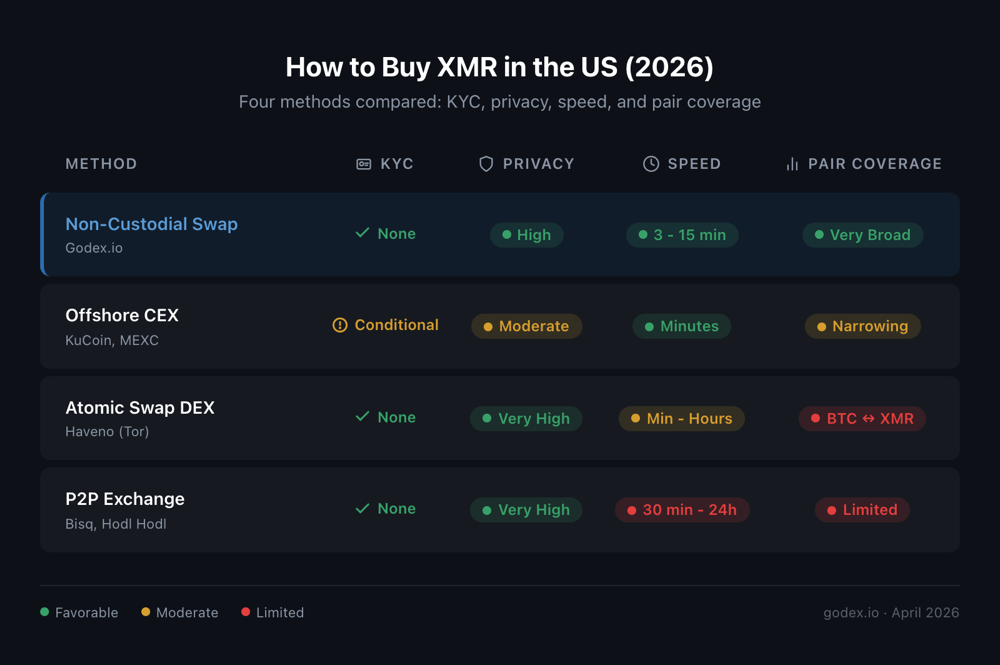
Method Comparison — At a Glance
| Method | Account / KYC | Privacy Level | Speed | Pair Coverage | Best For |
|---|---|---|---|---|---|
| Non-custodial swap (Godex) | None | High | 3–15 min | Very broad | Any user holding crypto already |
| Offshore CEX (KuCoin, MEXC) | Conditional | Moderate | Minutes | Narrowing | Spot trading, large pair selection |
| Atomic swap DEX (Haveno) | None | Very High | Minutes–hours | BTC↔XMR primarily | Technical users, max privacy |
| P2P (Bisq, Hodl Hodl) | None | Very High | 30 min – 24 hrs | Limited | Fiat-to-XMR without a bank |
A note on “Privacy Level” — it’s a profile, not a single number. The on-chain footprint of a Godex swap exists; the trade metadata at an offshore CEX exists. Both can be combined with operational privacy to produce a strong result. Neither is a magic eraser.
Operational Privacy for US Buyers
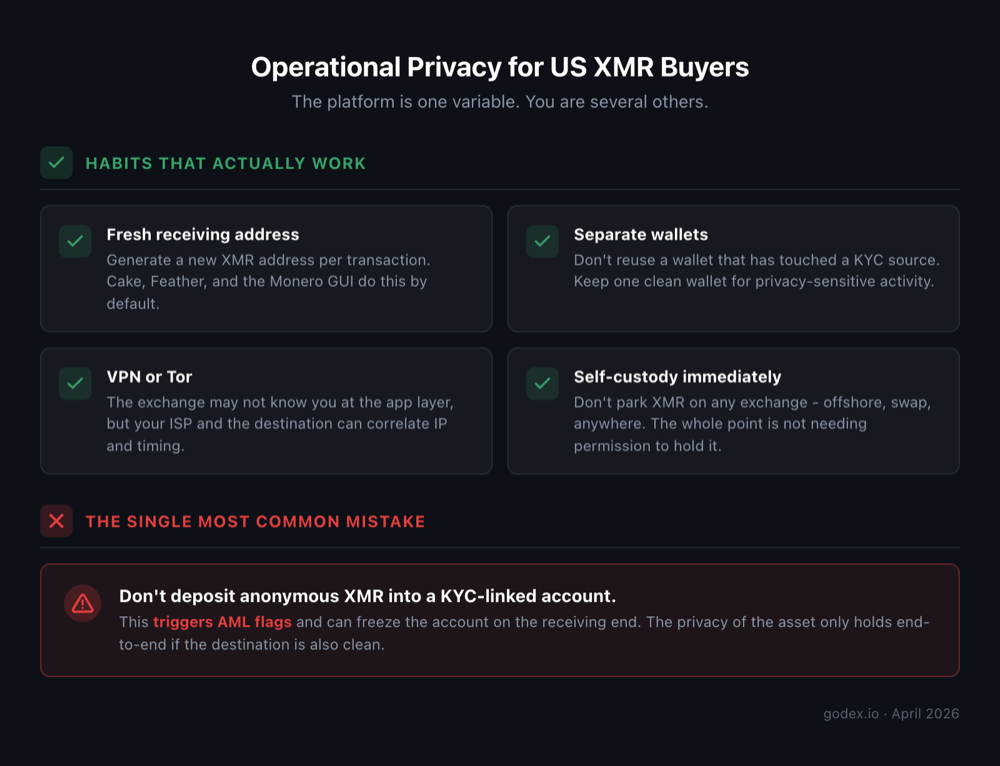
The platform is one variable. You are several others. The short list of habits that determine whether your XMR purchase is actually private in practice:
- Use a fresh receiving address generated by your XMR wallet for each transaction. Cake Wallet, Feather Wallet, and the Monero GUI all do this by default.
- Don’t reuse a wallet that has touched a KYC source. Funds from a KYC exchange wallet that pass through a swap and back to the same wallet are still linked to that wallet. Maintain a clean wallet for privacy-sensitive activity.
- Use a VPN or Tor when transacting. The exchange or DEX may not know who you are at the application layer, but your ISP and the destination service can correlate IP and timing.
- Self-custody immediately. Don’t leave XMR on any exchange — offshore, instant swap, anywhere. The whole point of the asset is that you don’t need permission to hold it. Exercise that property.
- Don’t deposit anonymous XMR into a KYC-linked account. This is the single most common mistake. It triggers AML flags and can freeze the account on the receiving end.
For a deeper walk-through of these and related habits, see our companion piece How to Exchange Crypto Anonymously in 2026.
A Word on US Tax Reality
Holding Monero is legal in the United States for individuals. Acquiring it through any of the methods above is legal. What is not optional is reporting taxable events. The 1099-DA broker reporting form is effective for the 2025 tax year (filed in 2026), and applies to centralized US broker activity. Privacy-conscious acquisition methods do not change your underlying tax obligations — gains and losses on crypto remain taxable events under existing US rules regardless of how the asset was acquired.
This article is not tax advice. Privacy and tax compliance are different concepts; the methods we describe are about the former, not the latter. Consult a qualified professional for jurisdiction- and situation-specific tax questions.
The Bottom Line
The cleanest US path to Monero in 2026 is no longer “find a US-friendly centralized exchange that still lists XMR.” That path has narrowed to a small handful of offshore venues with conditional accessibility, and the trend line is not in the user’s favor. The cleanest path is “use a non-custodial swap from any crypto you already hold, send it to a Monero wallet you control, and treat the swap service as a passthrough rather than a custodian.”
That path is available. It is fast. It does not require an account. It works for the smallest trade size and for the largest. And it is exactly the workflow that the privacy-conscious portion of the US crypto user base has been migrating toward through the entire delisting wave.
If you’re new to XMR and want to start small, the practical sequence is: install a Monero wallet (Cake, Feather, or the official GUI), generate a receiving address, choose a non-custodial swap service, send a small amount of any crypto you already own to test the flow, and confirm receipt. Once the test trade lands, you know the route works for any amount.
For a deeper analytical look at where Monero itself is going through 2030 — the network, the regulatory horizon, the bull and bear cases — see Monero (XMR) Price Prediction 2026–2030.
Last updated: April 8, 2026. Pair availability, US accessibility of specific platforms, and KYC thresholds change frequently — verify the current status at any chosen venue before sending funds. This article is informational and is not legal, financial, or tax advice. Consult a qualified professional for jurisdiction-specific questions.
Start a Cryptocurrency exchange
Try our crypto exchange platform
Disclaimer: Please keep in mind that the content of this article is not financial or investing advice. The information provided is the author’s opinion only and should not be considered as direct recommendations for trading or investment. Any article reader or website visitor should consider multiple viewpoints and become familiar with all local regulations before cryptocurrency investment. We do not make any warranties about reliability and accuracy of this information.
Read more
You may well think that an article dedicated to a Tether price prediction or the Tether price in general is a little bit strange — it is a stablecoin after all. However, the price of Tether does fluctuate significantly, although it is nowhere near as volatile as non-stablecoin cryptos. This means that staying up to […]
In the article we share our vision at Zcash cryptocurrency main features and add several price predictions. As cryptocurrencies gain global acceptance and decentralisation slowly enters our lives, privacy becomes the main concern when talking about blockchain adoption. It is no secret that distributed ledger is by far the most secure and transparent technology ever […]
Chiliz coin (CHZ) offers a compelling opportunity for traders interested in the intersection of blockchain technology and sports. By enabling fans to influence team decisions through the Socios app, Chiliz directly monetizes fan engagement and connects with major sports teams like Juventus and Paris Saint-Germain. These partnerships not only enhance the platform’s visibility but also […]
The exponential growth of Bitcoin Satoshi Vision (BSV) against the general bear trend on the cryptocurrency market in autumn 2019 has impressed the community. Due to the increasing market capitalization, the newly emerged altcoin was ranked 5th on CoinMarketCap and managed to maintain its high position at the beginning of 2020. In the article we […]
EOS is definitely on the list of the strongest and most stable projects in the crypto world. Despite the fact that the currency entered the market less than 3 years ago, it consistently occupies one of the top 10 places in the rating for project capitalization. it is often called the “main competitor of Ethereum”. […]
XRP price prediction 2026-2027: bear, base, and bull scenarios with ranges and named sources, the resolved SEC case, live spot ETFs, and can XRP reach $10?