
 Alex Tamm
Table of Contents
Most "no-KYC" crypto exchanges are conditional: they ask for nothing until you cross a volume, fiat, or risk threshold — then they demand ID. Changelly triggers above €10,000/48h; StealthEX and ChangeHero on fiat buys over roughly $700; ChangeNOW and SimpleSwap at an undisclosed point. Godex has no trigger at any size. This guide tables exactly where each one flips in 2026.
TL;DR — Where Does Each "No-KYC" Exchange Ask for ID in 2026?
There are three kinds of "no-KYC" exchange. Published-ceiling platforms tell you the line: Changelly (€10,000/48h), StealthEX and ChangeHero (~$700 on fiat buys). Undisclosed/discretionary platforms refuse to publish a number at all: ChangeNOW and SimpleSwap verify identity "at their discretion," so you can't plan around the line. Unconditional platforms have no line: Godex requires no account, no email, and no ID at any transaction size — you can swap without registration at any amount. The table below shows where each one triggers — and whether that figure is officially published or only community-reported.
If you regularly move four- or five-figure sums, this is aimed squarely at you: you sit inside most of these thresholds, which is exactly where the surprise freeze happens.
The Threshold Table — Where Every No-KYC Exchange Triggers ID

This is the part you came for. Every cell below is sourced and dated. A figure marked Published comes from the platform's own AML/KYC policy; Reported means it is community- or review-sourced, not official. Where a platform publishes no number, the cell says "undisclosed" — we did not invent one.
Data verified June 4, 2026. Thresholds sourced from each platform's published AML/KYC policy or third-party testing; "reported" figures are community/review-sourced, not official. Competitor policies change — re-verify before relying on any figure.
Legend: ✅ Unconditional · ⚠️ Conditional (published ceiling) · ❓ Undisclosed/discretionary
| Exchange | No-KYC model | ID-trigger threshold | What triggers it | Published or reported? | Source (accessed 2026-06-04) |
|---|---|---|---|---|---|
| Godex | ✅ Unconditional | None — no account, no email, no ID at any size | Nothing (non-custodial swap) | Published | godex.io (no-KYC swap, no registration) |
| Changelly | ⚠️ Conditional | >€10,000 / 48h (also fiat buys, risk-scored or large privacy-coin swaps) | Volume over €10K/48h, fiat, risk flag | Published | Changelly AML/KYC policy |
| ChangeNOW | ❓ Discretionary | Undisclosed — no published number. Community-reported ~€2,000+ | Risk-system flag, large sum, privacy coins | REPORTED (official: criteria are not public) | ChangeNOW KYC FAQ |
| SimpleSwap | ❓ Discretionary | Undisclosed — risk-based, FATF-aligned | Red-flag monitoring; AML hold | REPORTED (official: "at its discretion… any transaction") | SimpleSwap AML/KYC page |
| StealthEX | ⚠️ Conditional | ~$700 cumulative fiat (per user, not per swap) | Fiat buy over ~$700 total; flagged crypto swaps | Published | StealthEX: no KYC for buying crypto |
| ChangeHero | ⚠️ Conditional | ~$700 / €700 cumulative fiat (per user; per provider — FinchPay ~€500, Mercuryo ≤€699) | Fiat buy over provider cap; risk flag | Published (per-provider) | ChangeHero /buy/btc + FinchPay note |
| SwapSpace (aggregator) | ❓ Partner-dependent | ~$500 own policy; partner can demand ID at any size | Partner KYC; SwapSpace runs no AML itself | Published + partner-variable | SwapSpace: what AML/KYC are for |
| MEXC / CoinEx (CEX — different model) | Tiered / custodial | Region-dependent daily tiers (vary by country and account level) | Withdrawal/deposit tier | Published | Per-platform tier policy |
The last row is a different category — centralized, custodial exchanges with tiered limits — included for honesty, not as a like-for-like swap service. More on that below.
For platforms that cap how much you can move (volume limits, separate from the ID-trigger point), see our companion piece on the best crypto exchanges without limits in 2026.
Conditional vs. Unconditional No-KYC: The Distinction Nobody Explains
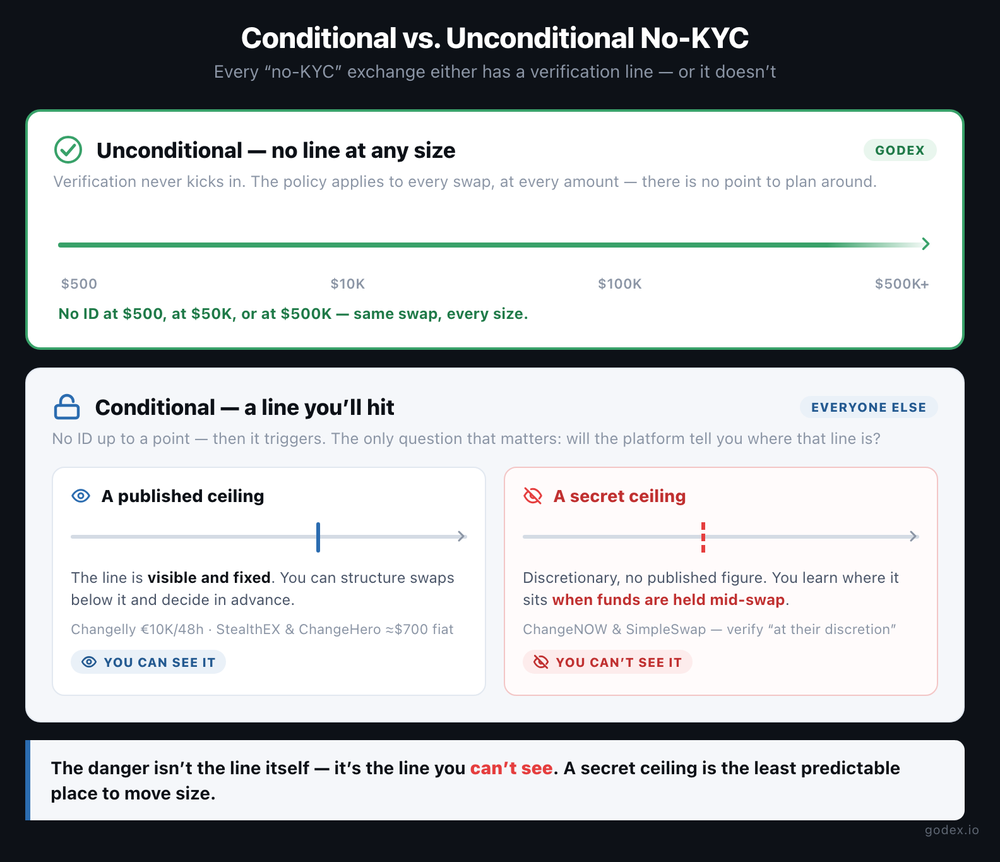
Conditional no-KYC means a platform skips identity verification up to a point, then requires it — triggered by transaction size, fiat involvement, or an automated risk flag. Unconditional no-KYC means there is no point at which verification kicks in: the policy applies to every swap, at every size. Almost every exchange marketed as "no-KYC" is the conditional kind. The marketing rarely says so.
The distinction matters because the word "no-KYC" sounds absolute and almost never is. A platform can advertise "no KYC" truthfully and still ask for your passport on a €12,000 swap — because the policy was conditional all along. The honest question is not "does it have KYC" but "at what point does it trigger, and will the platform tell me where that point is."
Godex.io is a non-custodial instant cryptocurrency exchange operating since 2017. It supports 936+ coins, requires no registration or KYC at any transaction size, and offers both fixed-rate and floating-rate swap modes. Processing time is 5–30 minutes after deposit confirmation.
How Much Can I Swap Without KYC? (Exchange by Exchange)
It depends entirely on the platform — that is the whole problem. On Godex there is no ceiling; on the conditional platforms, your swap size and whether fiat is involved decide it. Here is each one, with the trigger named and sourced.
- Godex — No threshold. No account, no email, no ID, at any swap size. The non-custodial swap model means there is nothing to verify.
- Changelly — Crypto-to-crypto swaps run without ID up to €10,000 in any 48-hour window; above that, or on fiat purchases and risk-flagged transactions, verification is required. The ceiling is published, which is to Changelly's credit. Enforcement is reportedly more aggressive than the headline number — some users report flags below it — so treat €10K as a stated maximum, not a guarantee.
- StealthEX — The ~$700 gate is a cumulative fiat-to-crypto total per user (a running total, not a per-swap limit), and doesn't apply to pure crypto-to-crypto swaps, which run higher before a flag. StealthEX is also cheaper than Godex (~0.40%), so for a small card buy under $700 with price as your priority it's a reasonable pick. But for crypto-to-crypto at size — the case this guide is about — that fiat gate is beside the point, and the no-trigger model you don't have to plan around wins.
- ChangeHero — Same shape: a ~$700/€700 cumulative fiat on-ramp cap per user, varying by provider (FinchPay around €500, Mercuryo's fast track up to €699). Pure crypto swaps aren't gated at that figure, and ChangeHero's fees (~0.5%) undercut Godex on a small fiat buy. At size, though, the comparison is no longer about that ~$700 line — it's about whether a trigger exists at all, and on Godex it doesn't.
- ChangeNOW and SimpleSwap — No published number. Both verify "at their discretion." ChangeNOW is fast (often under two minutes) and cheap; the weakness is predictability, not a claim that they always KYC. See the next two sections.
- SwapSpace — An aggregator. Its own policy lists ~$500, but it runs no AML itself — the partner exchange you route through can demand ID at any size. SwapSpace shows you which partner fills your order before you commit, so you can in principle check that partner's policy first — but the trigger then lives in that partner's terms, not SwapSpace's, so the predictability is only as good as whichever exchange you land on.
For the deeper dive into volume limits across custodial and non-custodial venues, see our explainer on large crypto swaps and no-KYC volume limits.
The Two Kinds of Conditional — A Published Ceiling vs. a Secret One
Within "conditional," there are two very different experiences, and the gap between them is the whole point. The first kind publishes a ceiling you can plan around: Changelly's €10,000/48h, StealthEX's and ChangeHero's ~$700 fiat gate. You may not love the line, but you can see it, structure your swaps below it, and decide in advance whether to use the platform.
The second kind keeps the line secret. ChangeNOW and SimpleSwap publish no figure and verify identity at their discretion. This is the scarier kind, because you cannot plan around a line you cannot see — the first time you learn where it sits is when your funds are held mid-swap. Conditional vs. unconditional no-KYC is the first axis; published vs. secret is the second. On both, a discretionary platform is the least predictable place to move size.
Why Won't ChangeNOW Publish Its KYC Threshold?
ChangeNOW does not publish a numeric threshold because its verification criteria are risk-based and deliberately kept private. Its FAQ frames identity checks as triggered by an automated risk system rather than a fixed amount, which is why no official figure exists to cite.
The community-reported trigger sits around €2,000, but that is a report, not an official number. In Godex's own hands-on test, a ~$2,000 transaction triggered verification while a ~$500 one did not — directional evidence, not a published policy. See the full methodology in our ChangeNOW vs Godex vs StealthEX no-KYC test (2026). The takeaway is about predictability: a discretionary policy can verify a transaction the system scores as risky regardless of size, which is harder to plan around than a stated ceiling.
What Actually Triggers an ID Request?
Across the conditional platforms, the same handful of triggers recur:
- A fiat on-ramp purchase — buying crypto with a card or bank transfer almost always carries the lowest gate (the ~$700 figures at StealthEX and ChangeHero apply here).
- Volume over a published ceiling — Changelly's €10,000/48h is the clearest example.
- A privacy-coin swap — large or repeated Monero/Zcash transactions are flagged more readily on several platforms.
- An automated risk-system flag — the discretionary trigger at ChangeNOW and SimpleSwap, which can fire independent of amount.
These gates exist because of risk-based AML expectations. The EU's MiCA framework reached full effect across the bloc in late 2024, and FATF guidance pushes virtual-asset service providers toward risk-based identity checks. That pressure is why conditional thresholds tend to tighten over time, not loosen.
Where Godex Sits — No Line to Hit
Godex has no threshold, and it is transparent that there isn't one. That is the distinction worth drawing: not merely "we don't do KYC," but "there is no hidden line waiting for you at €2K, €10K, or $100K." The no-KYC policy applies to every swap because the platform is structured as a non-custodial swap engine — there is no account to create and no identity profile to file.
The mechanics matter here, because "no ID" is necessary but not sufficient. The swap is non-custodial and there is no risk-scoring system in the path that can place a hold mid-swap — no separate compliance review, no manual large-transaction check, none of the machinery that quietly freezes funds on discretionary platforms. Fixed-rate mode locks the deal when you start it, so the size of your swap does not move the rate between deposit and settlement. And privacy coins aren't separately gated: Monero, Zcash and the rest swap at any size with no privacy-coin flag — exactly the trigger that fires across much of the conditional field. It's a policy that has stayed unconditional across eight years since 2017, not a launch promise from a platform that may not be here next quarter.
For a mid-tier user moving $5,000–$50,000, that is the practical difference. You are not betting that you'll stay under a published ceiling, and you are not gambling against a secret one. A swap runs the same way at $500, at $50,000, and at $500,000: pick a pair, send your deposit, receive your coins in 5–30 minutes after the deposit confirms. You can start a swap on Godex without registration, with fixed-rate or floating-rate mode, across 936+ supported assets. For Segment B, the value is reliability and a transparent policy with no delays — not a price claim.
This comparison is published on the Godex blog. We've aimed to present accurate, sourced information about every platform, but policies change — verify each one independently before you swap.
Frequently Asked Questions
How much crypto can I swap without KYC?
It depends on the platform. Godex has no threshold — any size, no ID. Changelly allows crypto swaps up to €10,000/48h before verification; StealthEX and ChangeHero gate fiat buys over ~$700; ChangeNOW and SimpleSwap verify at an undisclosed, discretionary point. See the threshold table above for the sourced figures.
Which no-KYC exchanges actually ask for ID?
The conditional ones. Changelly triggers above €10,000/48h, StealthEX and ChangeHero on fiat purchases over ~$700, and SwapSpace's partner exchanges can request ID at any size. ChangeNOW and SimpleSwap verify at their discretion with no published number. Godex does not ask for ID at any size.
Why won't ChangeNOW publish its KYC threshold?
Because its verification criteria are risk-based and deliberately not made public. ChangeNOW's policy frames ID checks as triggered by an automated risk system rather than a fixed amount, so no official figure exists. A community-reported trigger sits around €2,000, but that is unofficial — treat it as a report, not policy.
What's the difference between conditional and unconditional no-KYC?
Conditional no-KYC skips verification up to a trigger — a volume ceiling, a fiat purchase, or a risk flag — then requires ID. Unconditional no-KYC has no such trigger: the policy applies to every swap at every size. Most exchanges marketed as "no-KYC" are conditional. Godex is unconditional.
Do I need ID to swap crypto on Godex?
No. Godex requires no ID, no email, and no account at any transaction size, including swaps above $100,000. It is a non-custodial swap engine, so there is no identity profile to file. The no-KYC policy is unconditional — there is no threshold to plan around.
Is a no-KYC exchange legal?
Using a non-custodial swap service that doesn't require an account is legal in most jurisdictions, but laws vary and a no-KYC platform does not remove your own legal obligations (such as tax reporting). It removes account-creation friction, not your responsibilities. Verify the rules that apply where you live. This is general information, not legal advice.
Start a Cryptocurrency exchange
Try our crypto exchange platform
Disclaimer: Please keep in mind that the content of this article is not financial or investing advice. The information provided is the author’s opinion only and should not be considered as direct recommendations for trading or investment. Any article reader or website visitor should consider multiple viewpoints and become familiar with all local regulations before cryptocurrency investment. We do not make any warranties about reliability and accuracy of this information.
Read more
You may well think that an article dedicated to a Tether price prediction or the Tether price in general is a little bit strange — it is a stablecoin after all. However, the price of Tether does fluctuate significantly, although it is nowhere near as volatile as non-stablecoin cryptos. This means that staying up to […]
In the article we share our vision at Zcash cryptocurrency main features and add several price predictions. As cryptocurrencies gain global acceptance and decentralisation slowly enters our lives, privacy becomes the main concern when talking about blockchain adoption. It is no secret that distributed ledger is by far the most secure and transparent technology ever […]
Chiliz coin (CHZ) offers a compelling opportunity for traders interested in the intersection of blockchain technology and sports. By enabling fans to influence team decisions through the Socios app, Chiliz directly monetizes fan engagement and connects with major sports teams like Juventus and Paris Saint-Germain. These partnerships not only enhance the platform’s visibility but also […]
The exponential growth of Bitcoin Satoshi Vision (BSV) against the general bear trend on the cryptocurrency market in autumn 2019 has impressed the community. Due to the increasing market capitalization, the newly emerged altcoin was ranked 5th on CoinMarketCap and managed to maintain its high position at the beginning of 2020. In the article we […]
EOS is definitely on the list of the strongest and most stable projects in the crypto world. Despite the fact that the currency entered the market less than 3 years ago, it consistently occupies one of the top 10 places in the rating for project capitalization. it is often called the “main competitor of Ethereum”. […]
XRP price prediction 2026-2027: bear, base, and bull scenarios with ranges and named sources, the resolved SEC case, live spot ETFs, and can XRP reach $10?