
 Alex Tamm
Table of Contents
A crypto exchange is only “without limits” if it clears two bars: no cap on how much you can move, and no identity-verification trigger above a threshold. Most platforms pass the first and quietly fail the second. Three pass both for crypto-to-crypto swaps in 2026: Godex, Exolix, and GhostSwap. This guide ranks the field and flags exactly where each “no-KYC” platform starts asking for ID.
TL;DR — Which Crypto Exchanges Are Actually Without Limits?
Truly no-limit (no cap, no KYC trigger): Godex, Exolix, and GhostSwap process non-custodial swaps with no volume cap and no verification at any size.
No-KYC but threshold-gated (watch the fine print): ChangeNOW (~$2,000 trigger plus risk-engine flags), SimpleSwap (KYC can be requested on flagged transactions), StealthEX (fiat buys above ~$700 need verification), Changelly (KYC reportedly above ~€10,000 per 48 hours, with a documented enforcement reputation).
Other models: MEXC (centralized, high unverified cap — reportedly ~5–10 BTC/day, region-dependent — but ultimately tiered KYC) and Uniswap (decentralized, no protocol cap but gated by liquidity and self-custody complexity).
What Does “Without Limits” Actually Mean? (Volume Cap vs KYC Trigger)
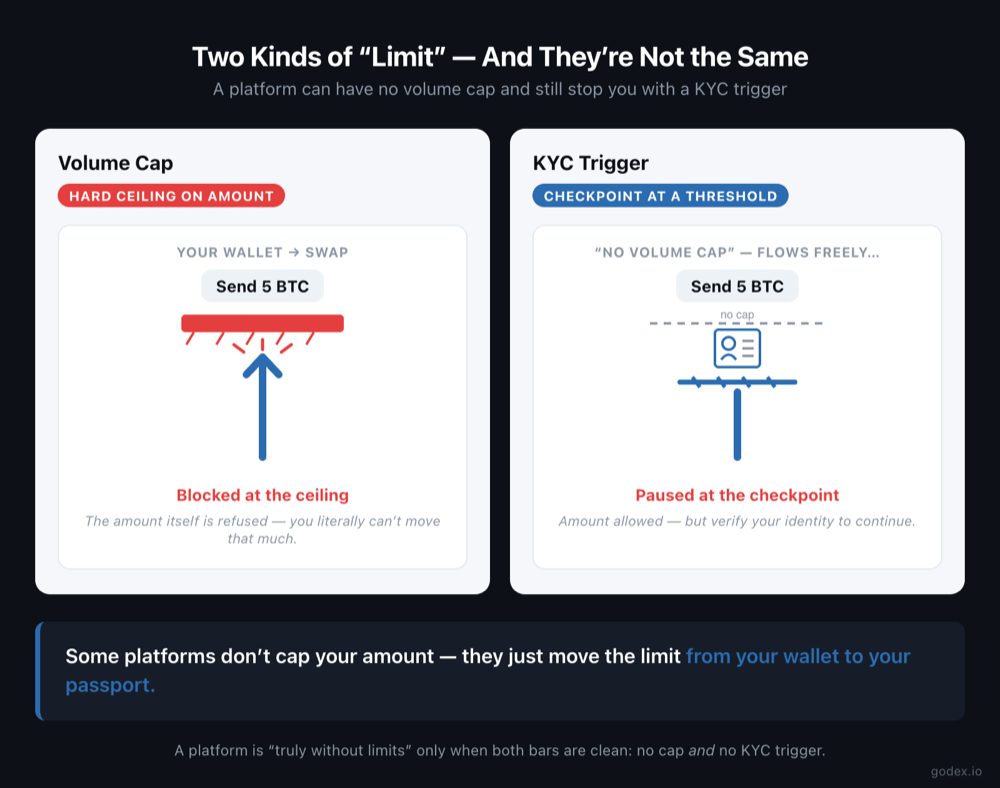
“Without limits” combines two separate things that most listicles treat as one. A volume cap is a ceiling on how much you can swap in a single transaction or per day. A KYC trigger is the dollar or BTC threshold above which a platform pauses your swap and demands identity verification. A platform with no volume cap but a $2,000 KYC trigger is not “without limits” — it just moved the limit from your wallet to your passport.
These are the two failure modes. Hard volume caps are rarer now; most instant-swap platforms advertise unlimited amounts and mean it. Conditional KYC thresholds are the common one — and they’re easy to miss, because the platform’s homepage says “no KYC” right up until a transaction crosses a number you weren’t shown.
That distinction is the whole point of this ranking. An unlimited crypto exchange with no KYC has to clear both bars, not just the marketing-friendly one.
Godex.io is a non-custodial instant cryptocurrency exchange operating since 2017. It supports 936+ coins, requires no registration or KYC at any transaction size, and offers both fixed-rate and floating-rate swap modes. Processing time is 3–15 minutes after deposit confirmation.
For $100,000-plus moves you can still use an OTC desk, but you’ll surrender full KYC and lose the speed of an instant swap — the opposite of what a no-limits search is looking for. For the full limit-by-limit breakdown across platforms, see how the volume and KYC limits actually work.
Best Crypto Exchanges Without Limits — Compared at a Glance
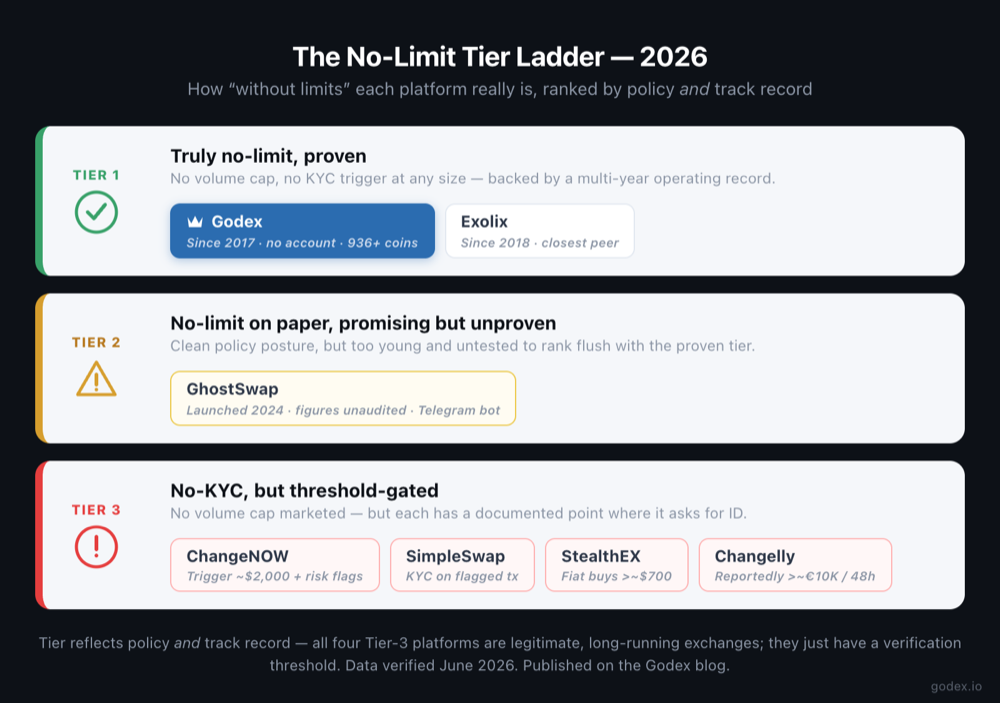
The table below is a ranking snapshot, not the exhaustive teardown. The lead columns are the two-bar test: volume cap first, then KYC trigger. A platform is “truly without limits” only when both columns are clean. Godex sits in the first data row.
| Platform | Volume cap? | KYC / verification trigger | Truly without limits? | Coins | Notes |
|---|---|---|---|---|---|
| Godex | None (any amount) | None — unconditional, no account | ✅ Yes (proven) | 936+ | Fixed + floating, since 2017 |
| Exolix | None (unlimited max) | None standard; optional AML on flagged | ✅ Yes (proven) | 1,750+ | Closest peer |
| GhostSwap | None | None at any size | 🟡 Yes (promising, unproven) | 1,600+ | New (2024), unaudited figures, Telegram bot |
| ChangeNOW | None marketed | ⚠️ ~$2,000 / risk-engine flag (a small share of tx) | Partial | 1,400+ | Lower advertised fees |
| SimpleSwap | None standard | ⚠️ Can be requested on flagged tx | Partial | 1,500+ | — |
| StealthEX | Soft on some pairs | ⚠️ Fiat buys >~$700 need verification | Partial | 1,500+ | ~0.40% fee |
| Changelly | Daily limits | ❌ KYC above ~€10K / 48h (reported; policy is discretionary risk-scoring) | No | 1,000+ | Documented enforcement reputation |
| MEXC (CEX) | High unverified cap (reportedly ~5–10 BTC/day, region-dependent) | ❌ Full KYC for higher tiers | No | — | Order books, leverage |
| Uniswap (DEX) | No protocol limit | None (DEX) | Gated | — | Liquidity / slippage + self-custody |
Legend: ✅ Yes (proven) = no cap, no KYC trigger, and a multi-year operating record · 🟡 Yes (promising, unproven) = clears both bars on paper but too young and untested to rank flush with the proven tier · ⚠️ no cap but a documented verification threshold · ❌ gated by KYC at a stated limit · Gated = no policy limit but constrained by liquidity or self-custody.
Data verified June 2026. Comparison published on the Godex blog. Competitor thresholds sourced from each platform’s published policy or third-party testing — verify independently before a large swap.
**
The Truly No-Limit Tier — Godex, Exolix, GhostSwap
Three platforms clear both bars for crypto-to-crypto swaps: no volume cap, and no identity-verification trigger at any size. They’re non-custodial, so there’s no account holding your funds and no profile accumulating a transaction history. Two of them are proven — Godex (since 2017) and Exolix (since 2018). The third, GhostSwap, clears both bars on paper but is barely 18 months old, so it sits a tier below on track record even though its policy posture is clean.
Godex — No Cap, No KYC, No Account
Godex has no volume cap and no KYC trigger. There is no transaction-size threshold at which it pauses your swap and asks for ID — the no-KYC policy applies at $1,000, $10,000, and $100,000 alike. There’s no account, no email, and no profile to create. Swaps run on a fixed rate by default (with a floating-rate option), settle in 3–15 minutes after the deposit confirms, and draw from 936+ coins. Support is 24/7, and the platform has operated since 2017.
For a large swap, the relevant detail is what isn’t in the path: no risk-scoring engine evaluating your transaction size, no cumulative per-account tracking, and order data deleted after roughly two weeks. The track record is concrete, not just a launch year: Godex has run as a non-custodial instant exchange continuously since 2017, with the same no-KYC, no-account posture applied at every volume by design rather than waived case by case . Because it never takes custody and never opens an account, there is no balance for the platform to freeze and no profile to subpoena — and across that run there is no public record of frozen or seized swap funds . You can swap crypto without registration on Godex at any volume — the fixed rate, the multi-year track record, and the no-account model are what make it the hero of this list, not the fee. Godex’s BTC→ETH rate runs 1.67–2.14% depending on volume, which is above the market average; you’re paying for certainty and an unconditional no-KYC posture, not the lowest sticker price.
Exolix — Closest No-Limit Peer
Exolix advertises an unlimited maximum and runs standard swaps with no KYC across roughly 1,750+ coins. It reserves an optional AML review for flagged or unusually large volume, which is a lighter posture than the threshold-gated tier below. On the two-bar test, Exolix is the closest peer to Godex. The main gap is track record: it’s a credible no-limit option without the eight-year operating history.
GhostSwap — Newest No-Limit Option
GhostSwap imposes no protocol cap and no KYC at any size, lists roughly 1,600+ coins, and runs a Telegram bot — a genuine UX edge that Godex doesn’t offer. The caveats are real. GhostSwap launched in 2024, and its headline volume and user figures are platform-reported and unaudited, so treat them as marketing claims rather than verified facts. It also has roughly a 0.5% undisclosed transaction-flag rate and hasn’t been stress-tested under sustained enforcement pressure. The posture is clean; the track record is thin next to Godex’s 2017 history.
The “No-KYC, But There’s a Threshold” Tier
These platforms market themselves as no-KYC and are, for most users most of the time. Each one has a documented point at which it stops being limit-free and starts asking for ID. That threshold is the difference between “no KYC” and “without limits.”
- ChangeNOW is conditional. Its automated compliance system, run through identity provider Sumsub, can freeze a swap and request ID — documented around a ~$2,000 trigger plus risk-engine flags affecting a small share of transactions, per ChangeNOW’s own AML/KYC disclosure (last updated February 2026). Worth noting: the EU’s 6AMLD occasional-customer threshold is €10,000, so a ~$2,000 trigger sits well below the regulatory minimum — that’s a platform policy choice, not a legal requirement. ChangeNOW earns its place on any shortlist, though: it lists more coins (1,400+), advertises lower fees (0.5–1%), and is faster on major pairs.
- SimpleSwap has no standard volume cap, and KYC isn’t routine — but it can be requested on large or flagged transactions. Roughly 1,500+ coins, operated by a Marshall Islands entity. Note: the UK FCA issued an unauthorized-firm warning on SimpleSwap on 17 March 2025 — relevant if you’re in the UK.
- StealthEX is largely fine for crypto-to-crypto, but fiat purchases above ~$700 require full verification through its payment partners — confirmed in its current KYC/AML policy. Its ~0.40% fee is genuinely cheaper than Godex; if price is your priority on a crypto-to-crypto pair, that’s a real edge. Operating since 2018, ~1,500+ coins.
- Changelly applies KYC on risk-flagged activity and reportedly above roughly €10,000 per 48 hours — though its published policy describes discretionary risk-scoring (providers Sumsub, Onfido) rather than a single fixed threshold. Third-party review patterns (Trustpilot, Reddit) document a more aggressive enforcement and fund-freeze reputation than peers in this tier. It’s EU-registered (Czech), so MiCA applies, and it has operated since 2013. It’s a legitimate, long-running exchange — it just doesn’t clear the no-limit bar. If the threshold is a dealbreaker, see Changelly alternatives.
For the complete roster of platforms that run without identity verification, see the full no-KYC exchange list. For a head-to-head test of three of these names, see the ChangeNOW vs Godex vs StealthEX no-KYC test.
What About Centralized Exchanges and DEXs? (MEXC, Uniswap)
Two adjacent options come up in “no limits” searches but sit outside the instant-swap model.
MEXC (CEX) offers a high unverified cap — reportedly around 5–10 BTC per day, varying by region — but it’s a tiered centralized exchange. Higher withdrawal tiers require full KYC, and it adds order books and leverage that an instant-swap platform doesn’t. A high unverified cap is not the same as no limit; it’s a generous limit with a verification wall behind it.
Uniswap (DEX) has no protocol limit and no KYC, with full self-custody throughout. The constraint isn’t identity — it’s liquidity and slippage on large orders, plus the operational complexity of managing the swap yourself. It’s an honest decentralized alternative, but a different trust model with different failure modes than a managed swap.
How Do I Swap a Large Amount of Crypto Anonymously? (For Whales)
Use a non-custodial swap platform with no volume cap and no KYC trigger, send a test transaction first, and prefer a fixed rate so the quote you accept is the rate you get regardless of confirmation-time market movement.
The reason the trigger surface matters more than the fee on a five- or six-figure swap is friction at exactly the wrong moment. A threshold-gated platform can pause a $50,000 swap mid-transaction, drop you into a verification queue, and ask source-of-funds questions triggered by nothing but the transaction size. For an early holder moving a 2017 ICO position, “explain where this came from” is precisely the conversation a no-account model avoids. On a platform with no KYC trigger and no risk-scoring engine in the path, there’s no transaction-size threshold to cross.
Fixed rate earns its premium here. On a 2 BTC swap at $85,000, a 3% market move during a slow Bitcoin confirmation costs about $5,100 — a fixed rate locks the quote and eliminates that risk; a floating rate leaves you exposed to the confirmation window. The habit experienced holders use is the test swap: run a small amount through first to verify the platform settles clean and asks for nothing, then send the full size. This is the broad version — for the full limit-by-limit breakdown of where each platform’s high-volume crypto swap without KYC actually caps out, read the deep-dive.
A note on safety: godex.io is the only official Godex domain. The lookalike godex.pro is a confirmed scam — check the address bar before you send anything.
Frequently Asked Questions
Is there a crypto exchange with no limits?
Yes. For crypto-to-crypto swaps, Godex, Exolix, and GhostSwap impose no volume cap and no KYC trigger at any size. Most other “no-KYC” platforms cap nothing on volume but request ID above a threshold — ChangeNOW around $2,000, StealthEX on fiat buys above ~$700, Changelly reportedly above ~€10,000 per 48 hours.
Which crypto exchanges have no KYC limit?
Godex (unconditional, no account), Exolix, and GhostSwap have no verification trigger at any transaction size. ChangeNOW (~$2,000), StealthEX (fiat above ~$700), and Changelly (reportedly ~€10,000 per 48 hours) all have documented verification thresholds, which means they have a no-KYC limit even if they don’t advertise one.
Can I swap a large amount of crypto without ID?
Yes, on a non-custodial platform with no verification trigger such as Godex. There is no transaction-size threshold and no risk-scoring engine in the swap path, so KYC isn’t requested at $1,000, $10,000, or $100,000. Sending a small test swap first is the standard way to confirm a platform asks for nothing before you move the full amount.
Do crypto exchanges have a maximum transaction limit?
Instant non-custodial swap platforms generally don’t cap volume — you can swap any amount in a single transaction. Centralized exchanges are different: MEXC, for example, limits unverified accounts (reported figures range from roughly 5 to 10 BTC per day, depending on region) and requires full KYC for higher tiers. The cap lives on the account, not the swap.
Is a no-KYC exchange legal?
Using a non-custodial swap with no registration is legal in most jurisdictions. It removes account friction, not your legal obligations — tax reporting and applicable local rules still apply to you regardless of whether the platform collected your ID. Verify the regulations for your own location before swapping large amounts.
What’s the difference between a volume cap and a KYC trigger?
A volume cap limits how much you can move in a transaction or per day. A KYC trigger is the threshold above which you must verify your identity to continue. A platform can have no volume cap and still have a KYC trigger — which is why “no limits” requires both bars to be clean, not just the first.
Start a Cryptocurrency exchange
Try our crypto exchange platform
Disclaimer: Please keep in mind that the content of this article is not financial or investing advice. The information provided is the author’s opinion only and should not be considered as direct recommendations for trading or investment. Any article reader or website visitor should consider multiple viewpoints and become familiar with all local regulations before cryptocurrency investment. We do not make any warranties about reliability and accuracy of this information.
Read more
You may well think that an article dedicated to a Tether price prediction or the Tether price in general is a little bit strange — it is a stablecoin after all. However, the price of Tether does fluctuate significantly, although it is nowhere near as volatile as non-stablecoin cryptos. This means that staying up to […]
In the article we share our vision at Zcash cryptocurrency main features and add several price predictions. As cryptocurrencies gain global acceptance and decentralisation slowly enters our lives, privacy becomes the main concern when talking about blockchain adoption. It is no secret that distributed ledger is by far the most secure and transparent technology ever […]
Chiliz coin (CHZ) offers a compelling opportunity for traders interested in the intersection of blockchain technology and sports. By enabling fans to influence team decisions through the Socios app, Chiliz directly monetizes fan engagement and connects with major sports teams like Juventus and Paris Saint-Germain. These partnerships not only enhance the platform’s visibility but also […]
The exponential growth of Bitcoin Satoshi Vision (BSV) against the general bear trend on the cryptocurrency market in autumn 2019 has impressed the community. Due to the increasing market capitalization, the newly emerged altcoin was ranked 5th on CoinMarketCap and managed to maintain its high position at the beginning of 2020. In the article we […]
EOS is definitely on the list of the strongest and most stable projects in the crypto world. Despite the fact that the currency entered the market less than 3 years ago, it consistently occupies one of the top 10 places in the rating for project capitalization. it is often called the “main competitor of Ethereum”. […]
XRP price prediction 2026-2027: bear, base, and bull scenarios with ranges and named sources, the resolved SEC case, live spot ETFs, and can XRP reach $10?