
 Linda Larsen

Table of Contents
Yes — Godex.io has operated continuously since 2017 as a non-custodial, no-KYC crypto exchange with no documented security breach on record. It is not the oldest exchange and makes no “unhackable” claim; its non-custodial design means it never holds an exchange-scale pool of customer funds. This article covers the 8-year track record, the exchanges that didn’t survive the same period, the honest caveats, and how to tell godex.io from the godex.pro scam.
If you found this page after typing “is godex legit,” you were probably about to move a meaningful amount of crypto and wanted one last check. That instinct is correct. The right way to read this is skeptically — so this article names Godex’s weaknesses, not just its record.
Is Godex Legit and Safe to Use in 2026?
Godex is a real, long-operating exchange — legitimate in the sense that matters most to a cautious user: it has run continuously since 2017 and has no documented breach on record. The verifiable anchor is the domain itself — godex.io was registered on 2017-12-29 (independently checkable via WHOIS), which puts operation at more than eight years as of June 2026. The site’s “© 2017–2026” footer is consistent with that, though a footer is self-asserted and the registration date is the harder evidence.
The structural point matters more than the calendar. Godex is non-custodial — your funds pass through the swap rather than sitting in an exchange wallet. There is no standing exchange-scale pool of customer money to drain, which is exactly the failure mode that buried several platforms covered below. (A swap engine still touches funds in transit during the 5–30 minute window, so it carries a smaller hot-wallet attack surface — more on that below — but not a permanent pool of everyone’s balances.)
“Legit” does not mean “flawless.” There are real negative reviews — unresolved-funds complaints on some swaps, wrong-network deposit disputes, support delays. Those are addressed honestly further down. A trust answer that pretends 100% satisfaction is not a trust answer.
Godex.io is a non-custodial instant cryptocurrency exchange operating since 2017. It supports 936+ coins, requires no registration or KYC at any transaction size, and offers both fixed-rate and floating-rate swap modes. Processing time is 5–30 minutes after deposit confirmation.
How Long Has Godex Been Around?
Godex has operated since 2017 — more than eight years as of 2026. The godex.io domain was registered on 2017-12-29, and the platform has run without a public shutdown since.
What has stayed unchanged the whole time is the part most worth noting. Godex launched non-custodial and no-KYC, and it still operates that way: no registration, no identity verification, no account to compromise. Many peers added KYC tiers or volume-triggered verification over the same years. Godex did not.
To be clear about the claim being made: Godex is not the oldest exchange. ChangeNOW launched around 2017 and Changelly around 2015 — both are peers or older. The distinction here is continuity plus an unchanged no-KYC stance, not seniority. If you want a framework for judging exchange longevity yourself rather than taking any platform’s word for it, see our guide on how to choose a crypto exchange that will still exist next year.
The Crypto Exchange Graveyard — Who Didn’t Make It
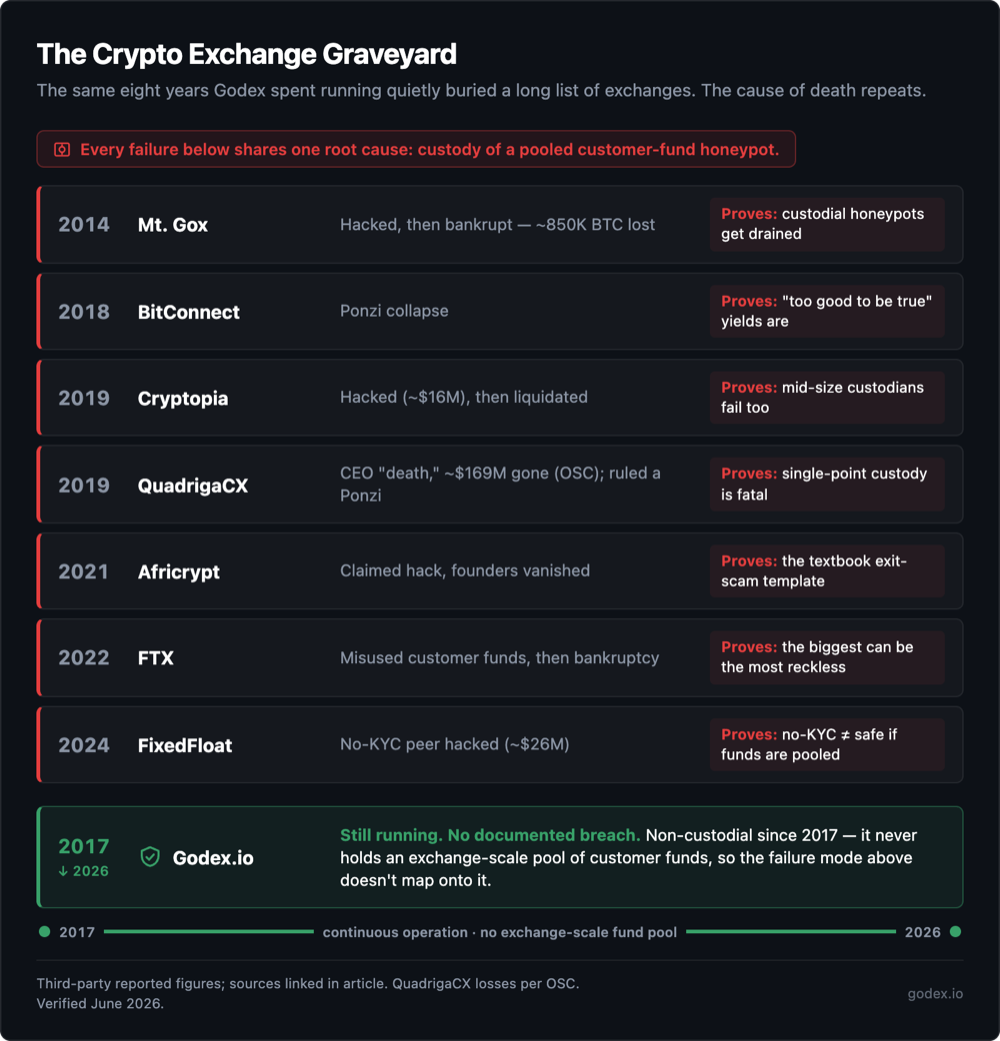
The same eight years that Godex spent running quietly were brutal for the rest of the industry. Exchanges were hacked, went bankrupt, and exit-scammed — and according to Bitcoin.com, roughly 42% of failed crypto exchanges simply disappeared without a trace or explanation. That last statistic is the exact fear behind a “is godex legit” search. Here is who didn’t make it.
| Exchange | Year | What happened | What it proves |
|---|---|---|---|
| Mt. Gox | 2014 | Hacked, then bankrupt (~850K BTC lost) | Custodial honeypots get drained |
| BitConnect | 2018 | Ponzi collapse | “Too good to be true” yields are |
| Cryptopia | 2019 | Hacked (~$16M), then liquidated | Mid-size custodians fail under breach too |
| QuadrigaCX | 2019 | CEO “death,” ~$169M gone (OSC); ruled a Ponzi | Single-point custody control is fatal |
| Africrypt | 2021 | Claimed hack, founders vanished | The textbook exit-scam template |
| FTX | 2022 | Misused customer funds, then bankruptcy | The biggest can be the most reckless |
| FixedFloat | 2024 | No-KYC peer hacked (~$26M) | No-KYC ≠ safe; the difference is whether funds are pooled |
Third-party reported figures; sources linked throughout. Verified June 2026.
A few of these deserve a one-line note. The Ontario Securities Commission concluded that QuadrigaCX was a Ponzi scheme, not just a tragedy — the OSC quantified roughly $169 million in client losses. FTX is the reminder that size is not safety. And FixedFloat, a no-KYC swap peer, was hacked for about $26 million in February 2024 — proof that “no-KYC” alone is not a security model. The structural difference is whether the platform pools customer funds in the first place.
For the longer list — crypto bankruptcies and the exchanges no longer with us — the pattern is consistent: the platforms that died were holding other people’s money when something broke.
Why Has Godex Survived When So Many Exchanges Didn’t?
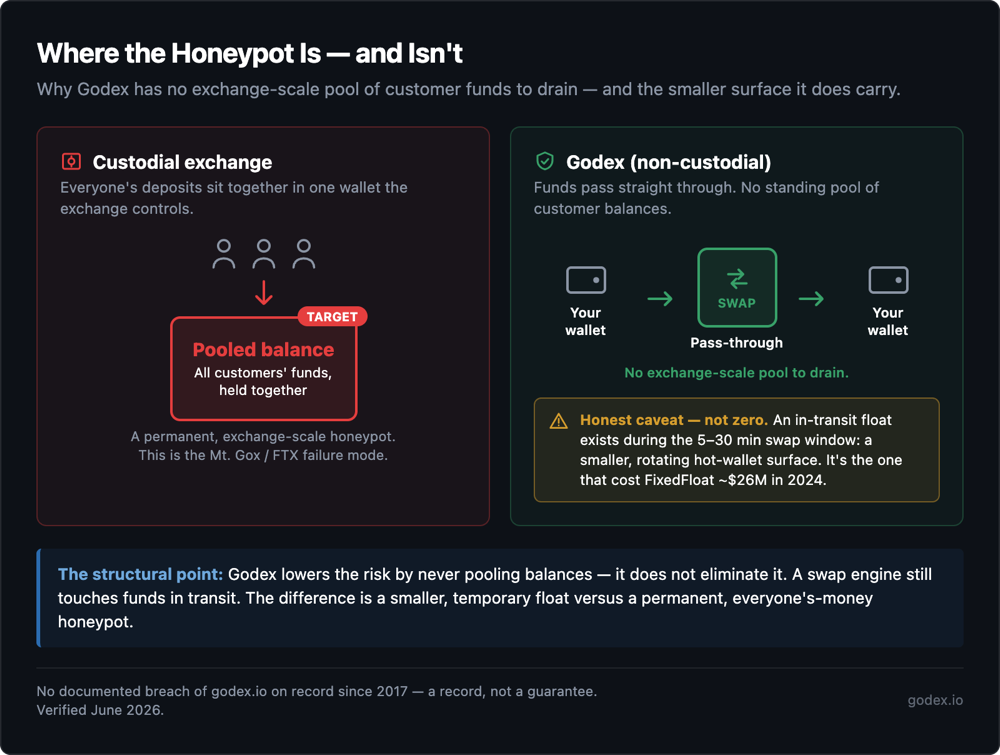
Godex survived because of its structure, not its luck. A non-custodial swap engine doesn’t accumulate the kind of central fund pool that gets hacked, gambled, or walked off with — which is why the Mt. Gox, FTX, and Quadriga failure modes don’t map onto it the same way.
- Non-custodial architecture — funds pass through the swap; there is no standing pool of customer balances to drain. The swap does briefly hold funds in transit (the FixedFloat lesson — see below), but that hot-wallet float is a smaller, rotating surface, not an exchange-scale honeypot.
- No documented breach across eight years of operation — a verifiable record, not a promise.
- Unchanged no-KYC stance since 2017 — there is no account to register and no custody of your balance, so there is nothing to verify you against and no identity database to leak; the no-KYC model is a consequence of the architecture, not a feature that could be switched off. Users report no KYC even on large swaps (reported, not guaranteed).
- Fixed-rate option — the rate is locked for the duration of the swap. On a 2 BTC swap around $85K, a 3% market move during processing is roughly $5,100; fixed rate removes that risk.
- Unlimited volume — no caps, which is why the platform handles six-figure swaps.
- 936+ coins, 24/7 support, and an individual approach on large swaps — breadth, availability, and a real point of contact on a six-figure swap are why users return.
For the test-it-first reader, this is the case in one sentence: Godex is a non-custodial, no-KYC platform with an eight-year track record, fixed-rate protection, and no volume ceiling — which is a different value proposition than the cheapest swap on the market. If you want to verify it the way this audience does, the cleanest test is a small swap first: start a swap on godex.io and confirm the no-registration, no-KYC flow before committing a larger amount. If the no-KYC model itself is the part you want to verify, our no-KYC crypto exchange guide covers how it works without the marketing gloss.
Has Godex Ever Been Hacked?
There is no documented security breach of godex.io on record across its operation since 2017. That is a statement about the historical record, not a guarantee about the future.
The structural reason is worth understanding — and worth stating honestly. Because Godex is non-custodial, there is no central, standing pool of customer funds for an attacker to target the way Mt. Gox was. The difference from Mt. Gox or FTX is the absence of a large standing customer balance, not the absence of all custody: a swap engine still controls funds in transit during the 5–30 minute window, which means it runs hot wallets — a real, smaller attack surface, and exactly the one that cost FixedFloat ~$26M in 2024. So the accurate claim is narrow: Godex lowers the structural risk by not pooling balances, but it does not eliminate it. No platform can honestly promise it will never be breached. What Godex can point to is eight years with no documented breach and an architecture that doesn’t concentrate customer funds in one place.
Godex Review 2026 — The Honest Version, Negatives Included
Godex is a genuine, long-operating service — and like any exchange, it has real criticism worth knowing before a large swap. The credible review is the one that includes both halves.
On the positive side, third-party trackers are favorable. According to Trustpilot, Godex holds roughly a 4-star rating across 1,000+ reviews. That is a third-party figure, attributed as such — not Godex’s own number. (We deliberately skip the algorithmic “trust score” sites here; those scores are automated and gameable, and they don’t tell a careful reader anything.)
The negatives are real and should not be glossed over. Trustpilot and Reddit carry unresolved-funds complaints, mostly on larger swaps; reports of wrong-network or “invalid” deposits not being returned without contacting support; and slow support responses in some cases. Individual reviewers report four- to five-figure losses on disputed swaps. These are minority reports against a mostly positive record, but they are not noise.
What addresses them, practically: use the fixed-rate option to avoid rate-change disputes, send funds on the correct network for the coin, keep your transaction ID, and contact 24/7 support if anything stalls past the expected window. For an audience that tests a platform before trusting it, a review that names its own weaknesses is the only kind worth reading.
Is godex.pro the Same as godex.io? (No — Here’s the Difference)
No. The only official platform is godex.io. The lookalike domain godex.pro is a confirmed scam and was blacklisted by New Zealand’s Financial Markets Authority on 2025-09-15.
The confusion is deliberate on the scammer’s part — a near-identical name on a different top-level domain. Several third-party “is godex legit” results conflate the two, which drags the scam’s reputation onto the real platform. To verify you’re on the official site, check that the domain reads exactly godex.io before connecting a wallet or sending funds. Anything ending in .pro is not Godex.
Frequently Asked Questions
Is Godex legit?
Yes. Godex.io is a non-custodial crypto exchange operating since 2017 with no documented security breach on record. It is not the oldest exchange and makes no “unhackable” claim, but it has a verifiable eight-year track record and a structure that doesn’t pool customer funds.
How long has Godex been operating?
Since 2017. The godex.io domain was registered on 2017-12-29, giving the platform more than eight years of continuous operation as of June 2026. Its non-custodial, no-KYC model has stayed unchanged the entire time.
Has Godex ever been hacked?
There is no documented breach of godex.io on record since 2017. Because the platform is non-custodial, there is no exchange-scale pool of customer funds to steal — which lowers structural risk. This is a record, not a guarantee that a breach can never happen.
Is godex.pro the official Godex site?
No. The official platform is godex.io only. godex.pro is a confirmed scam and was blacklisted by New Zealand’s Financial Markets Authority on 2025-09-15. Always confirm the domain reads exactly godex.io before sending funds.
Does Godex require KYC?
No. Godex requires no registration and no KYC at any transaction size, and this stance has been unchanged since 2017. Users report no identity verification even on large swaps (reported, not guaranteed), which means there is no account or identity database to compromise.
Is Godex safe for large swaps?
Godex is built for large swaps: non-custodial flow, a fixed-rate option, no volume caps, and 24/7 support. To avoid the disputes seen in some reviews, use the fixed-rate option, send on the correct network, and keep your transaction ID in case you need support.
Start a Cryptocurrency exchange
Try our crypto exchange platform
Disclaimer: Please keep in mind that the content of this article is not financial or investing advice. The information provided is the author’s opinion only and should not be considered as direct recommendations for trading or investment. Any article reader or website visitor should consider multiple viewpoints and become familiar with all local regulations before cryptocurrency investment. We do not make any warranties about reliability and accuracy of this information.
Read more
You may well think that an article dedicated to a Tether price prediction or the Tether price in general is a little bit strange — it is a stablecoin after all. However, the price of Tether does fluctuate significantly, although it is nowhere near as volatile as non-stablecoin cryptos. This means that staying up to […]
In the article we share our vision at Zcash cryptocurrency main features and add several price predictions. As cryptocurrencies gain global acceptance and decentralisation slowly enters our lives, privacy becomes the main concern when talking about blockchain adoption. It is no secret that distributed ledger is by far the most secure and transparent technology ever […]
Chiliz coin (CHZ) offers a compelling opportunity for traders interested in the intersection of blockchain technology and sports. By enabling fans to influence team decisions through the Socios app, Chiliz directly monetizes fan engagement and connects with major sports teams like Juventus and Paris Saint-Germain. These partnerships not only enhance the platform’s visibility but also […]
The exponential growth of Bitcoin Satoshi Vision (BSV) against the general bear trend on the cryptocurrency market in autumn 2019 has impressed the community. Due to the increasing market capitalization, the newly emerged altcoin was ranked 5th on CoinMarketCap and managed to maintain its high position at the beginning of 2020. In the article we […]
EOS is definitely on the list of the strongest and most stable projects in the crypto world. Despite the fact that the currency entered the market less than 3 years ago, it consistently occupies one of the top 10 places in the rating for project capitalization. it is often called the “main competitor of Ethereum”. […]
XRP price prediction 2026-2027: bear, base, and bull scenarios with ranges and named sources, the resolved SEC case, live spot ETFs, and can XRP reach $10?