
 Peter Moore
Table of Contents
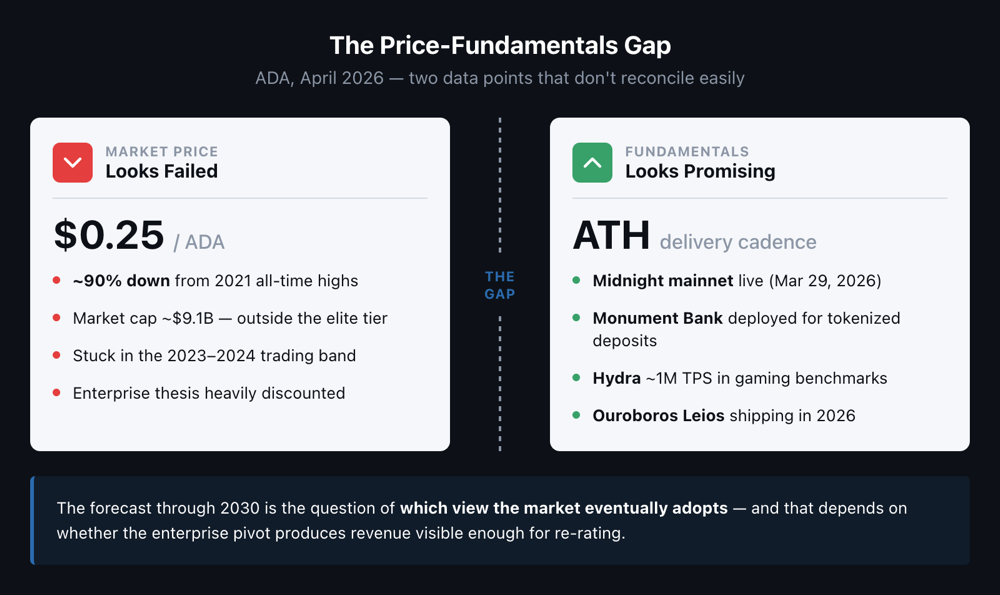
Cardano in April 2026 is a strange asset to forecast. ADA is trading around $0.25, down from the all-time highs of the 2021 cycle by roughly 90%, which makes it look like a project that’s failed. At the same time, the Midnight privacy sidechain launched mainnet on March 29, 2026, with Monument Bank already live for tokenized deposits, and Hydra — Cardano’s layer-2 scaling solution — has demonstrated throughput approaching a million transactions per second in gaming-focused benchmarks. That’s the opposite profile of a failed project.
Both data points are real and they don’t reconcile easily. The honest forecast for ADA through 2030 starts with the question of which data point matters more for price.
Most ADA prediction articles you’ll find on the web are either hype recycling from 2021 (“ADA to $10 inevitable”) or disappointment recycling from 2023 (“ADA is a technical museum piece that never delivered”). Neither narrative fits the April 2026 data. Cardano is finally shipping the things it promised, and the price hasn’t caught up because the enterprise revenue thesis takes years to validate. That’s a specific forecasting problem and it deserves a specific forecast.
This article takes the current state seriously. Where ADA stands, what Midnight actually is, what Hydra actually does, three scenarios from bull to bear, and a year-by-year table. The reasoning is what matters; the numbers are illustrative of the reasoning.
Where ADA Stands in April 2026
As of early April 2026, ADA is trading at approximately $0.248, with forecast ranges for the full year typically cited between $0.25 on the low end and $0.80 on the upper end under favorable conditions. The market cap sits around $9.1 billion, which keeps ADA in the top fifteen by market cap without being in the elite tier.
The price-to-fundamentals gap is wide. ADA’s network usage, developer activity, and enterprise engagement are arguably at all-time highs; the token price is in the same band it traded in during 2023 and 2024. This gap can close in either direction over a forecast horizon — through price appreciation as the fundamentals get recognized, or through narrative resignation if the enterprise pivot doesn’t produce visible revenue.
Reading the current price correctly: the market is heavily discounting the enterprise thesis. It is not pricing in the Midnight mainnet launch in any meaningful way. It is not pricing in the Hydra throughput demonstrations. The implied probability the market is assigning to “the enterprise pivot works” is low. The bull case on ADA, structurally, is about whether that implied probability is correct or too pessimistic.
Midnight — What It Is and Why Banks Care
Midnight is Cardano’s privacy-focused sidechain, and it launched mainnet on March 29, 2026. This is arguably the most important single event in Cardano’s 2024–2026 delivery cadence and it deserves a dedicated section in the forecast.
The pitch for Midnight, in plain language: it’s a blockchain that gives regulated institutions the privacy properties they need (selective disclosure, programmable compliance, confidentiality of sensitive transaction details) without the properties that make most privacy blockchains ineligible for institutional use (complete opacity, no compliance hooks, no identity integration where needed). It’s privacy for finance, not privacy against finance.
Monument Bank is already live on Midnight for tokenized deposits. That is a single data point — one bank, one product — but it’s the kind of data point that either leads to more of them or doesn’t. If Monument’s experience is positive and other regulated institutions follow, Midnight becomes the regulated privacy layer for a non-trivial chunk of tokenized finance. If Monument stays the only name on the list in six months, the thesis is weaker than the initial launch suggested.
The Cardano team has confirmed that Cardano infrastructure sits underneath every Midnight commercial deal, which is the explicit link back to ADA value capture. Institutional adoption of Midnight flows, by design, back to Cardano’s economic model. Whether that flow is material enough to move ADA’s price over a multi-year horizon is the question the forecast is answering.
Hydra and Ouroboros Leios — The Scaling Story
Hydra is Cardano’s layer-2 micropayment solution. It uses state channels and multi-party computation to enable very high throughput for specific use cases — primarily gaming and micropayments, though the architecture generalizes. Hydra has demonstrated throughput approaching a million transactions per second in gaming-focused environments. That number is real in the specific context it was measured; it is not a general-purpose “Cardano does 1M TPS” claim, which is the kind of framing the less-careful coverage turns it into.
Where Hydra matters for the forecast: it removes the throughput ceiling as a bottleneck for consumer-facing applications built on Cardano. If a consumer app with genuine user demand lands on the ecosystem, Hydra provides the scaling headroom without the application needing to move to a different chain. That’s a precondition for some kinds of growth but it’s not by itself a growth catalyst. Throughput is necessary, not sufficient.
Ouroboros Leios is the broader scaling upgrade slated for 2026. It enhances base-layer throughput by parallelizing block production in ways the original Ouroboros design didn’t. The technical details are worth a separate article; for this forecast the relevant point is that base-layer capacity keeps improving through the forecast window.
Neither Hydra nor Leios is an immediate price catalyst on its own. Both are preconditions for the kinds of use cases that could produce fee revenue at scale. The forecast treats them as infrastructure — the road, not the car.
Bull Case — Why ADA Could Outperform Through 2030
The bull case for ADA is not a meme cycle story. It’s an enterprise revenue story that requires specific things to happen in a specific order.
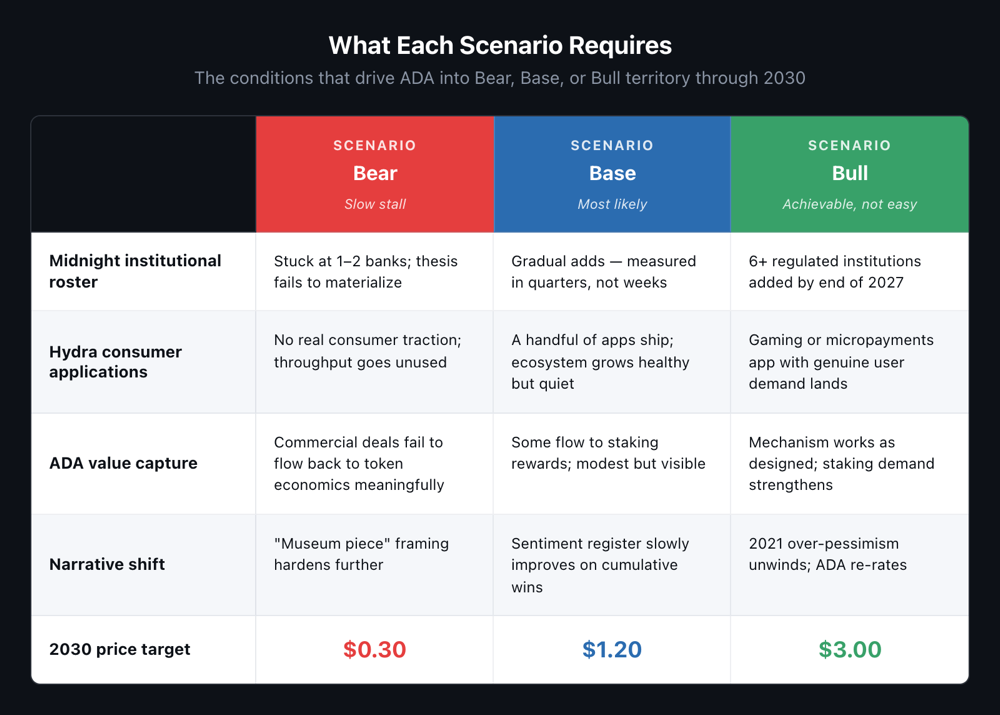
Midnight gains a meaningful roster of institutional users through 2026 and 2027. Monument Bank is the first name. Adding another half-dozen regulated financial institutions to the list by the end of 2027 would materially change the narrative. Each institutional deployment is harder to reverse than it is to land (institutional crypto integrations are sticky), so the flow compounds if it starts.
Hydra-enabled consumer applications land. A gaming platform or a micropayments-native application with real user traction, built on Cardano because of the throughput and economic properties, shifts the public perception of what Cardano is for. The ecosystem stops being “a technical project waiting for its moment” and becomes “the chain where X category happens.”
The ADA value capture mechanism works as designed. Midnight commercial deals flow value back to Cardano infrastructure, which flows to staking rewards, which supports ADA demand. The math here isn’t obvious from outside and depends on implementation details the market hasn’t yet digested.
The 2021 discount unwinds partially. Some portion of the 90% drawdown from 2021 highs was narrative collapse rather than fundamental impairment. If the fundamental story starts catching up, part of that discount can close without requiring new narrative hype — just a correction of over-pessimism.
Regulatory clarity favors privacy-with-compliance assets. As MiCA and AMLR push centralized crypto toward banking-adjacent compliance, an asset that offers both privacy and compliance becomes unusually well-positioned. Midnight is essentially the only major project in that specific intersection.

Bull-case targets at the bottom. This outcome requires many things to go right simultaneously — not impossible, not the most likely.
Base Case — The Most Likely Path
The base case is a slow grind of narrative recovery with intermittent proof points.
Midnight adds institutional users gradually. The Monument Bank deployment is followed by others, but the cadence is measured in quarters rather than weeks. Each new logo is a narrative win that doesn’t move the price much by itself but cumulatively shifts the sentiment register.
Hydra and Leios continue to ship. Developers who are paying attention notice. Developers who aren’t continue to default to Ethereum L2s or Solana. The ecosystem grows at a pace that’s healthy but not spectacular.
ADA price appreciates through the forecast window but doesn’t hit 2021 highs in real terms. The 2021 price was driven by a combination of genuine enthusiasm and a cycle top; recovering to those nominal levels without another full cycle top is unlikely. The base case is a gradual repricing toward a number that reflects the maturing fundamentals, not a return to the speculative peak.
Through 2027 and 2028, ADA tracks BTC with an ecosystem-specific component driven by enterprise traction. Through 2029 and 2030, the picture clarifies — either the enterprise pivot produced durable revenue or it didn’t.
The base case price band at the end of the forecast window is meaningfully higher than current levels but not in 2021 territory.
Bear Case — What Would Break the Forecast
The bear case for ADA has two distinct forms and they’re worth separating.
Path 1: The enterprise pivot doesn’t produce revenue. Midnight stays at one or two institutional users for the duration of the forecast window. The banks that evaluated it decide other solutions meet their needs better. The infrastructure is shipped, the technical work is impressive, and it produces approximately no fee revenue relative to the size of the token’s market cap. Under this path, ADA remains an asset that has interesting technology and a disappointing economic outcome.
Path 2: A specific technical or governance failure damages the brand further. A bug in a critical component, a contentious governance vote that splits the community, a major ecosystem project leaving for another chain. Any of these hardens the “ADA is a museum piece” narrative and makes the price harder to support even at current levels.
The bear case doesn’t require anything dramatic to happen. It just requires nothing specific to happen — for the enterprise story to fail to materialize in a visible way for long enough that the market gives up on the thesis. That’s a slow bear, not a fast one, and it’s harder to identify in real time than a catastrophic event. Anyone modeling the bear case should be paying attention to the Midnight institutional roster count and the Hydra consumer application pipeline as their leading indicators.
Year-by-Year Forecast (2026–2030)
| Year | Bear | Base | Bull |
|---|---|---|---|
| 2026 | $0.18 | $0.42 | $0.85 |
| 2027 | $0.15 | $0.55 | $1.20 |
| 2028 | $0.17 | $0.72 | $1.80 |
| 2029 | $0.22 | $0.95 | $2.40 |
| 2030 | $0.30 | $1.20 | $3.00 |
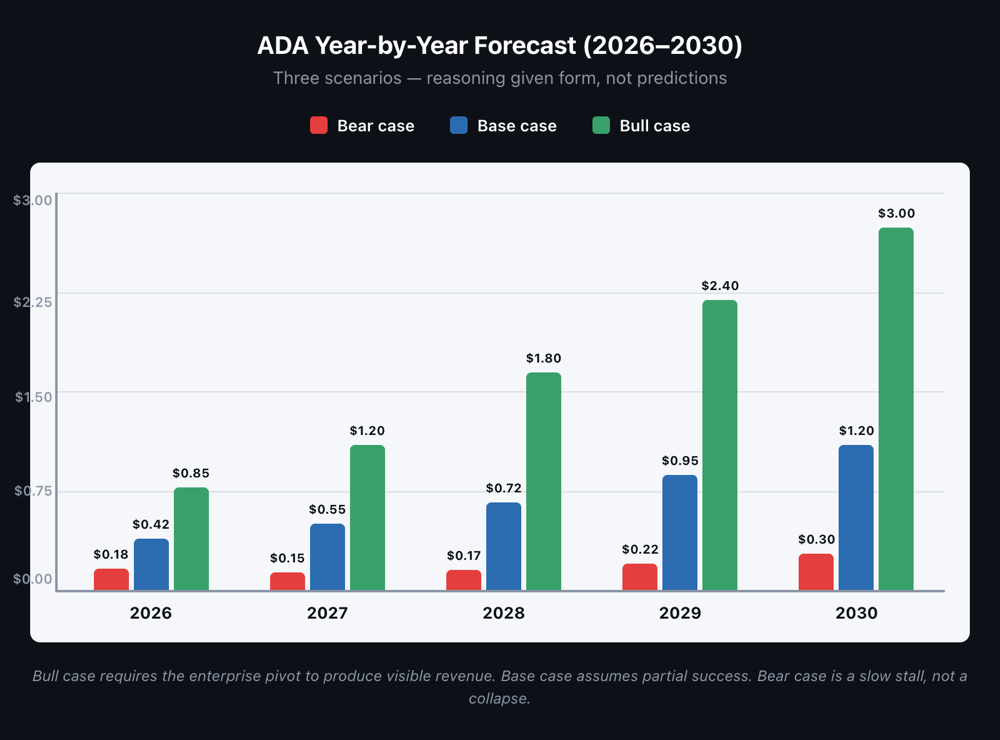
The numbers above are scenarios, not predictions. A few notes on reading them:
- The bull case requires the enterprise pivot to produce visible revenue through the forecast window. If you don’t believe the enterprise story is credible, you should be somewhere in the bear-to-base column for the entire window.
- The base case requires partial success — some institutional adoption, some consumer application traction, gradual narrative recovery. It’s the most likely outcome in our reading.
- The bear case doesn’t collapse the price catastrophically. It just keeps it stuck in the current range with marginal drift. A “stalled” bear is different from a “breaking” bear.
- The $3 upper bound in 2030 is not a return to 2021 highs in real terms — it’s a meaningful appreciation from current levels but not a hype-cycle peak.
How to Acquire ADA in 2026
ADA is widely available on centralized exchanges that retained their listing through the 2024–2025 regulatory wave, and through non-custodial swap services for users who prefer not to create an account. A non-custodial swap like Godex.io supports ADA across its 934+ pair list with a fixed-rate option and no volume caps. For a walk-through of the non-custodial swap model, see the Godex step-by-step guide.
Risks
- Thesis risk. The enterprise pivot is the core bullish narrative. If it doesn’t convert to revenue, the forecast shifts toward the bear column.
- Competitive risk. Ethereum, Solana, and newer L1s compete for the same developer attention and the same institutional budget. Cardano’s positioning is differentiated but not unique.
- Governance risk. Cardano’s on-chain governance is novel and untested at scale under contentious conditions. Smooth governance is assumed in the base case.
- Liquidity risk. ADA’s order books are adequate but not deep by the standards of the top-five assets. Large positions should be sized accordingly.
- Narrative risk. ADA’s brand spent 2022–2024 in a specific “disappointment” register in crypto-native media. That narrative is sticky and takes real catalysts to shift.
The Bottom Line
ADA in April 2026 is an asset that looks failed if you look at the price and looks promising if you look at the delivery schedule. Both views are internally consistent with their data. The forecast through 2030 is the question of which view the market eventually adopts — and the answer depends on whether the enterprise pivot, Midnight specifically, produces revenue visible enough for the market to re-rate the asset.
The bull case is achievable but requires several independent conditions to hold. The base case is the most likely outcome. The bear case doesn’t require anything dramatic, just a failure of the thesis to materialize in visible form. Anyone holding ADA through 2030 should be watching the Midnight institutional roster and the Hydra consumer pipeline as their primary fundamental indicators, not the price chart.
The numbers above are scenarios that follow from this reasoning. Treat them as reasoning given form, not as targets.
Last updated: April 8, 2026. Nothing in this article is financial advice. Do your own research and size positions to your risk tolerance.
Start a Cryptocurrency exchange
Try our crypto exchange platform
Disclaimer: Please keep in mind that the content of this article is not financial or investing advice. The information provided is the author’s opinion only and should not be considered as direct recommendations for trading or investment. Any article reader or website visitor should consider multiple viewpoints and become familiar with all local regulations before cryptocurrency investment. We do not make any warranties about reliability and accuracy of this information.
Read more
You may well think that an article dedicated to a Tether price prediction or the Tether price in general is a little bit strange — it is a stablecoin after all. However, the price of Tether does fluctuate significantly, although it is nowhere near as volatile as non-stablecoin cryptos. This means that staying up to […]
In the article we share our vision at Zcash cryptocurrency main features and add several price predictions. As cryptocurrencies gain global acceptance and decentralisation slowly enters our lives, privacy becomes the main concern when talking about blockchain adoption. It is no secret that distributed ledger is by far the most secure and transparent technology ever […]
Chiliz coin (CHZ) offers a compelling opportunity for traders interested in the intersection of blockchain technology and sports. By enabling fans to influence team decisions through the Socios app, Chiliz directly monetizes fan engagement and connects with major sports teams like Juventus and Paris Saint-Germain. These partnerships not only enhance the platform’s visibility but also […]
The exponential growth of Bitcoin Satoshi Vision (BSV) against the general bear trend on the cryptocurrency market in autumn 2019 has impressed the community. Due to the increasing market capitalization, the newly emerged altcoin was ranked 5th on CoinMarketCap and managed to maintain its high position at the beginning of 2020. In the article we […]
EOS is definitely on the list of the strongest and most stable projects in the crypto world. Despite the fact that the currency entered the market less than 3 years ago, it consistently occupies one of the top 10 places in the rating for project capitalization. it is often called the “main competitor of Ethereum”. […]
XRP price prediction 2026-2027: bear, base, and bull scenarios with ranges and named sources, the resolved SEC case, live spot ETFs, and can XRP reach $10?