
 Alex Tamm
Table of Contents
When you sign up for a crypto exchange, you’re making two trades at once. The obvious one involves coins. The less visible one involves your personal information. Every platform you use collects something about you, the question is how much, how long they keep it, and what happens to it when a regulator knocks or a hacker strikes.
This guide ranks 11 major exchanges from maximum data exposure to near-zero, so you can make an informed choice before you start trading.
Why Crypto Exchange Data Collection Matters More Than Ever
The stakes around exchange data collection have never been higher. In May 2025, Coinbase disclosed a breach in which attackers bribed customer support agents to extract sensitive user records: names, dates of birth, addresses, government ID numbers, and partial banking details. The company estimated the incident could cost up to $400 million. Meanwhile, the EU’s Transfer of Funds Regulation (TFR), which became enforceable in December 2024, now requires European crypto asset service providers to collect, verify, and retain originator and beneficiary data for every single transaction, regardless of value.
The result is a widening gap between exchanges that are data-heavy by design and those built on minimal collection from the ground up. Understanding where each platform falls on that spectrum is now a fundamental part of managing your crypto security.
At a Glance: How 11 Exchanges Stack Up on Privacy
| # | Exchange | KYC Required | Data Deleted? | Biometrics | Order History Stored | Privacy Score |
|---|---|---|---|---|---|---|
| 1 | Godex | Identity-light | After 2 weeks | No | Deleted | 5/5 |
| 2 | Bisq | None | N/A | No | Local only | 4/5 |
| 3 | dYdX | None (on-chain) | N/A | No | Public blockchain | 4/5 |
| 4 | Bitfinex | Full | Up to 10 years | Yes | Yes | 3/5 |
| 5 | MEXC | Tiered | Varies | Partial | Yes | 3/5 |
| 6 | KuCoin | Full (added 2023) | Varies | Yes | Yes | 2/5 |
| 7 | Bybit | Full | After ~5 years | Yes | Yes | 2/5 |
| 8 | OKX | Full (mandatory) | After 5+ years | Yes | Yes | 1/5 |
| 9 | Kraken | Full | After ~5 years | Yes | Yes | 1/5 |
| 10 | Binance | Full | After ~5 years | Yes | Yes | 1/5 |
| 11 | Coinbase | Full | After ~5 years | Yes | Yes | 0/5 |
#1 Godex — A Privacy-Focused Instant Exchange That Deletes Order Data After Two Weeks
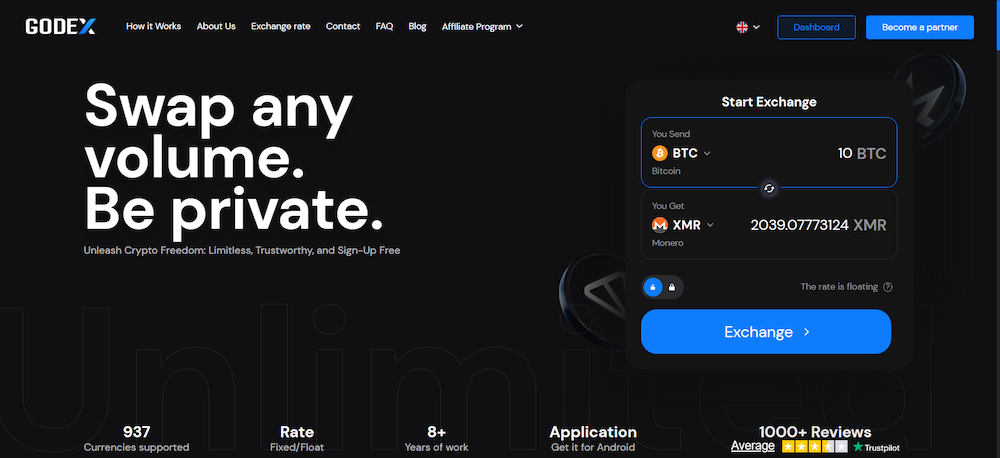
Godex collects the least personal data of any exchange on this list — and its architecture is built to keep it that way. As a privacy-focused instant exchange, Godex operates on a sign-up-free model: you initiate a swap, send your coins, and receive the exchanged asset directly to your wallet. The only information the platform handles is what is technically required to process that transaction: wallet addresses, transaction hashes, and exchange IDs.
Here is what makes Godex structurally different from the exchanges above:
- Sign-up-free access — because no persistent account is created, there is no account profile to breach, freeze, or subpoena
- Minimal identity footprint — Godex applies a risk-based approach to compliance, meaning routine swaps generate no identity paper trail; the platform doesn’t collect government IDs, biometric data, or address documentation as a default practice
- Automatic deletion — order data is removed after two weeks, not retained for five or ten years the way regulated CEXs are required to hold it
- Non-custodial — Godex never holds your funds in a centralized wallet, eliminating the custody relationship that regulators can compel disclosure through
- 937 supported coins — being identity-light doesn’t mean being asset-light; the trading breadth is comparable to major centralized platforms
The privacy design is architectural, not merely a current policy. Platforms like Coinbase, Binance, and Kraken were targeted in the 2025 wave of social engineering attacks specifically because they maintained large, centralized databases of verified user identities. A confidential trading platform that minimizes what it collects in the first place presents a fundamentally different risk profile — there is far less data to breach, compel, or expose.
Godex does retain some minimal technical data when operationally necessary — for instance, to resolve refund requests or support cases — and may receive an email address if a user chooses to provide one. But the platform’s default posture is to collect as little as possible and delete it on a defined schedule.
Bottom line: Among the 11 exchanges on this list, Godex stands alone as a high-privacy, instant-access platform that keeps the identity footprint of each swap as small as architecturally possible — without sacrificing asset selection or trading speed.
Website: godex.io
#2 Bisq — Maximum Decentralization, Maximum Privacy Effort
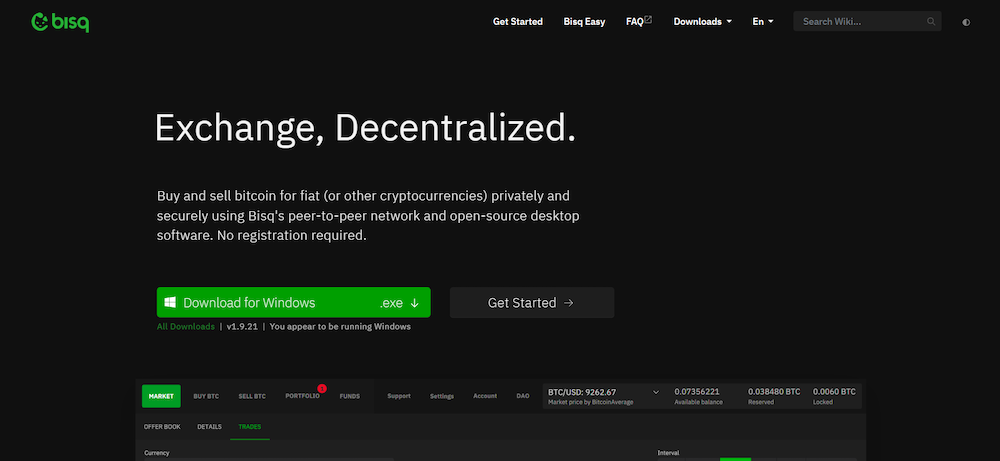
Bisq is a fully decentralized, open-source, peer-to-peer exchange that requires no registration, no KYC, and stores no user data on any central server. It represents the ideological extreme of the privacy-first exchange philosophy.
Bisq’s privacy characteristics:
- No central server stores personal information
- Operates over Tor by default, masking IP addresses
- Trade data is stored locally on users’ devices only
- No company to subpoena, no database to breach
The significant tradeoffs are real. Bisq has lower liquidity than centralized alternatives, supports fewer trading pairs, has a steeper learning curve, and processes trades more slowly. For traders who need high volume or a wide asset selection, it may not be practical.
Bottom line: Bisq is the purest expression of privacy-first crypto trading. Its tradeoffs are significant, but for users who prioritize privacy above all else, it is architecturally the most robust non-custodial option.
Website: bisq.network
#3 dYdX — Decentralized by Design, Minimal Data by Default
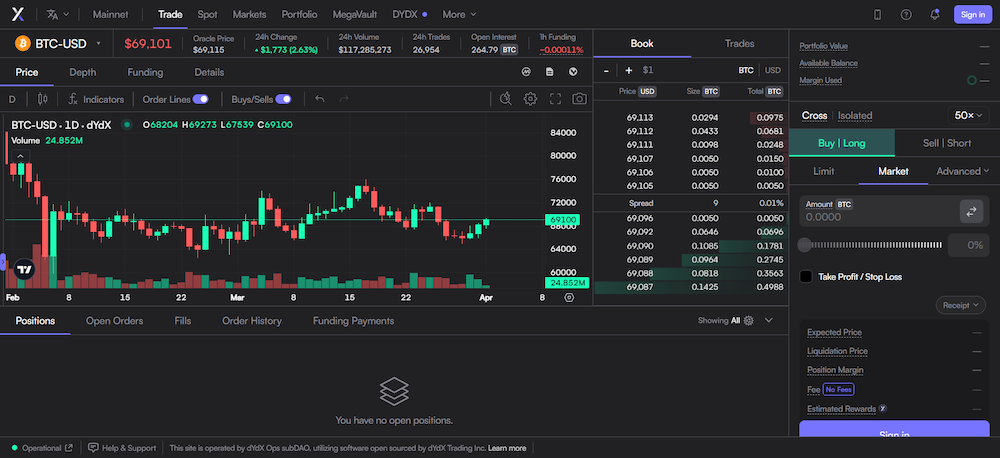
dYdX is a decentralized exchange (DEX) that, for most users, requires no identity verification and collects no centralized personal data. Trades execute on-chain through smart contracts, meaning the platform itself never takes custody of your funds or your identity.
What dYdX does collect:
- Nothing that identifies you personally (for standard use)
- IP addresses may be logged at the infrastructure level
- On-chain transaction data is, by definition, publicly visible on the blockchain
The privacy tradeoff with dYdX and DEXs generally is that while the platform collects minimal personal data, blockchain transactions are public. Anyone with sufficient analytical tools can observe on-chain activity. This is different from centralized exchange privacy risks, but it is still a consideration for users who want complete transactional privacy.
dYdX also has more limited asset selection, higher technical complexity, and fewer customer support options than centralized alternatives.
Bottom line: dYdX offers excellent privacy from a data-collection standpoint, with the caveat that blockchain transparency is a different kind of exposure.
Website: dydx.exchange
#4 Bitfinex — Long Retention Windows and Full KYC
Bitfinex collects full KYC documentation and is notable for one of the longer data retention windows in the industry. Reviews of its privacy policies have flagged that user data may be stored for up to 10 years after an account is deleted — substantially longer than the five-year standard cited by most exchanges.
Bitfinex does collect biometric data during verification, government IDs, and full trading histories. The extended retention period means that even users who close their accounts remain in Bitfinex’s databases for a decade.
The platform suffered a significant hack in 2016, underscoring the long-term risk that extensive, long-retained data creates. Holding user identity records for 10 years is 10 years of exposure windows.
Bottom line: The combination of full KYC and extended data retention makes Bitfinex one of the higher long-term privacy risks among regulated exchanges.
Website: bitfinex.com
#5 MEXC — Tiered KYC with Better Low-Volume Privacy
MEXC operates a tiered verification system, allowing basic trading and withdrawals up to certain thresholds without full identity verification. Below those thresholds, data collection is significantly more limited than the fully compliant exchanges above.
For users operating under MEXC’s lowest tier, the exchange collects primarily transactional data — wallet addresses and exchange records — without government-issued ID or biometrics. However, higher withdrawal limits, fiat on/off ramps, and certain advanced features trigger full KYC requirements that match industry standards.
The tiered model is common across many exchanges in 2026, but it comes with important caveats:
- Policies can and do change without notice
- Thresholds may be lower than marketed in certain jurisdictions
- Even “no-KYC” tiers typically log IP addresses and behavioral data
Bottom line: MEXC offers meaningful privacy at low trading volumes, but its tiered system isn’t a structural commitment — it’s a current policy that could change.
Website: mexc.com
#6 KuCoin — Privacy Champion Turned KYC-Mandatory
KuCoin added mandatory KYC requirements in 2023, ending its earlier reputation as a low-friction, relatively private exchange. This shift is worth documenting because it shows how quickly the landscape can change.
Prior to implementing KYC, KuCoin attracted users specifically because it allowed substantial trading without identity verification. Regulatory pressure — particularly around FATF compliance standards and jurisdictional enforcement — pushed the exchange to implement full identity verification, biometrics, and address documentation.
KuCoin now holds the same category of data as any major regulated exchange: government IDs, transaction histories linked to verified identities, and device/IP logs. Users who chose KuCoin for privacy reasons no longer have the platform they signed up for.
Bottom line: KuCoin’s trajectory demonstrates why structural architecture matters more than current policy when evaluating exchange privacy. What a platform collects today can change; how it is built does not.
Website: kucoin.com
#7 Bybit — Full KYC with High-Volume Trading Focus
Bybit requires KYC verification and collects the standard suite of identity documents, biometric data, and transaction records associated with regulated centralized exchanges.
Bybit suffered a historic $1.5 billion security breach in early 2025 — the largest in crypto history. While the breach targeted custodial assets rather than user data specifically, it demonstrated the scale of risk that centralizing both assets and identity information creates. No centralized database of user records is immune from targeting; the only way to eliminate the risk is to not create the database in the first place.
Bybit does offer tiered KYC, with basic trading available at lower verification levels. But for higher withdrawal limits and full platform access, comprehensive identity verification is required.
Bottom line: Bybit’s breach history is a concrete illustration of custodial risk. Data collection and asset custody create linked vulnerabilities.
Website: bybit.com
#8 OKX — Mandatory KYC After a $504 Million Fine
OKX now requires full KYC verification for all users, following its $504 million settlement with the US Department of Justice in February 2025 over AML failures. This makes it one of the clearest examples of regulatory enforcement pushing a formerly more permissive exchange toward comprehensive data collection.
Before 2024, OKX operated with more lenient verification tiers. That era is over. Users must now submit government IDs, biometric verification, and proof of address before accessing core trading features. The exchange retains this data for at least five years post-account closure.
What makes OKX notable in the privacy context is how quickly its data posture changed under regulatory pressure — a reminder that “currently no-KYC” is a policy choice that can reverse overnight, not an architectural guarantee.
Bottom line: OKX is a good case study in how external pressure reshapes data collection. Plan your privacy strategy around what a platform is built to do, not what it currently allows.
Website: okx.com
#9 Kraken — Compliance-Focused, Privacy-Limited
Kraken collects full KYC information and retains it for years, consistent with its reputation as one of the most compliance-oriented exchanges in the industry.
Its data collection includes government IDs, biometric verification, address documentation, bank account details, and full transaction history. Kraken, like Coinbase and Binance, was subject to a UK Supreme Court order requiring it to disclose user data in connection with a fraud investigation — demonstrating that compliant exchanges will share data when legally compelled.
Kraken does have a strong security reputation and successfully deflected a social engineering attempt similar to the Coinbase breach in 2025. But security and privacy are different things: Kraken can protect your data from hackers while still providing it to regulators.
Bottom line: If you need a heavily regulated exchange with strong security, Kraken is a reasonable choice. If you want minimal data exposure, it isn’t.
Website: kraken.com
#10 Binance — Global Scale, Global Data Collection
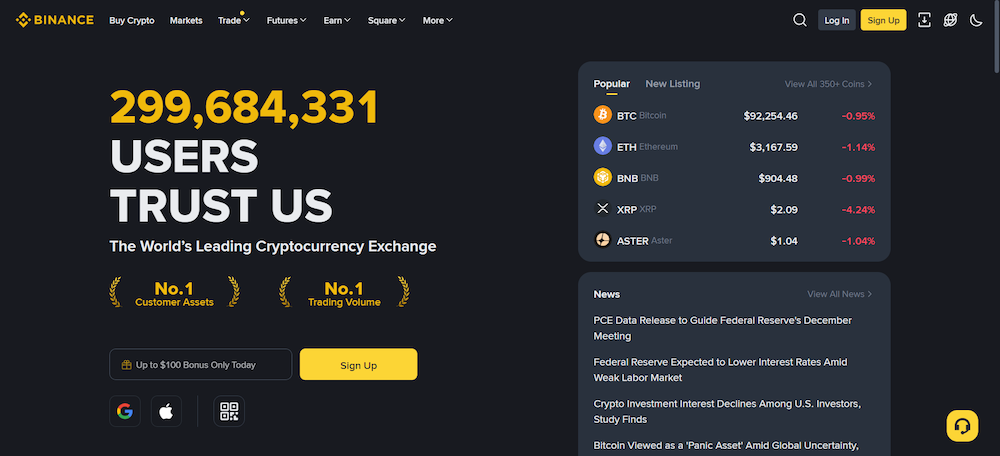
Binance requires full KYC verification and operates one of the most comprehensive data collection systems in the industry. With over 150 million users globally, the data it holds represents a significant concentration of personal financial information.
Standard Binance onboarding requires:
- Government-issued photo ID
- Facial recognition or selfie verification
- Residential address documentation
- Full trading history linked to verified identity
Binance paid a $4.3 billion criminal resolution to the US Department of Justice in November 2023 — the largest corporate criminal penalty in crypto history — partly related to AML and KYC compliance failures. Following that settlement, the platform doubled down on identity verification, making robust KYC mandatory for all users.
A notable privacy practice: Binance uses AI bots to monitor internal communications for potential bribery attempts — a system that successfully repelled a social engineering attack in 2025. That internal vigilance doesn’t change the fundamental reality that the platform holds a vast trove of user identity data.
Bottom line: Large user base and post-settlement compliance posture mean your data is thoroughly verified, stored at scale, and subject to broad legal jurisdiction.
Website: binance.com
#11 Coinbase — The Most Data-Hungry Exchange on This List
Coinbase collects more types of personal data than virtually any other exchange in the market. As a publicly listed, US-regulated company, it is subject to some of the most demanding compliance requirements in the industry — and its data practices reflect that fully.
What Coinbase collects about you:
- Full government-issued ID (passport, driver’s license, national ID)
- Biometric data for identity verification
- Email address and phone number
- Bank account numbers and card details
- Full trading and transaction history
- Device information, IP addresses, and geolocation data
- Behavioral usage data across its apps and platforms
The 2025 data breach underscored the real-world risk this creates. Even when no funds were directly stolen, exposed personal information became a vector for social engineering attacks. What’s more, the IRS famously obtained records on approximately 13,000 US Coinbase users after a protracted legal fight — a precedent that signals how government data requests can translate directly into user exposure.
Data is typically retained for around five years after account closure, though regulatory investigations can extend this indefinitely. Coinbase is transparent about its data practices, but transparency doesn’t reduce the volume collected.
Bottom line for privacy seekers: Coinbase is built for regulatory compliance first, user privacy second. If crypto privacy matters to you, this is the platform to avoid.
Website: coinbase.com
What You Should Actually Look for When Comparing Exchange Privacy
The ranking above applies several key criteria that go beyond the marketing headline of “no KYC.” Here is what actually matters:
Structural commitment vs. current policy. KuCoin was once considered privacy-friendly — until it wasn’t. OKX offered more permissive tiers — until regulatory pressure eliminated them. Platforms that are architecturally non-custodial and never build identity databases are less vulnerable to these reversals than those operating on a policy basis.
Data retention period. Five years is common; ten years is a significant risk extension. Two weeks is categorically different from either.
What triggers verification. Some platforms advertise low-friction access while implementing full identity checks at volume thresholds you might routinely hit. Understand the actual trigger conditions, not the marketing headline. The most reliable platforms are those whose minimal-data posture is built into their architecture rather than expressed as a current tier policy.
Custody model. Exchanges that hold your funds during a trade also create a regulatory relationship that can compel disclosure. Non-custodial architectures reduce this risk.
Breach history and response. The 2024–2025 period saw over $2.8 billion lost to exchange hacks, virtually all at custodial, data-rich platforms. That pattern is not coincidental.
The Bottom Line
Crypto grew from a movement that valued privacy and self-sovereignty. In 2026, that philosophy survives, but you have to look for it deliberately. The exchanges at the top of this ranking are compliant, regulated, and built to serve users who want a conventional financial services experience. The exchanges at the bottom of this ranking are built for something different: the original promise of trading without needing to hand over your identity first.
The right choice depends on your needs, trading volume, and jurisdictional context. But now you have the data to make that choice with your eyes open.
Frequently Asked Questions
If exchanges encrypt my data, why should I even care what they collect? Encryption protects against hackers — not against the exchange itself. Coinbase handed ~13,000 user records to the IRS. Kraken was court-ordered to disclose user data in a fraud case. Those aren’t security failures. That’s the system working as designed.
If I use a DEX, isn’t that automatically private — my wallet, my data? The DEX won’t hold your passport. But every transaction is permanently visible on-chain, and blockchain analytics firms can de-anonymize roughly 68% of “anonymous” users by combining transaction patterns with public data. DEX trading trades identity exposure for transaction history exposure. Neither is fully private.
If a no-KYC exchange gets shut down, what happens to my funds mid-swap? Non-custodial instant swap platforms process transactions in minutes — regulatory shutdowns almost never catch funds in transit. The real risk is centralized no-KYC platforms that hold funds between steps. The custody model is the variable that determines your exposure, not the KYC status.
This article is for informational purposes only and does not constitute financial or legal advice. Exchange policies are subject to change — verify current terms directly with each platform before transacting.
Start a Cryptocurrency exchange
Try our crypto exchange platform
Disclaimer: Please keep in mind that the content of this article is not financial or investing advice. The information provided is the author’s opinion only and should not be considered as direct recommendations for trading or investment. Any article reader or website visitor should consider multiple viewpoints and become familiar with all local regulations before cryptocurrency investment. We do not make any warranties about reliability and accuracy of this information.
Read more
XRP price prediction 2026-2027: bear, base, and bull scenarios with ranges and named sources, the resolved SEC case, live spot ETFs, and can XRP reach $10?
In this article we will talk about Ripple (XRP) and its price prediction. What is Ripple (XRP) Ripple is a San Francisco-based startup that was launched in 2012 by Ripple Labs as a global network both for cross-currency and gross payments. Ripple history began in 2004 with the discussions around the digital coin in the […]
You may well think that an article dedicated to a Tether price prediction or the Tether price in general is a little bit strange — it is a stablecoin after all. However, the price of Tether does fluctuate significantly, although it is nowhere near as volatile as non-stablecoin cryptos. This means that staying up to […]
In the article we share our vision at Zcash cryptocurrency main features and add several price predictions. As cryptocurrencies gain global acceptance and decentralisation slowly enters our lives, privacy becomes the main concern when talking about blockchain adoption. It is no secret that distributed ledger is by far the most secure and transparent technology ever […]
Chiliz coin (CHZ) offers a compelling opportunity for traders interested in the intersection of blockchain technology and sports. By enabling fans to influence team decisions through the Socios app, Chiliz directly monetizes fan engagement and connects with major sports teams like Juventus and Paris Saint-Germain. These partnerships not only enhance the platform’s visibility but also […]
The exponential growth of Bitcoin Satoshi Vision (BSV) against the general bear trend on the cryptocurrency market in autumn 2019 has impressed the community. Due to the increasing market capitalization, the newly emerged altcoin was ranked 5th on CoinMarketCap and managed to maintain its high position at the beginning of 2020. In the article we […]