
 Peter Moore
Table of Contents
The crypto space rewards the bold — but punishes the careless. Every year, millions of dollars vanish into fraudulent platforms that look professional, sound convincing, and disappear overnight. If you want to trade with confidence in 2026, knowing how to verify exchange legitimacy is not optional — it is the single most important skill you can develop as a crypto user.
This guide gives you a battle-tested security checklist to separate safe crypto exchanges from sophisticated traps, and shows you exactly what to look for before you ever deposit a single coin.
Why Verifying an Exchange Matters More Than Ever in 2026
Crypto scams have grown dramatically more sophisticated, and vetting a platform before using it is your most powerful defense. From fake Proof of Reserves to AI-generated endorsements and deepfake executives, the tactics fraudulent platforms use in 2026 are harder to spot than ever. Between 2018 and today, high-profile collapses — QuadrigaCX, PlusToken, and dozens of lesser-known operations — have wiped out billions in user funds. The common thread? Users skipped the verification step.
The good news: legitimate platforms leave clear, verifiable signals. You just need to know where to look.
Step 1: Check Regulatory Status and Licensing
A licensed exchange is one of the most reliable indicators of a safe crypto exchange. Every jurisdiction has its own regulatory framework. In the EU, the Markets in Crypto-Assets (MiCA) regulation now requires Crypto-Asset Service Providers (CASPs) to obtain authorization from national competent authorities, with ESMA’s centralized register expected to go fully live by late 2026. In the UK, registration appears on the FCA Register. In the US, check FinCEN for MSB registration and consult the SEC and CFTC databases for any enforcement actions.
How to verify exchange licensing in practice:
- Search the platform’s name on your country’s official financial regulator database
- Look for a registration or license number displayed on the exchange’s website
- Cross-check that number directly on the regulator’s portal — never trust the platform’s word alone
- Check whether services are restricted in your region, since large exchanges often hold approvals in some jurisdictions but not others
No license, no trade. It is that simple.
Step 2: Audit the Security Infrastructure
Strong security measures are non-negotiable markers of exchange legitimacy. Before moving any funds, you need to understand exactly how a platform protects user assets — not just what it claims, but what it can demonstrate.
The core security features every legitimate platform must offer in 2026:
- Two-factor authentication (2FA) — ideally hardware-key or app-based, not just SMS
- Cold storage for the majority of user funds, keeping them offline and away from hackers
- Multi-signature withdrawal protocols that prevent a single point of failure
- End-to-end encryption for account data and communications
- Regular independent security audits, with results published or verifiable
- Proof of Reserves (PoR) — transparent, third-party verified confirmation that user assets are fully backed
Also investigate the exchange’s history. A quick search for “[exchange name] hack” or “[exchange name] security breach” can reveal a great deal about how a platform has responded to threats in the past. Responsiveness and transparency after an incident often says more about a platform’s character than a clean record.
Step 3: Evaluate Transparency and Team Credibility
Trustworthy exchanges are open about who runs them. Anonymous leadership is a classic red flag in the crypto space. A legitimate platform will prominently feature its founding team, leadership structure, and company registration information. If you cannot find verifiable LinkedIn profiles, public track records, or even a named headquarters address, treat that as a serious warning sign.
Transparency also extends to fees and exchange rates. Hidden charges have derailed many traders who assumed a low-fee platform was exactly that. Always look for:
- A clearly published fee schedule with no ambiguous clauses
- Real-time exchange rate data visible before you confirm a swap
- Explicit policies on withdrawal limits, processing times, and fund custody
One example of a platform built around radical transparency is Godex. Godex offers transparent exchange rates and zero hidden fees across more than 934 coins, operating as a blockchain-powered crypto exchange with no registration required and a strict no-data-collection policy — user order information is deleted after two weeks. That kind of structural transparency is exactly what you want to see.
The 2026 Exchange Legitimacy Checklist
Use this table as your go-to reference before using any new platform:
| Verification Point | What to Check | Where to Check |
| Regulatory license | Registration number, active status | FCA, FinCEN, NCA, ESMA registries |
| Security features | 2FA, cold storage, PoR, audits | Platform’s security page, audit reports |
| Team transparency | Named leadership, verifiable backgrounds | Website, LinkedIn, CrunchBase |
| Fee structure | Explicit rates, no hidden charges | Fee schedule page |
| User reviews | Patterns in feedback, response to complaints | Trustpilot, Reddit, crypto forums |
| Domain authenticity | Exact URL match, HTTPS, no typosquatting | Browser address bar, WHOIS lookup |
| Proof of Reserves | Third-party verified asset backing | Published audit reports |
| Customer support | Response time, quality, available channels | Live test via chat or email |
Run through every row before depositing funds. If any item produces a red flag or unanswered question, stop and investigate further.
Step 4: Read Real User Feedback — Critically
User reviews are invaluable for verifying an exchange, but only if you read them with a discerning eye. Fraudulent platforms routinely manufacture five-star reviews to appear credible. Here is how to cut through the noise:
Look for patterns rather than individual reviews. A cluster of five-star reviews posted in the same week, all using similar language, is a manipulation signal. Equally, watch for how the platform responds to negative feedback — legitimate exchanges engage constructively, while scam operations tend to ignore or aggressively attack critics.
Consult multiple sources: Trustpilot, Reddit communities like r/CryptoCurrency, and specialized review platforms give you a broader, harder-to-fake picture. Pay special attention to reviews mentioning withdrawal issues — this is the area where fraudulent platforms most often reveal themselves.
Step 5: Verify the Domain and App Authenticity
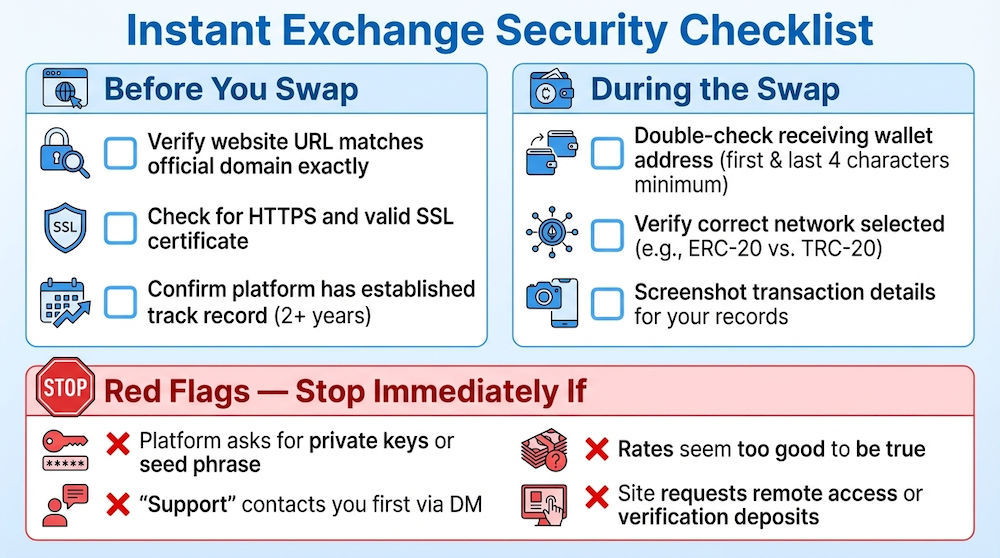
Phishing platforms are one of the most common tools scammers use to steal funds. They create near-identical copies of legitimate exchanges with URLs that differ by a single character — a technique called typosquatting. Always manually type exchange URLs or use a bookmarked link you set up yourself.
Before logging in, check:
- The URL is exactly correct, including subdomains
- The site uses HTTPS with a valid security certificate
- The domain registration date (new domains less than a year old warrant extra scrutiny)
- Mobile apps come only from links on the verified official website, not third-party stores or social media ads
If someone sends you a link to an exchange — especially on social media or through a private message — treat it as suspicious by default.
Step 6: Test the Exchange Before Committing Large Sums
Even after passing every verification step, start with a small transaction before moving significant value. A safe crypto exchange will process small trades and withdrawals smoothly and quickly. Problems at this stage — delays, unusual error messages, unexpected fees — tell you what you need to know before real money is at risk.
This is also the ideal time to test customer support. Reach out with a question before you need urgent help. Legitimate platforms respond promptly and professionally; scam operations are often evasive or unresponsive.
What a Genuinely Safe Exchange Looks Like in 2026

The safest platforms in 2026 share a recognizable profile: regulatory compliance in multiple jurisdictions, independently audited Proof of Reserves, named and verifiable leadership, crystal-clear fee structures, and a consistent track record of responsive customer support.
For traders who prioritize privacy without sacrificing reliability, platforms like Godex offer a compelling alternative model. No registration, no personal data collection, transparent rates, and fast execution across over 934 cryptocurrencies — with an affiliate program that lets users earn up to 0.6% of total transaction volume plus a 0.005 BTC welcome bonus. It is a model that takes the friction out of trading while keeping the integrity in.
The bottom line is this: verifying exchange legitimacy takes less than an hour, and it is the single highest-return investment of time you can make in your crypto journey. Use the checklist, trust your instincts, and never skip the verification step — no matter how legitimate a platform looks at first glance.
Staying informed is your best defense. Regulations shift, new platforms emerge, and scam tactics evolve. Bookmark the official registers for your jurisdiction, revisit your chosen platforms periodically, and share what you learn with others in your community. The more educated the market becomes, the harder it gets for bad actors to operate.
Start a Cryptocurrency exchange
Try our crypto exchange platform
Disclaimer: Please keep in mind that the content of this article is not financial or investing advice. The information provided is the author’s opinion only and should not be considered as direct recommendations for trading or investment. Any article reader or website visitor should consider multiple viewpoints and become familiar with all local regulations before cryptocurrency investment. We do not make any warranties about reliability and accuracy of this information.
Read more
You may well think that an article dedicated to a Tether price prediction or the Tether price in general is a little bit strange — it is a stablecoin after all. However, the price of Tether does fluctuate significantly, although it is nowhere near as volatile as non-stablecoin cryptos. This means that staying up to […]
In the article we share our vision at Zcash cryptocurrency main features and add several price predictions. As cryptocurrencies gain global acceptance and decentralisation slowly enters our lives, privacy becomes the main concern when talking about blockchain adoption. It is no secret that distributed ledger is by far the most secure and transparent technology ever […]
Chiliz coin (CHZ) offers a compelling opportunity for traders interested in the intersection of blockchain technology and sports. By enabling fans to influence team decisions through the Socios app, Chiliz directly monetizes fan engagement and connects with major sports teams like Juventus and Paris Saint-Germain. These partnerships not only enhance the platform’s visibility but also […]
The exponential growth of Bitcoin Satoshi Vision (BSV) against the general bear trend on the cryptocurrency market in autumn 2019 has impressed the community. Due to the increasing market capitalization, the newly emerged altcoin was ranked 5th on CoinMarketCap and managed to maintain its high position at the beginning of 2020. In the article we […]
EOS is definitely on the list of the strongest and most stable projects in the crypto world. Despite the fact that the currency entered the market less than 3 years ago, it consistently occupies one of the top 10 places in the rating for project capitalization. it is often called the “main competitor of Ethereum”. […]
XRP price prediction 2026-2027: bear, base, and bull scenarios with ranges and named sources, the resolved SEC case, live spot ETFs, and can XRP reach $10?