
 Peter Moore
Table of Contents
Every USDT transaction leaves a trail. Tether runs on public blockchains (Ethereum, Tron, BNB Chain), where every transfer is logged, timestamped, and permanently visible to anyone with a blockchain explorer. Custodial exchanges are legally required to record identities. Your financial activity is, by default, public record.
Monero is the other thing entirely. Not private-ish, not optionally private. Every XMR transaction hides the sender, the receiver, and the amount — not through configuration, but because that’s what the protocol does by design, for every transaction.
The swap is straightforward in 2026: no registration, no identity check, no waiting. Most of the platforms below need only a destination wallet address and a few minutes.
This guide covers ten options, from single-click centralized swaps to fully decentralized P2P networks, each suited to different priorities.
At a Glance: Platform Comparison
| Platform | Direct USDT→XMR | Infrastructure | Best for |
| Godex | Yes | Instant swap | Speed, no limits, fixed/floating rates |
| Exolix | Yes | Instant swap | Unlimited amounts, rate flexibility |
| Xchange.me | Yes | Instant swap | Simplicity, first-time users |
| Crypton Exchange | Yes | Instant swap | Maximum data minimization |
| PegasusSwap | Yes | Instant swap | Wide asset variety |
| RetoSwap | Yes | P2P / Tor | Full decentralization, no company |
| Bisq | Via BTC | P2P / Tor | Large P2P trades, XMR/BTC depth |
| RoboSats | Via Lightning | P2P / Lightning | Speed, zero identity footprint |
| Boltz | Via Lightning | Atomic swaps | Lightning-to-on-chain bridging |
| lnp2pbot | Via Lightning | P2P / Telegram | Social P2P, Telegram-native users |
Why Convert USDT to XMR?
Tether is transparent by design. Monero is private by design. For anyone who takes financial sovereignty seriously, the difference matters.
USDT lives on public blockchains. Every address, every transfer, every contract interaction is permanently on-chain. Chain analysis firms like Chainalysis and Elliptic specialize in mapping these graphs — linking addresses to identities, exchanges, and behavioral patterns. Tether can also freeze specific USDT addresses and has done so multiple times at law enforcement requests.
XMR achieves genuine on-chain privacy through three cryptographic mechanisms:
- Ring signatures — The real sender’s signature is blended with a set of decoys. An outside observer cannot tell which of the ring members actually authorized the transaction.
- Stealth addresses — Each transaction generates a unique, one-time receiving address. The recipient’s public wallet address never appears on the blockchain.
- RingCT (Ring Confidential Transactions) — Transaction amounts are encrypted while still proving mathematically that no coins were created or destroyed.
The result: a Monero transaction reveals nothing about who sent it, who received it, or how much moved. Privacy is automatic and mandatory, not a setting.
Regulation has been narrowing the conventional path to XMR. Kraken delisted Monero for EEA users in late 2024, ahead of MiCA Phase 2 — Article 76 of that regulation prohibits trading platforms from listing crypto-assets with built-in anonymization functions unless holder identity can be verified. Across the industry, 73 exchanges removed privacy coins in 2025, up 43% from 2023. Binance, OKX, HTX (formerly Huobi), and Bitstamp all restricted or removed XMR at various points.
The fewer compliant on-ramps remain, the more useful it is to know the alternatives. Below are ten of them.
What to Look for in a USDT-To-XMR Exchange
The best platform isn’t simply the one with the best rate. It’s the one that doesn’t undo the privacy you’re after.
Three things matter most:
- No KYC, no registration. Any platform requiring identity verification creates the data linkage you’re trying to avoid. A passport scan plus a USDT transaction equals a tied identity.
- Non-custodial model. If the platform holds your funds during the swap, you’re extending trust to a third party. Non-custodial means you control your assets until the swap settles.
- USDT network support. USDT exists on Ethereum (ERC-20), Tron (TRC-20), and BNB Chain (BEP-20). TRC-20 carries the lowest fees, worth factoring in before sending.
After those: rate transparency (fixed vs. floating), per-swap limits, settlement speed, and the platform’s own data practices.
Top 10 Platforms to Convert USDT to XMR
1. Godex
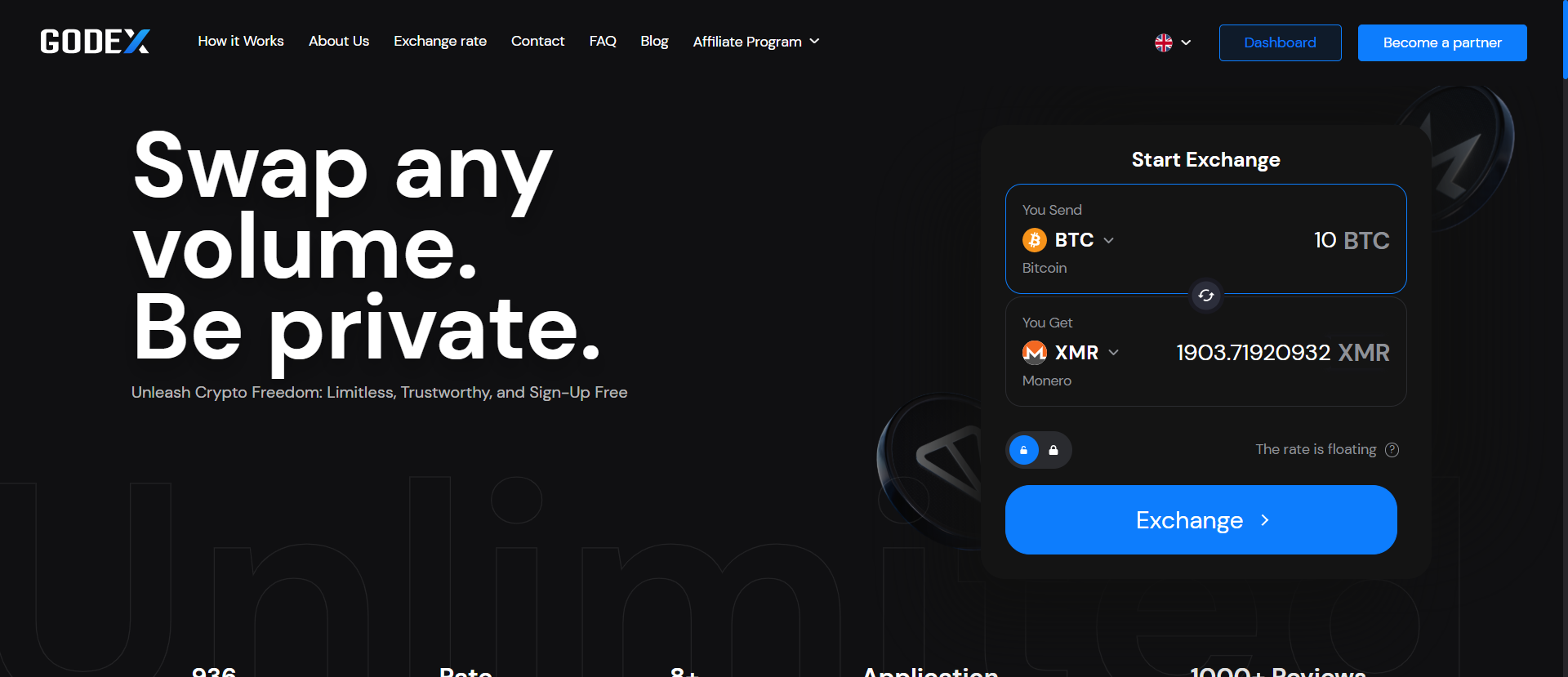
Godex (godex.io) processes USDT-to-XMR swaps with no account, no email, and no identity verification. The entire interaction happens through wallet addresses.
The mechanics are minimal: enter the amount, paste your XMR address, review the rate, send USDT. The platform generates a deposit address, confirms your incoming transaction, and delivers XMR to your wallet. No account is created.
A few things worth noting:
- No upper limit on swap amounts, which matters when other platforms cap trades
- Supports ERC-20, TRC-20, and BEP-20 USDT, so you choose the input network (and its fee)
- Both fixed and floating rates: fixed locks the rate at order time; floating tracks market price
- No email required at any stage
For users concerned about IP exposure, Godex works without connecting a browser wallet extension. Adding Tor or a no-log VPN puts another layer between your network activity and the swap.
2. Exolix

Exolix (exolix.com) supports over 1,755 cryptocurrencies and offers direct USDT-to-XMR pairs with no registration and no KYC for standard swaps. Unlike most platforms, it explicitly offers unlimited transaction sizes for XMR pairs.
Users choose fixed or floating rates. Fixed locks the exchange rate at order time and protects against price movement during settlement. Floating tracks market price and can yield slightly more XMR when conditions move in your favor.
Exolix charges no additional service fees beyond the network spread. Swaps typically settle in 5 to 30 minutes. TRC-20 USDT confirms faster and costs less than ERC-20 — worth choosing if speed and cost matter. All three major USDT networks are supported.
The platform also exposes an API for developers who need XMR as an output asset.
3. Xchange.me
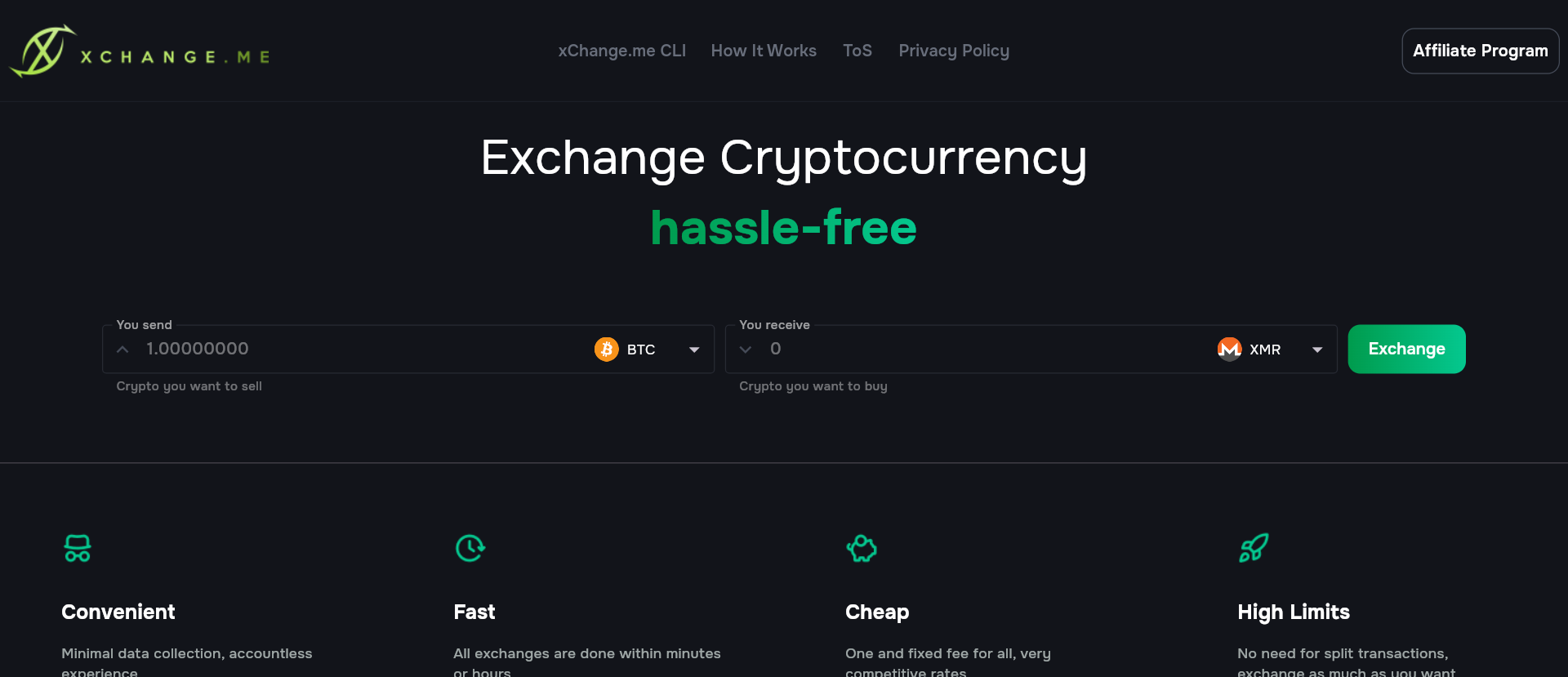
Xchange.me (xchange.me) is a no-registration instant exchange built around anonymity. It handles USDT-to-XMR through a clean interface with one useful feature: the expected XMR output is shown before you confirm the transaction.
Most swap platforms display an estimated rate that shifts between selection and execution. The gap is usually small but occasionally isn’t. Xchange.me’s approach reduces that uncertainty upfront.
Settlement runs 10 to 30 minutes. No account, no email, no extra steps. For a one-time conversion where you just want it done without reading documentation, this is one of the simpler options on the list.
4. Crypton Exchange
Crypton Exchange (crp.is) consistently scores highest in independent privacy evaluations among KYC-free platforms — above services that skip identity checks but still log extensively.
The difference is what happens after you send funds. Many no-KYC platforms still collect IP addresses, browser fingerprints, and transaction timestamps. Crypton was built with Monero users specifically in mind and avoids those logging practices at the infrastructure level. It supports USDT deposits and XMR withdrawals with no mandatory identity verification.
Most no-KYC platforms skip the passport scan. Crypton also skips the part where it quietly builds a metadata record of your activity. If your threat model includes the exchange itself as a potential data source, this distinction is worth taking seriously.
5. PegasusSwap
PegasusSwap (pegasusswap.com) is a no-KYC instant swap platform with broad asset coverage, competitive with the widest-variety platforms in the privacy exchange space.
For USDT-to-XMR, it offers direct pairs across USDT networks with no registration. The main draw is range: users managing multiple privacy coins or less common assets can handle everything on one platform instead of switching services for each swap. Competitive rates on high-volume pairs, no KYC by default.
6. RetoSwap
RetoSwap (retoswap.com) is in a different category from the five above. It’s a peer-to-peer, non-custodial decentralized exchange built on Haveno — a fork of Bisq — and runs exclusively over Tor.
Monero is the base settlement currency. Every trade ultimately settles in XMR, meaning the entire architecture is built around Monero’s privacy properties. Trades happen directly between two users. No company, no server, no custodian in the middle.
USDT is supported as a trade input. Users post or accept offers to exchange USDT for XMR in a P2P environment, with settlement secured by XMR’s multisig mechanism. Neither side can take the other’s funds without consensus.
The downsides:
- Setup involves downloading the RetoSwap application and syncing the Haveno network
- Liquidity is lower than on centralized platforms
- Settlement time depends on when a counterparty accepts your offer
But if privacy means “no third party at any level,” RetoSwap is the only option on this list that actually meets that standard. It removes the exchange company as a point of trust entirely.
7. Bisq
Bisq (bisq.network) is the original decentralized P2P exchange. No central server, no company, no accounts. Like RetoSwap, it runs over Tor and uses Bitcoin multisig for trade security.
It does not offer a direct USDT-to-XMR pair. The path runs: USDT to BTC via a separate no-KYC platform, then BTC to XMR via Bisq’s XMR/BTC market. Two steps, both within no-KYC infrastructure.
Bisq’s XMR/BTC market is one of the most liquid P2P XMR markets available — meaningful for larger trades where centralized platforms impose limits. A Bitcoin security deposit is required from both parties, which trips up first-time users but is what keeps the trust model intact over the long run.
Best fit: users comfortable with the setup process who are executing trades large enough to care about P2P depth and no upper limits.
8. RoboSats
RoboSats (robosats.org) is Bitcoin and Lightning only. It does not support XMR natively. The path to Monero goes in two legs: trade USDT for Lightning BTC on RoboSats, then convert that BTC to XMR via a separate no-KYC platform.
That said, RoboSats is worth knowing. Users generate a temporary robot avatar for each trade — no accounts, no usernames, nothing persistent. When the trade closes, the robot disappears. Lightning settlements happen in seconds and off-chain, so the first leg is fast enough that the two-step route is quicker than it sounds.
RoboSats works best when:
- Speed matters and you’re already in the Lightning ecosystem
- You want the lowest possible identity footprint across the whole process
- You’re fine handling the BTC-to-XMR conversion separately
The platform runs natively over Tor. No IP reaches the exchange.
9. Boltz
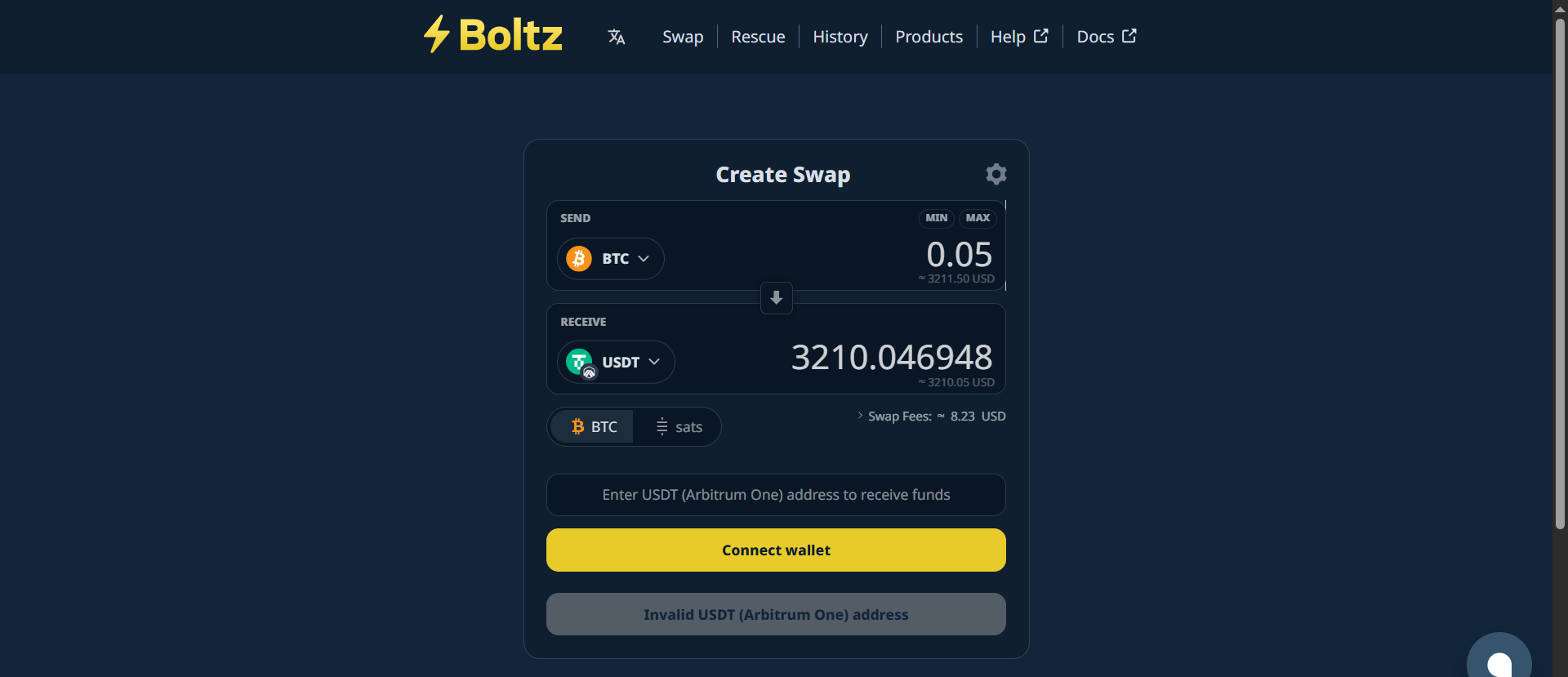
Boltz (boltz.exchange) is a non-custodial swap service for Bitcoin and Lightning, using submarine swaps — a type of atomic swap that moves value between Bitcoin’s on-chain and Lightning layers without a custodian.
As of March 2026, Boltz also handles USDT directly. It supports atomic, non-custodial swaps between Lightning sats and USDT on Arbitrum (via USDT0). That makes the USDT leg of a multi-hop privacy stack handleable by Boltz alone, with Lightning BTC as the bridge to XMR on another platform.
Still not a direct USDT-to-XMR service. But for users assembling a trustless multi-leg route, the code is open source and independently auditable, and the atomic swap mechanism means neither party can steal funds mid-swap.
10. lnp2pbot
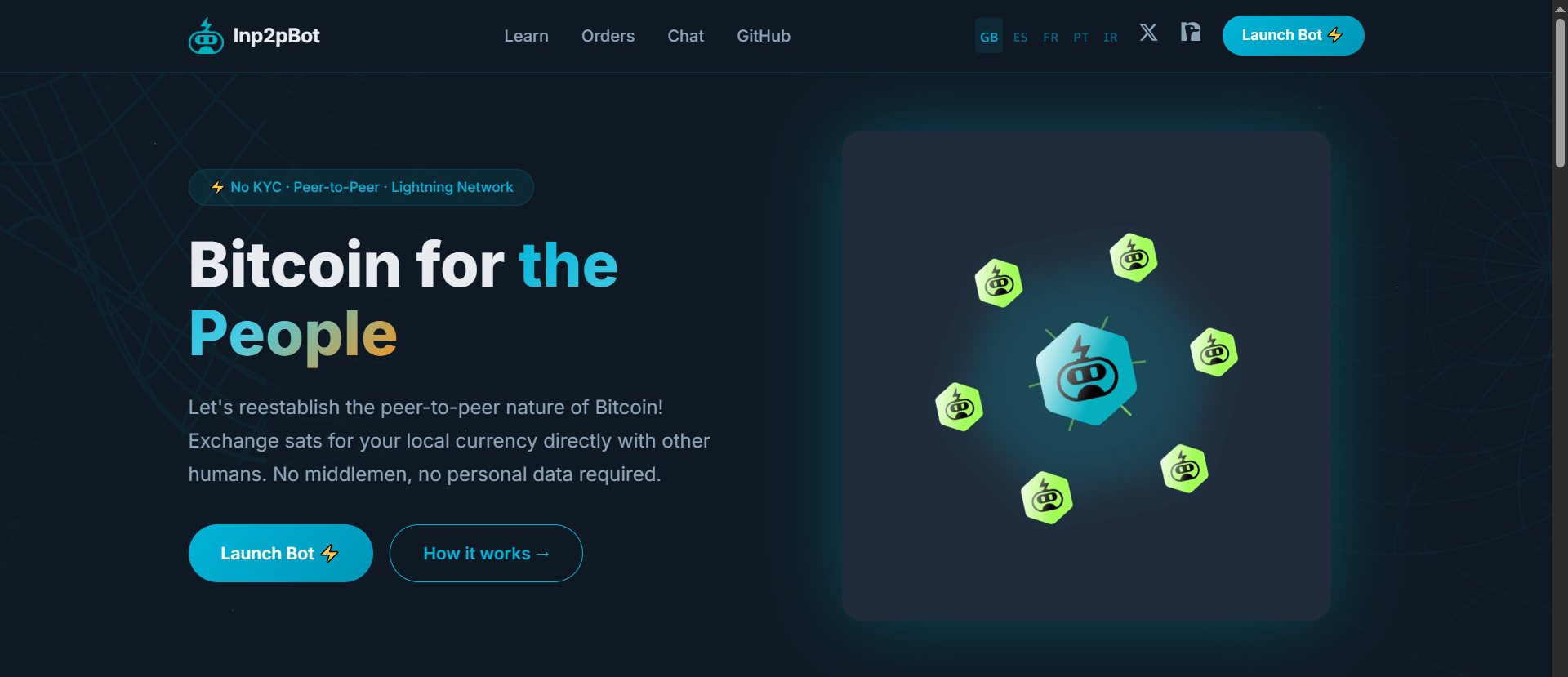
lnp2pbot (lnp2pbot.com) is a Telegram bot. Peer-to-peer Lightning Bitcoin trades happen inside the app, with the bot acting as escrow. No separate interface, no account to create.
Getting to XMR from USDT via lnp2pbot takes two legs: sell USDT for Lightning BTC through the bot’s P2P market, then convert that BTC to XMR elsewhere. Same structure as RoboSats.
What’s different is the social layer. Users build reputation scores across trades, creating trust without identity. The network covers most fiat currencies and major crypto pairs. For people already in Telegram all day who want P2P trading without leaving the app, it fits naturally into an existing workflow.
How to Convert USDT to XMR: Step by Step
The fastest route goes through any of the five centralized no-KYC platforms: Godex, Exolix, Xchange.me, Crypton, or PegasusSwap. The process is the same across all of them.
- Set up your XMR wallet. Download Feather Wallet, the official Monero GUI, or use a hardware wallet with XMR support. Copy your receiving address (or a subaddress — most wallets generate these automatically).
- Pick your platform. Consider which USDT network you’re sending from (TRC-20 is cheapest), whether you want a fixed or floating rate, and whether any per-swap limits apply.
- Enter the conversion details. Input the amount, select the USDT network, paste your XMR address.
- Review the rate. Confirm the expected XMR output before sending. On fixed-rate platforms, that number is what you get.
- Send USDT to the deposit address. The platform generates a one-time address. Send from a wallet you control, not from a custodial exchange — otherwise you’re attaching an exchange-linked identity to the transaction.
- Wait for settlement. Usually 5 to 30 minutes. Most platforms provide a transaction ID for tracking.
- Check your XMR wallet. Monero balances can take a few minutes to appear after confirmation while the wallet scans for your transaction.
For extra privacy: use Tor Browser or a no-log VPN when accessing swap platforms, generate a fresh subaddress for each incoming transfer, and avoid sending from custodial exchanges where your identity is already tied to the source wallet.
Conclusion
USDT-to-XMR isn’t a niche technical operation. It’s what a lot of users do when they want their on-chain activity to stay private — and in 2026, the infrastructure for it is genuinely solid.
Priorities vary. Speed and a direct swap: go centralized no-KYC (Godex, Exolix, Xchange.me, Crypton, PegasusSwap). No third party at all: RetoSwap or Bisq, which take longer but remove the exchange as a trust dependency. Already in Lightning: RoboSats, Boltz, and lnp2pbot cover that.
None of these platforms require registration. None will ask for a passport.
This article is for informational purposes only and does not constitute financial advice. Cryptocurrency regulations vary by jurisdiction. Always verify platform availability in your region before transacting.
Start a Cryptocurrency exchange
Try our crypto exchange platform
Disclaimer: Please keep in mind that the content of this article is not financial or investing advice. The information provided is the author’s opinion only and should not be considered as direct recommendations for trading or investment. Any article reader or website visitor should consider multiple viewpoints and become familiar with all local regulations before cryptocurrency investment. We do not make any warranties about reliability and accuracy of this information.
Read more
You may well think that an article dedicated to a Tether price prediction or the Tether price in general is a little bit strange — it is a stablecoin after all. However, the price of Tether does fluctuate significantly, although it is nowhere near as volatile as non-stablecoin cryptos. This means that staying up to […]
In the article we share our vision at Zcash cryptocurrency main features and add several price predictions. As cryptocurrencies gain global acceptance and decentralisation slowly enters our lives, privacy becomes the main concern when talking about blockchain adoption. It is no secret that distributed ledger is by far the most secure and transparent technology ever […]
Chiliz coin (CHZ) offers a compelling opportunity for traders interested in the intersection of blockchain technology and sports. By enabling fans to influence team decisions through the Socios app, Chiliz directly monetizes fan engagement and connects with major sports teams like Juventus and Paris Saint-Germain. These partnerships not only enhance the platform’s visibility but also […]
The exponential growth of Bitcoin Satoshi Vision (BSV) against the general bear trend on the cryptocurrency market in autumn 2019 has impressed the community. Due to the increasing market capitalization, the newly emerged altcoin was ranked 5th on CoinMarketCap and managed to maintain its high position at the beginning of 2020. In the article we […]
EOS is definitely on the list of the strongest and most stable projects in the crypto world. Despite the fact that the currency entered the market less than 3 years ago, it consistently occupies one of the top 10 places in the rating for project capitalization. it is often called the “main competitor of Ethereum”. […]
XRP price prediction 2026-2027: bear, base, and bull scenarios with ranges and named sources, the resolved SEC case, live spot ETFs, and can XRP reach $10?