
 Linda Larsen
Table of Contents
Stablecoins are where a lot of crypto capital parks between moves. When it’s time to rotate from Tether into Bitcoin — or to do a USDT to Bitcoin swap after sitting on the sidelines through a volatile stretch — the mechanics of how you execute that swap matter more than most people realize. The USDT to BTC exchange looks simple on paper. In practice, there are two layers of friction that can cost you money or, in the worst case, your funds entirely.
This guide covers both: the network fragmentation problem that trips up even experienced traders, and the custody and verification bottlenecks that make centralized exchanges a poor fit for anyone who needs to move fast. It also walks through exactly how to convert Tether to Bitcoin on Godex without an account, without KYC, and with a rate that’s locked before your deposit even confirms.
The Hidden Hurdles of a USDT to BTC Exchange
The Fragmentation of Stablecoin Networks: ERC-20 vs. TRC-20 and Beyond
Here’s something that catches people off guard: Tether isn’t a single token on a single blockchain. USDT is issued across multiple networks simultaneously — Ethereum (ERC-20), Tron (TRC-20), BNB Chain (BEP-20), Solana, and others. Each version is a distinct asset on a separate blockchain, even though they all share the same ticker and dollar peg.
This matters enormously when you’re initiating a USDT to BTC swap. The network your USDT lives on determines which deposit address is valid for your transaction. Send ERC-20 USDT to a TRC-20 deposit address, and those funds don’t arrive late — they’re gone. There’s no recovery mechanism. The blockchain processed exactly what you told it to, just not where you intended.
The fee structures differ too. ERC-20 transfers use ETH as gas, and costs spike during periods of Ethereum network congestion. TRC-20 on Tron is significantly cheaper per transaction, which is why it’s become the dominant standard for USDT transfers on lower-cost platforms. BEP-20 on BNB Chain sits somewhere in between. Knowing which version you’re holding — and confirming the network before you send — is the single most important step in a USDT BTC exchange.
Why Swapping Tether for Bitcoin Instantly Matters for Traders
Bitcoin’s price doesn’t wait. When a dip opens a buying window, the difference between executing in two minutes and executing in twenty minutes can mean a materially different entry price — and that’s before you account for the friction of centralized exchange login flows.
Standard centralized platforms layer verification steps on top of one another: 2FA confirmation, withdrawal whitelist checks, and internal processing queues. A trader holding USDT on a CEX who wants to buy Bitcoin during a sudden market move often finds themselves watching the opportunity close while the platform processes their request. Worse, verification requirements can escalate without notice — a withdrawal that worked fine last month now triggers an additional ID check.
The fix is straightforward: use a swap platform that accepts USDT directly from your wallet and routes it to Bitcoin without requiring an account, deposit history, or platform-verified identity. Whether you’re moving USDT to Bitcoin in one direction or rotating Bitcoin to USDT to lock in gains, the same logic applies — the fewer intermediaries with custody of your funds, the better.
Why the Traditional CEX Verification Route Fails
Beyond the speed problem, centralized exchanges introduce a custody risk that non-custodial swaps don’t. When you deposit USDT into a centralized platform, the exchange holds it. You hold an IOU, not the asset. That distinction matters when platforms freeze withdrawals, undergo maintenance at critical moments, or — in more dramatic cases — face insolvency.
The KYC requirement compounds this. Uploading identity documents creates a permanent record linking your wallet addresses to your legal identity. For traders who value financial privacy, this is the opposite of what a crypto swap should involve. And practically speaking, KYC verification on most platforms isn’t instant — onboarding can take hours to days, which is irrelevant if your goal is a same-session USDT BTC swap.
Why Godex Stands Out for a USDT BTC Swap
| Operational Metric | Traditional Centralized Exchanges | Godex Automated Gateway |
| Network flexibility | Requires manual deposit setup and matching internal sub-accounts per network | Native cross-chain routing for all major USDT standards (ERC-20, TRC-20, BEP-20) on a single screen |
| Speed to trade | Dependent on 2FA loops, login verification, and internal processing queues | Immediate execution once your on-chain deposit confirms — no internal queue |
| Slippage protection | Floating spot market rates — high volume can push your execution price down | Fixed-rate execution locks the conversion price for 30 minutes |
| KYC requirement | Mandatory identity verification; escalating requirements at higher volumes | Zero KYC at any transaction size |
| Data retention | Identity documents, wallet addresses, and trade history retained indefinitely | Transaction data erased within a week of completion |
| Transaction limits | Daily caps tied to verification tier | No upper limits — minimum amounts only, set to cover network fees |
One point in the data retention row deserves emphasis. Godex erases transaction records within a week — keeping only what’s needed to resolve active support cases (a tx hash or email address if you provided one), and clearing even that once the issue closes. No identity profile is ever created, because no registration is required to swap.
Step-by-Step Guide to Executing Your USDT to BTC Swap
Before you start: confirm which USDT network your tokens are on. Check your wallet — it will show whether your USDT is ERC-20, TRC-20, BEP-20, or another standard. You’ll need this information in step 3.
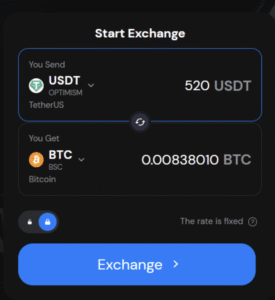
- Go to godex.io. In the “You send” field, select USDT and enter the amount you want to convert.
- Select BTC in the “You get” field. The platform calculates your estimated Bitcoin output in real time.
- Select your USDT network. This is the critical step. Match the network shown in Godex to the network your USDT actually lives on — ERC-20, TRC-20, or BEP-20. A mismatch here means lost funds with no recovery option.
- Choose your rate type. Fixed-rate locks your quoted BTC output for 30 minutes. Floating-rate adjusts to market conditions at execution. For larger amounts, a fixed rate is the more predictable choice.
- Enter your BTC destination address. This is the Bitcoin wallet that will receive your converted funds. Verify it carefully — there’s no reversing a confirmed blockchain transaction.
- Enter your USDT refund address on the same network as your deposit. This is where Godex returns your funds if the transaction fails for any reason.
- Click Exchange. Godex generates a unique USDT deposit address for your transaction, specific to your chosen network.
- Send your USDT from your wallet to that deposit address, on the correct network. If you selected fixed-rate, the amount must match exactly.
- Wait for confirmation. Once your deposit confirms on-chain, the engine executes the conversion and sends BTC to your destination address. Total time: typically 5 to 30 minutes.
- Done. Status updates to “Completed.” Your Bitcoin is in your wallet.
No login. No withdrawal queue. No verification hold.
How to Convert Tether to Bitcoin Without Giving Up Asset Control
Non-custodial swap platforms like Godex handle the USDT/BTC conversion differently. You keep your assets in your own wallet until the moment of the swap. The platform generates a one-time deposit address for your transaction; you send USDT from your wallet to that address, and BTC arrives in the destination wallet you specified. The platform never holds an account in your name and never takes custody, as a centralized exchange does.
The key technical element here is liquidity aggregation. Godex pulls rates from multiple trading venues in real time — including Bitfinex, HitBTC, Binance, and other partners — to find the best available conversion for your specific amount. You’re not trading against a single order book; you’re getting the output of a live rate comparison across the market.
On the rate side, you have two options:
With a floating-rate swap, the conversion price is calculated at the moment your USDT deposit confirms on-chain. If the market moved during the confirmation window, your BTC output reflects that movement, up or down.
With a fixed-rate swap, Godex locks the quoted conversion rate for 30 minutes from the moment you initiate the transaction. The USDT-to-BTC rate you see when you click Exchange is the rate that applies, regardless of what Bitcoin’s price does while your deposit is being confirmed. For anyone converting meaningful amounts of Tether, this is the more predictable option — it eliminates the slippage risk that floats with a floating rate.
The fixed-rate constraint: the deposit amount must exactly match the quoted amount. A mismatch breaks the lock. And if network congestion delays your USDT deposit beyond the 30-minute window, the rate automatically converts to floating. Under normal conditions, that window is more than sufficient — the average settlement time for a USDT BTC swap is 5 to 30 minutes end-to-end.
A Note on Network Fees for the USDT Transfer
The fee you pay to send your USDT to the Godex deposit address comes from your own wallet and depends entirely on the network you’re using. TRC-20 transfers on Tron are typically the cheapest — often a fraction of a dollar. ERC-20 transfers on Ethereum can run anywhere from a few dollars to significantly more during periods of high gas prices. BEP-20 sits in the middle.
This fee is separate from whatever Godex factors into the conversion rate. It’s a network cost you pay at the point of sending, not a platform fee. If you have flexibility over which USDT standard to use, TRC-20 is usually the most cost-effective for the transfer leg.
The Bottom Line
A USDT to BTC exchange sounds like a routine operation — and on a platform that handles the network complexity correctly, it is. The two things that make it go wrong are sending on the wrong network and using a platform that interposes custody, verification delays, or withdrawal queues between you and your Bitcoin.
Neither of those problems exists on a non-custodial, no-registration swap engine. Select the right network, lock your rate, send from your wallet, and the rest is automatic. That’s how converting Tether to Bitcoin should work.
FAQ: Everything You Need to Know About the USDT to BTC Pair
What is a no-KYC USDT to BTC exchange?
A no-KYC USDT-to-BTC exchange is a non-custodial swap platform that converts Tether into native Bitcoin without requiring identity documents, account registration, or any personal data. You send from your wallet; BTC arrives in your wallet. The platform is an execution engine, not a custodian.
How do you convert Tether to Bitcoin safely?
Send your USDT from a private wallet to a non-custodial swap service that routes the conversion through aggregated liquidity and deposits BTC directly into a destination address you control. The key safety steps: confirm the USDT network before sending, verify the deposit address, and use a fresh Bitcoin receiving address to avoid linking transactions.
How does a fixed-rate USDT BTC swap protect against slippage?
It locks the conversion price for 30 minutes from the moment you initiate the transaction. The Bitcoin amount shown at the start of your swap is what arrives in your wallet, regardless of price movement during network confirmation. This is particularly useful when converting large amounts of Tether, where even small rate shifts translate to meaningful differences in BTC output.
What networks can be used for a USDT to BTC swap on Godex?
Godex supports all major USDT token standards, including Ethereum (ERC-20), Tron (TRC-20), and BNB Chain (BEP-20). The network you select during the swap setup must match the network your USDT tokens actually live on — this is non-negotiable and cannot be corrected after the deposit is sent.
Are there transaction caps on a no-account USDT BTC exchange?
There are no upper limits on Godex. Minimum amounts exist and are dynamically set to cover blockchain network fees, but there’s no ceiling. Note that very large transactions may take somewhat longer to process than standard swaps.
Why is the BTC amount I received different from the initial estimate?
If you selected floating-rate execution, the final conversion is calculated at the moment your deposit is confirmed on-chain, not at the moment you initiate the swap. Market movement during the confirmation window causes the difference. To avoid this, use fixed-rate execution, which locks the quoted amount for 30 minutes and guarantees the output regardless of price movement during that window.
Start a Cryptocurrency exchange
Try our crypto exchange platform
Disclaimer: Please keep in mind that the content of this article is not financial or investing advice. The information provided is the author’s opinion only and should not be considered as direct recommendations for trading or investment. Any article reader or website visitor should consider multiple viewpoints and become familiar with all local regulations before cryptocurrency investment. We do not make any warranties about reliability and accuracy of this information.
Read more
You may well think that an article dedicated to a Tether price prediction or the Tether price in general is a little bit strange — it is a stablecoin after all. However, the price of Tether does fluctuate significantly, although it is nowhere near as volatile as non-stablecoin cryptos. This means that staying up to […]
In the article we share our vision at Zcash cryptocurrency main features and add several price predictions. As cryptocurrencies gain global acceptance and decentralisation slowly enters our lives, privacy becomes the main concern when talking about blockchain adoption. It is no secret that distributed ledger is by far the most secure and transparent technology ever […]
Chiliz coin (CHZ) offers a compelling opportunity for traders interested in the intersection of blockchain technology and sports. By enabling fans to influence team decisions through the Socios app, Chiliz directly monetizes fan engagement and connects with major sports teams like Juventus and Paris Saint-Germain. These partnerships not only enhance the platform’s visibility but also […]
The exponential growth of Bitcoin Satoshi Vision (BSV) against the general bear trend on the cryptocurrency market in autumn 2019 has impressed the community. Due to the increasing market capitalization, the newly emerged altcoin was ranked 5th on CoinMarketCap and managed to maintain its high position at the beginning of 2020. In the article we […]
EOS is definitely on the list of the strongest and most stable projects in the crypto world. Despite the fact that the currency entered the market less than 3 years ago, it consistently occupies one of the top 10 places in the rating for project capitalization. it is often called the “main competitor of Ethereum”. […]
XRP price prediction 2026-2027: bear, base, and bull scenarios with ranges and named sources, the resolved SEC case, live spot ETFs, and can XRP reach $10?