
 Peter Moore
Table of Contents
Solana in April 2026 is a paradox, and any forecast that doesn’t start by admitting it isn’t worth reading. On one hand, the network just shipped Alpenglow — the consensus upgrade that slashes block finality from around 12 seconds down to roughly 150 milliseconds, which is a change of an order of magnitude in a category that doesn’t often move by orders of magnitude. On the other hand, Drift Protocol was exploited for $285 million earlier this month, the second-largest hack in Solana’s history, and the price is trading in the $71–$80 band after a 30-day correction of roughly 45%. Two stories, same asset, same month.
Most SOL predictions you’ll find on the web split into two camps that have nothing to say to each other. The first camp is still recycling 2021 price targets with the dates updated, modeling SOL as if the April 2026 drawdown and the Drift exploit didn’t happen. The second camp treats every exploit as a category-five event and forecasts accordingly, ignoring that the upgrades are shipping on schedule and the network is processing real transactions at real throughput. Neither camp is forecasting the asset in front of them.
This article is the honest version. We’ll cover where SOL stands, what Alpenglow actually changes, what the Drift exploit does and doesn’t mean for the forecast, three scenarios from bull to bear, and a year-by-year table for 2026 through 2030. The reasoning is at the top of each section. The numbers are at the bottom. The reasoning is what matters.
Where SOL Stands in April 2026
As of early April 2026, SOL is trading in the $71–$80 band after a significant correction. Market capitalization is around $45.8 billion, keeping SOL in the seventh position by market cap. The 30-day drawdown is roughly 45%, which is steep but not unprecedented for SOL — this is the asset that dropped from $260 to under $10 during the 2022 bear market and then recovered to new all-time highs in 2024.
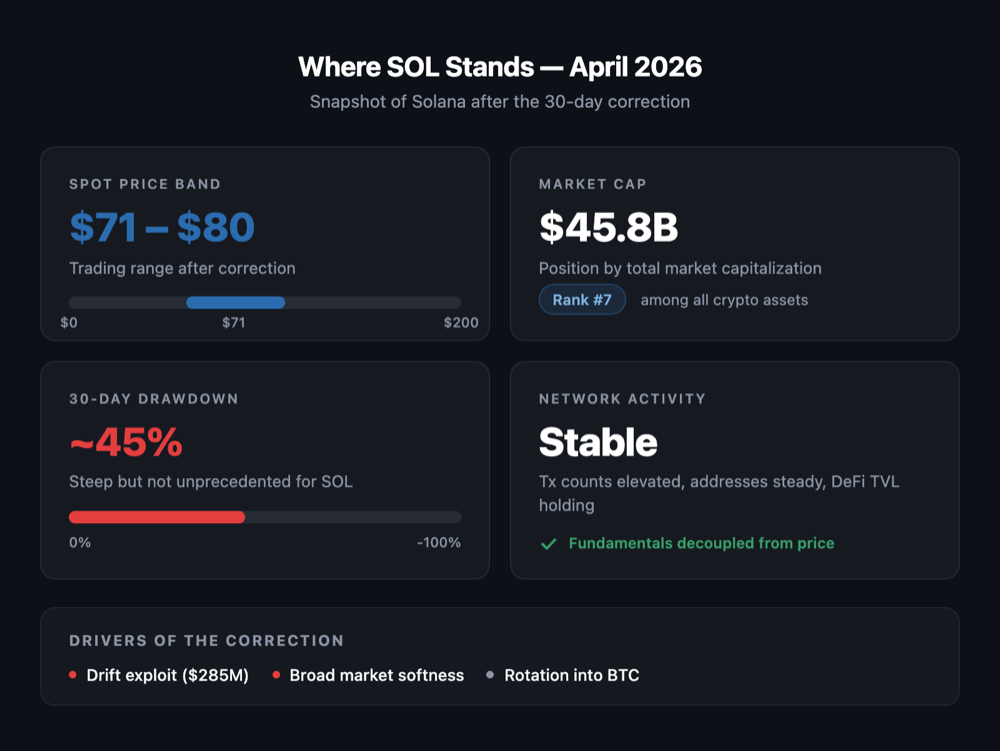
The correction has several drivers. Broad crypto market softness is one. The Drift exploit sentiment hit is another. Rotation out of high-beta layer-1 exposure into Bitcoin is a third. What the correction is not, based on the usage data, is a reflection of declining network activity. Transaction counts remain elevated, active addresses are stable, and the DeFi total value locked on Solana is holding up better than the SOL price itself would suggest.
Read correctly, the current price is the market pricing in sentiment risk more than fundamental risk. That’s not a reason to dismiss it — sentiment risk is a real thing that produces real drawdowns and can stay priced-in for extended periods — but it changes how you think about the forecast. Sentiment-driven corrections tend to revert when the next catalyst lands. Fundamental corrections tend not to.
What Alpenglow Actually Changes
Alpenglow is the 2026 consensus upgrade that replaces Solana’s current finality model with a much faster one. The headline number is block finality dropping from around 12 seconds to roughly 150 milliseconds — a 60–80× improvement depending on network conditions. For users, the practical effect is that transactions become effectively instant from a UX perspective. For developers, it opens up categories of application that weren’t viable at 12-second finality: real-time payments, high-frequency on-chain systems, trading infrastructure that previously needed off-chain components to hit the latency budget.
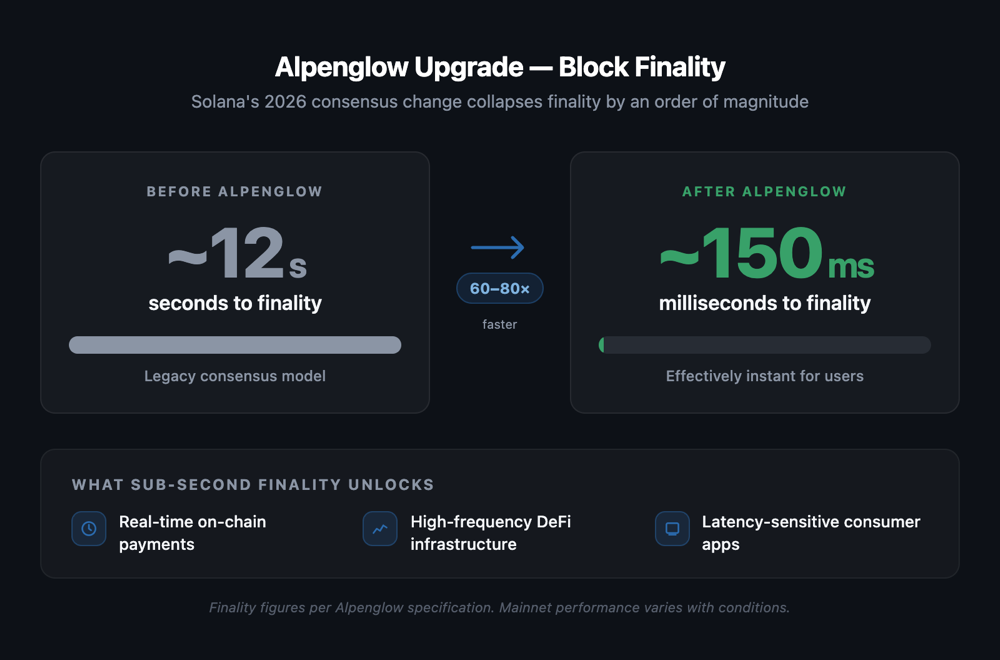
The upgrade matters for the forecast in two distinct ways.
First, it closes a specific competitive gap. Solana’s finality was one of the few remaining places where newer L1s or L2s could claim a technical advantage. At 150ms finality, that argument becomes much harder to make. The specific narrative “an X competitor will replace Solana because of faster finality” loses its most credible form.
Second, it enables new revenue models on the chain. Real-time payment systems, on-chain market-making infrastructure, and latency-sensitive consumer applications all become viable in ways they weren’t before. Whether any of these produce meaningful fee revenue in the forecast window is uncertain, but the possibility space is larger than it was before Alpenglow.
The SIMD-0334 efficiency fix (targeting Q2 2026) is the quieter upgrade worth mentioning. It resolves a zk-proof syscall inefficiency that was a meaningful cost center for certain transaction categories. It’s live on testnet at the time of this writing and is expected to reach mainnet in the second quarter. The MCP Protocol work on in-protocol transaction ordering is the longer-horizon change — it restructures how transactions are sequenced at the protocol level, which matters for MEV dynamics and fairness guarantees but is further from user-visible impact.
The bottom line for the engineering track: Solana is shipping. The upgrade cadence through 2026 is the healthiest it’s been since mainnet.
The Drift Exploit and What It Actually Means
The Drift Protocol exploit in April 2026 drained approximately $285 million from the perpetuals platform, making it the second-largest hack in Solana’s history. This is a real event that matters. It is not a minor footnote.
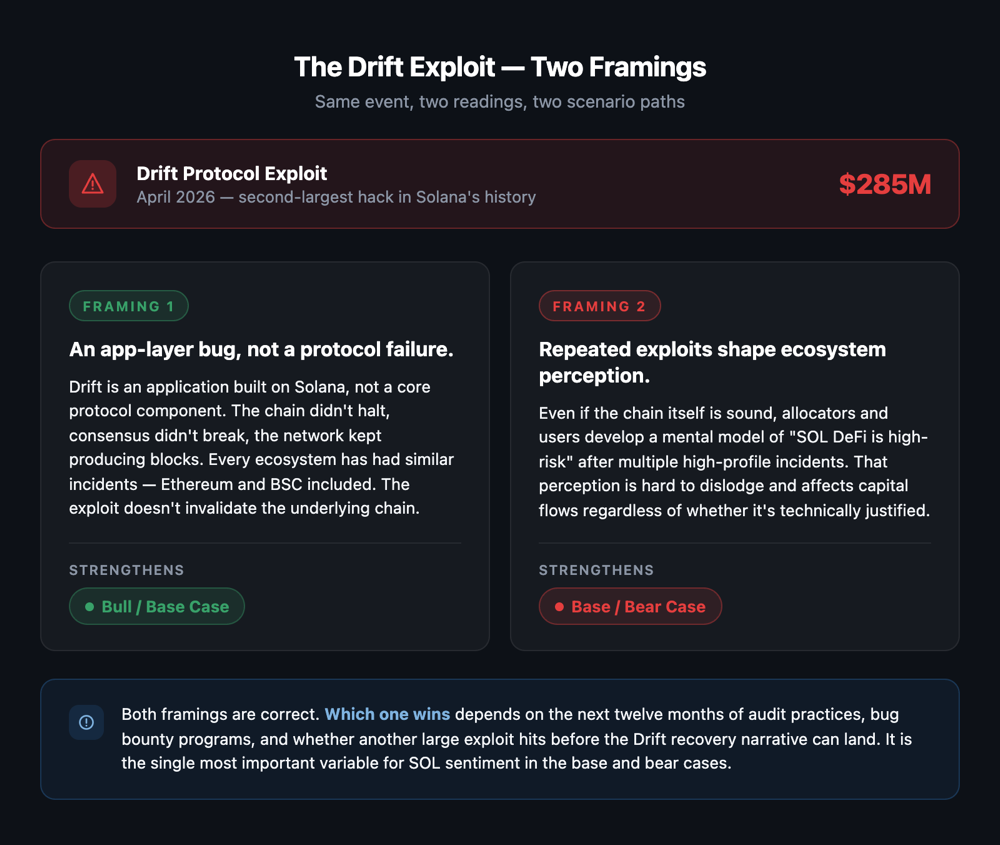
What the exploit means for the forecast depends on how you categorize it. Two framings, both worth considering:
Framing 1: A smart contract bug in an application is not a protocol failure. Drift is an application built on Solana, not a core protocol component. The Drift exploit didn’t break the Solana network, didn’t halt the chain, didn’t corrupt consensus. It was a bug in application logic that an attacker found and exploited. This happens in every ecosystem — Ethereum has had larger individual exploits, BSC has had multiple. The existence of the exploit doesn’t invalidate the underlying chain.
Framing 2: Repeated large exploits in a specific ecosystem shape perception of that ecosystem’s security posture. Even if the chain itself is fine, users and allocators develop a mental model of “SOL DeFi is high-risk” after multiple high-profile incidents. That mental model is hard to dislodge and it affects capital flows into the ecosystem regardless of whether it’s technically justified.
Both framings are correct. The bull case for SOL requires the first framing to eventually win out — applications mature, audits improve, exploit frequency declines, the ecosystem reputation recovers. The bear case requires the second framing to harden — SOL becomes “the ecosystem where DeFi keeps getting hacked” and institutional and retail capital routes around it.
Which framing wins depends on the next twelve months of audit practices, bug bounty programs, and whether another large exploit hits before the Drift recovery narrative can land. It is not knowable with certainty now. But it is the single most important variable for SOL sentiment in the base and bear cases.
Bull Case — Why SOL Could Outperform Through 2030
The bull case for SOL doesn’t depend on a meme cycle. It depends on the ecosystem converting its technical throughput into durable economic activity faster than the competition and recovering reputation from the exploit cycle.
Alpenglow delivers as spec’d and developers start building applications that require sub-second finality. Real-time on-chain payments, high-frequency DeFi infrastructure, consumer applications that feel native rather than blockchain-clunky. A handful of these produce meaningful fee revenue on the chain, which flows to validators and indirectly supports SOL valuation.
The DeFi exploit frequency declines through improved audit practices, formal verification in larger applications, and the gradual maturation of the ecosystem’s security norms. Drift is remembered as the low point, not the trajectory.
Memecoin and consumer app throughput continues to generate meaningful fee revenue. SOL is the chain where retail activity actually happens at scale; that’s a revenue stream competitors don’t have to the same degree.
Institutional rails — custody, staking products, ETF exposure — deepen through the forecast window. SOL gains the institutional infrastructure that BTC and ETH already have.
Jupiter, Jito, Raydium, Pyth, Helius — the core ecosystem participants — continue to ship and capture value. The flywheel effect of a healthy ecosystem is real and hard to replicate.
Bull case for SOL in 2030: a mature L1 with durable throughput, recovered reputation, and a price that reflects both. Numbers at the bottom.
Base Case — The Most Likely Path
The base case is less dramatic than either tail.
SOL recovers from the April 2026 correction over the next six to twelve months as the market digests the Drift exploit and Alpenglow comes into full effect. The recovery is gradual rather than V-shaped; memory of the exploit persists in the institutional allocation discussion for longer than in the price chart.
Through 2027 and 2028, SOL tracks BTC with an ecosystem-specific premium when things are going well (upgrade delivery, notable new applications) and a discount when things aren’t (another exploit, a specific DeFi protocol failure, macro risk-off events affecting high-beta L1s disproportionately). On average, the price range expands meaningfully from current levels but doesn’t hit 2021 highs in real terms.
By 2029–2030, Solana has either converted the Alpenglow advantage into durable economic activity or it hasn’t. The base case assumes partial conversion — real use cases landing, fee revenue growing, but not the full “SOL replaces large chunks of traditional finance rails” outcome. Price reflects accordingly.
The regulatory environment matters too. SOL has been subject to various classifications and investigations through 2024–2025. The base case assumes this continues to be a manageable overhang rather than a catalyst event.
Bear Case — What Would Break the Forecast
The bear case has several distinct paths and any honest forecast has to acknowledge them.
Another large exploit — particularly one that affects a core primitive like a major DEX, a bridge, or a widely-used staking product — hardens the “SOL is the insecure ecosystem” narrative to the point where institutional capital decides to wait for another cycle. This is the path the bear case most likely takes.
An Alpenglow-related incident that is unlikely but not impossible. Consensus upgrades are high-risk engineering; most go smoothly, some don’t. A chain halt or rollback would be a category-changing event for the asset.
Regulatory action targeting SOL specifically, rather than the broader crypto space. The asset has been on and off various watchlists, and while the base case assumes this is overhang rather than catalyst, it’s possible for an overhang to become a catalyst with the wrong enforcement action.
A credible competitor L1 emerges that solves a problem SOL doesn’t (not likely in the short term) or executes better on the problems both chains share (more plausible). The L1 landscape is competitive and the winner is not settled.
Macro. Every high-beta asset is exposed to macro. SOL’s beta relative to BTC is high enough that a sustained risk-off period hits it disproportionately.
We don’t think the bear case is the most likely outcome. But anyone holding SOL through 2030 should be able to articulate every paragraph above.
Year-by-Year Forecast (2026–2030)
| Year | Bear | Base | Bull |
|---|---|---|---|
| 2026 | $38 | $95 | $180 |
| 2027 | $30 | $125 | $260 |
| 2028 | $45 | $170 | $360 |
| 2029 | $60 | $220 | $500 |
| 2030 | $75 | $280 | $680 |
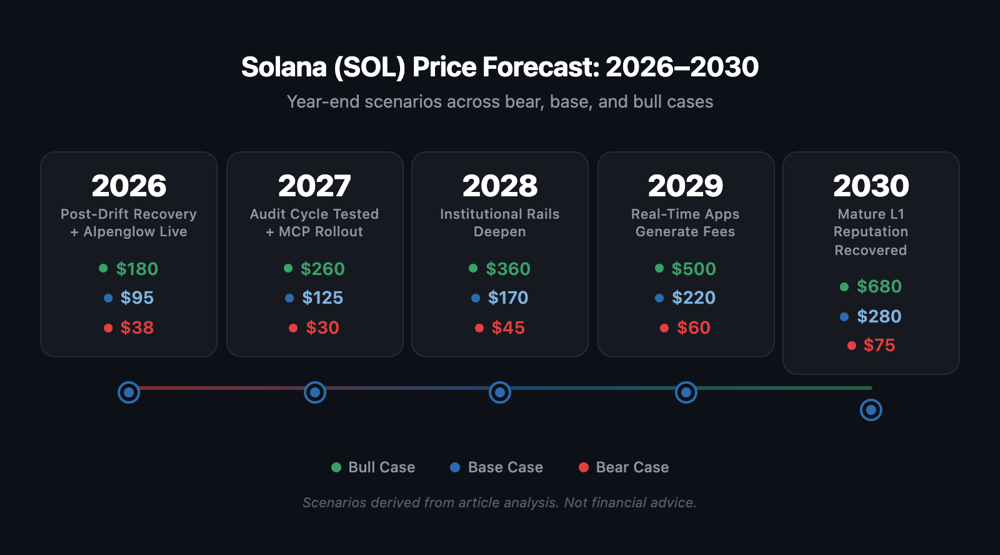
The numbers above are scenarios derived from the reasoning in the previous sections. They are not predictions and they are not financial advice.
Reading the table:
- The bear-case 2026–2027 range reflects further downside if another exploit lands or Alpenglow hits issues in mainnet rollout. The recovery from there is the key question.
- The base case requires both Alpenglow delivery and a meaningful decline in DeFi exploit frequency. Partial success produces numbers in the lower half of the base column.
- The bull case requires everything to go roughly right: upgrades land, exploits decline, ecosystem matures, institutional rails deepen. Plausible but not guaranteed.
If you want a more confident forecast than the table above, every other site will sell you one. We don’t think they’re useful. The reasoning above is what should drive position sizing.
How to Acquire SOL in 2026
SOL is widely available on centralized exchanges and through non-custodial swap services. For users who already hold any cryptocurrency and want to acquire SOL without an account, a non-custodial swap like Godex.io handles any of the 936+ supported pairs, including SOL, with a fixed-rate option and no volume caps. For users who want to trade SOL actively through an order book, centralized exchanges remain the venue.
For the operational privacy of acquiring and holding SOL, see our companion guide on anonymous crypto exchange in 2026.
Risks
- Protocol risk. Consensus upgrades are high-risk. Alpenglow has been extensively tested but production rollout at Solana’s scale is not guaranteed.
- Application risk. The DeFi exploit frequency on Solana has been higher than ideal. Hold SOL in your own wallet; be cautious about which applications you deposit into.
- Regulatory risk. SOL’s classification status in the US remains contested. A specific enforcement action would affect pricing.
- Liquidity risk. SOL is liquid but beta to BTC is high; risk-off events produce larger drawdowns than the median.
- Concentration risk. Validator distribution and stake concentration on Solana have been ongoing concerns. The chain is more decentralized than critics claim and less decentralized than proponents claim.
Size positions accordingly.
The Bottom Line
Solana in April 2026 is shipping meaningful upgrades and absorbing a meaningful exploit in the same quarter. The forecast for 2026–2030 is the question of which of those two stories wins more attention over the forecast window. The engineering track is the healthiest it’s been. The ecosystem reputation is still recovering from Drift and will be recovering from the next exploit whenever that lands. Price will oscillate around the tension between those two forces and gradually resolve toward whichever narrative wins the patient investor cycle.
If you believe Alpenglow matters more than the current exploit sentiment, the base and bull cases become interesting. If you believe the exploit cycle is a structural property of Solana’s ecosystem rather than a growing pain, the base and bear cases are the honest position. Either view is defensible from the current data. Neither is certain.
The numbers above are the scenarios that follow from the reasoning. Treat them as illustration. Revisit in six months when the Alpenglow impact and the post-Drift sentiment have both had time to settle.
Last updated: April 8, 2026. Nothing in this article is financial advice. Do your own research, size positions to your risk tolerance, and verify the current state of the ecosystem before acting on any forecast that is more than a few weeks old.
Start a Cryptocurrency exchange
Try our crypto exchange platform
Disclaimer: Please keep in mind that the content of this article is not financial or investing advice. The information provided is the author’s opinion only and should not be considered as direct recommendations for trading or investment. Any article reader or website visitor should consider multiple viewpoints and become familiar with all local regulations before cryptocurrency investment. We do not make any warranties about reliability and accuracy of this information.
Read more
Chiliz coin (CHZ) offers a compelling opportunity for traders interested in the intersection of blockchain technology and sports. By enabling fans to influence team decisions through the Socios app, Chiliz directly monetizes fan engagement and connects with major sports teams like Juventus and Paris Saint-Germain. These partnerships not only enhance the platform’s visibility but also […]
The exponential growth of Bitcoin Satoshi Vision (BSV) against the general bear trend on the cryptocurrency market in autumn 2019 has impressed the community. Due to the increasing market capitalization, the newly emerged altcoin was ranked 5th on CoinMarketCap and managed to maintain its high position at the beginning of 2020. In the article we […]
EOS is definitely on the list of the strongest and most stable projects in the crypto world. Despite the fact that the currency entered the market less than 3 years ago, it consistently occupies one of the top 10 places in the rating for project capitalization. it is often called the “main competitor of Ethereum”. […]
XRP price prediction 2026-2027: bear, base, and bull scenarios with ranges and named sources, the resolved SEC case, live spot ETFs, and can XRP reach $10?
In this article we will talk about Ripple (XRP) and its price prediction. What is Ripple (XRP) Ripple is a San Francisco-based startup that was launched in 2012 by Ripple Labs as a global network both for cross-currency and gross payments. Ripple history began in 2004 with the discussions around the digital coin in the […]
You may well think that an article dedicated to a Tether price prediction or the Tether price in general is a little bit strange — it is a stablecoin after all. However, the price of Tether does fluctuate significantly, although it is nowhere near as volatile as non-stablecoin cryptos. This means that staying up to […]