
 Peter Moore
Table of Contents
There’s a number that should change the way you think about crypto exchanges: $3.4 billion. That’s how much was stolen from cryptocurrency platforms in 2025 alone — the highest annual total since 2022, according to blockchain intelligence firm Chainalysis. One single attack, the February breach of Bybit, accounted for roughly $1.5 billion of that figure. The funds were held in cold, multi-signature wallets — the kind the industry had long considered the gold standard of security. The breach was later attributed by FBI investigators to North Korea’s Lazarus Group. They were gone in hours.
What makes that number alarming isn’t just the scale. It’s that the top three hacks in 2025 together accounted for 69% of all service-side losses. This isn’t a broad, diffuse threat landscape. It’s a targeted, concentrated one — and the targets are the custodial platforms holding the most funds. State-sponsored attackers with virtually unlimited resources are doing reconnaissance on exchanges for months before striking.
This is the environment you’re trading in. And the question of which exchange to use is no longer a matter of comparing fee structures or coin selection. It’s a question of structural risk. When you can’t afford to lose funds, the architecture of how an exchange holds your assets matters far more than the quality of its charts or the size of its customer support team.
This guide breaks down what actually makes a crypto exchange safe in 2026, which platforms meet that standard, and how to build a trading setup that minimizes the amount any single platform can lose on your behalf.
Why “Safe” Has a New Definition in 2026
The safest crypto exchange in 2026 is the one that minimizes how much it can lose on your behalf — either through a hack, insolvency, or a regulatory freeze. That definition has shifted meaningfully since the FTX collapse of 2022 and the Bybit breach of 2025.
Before FTX, most traders measured safety by reputation and longevity. After FTX, the focus moved to proof of reserves: does the exchange actually hold what it claims? After Bybit — which did hold reserves, did use cold storage, and still lost $1.5 billion — the conversation has moved further upstream, toward custody architecture itself.
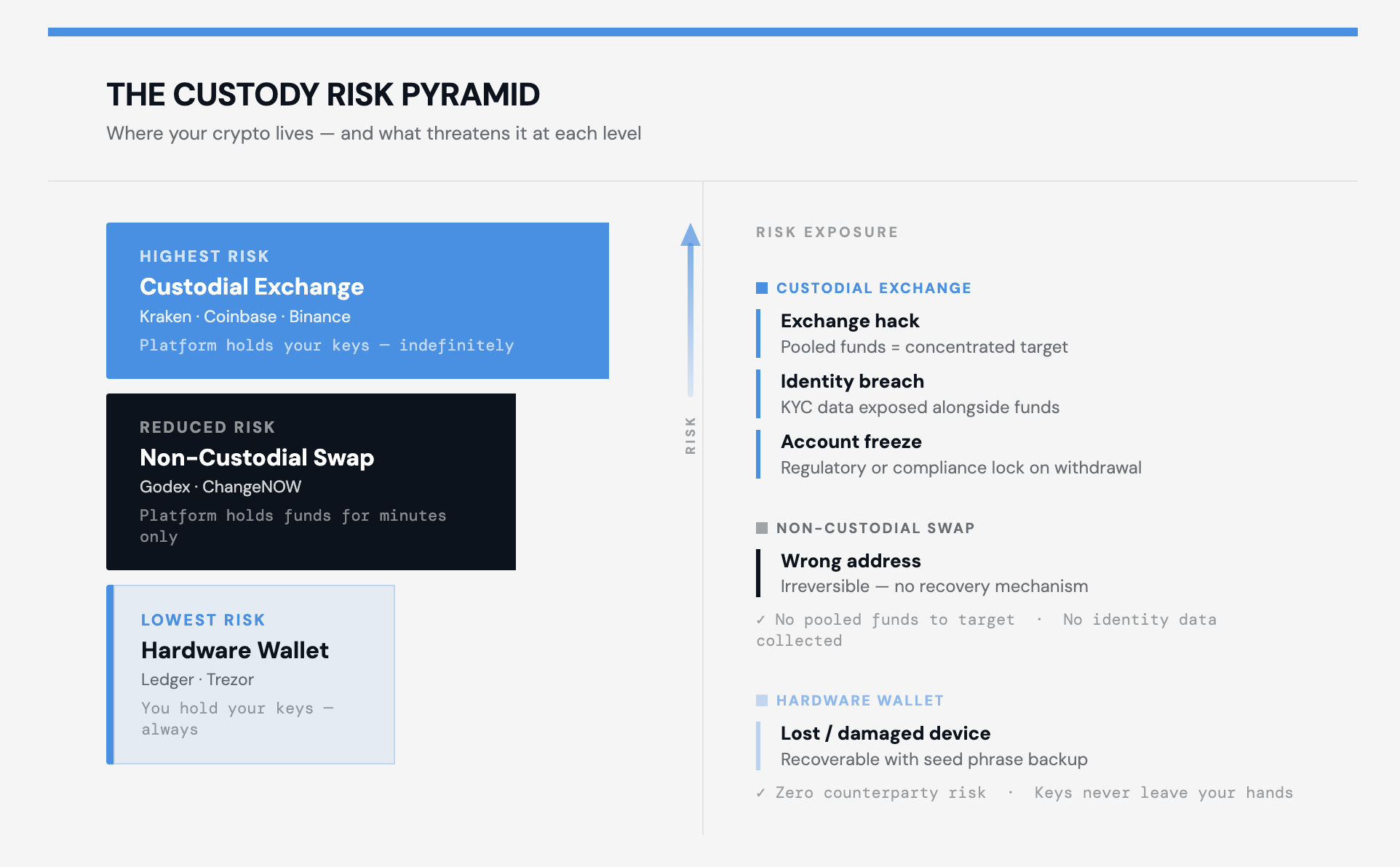
The key insight from 2025’s data: centralized platforms accounted for 53.5% of all documented cryptocurrency losses despite holding only a fraction of the total assets in the ecosystem. The concentration of funds in custodial systems creates a target. When state-sponsored actors with virtually unlimited resources decide to target an exchange, even excellent security may not be enough.
Three categories of security now dominate the discussion:
- Custodial centralized exchanges (CEXs): Strong regulatory frameworks, insurance funds, and proof-of-reserves audits — but they hold your keys, and that creates irreducible counterparty risk
- Decentralized exchanges (DEXs): You keep your keys; no central target for hackers — but smart contract risk, wallet complexity, and gas costs add friction
- Non-custodial instant swap services: You keep your keys before and after the swap; the platform holds your funds only during the transaction itself — combining reasonable convenience with structural security benefits
| Security Factor | Why It Matters | What to Look For |
| Custody model | Determines counterparty risk at the structural level | Non-custodial eliminates pooled-fund exposure |
| Proof of Reserves | Proves the exchange holds what it claims | User-verifiable Merkle tree audits, not just announcements |
| Cold storage ratio | Limits online exposure of user funds | 90%+ of assets in offline cold storage |
| 2FA & authentication | Prevents unauthorized account access | FIDO2 passkeys, hardware key support — not just SMS |
| Incident history | Shows how the platform handles crises | Transparent responses, full reimbursement track record |
| Data retention policy | Limits exposure from data breaches | Minimal or zero personal data collection |
| Regulatory standing | Determines legal protections available | Recognized jurisdiction licenses, MiCA compliance for EU |
| KYC policy | Affects both privacy and breach exposure | No personal data = no personal data to steal |
| Insurance/reserves fund | Last line of defense after a breach | Dedicated emergency fund (e.g., SAFU model) |
One factor that’s often overlooked: data breach exposure. When a custodial exchange gets hacked, the attacker frequently gets both the funds and the user database. That database — containing names, addresses, passport scans — has its own secondary market value. Non-custodial platforms that collect no personal data eliminate this risk entirely.
The Safest Crypto Exchanges in 2026: A Ranked Overview
The platforms below represent the strongest options across different security models and use cases. No single choice is right for everyone. The goal is matching your risk tolerance and trading needs to the appropriate architecture.
1. Godex — Best Overall for Privacy and Structural Security
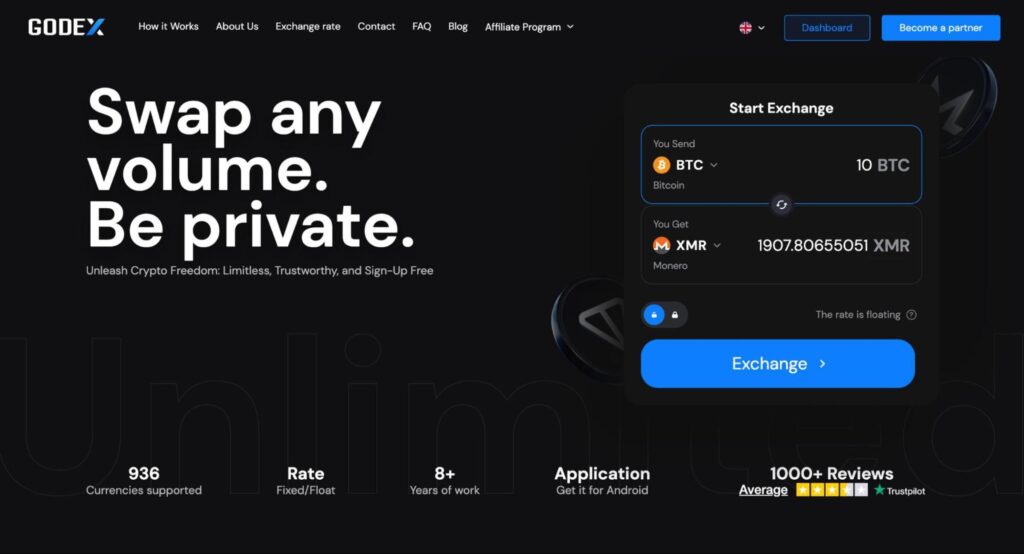
The most fundamental way to protect funds on an exchange is to ensure the exchange never holds them in the first place. Godex is built on exactly that principle: it operates as a non-custodial instant swap aggregator, meaning your funds are held on the platform only during the active execution of the trade — typically 5 to 30 minutes — and then sent directly to the wallet address you control.
There is no account to hack. There is no database of user identities to breach. There is no pooled reserve of funds sitting exposed to the kind of state-sponsored attack that took down Bybit. As a 2026 security report by Ventureburn noted, platforms with this architecture “provide instant swaps across hundreds of cryptocurrencies without ever taking custody of your funds,” and the absence of KYC requirements “protects against data breaches that could expose your personal information.”
What sets it apart in 2026:
- Non-custodial architecture: the exchange holds your coins only while actively routing the swap
- Zero registration, zero KYC, zero personal data collection for any swap — no data stored means no data to steal
- Order details automatically deleted after two weeks
- 936+ cryptocurrencies supported, including Monero and other privacy coins
- Fixed-rate option locks the exchange rate for 30 minutes, protecting against volatility during the swap window
- Official Trezor integration after passing the wallet maker’s security audit; Tor connection supported
- No verified hacks since launch in 2018; named #1 no-KYC exchange by Coinpedia in 2025
Best for: Privacy-conscious traders, anyone rebalancing a portfolio between coins without creating new identity records, and users who already hold crypto in self-custody and want to swap without moving to a full custodial platform.
Limitation: Crypto-to-crypto only — no fiat on/off ramp. Not available to U.S. users. As with any non-custodial service, a wrong receiving address cannot be reversed, so double-checking destination addresses before confirming is essential.
2. Kraken — Best Custodial Exchange for Security Track Record
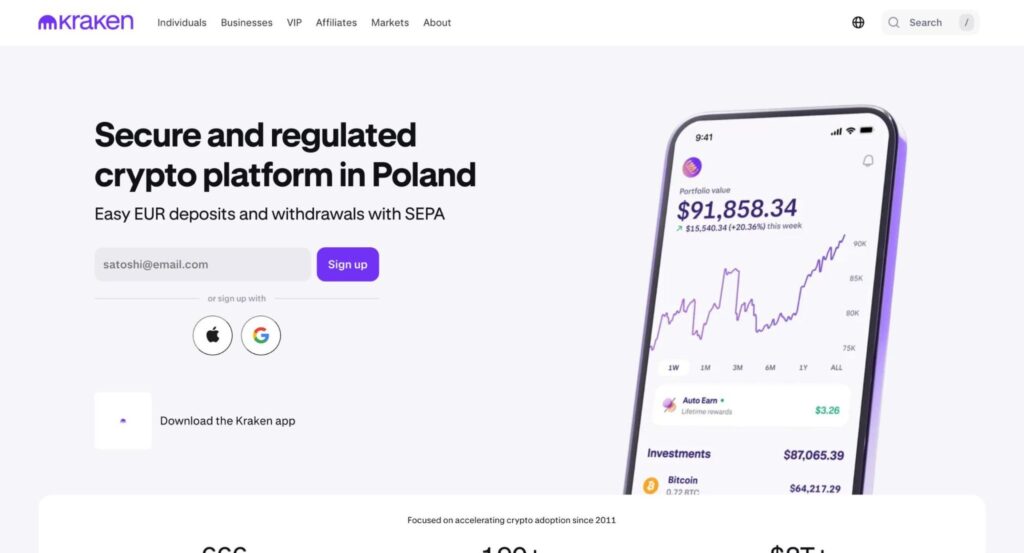
Kraken is the benchmark for custodial exchange security. It has operated since 2011 and has never lost customer funds to a hack — a record that, in this industry, is genuinely rare and meaningful. The platform was the first exchange to undergo a publicly verifiable Proof of Reserves audit, allowing users to independently confirm their funds are backed by real assets.
What sets it apart in 2026:
- Stores the vast majority of user funds in cold storage in physically guarded, offline facilities
- FIDO2-compliant two-factor authentication with passkeys and hardware security key support
- Holds a MiCA license for EU regulatory compliance — one of the few exchanges compliant before MiCA’s full enforcement
- “Productively paranoid” security philosophy: Kraken Security Labs actively finds and discloses vulnerabilities in third-party products
Best for: Active traders in regulated markets who need deep liquidity, advanced order types, and the strongest compliance posture available in a custodial platform.
Limitation: Custodial by nature — Kraken holds your private keys when funds are on the platform. Despite the clean record, users carry counterparty exposure during market turmoil or extreme regulatory scenarios.
3. Coinbase — Best for U.S. Regulatory Protection
Coinbase is the only NASDAQ-listed crypto exchange — a level of public accountability that few competitors can match. For U.S. users in particular, the regulatory protections are unmatched: licenses in 49 states and FDIC insurance on USD cash balances held in partner banks.
What sets it apart in 2026:
- Publicly traded company with SEC oversight and quarterly financial disclosures
- Stores the significant majority of customer assets in cold storage
- Regular third-party security audits
- Dedicated asset protection with clear recovery processes for account issues
Best for: U.S.-based traders who prioritize regulatory protection, legal recourse, and institutional-grade accountability.
Limitation: Full KYC required for all users, and not available in all jurisdictions. Custodial model means Coinbase holds private keys on behalf of users.
4. Bitget — Best for Proof-of-Reserves Transparency
Bitget has built one of the most verifiable reserve frameworks among major custodial exchanges. The platform publishes monthly Proof of Reserves updates using a Merkle tree structure — meaning any user can independently verify their own balance was included in the audit snapshot, without exposing other users’ data. As of April 2026, Bitget’s total reserve ratio stands at 130%, with BTC reserves historically running above 300% of user holdings.
Beyond the reserve reports, Bitget maintains a $300M+ Protection Fund — a dedicated emergency reserve that covers users whose accounts are compromised through events outside their own control. The fund’s BTC wallet addresses are publicly visible on-chain, making it independently auditable rather than just announced. Bitget holds an AA rating on CER.live, demonstrating strong transparency and security standards, and has earned ISO 27001 certification for its information security management systems.
What sets it apart in 2026:
- Monthly Merkle tree Proof of Reserves — user-verifiable, not just announced
- 130%+ total reserve ratio as of April 2026; BTC reserves consistently above 300%
- $300M+ Protection Fund held in publicly visible on-chain wallets
- ISO 27001 certified; offline multi-signature cold storage for the majority of assets
- 120 million registered users; regulated across AUSTRAC, OAM Italy, FCA partner model (UK), and multiple other jurisdictions
- Copy trading, futures, and spot trading in one platform — broad use case coverage
Best for: Active traders who want the strongest combination of reserve transparency and platform features, and who treat monthly on-chain verification as a baseline security requirement.
Limitation: Custodial by nature — Bitget holds private keys on behalf of users. No independent audit of Bitget Holdings has been published to date, meaning reserve reports, while user-verifiable at the account level, lack full corporate-level third-party attestation. Not available to users in certain restricted jurisdictions.
5. Binance — Best Insurance Fund Coverage
Binance is the world’s largest exchange by trading volume, with over 300 million users globally. Size creates both risk and resilience: the platform maintains the Secure Asset Fund for Users (SAFU), a dedicated emergency reserve valued at approximately $1 billion, designed to cover user losses in the event of a breach.
What sets it apart in 2026:
- SAFU fund represents the largest dedicated insurance reserve in the industry
- Multi-layer risk management system with real-time transaction monitoring and anomaly detection
- Multi-factor authentication, withdrawal safeguards, and cold storage for the majority of assets
- Competitive spot trading fees of 0.10%, reduced further through VIP tiers
Best for: High-volume traders who need the deepest liquidity and want the largest institutional backstop in the event of a security incident.
Limitation: Size and complexity create their own attack surface. The platform has a more turbulent regulatory history than Kraken or Coinbase. U.S. users cannot use the main platform; Binance.US is a separate, more limited entity.
Custodial vs. Non-Custodial: The Core Security Trade-Off
The most important decision you’ll make isn’t which exchange to use — it’s which model to use for which purpose. Here’s how the two primary approaches compare across the dimensions that matter most.
| Dimension | Custodial CEX | Non-Custodial Swap (e.g., Godex) | DEX |
| Who holds your keys | The exchange | You (before/after only) | You (always) |
| Counterparty risk | High | Very low | None |
| Data breach exposure | High (identity + funds) | Very low (no identity data) | None |
| Account recovery | Yes (password reset, support) | No | No |
| Regulatory protection | High (in licensed jurisdictions) | Low | None |
| KYC requirement | Always | Never | Never |
| Fiat on/off ramp | Yes | No | No |
| Suitable for active trading | Yes | No | Partial |
| Suitable for long-term storage | No | No | Yes (via wallet) |
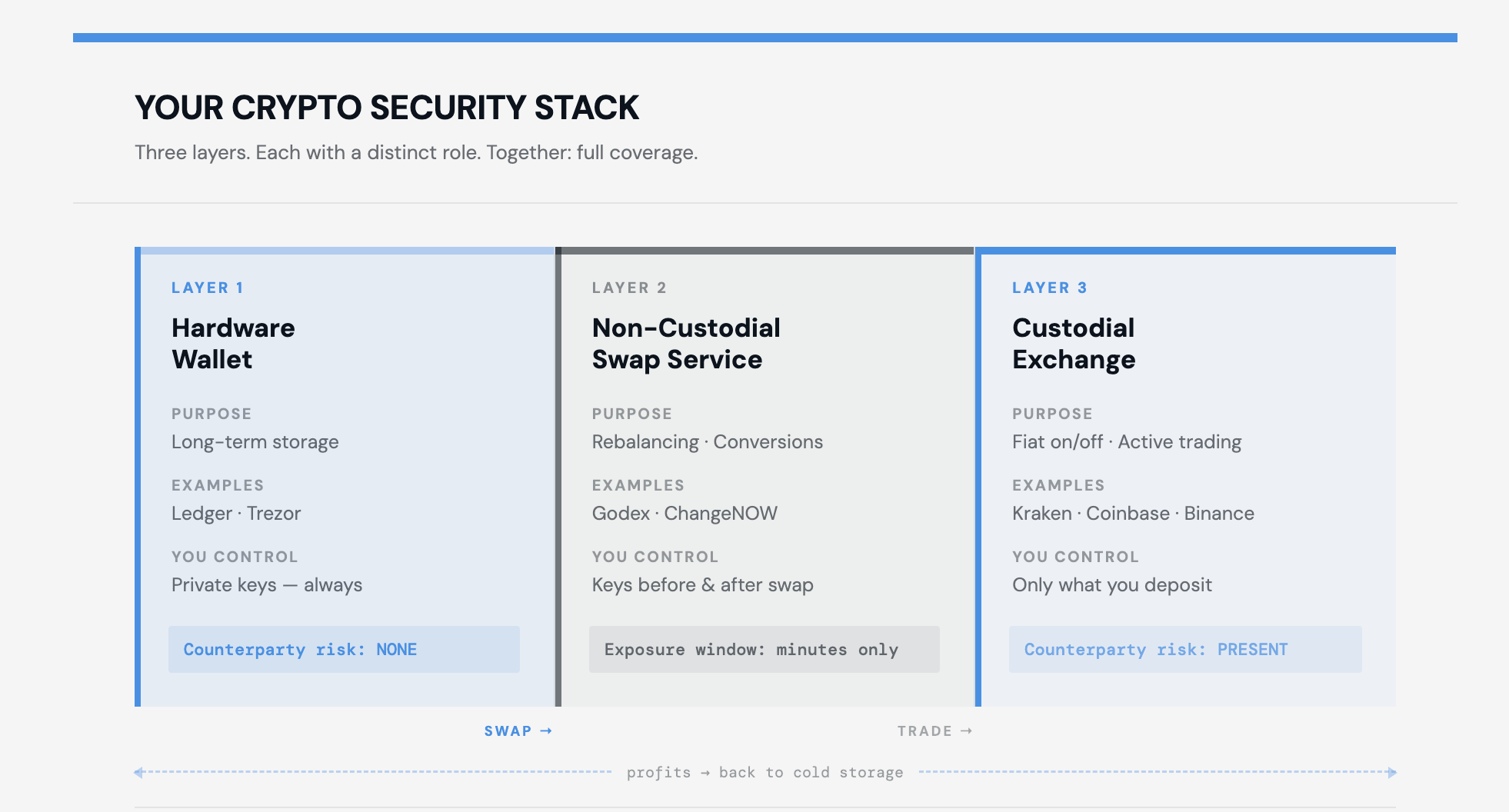
The practical recommendation: use multiple models for different purposes. Non-custodial swap services like Godex for routine portfolio rebalancing and cross-chain conversions. Regulated custodial platforms for fiat conversions and active trading. Hardware wallets for long-term storage. No single platform should hold more of your assets than you’re prepared to lose.
The Security Habits That Matter as Much as the Platform
Even the safest crypto exchange can be undermined by poor personal security. The 2025 data from Chainalysis is instructive: nearly 20% of all stolen funds came from personal wallet compromises — not exchange hacks. The attack surface has expanded beyond platforms and onto the users themselves.
Habits that make a measurable difference:
- Enable 2FA everywhere, but use hardware keys or authenticator apps — SMS-based 2FA can be bypassed through SIM-swapping attacks
- Withdraw long-term holdings to cold storage — no exchange, however secure, is a substitute for a hardware wallet for funds you don’t need immediate access to
- Whitelist withdrawal addresses on custodial exchanges — this prevents attackers who gain account access from sending funds to unknown wallets
- Use a unique, strong password for every exchange — credential stuffing attacks remain a primary attack vector
- Verify URLs and bookmark exchanges directly — phishing attacks on crypto users increased 40% in 2025 according to blockchain security firm DeepStrike, primarily through fake exchange sites
- Test new pairs with small amounts first — especially on non-custodial platforms where wrong addresses mean permanent loss
One more principle worth internalizing: treat exchange accounts like a checking account, not a savings account. Keep only what you need for active trades on any platform. Move the rest to wallets you control.
How to Choose: A Decision Framework
Not everyone needs the same exchange. The right choice depends on what you’re trying to do.
If you already hold crypto and want to swap between coins privately and quickly: → Godex. No account, no KYC, no data retained — and a fixed-rate option that locks your price for 30 minutes. Your funds stay in your wallet before and after the swap.
If you’re a U.S.-based retail trader who needs fiat conversion and regulatory protection: → Coinbase or Kraken. Both have clean security records and strong regulatory standing. Kraken has the longer track record; Coinbase has the deepest U.S. regulatory integration.
If you’re trading actively and need deep liquidity and advanced tools: → Kraken Pro or Binance (outside the U.S.). Prioritize platforms with proof-of-reserves and strong insurance coverage.
If reserve transparency is your primary concern: → Bitget. Monthly Merkle tree Proof of Reserves, a publicly visible $300M+ Protection Fund, and a 130%+ reserve ratio make it the strongest custodial option for users who want on-chain verifiability as a baseline.
The Bottom Line
The $1.5 billion Bybit hack didn’t happen because Bybit was careless. It happened because concentrated custody of user funds is inherently a high-value target — and sophisticated, well-resourced attackers will eventually find a way through.
The safest approach in 2026 isn’t about picking the one exchange with the best security team. It’s about structuring your crypto activity to minimize how much any single platform can lose on your behalf.
Use non-custodial swap services like Godex when you need to move between assets without creating custodial exposure or an identity record. Use regulated custodial exchanges where their protections genuinely benefit you — fiat ramps, legal recourse, advanced trading tools. Use hardware wallets for everything else.
The exchange that can’t be hacked is the one that doesn’t hold your funds in the first place.
FAQ
Is a non-custodial exchange actually safer than a regulated one like Coinbase or Kraken? For hack risk — yes. Non-custodial platforms hold no pooled funds, so there’s nothing to drain. For legal protection and account recovery, regulated custodials win. The safest setup uses both.
What does non-custodial mean in practice? You send crypto from your wallet, the platform routes the swap, the result lands in your wallet. The exchange never holds a balance in your name — only briefly during the transaction itself, typically under 30 minutes.
Do I need KYC to use Godex? No. Godex requires no registration, no email, and no identity documents for any swap regardless of amount. Order data is deleted after two weeks. It’s one of the few platforms that maintains this policy consistently at large volumes.
Can crypto exchanges freeze my funds? Custodial exchanges can — and do — freeze accounts for compliance checks, legal orders, or suspicious activity flags. Non-custodial platforms like Godex have no mechanism to freeze funds because they never hold them.
How do I store crypto safely long-term if not on an exchange? Use a hardware wallet (Ledger or Trezor). Your private keys stay offline, unreachable by hackers. Keep only what you need for active trading on any exchange — treat it like a checking account, not a savings account.
Is it legal to use a no-KYC exchange? In most jurisdictions, yes — a no-KYC platform is legal by default. It simply doesn’t collect identity documents. Users remain fully responsible for tax reporting regardless of whether the exchange requires verification.
Start a Cryptocurrency exchange
Try our crypto exchange platform
Disclaimer: Please keep in mind that the content of this article is not financial or investing advice. The information provided is the author’s opinion only and should not be considered as direct recommendations for trading or investment. Any article reader or website visitor should consider multiple viewpoints and become familiar with all local regulations before cryptocurrency investment. We do not make any warranties about reliability and accuracy of this information.
Read more
You may well think that an article dedicated to a Tether price prediction or the Tether price in general is a little bit strange — it is a stablecoin after all. However, the price of Tether does fluctuate significantly, although it is nowhere near as volatile as non-stablecoin cryptos. This means that staying up to […]
In the article we share our vision at Zcash cryptocurrency main features and add several price predictions. As cryptocurrencies gain global acceptance and decentralisation slowly enters our lives, privacy becomes the main concern when talking about blockchain adoption. It is no secret that distributed ledger is by far the most secure and transparent technology ever […]
Chiliz coin (CHZ) offers a compelling opportunity for traders interested in the intersection of blockchain technology and sports. By enabling fans to influence team decisions through the Socios app, Chiliz directly monetizes fan engagement and connects with major sports teams like Juventus and Paris Saint-Germain. These partnerships not only enhance the platform’s visibility but also […]
The exponential growth of Bitcoin Satoshi Vision (BSV) against the general bear trend on the cryptocurrency market in autumn 2019 has impressed the community. Due to the increasing market capitalization, the newly emerged altcoin was ranked 5th on CoinMarketCap and managed to maintain its high position at the beginning of 2020. In the article we […]
EOS is definitely on the list of the strongest and most stable projects in the crypto world. Despite the fact that the currency entered the market less than 3 years ago, it consistently occupies one of the top 10 places in the rating for project capitalization. it is often called the “main competitor of Ethereum”. […]
XRP price prediction 2026-2027: bear, base, and bull scenarios with ranges and named sources, the resolved SEC case, live spot ETFs, and can XRP reach $10?