
 Linda Larsen
Table of Contents
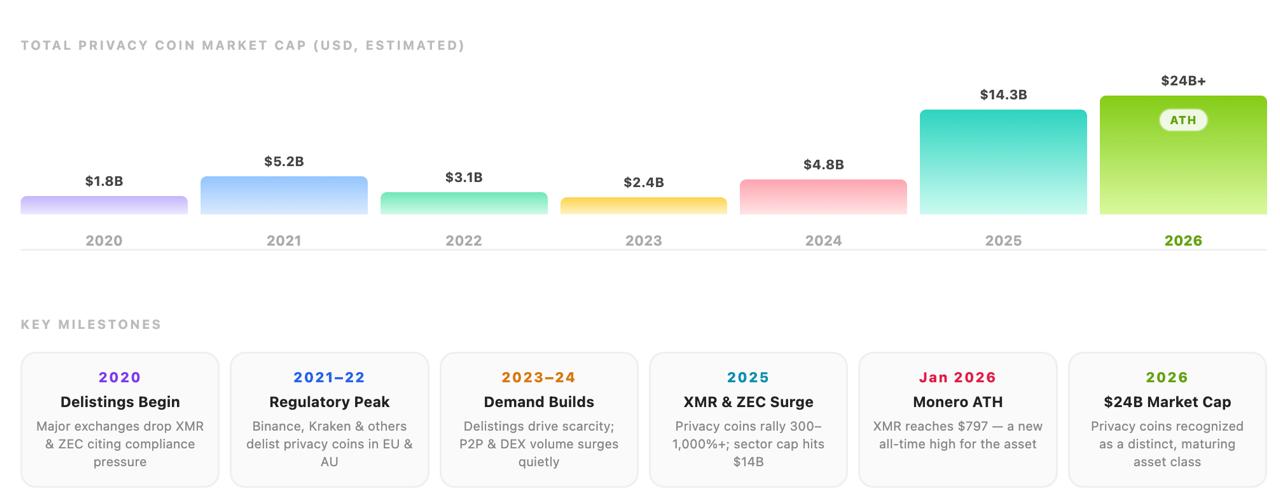
Financial privacy is no longer optional — and if you’re holding Monero (XMR) or Zcash (ZEC), you already know it. The crypto market delivered a powerful signal in 2026: privacy coins surged 288% while most of the broader market flatlined. Monero hit a new all-time high of $797 in early 2026. Zcash exploded over 1,000% from its cycle lows. These aren’t speculative moonshots — they’re assets that serve a genuine and growing demand for financial sovereignty.
But here’s the paradox that’s driving privacy coin holders crazy: the more powerful these assets become, the harder mainstream exchanges make it to actually swap them. In 2024 alone, over 23 exchanges — including Binance, Kraken, and OKX — delisted Monero, Zcash, and similar coins, citing regulatory compliance. The very thing that makes these coins valuable (untraceable, censorship-resistant transactions) is what gets them kicked off centralized platforms.
So where do you actually go to perform a privacy coins exchange without surrendering the very anonymity you’re protecting? That’s exactly what this guide answers — with depth, clarity, and zero fluff.
Why Privacy Coins Are Having Their Moment Right Now
Privacy coins are the fastest-growing crypto sector of 2026, and the reasons go far deeper than speculation. Three forces are driving unprecedented demand, and understanding them will make you a smarter, more confident holder.
- Blockchain Surveillance Is Getting Frighteningly Good
Traditional cryptocurrencies like Bitcoin operate on fully transparent public ledgers. Every transaction, every wallet address, every amount — all permanently visible to anyone with the right tools. In 2026, blockchain analytics firms use machine learning to build detailed financial profiles of wallet owners, cross-referencing on-chain data with exchange KYC records, IP addresses, and even social media. The U.S. Treasury’s blockchain monitoring initiatives and the EU’s MiCA regulations have formalized this surveillance apparatus. For individuals who value genuine financial privacy, this is not hypothetical — it’s happening now.
- Major Delistings Created a Supply Shock of Access
Counterintuitively, the wave of exchange delistings has strengthened the conviction behind privacy coins rather than destroying it. When Binance removed XMR for European users in early 2024, it didn’t kill demand — it redirected it toward no-KYC platforms and decentralized alternatives. The result: Monero’s on-chain activity increased, its community doubled down on development (including the Full-Chain Membership Proofs upgrade), and its market cap surpassed $14 billion. Scarcity of access, combined with inelastic demand, is a powerful price catalyst.
- Financial Privacy Is Now a Mainstream Value
This is perhaps the most underappreciated shift. Privacy is no longer the exclusive concern of cypherpunks and hardcore libertarians. Everyday users who’ve lived through data breaches, corporate surveillance scandals, and government overreach are actively seeking tools that give them back control over their financial data. The narrative has evolved from “privacy is for criminals” to “privacy is a fundamental human right” — and it’s resonating globally.
Monero vs. Zcash: Understanding the Privacy Coin Powerhouses
Before diving into where to swap them, you need to understand what you’re swapping and why each coin matters. These are not interchangeable assets.
Monero (XMR): Privacy by Default, Always
Monero is the gold standard of financial privacy — every single transaction is private, mandatory, and untraceable by design. There are no transparent modes, no opt-in requirements, no exceptions.
XMR achieves this through a sophisticated stack of cryptographic technologies:
- Ring Signatures — Your transaction is bundled with several others, making it mathematically impossible to identify the real sender among the group.
- Stealth Addresses — Every transaction generates a unique, one-time receiving address. Even if someone knows your public address, they cannot link incoming payments to your wallet.
- RingCT (Ring Confidential Transactions) — Transaction amounts are hidden from all parties except sender and recipient.
The result is true fungibility — every XMR coin is identical to every other XMR coin, with no “tainted” coins that can be blacklisted or flagged. This is something Bitcoin fundamentally cannot offer.
The trade-off? Monero’s uncompromising privacy makes it a regulatory target, which is why it’s been delisted from virtually every major centralized exchange. Finding a reliable Monero exchange without KYC is now the central challenge for XMR holders.
Zcash (ZEC): Optional Privacy with Cryptographic Precision
Zcash offers a flexible, opt-in privacy model powered by zk-SNARKs — the most mathematically sophisticated form of zero-knowledge cryptography deployed at scale. Users choose between transparent transactions (publicly visible, similar to Bitcoin) and shielded transactions (completely private sender, recipient, and amount).
Key characteristics of ZEC:
- Shielded addresses (z-addresses) use zk-SNARKs to allow the network to verify a transaction’s validity without revealing any transaction details — an extraordinary cryptographic feat.
- Transparent addresses (t-addresses) function similarly to Bitcoin, providing a publicly auditable record.
- Selective disclosure — Zcash allows users to share specific transaction details with auditors or regulators while keeping all other data private, making it more institutionally compatible than Monero.
In January 2026, the SEC concluded its review of Zcash and recommended no enforcement action — a significant regulatory green light that’s further fueled ZEC’s rally. For users who occasionally need auditability alongside privacy, Zcash’s hybrid model is uniquely powerful.
Monero vs. Zcash: Quick Comparison
| Feature | Monero (XMR) | Zcash (ZEC) |
| Privacy Model | Mandatory (always on) | Optional (user-selected) |
| Core Technology | Ring Signatures, RingCT, Stealth Addresses | zk-SNARKs (zero-knowledge proofs) |
| Transaction Visibility | Always hidden | Transparent or shielded (user choice) |
| Fungibility | Complete | Partial (transparent txns are traceable) |
| Regulatory Standing | High scrutiny, widely delisted | Improving — recent SEC review concluded favorably |
| Exchange Availability | Very limited on CEXs | Limited but improving |
| Auditability | Not possible by design | Selective disclosure available |
| Best For | Maximum default anonymity | Privacy with optional compliance |
Both coins are powerful. Both require careful platform selection for swapping. And both are fully supported on Godex.io — which is where the real solution comes in.
What Makes a Privacy Coins Exchange Platform Actually Trustworthy?
Not all “no-KYC” exchanges are created equal — and this is where many privacy-focused traders get burned. Before you trust a platform with your XMR or ZEC swap, evaluate it across these critical dimensions.
True No-KYC Policy vs. “No-KYC Until You Hit a Threshold”
This is the most important distinction. Many platforms advertise themselves as KYC-free, then silently trigger verification requirements when your swap exceeds an undisclosed dollar amount, involves privacy coins specifically, or gets flagged by an opaque algorithm. You send your funds, the swap freezes, and suddenly you’re being asked for a passport selfie. With a privacy coin, this isn’t just inconvenient — it defeats the entire purpose.
A genuinely trustworthy privacy coins exchange never asks for identity verification regardless of swap size. This should be unambiguous and demonstrable, not just marketing language.
Full Support for XMR and ZEC Specific Address Formats
Privacy coins have technical nuances that generic exchanges often get wrong:
- Monero requires a Payment ID in addition to a wallet address for many exchange transactions. Platforms that don’t handle this correctly result in lost funds — permanently, with no recourse.
- Zcash supports both transparent (t-addresses) and shielded (z-addresses). Many exchanges only support transparent addresses, which eliminates the entire privacy benefit of using ZEC.
A proper Zcash swap platform must handle shielded addresses correctly. A proper Monero exchange must handle Payment IDs seamlessly.
Non-Custodial Operation
The platform should never hold your funds during the swap. A non-custodial design means your assets move directly from your wallet to your destination address, with the exchange simply facilitating the conversion. This eliminates counterparty risk and prevents the nightmare scenario of a compliance team freezing your Monero mid-swap.
Rate Transparency and Consistency
Privacy coin swaps can be volatile. A trustworthy platform offers both fixed-rate options (locking your rate for the duration of the transaction) and floating-rate options, with full transparency about fees and spreads before you commit.
Why Godex Is the Premier Platform for Monero and Zcash Swaps
Godex is the most reliable privacy coins exchange operating today — built from the ground up for anonymous, instant crypto swaps without compromise.
Since 2018, Godex has maintained an unwavering commitment to the principles that privacy coin holders care about most: zero KYC, no registration, and no personal data collection — ever. While competitors have quietly introduced verification triggers, imposed volume caps, or quietly delisted XMR and ZEC under regulatory pressure, Godex has held firm. This consistency over 8+ years of operation isn’t just admirable — it’s rare, and it’s what has earned Godex 1,000+ verified reviews on Trustpilot and official partnerships with Trezor, Monero, and Edge Wallet.
Here’s what makes Godex the definitive platform for Monero exchange and Zcash swap needs:
- Zero KYC, Zero Registration — You don’t create an account. You don’t provide an email address. You don’t upload documents. You simply select your currencies, enter your wallet address, and swap. Your personal data is never collected.
- Full XMR and ZEC Support — Godex properly handles Monero’s Payment ID requirements and supports Zcash shielded addresses, ensuring your swap is technically correct and your privacy is genuinely preserved end-to-end.
- 928+ Cryptocurrencies — The depth of asset support means you can swap directly between XMR, ZEC, BTC, ETH, stablecoins, and hundreds of other assets without ever touching a KYC platform.
- No Exchange Volume Limits — Whether you’re swapping $100 or $100,000 in Monero, there are no arbitrary caps. Swap any amount, any time.
- Both Fixed and Floating Rates — Lock in a fixed rate to protect against slippage during confirmation, or choose a floating rate for potentially better value in stable market conditions.
- Lowest Fees with Full Transparency — Godex is built on a transparent fee structure with no hidden costs and no surprise charges after the fact.
- Non-Custodial by Design — Your swap goes wallet-to-wallet. Godex never holds your funds, eliminating both custodial risk and the possibility of a compliance team freezing your XMR mid-transaction.
- Fast Swaps, 24/7 — Most swaps complete in 5–30 minutes, with round-the-clock customer support available if any issues arise.
- Tor-Compatible — For users who want an additional layer of network anonymity, Godex is accessible via Tor, adding an extra dimension of privacy beyond the swap itself.
- Trusted by the Ecosystem — Godex is officially integrated with Trezor hardware wallets, and endorsed by the Monero and Edge Wallet communities. These aren’t paid promotions — they’re endorsements earned through years of demonstrated reliability.
How to Perform a Privacy Coins Exchange on Godex: Step-by-Step
Swapping Monero or Zcash on Godex takes under two minutes to set up — here’s the exact process.
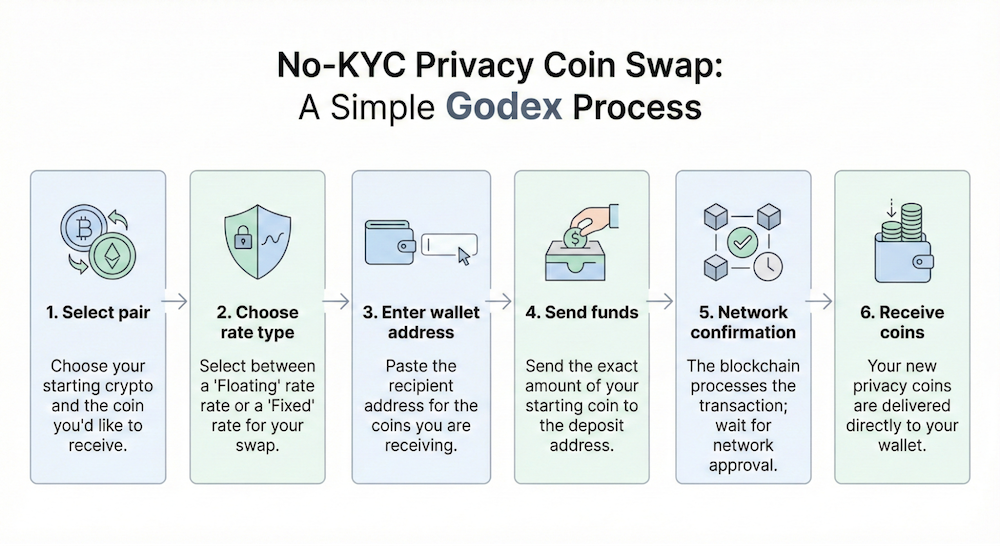
Step 1: Open Godex.io — No Account Needed Navigate to godex.io. You’ll see a clean exchange interface immediately on the homepage. No sign-up prompt. No pop-up asking for your email. Just the exchange tool.
Step 2: Select Your Currency Pair In the “You Send” field, select your source currency (e.g., XMR if you’re swapping Monero). In the “You Receive” field, select your destination currency (e.g., BTC, ETH, ZEC, or any of the 928+ available assets). Enter the amount you want to swap.
Step 3: Choose Your Rate Type Select Fixed Rate to lock in the current exchange rate for the duration of your transaction — recommended for larger swaps or volatile market conditions. Select Floating Rate if you’re comfortable with slight rate movement in exchange for potentially more favorable pricing.
Step 4: Enter Your Destination Wallet Address Input the wallet address where you want to receive your swapped funds. For Zcash swaps to a shielded address, enter the z-address directly — Godex handles it correctly. Double-check this address. Crypto transactions are irreversible.
Step 5: Send Your Funds to the Godex Deposit Address Godex generates a unique deposit address for your swap. Send the exact amount of your source currency (e.g., your XMR) to this address from your personal wallet. For Monero, include the Payment ID if specified by the platform.
Step 6: Wait for Confirmation and Receive Your Funds Once your transaction is confirmed on the network (timing varies by blockchain), Godex processes the conversion and sends your funds directly to your destination wallet. Most swaps complete in 5–30 minutes. You’ll receive the exact amount shown at order creation if you chose the fixed rate.
That’s it. No account. No identity check. No waiting for approval. Just clean, direct crypto-to-crypto conversion.
Pro Tips for Maximizing Privacy During Your Swap
Even with a no-KYC exchange like Godex, there are additional steps you can take to maximize operational security and truly close the privacy loop.
Use a Fresh Receiving Address for Every Swap Never reuse wallet addresses. Reusing addresses links your transactions together on the blockchain, creating a traceable pattern even when using privacy coins. Most modern wallets generate new addresses automatically for each transaction.
Access Godex via Tor or a Trusted VPN Your IP address is metadata. While Godex minimizes data collection, accessing the platform through Tor or a no-logs VPN prevents your Internet Service Provider or network observer from seeing that you initiated a swap.
Self-Custody Your Privacy Coins Never leave XMR or ZEC on an exchange — even a no-KYC one. Keep your holdings in wallets where you control the private keys. For Monero, the official GUI/CLI wallet or hardware wallets with Monero support (like Trezor with Godex integration) are the gold standard.
Understand Your Local Regulatory Environment Holding and using privacy coins is legal in most jurisdictions. However, some countries (Japan, South Korea, Australia) have imposed exchange-level restrictions. Tax obligations apply to crypto transactions regardless of privacy status. Stay informed about the regulations in your region.
Test With a Small Amount First If you’re using Godex for the first time or swapping a new currency pair, do a small test transaction first. Confirm the funds arrive correctly at your destination address before committing a larger amount.
The Future of Privacy Coins and Why It’s Bright
The regulatory pressure on privacy coins is real — but it’s not the death knell that fearful headlines suggest. If anything, the current landscape is strengthening the ecosystem by filtering out fair-weather participants and concentrating development energy in the most technically resilient projects.
Monero’s FCMP++ (Full-Chain Membership Proofs) upgrade is in active development and promises to improve both the strength and efficiency of XMR’s privacy guarantees. Zcash’s NU6.1 governance and funding reform is positioning the project for long-term sustainability post-Founder’s Tax. Both protocols are being built by deeply committed developer communities who view privacy not as a feature, but as a fundamental right.
The total privacy coin market cap surpassed $24 billion in early 2026 — a mainstream threshold that’s difficult to dismiss. Institutional conversations about privacy-preserving technology in banking are quietly accelerating. And as the broader crypto ecosystem matures, the philosophical case for financial privacy only grows stronger.
For the holders, traders, and believers who are already in this space: the infrastructure to swap, hold, and use your privacy coins exists right now. Platforms like Godex make it seamless, safe, and genuinely anonymous.
Frequently Asked Questions
Is it legal to swap Monero and Zcash without KYC?
Using a no-KYC privacy coins exchange is legal in most countries, though exchange-level restrictions exist in places like Japan and South Korea. Keep in mind that tax reporting obligations still apply regardless of how you swap.
Can privacy coins like Monero be truly traced by blockchain analytics firms?
Monero’s combination of ring signatures, stealth addresses, and RingCT makes it the most forensically resistant privacy coin available — no analytics firm has publicly demonstrated a reliable method for tracing XMR transactions at scale. Zcash shielded transactions using zk-SNARKs offer comparable protection, provided you consistently use z-addresses rather than transparent t-addresses.
What should I look for when choosing a privacy coins exchange platform?
Prioritize a verifiable no-KYC policy with no hidden volume thresholds, proper technical support for privacy coin address formats, and a non-custodial swap model that never holds your funds. Platforms like Godex check all three boxes — with zero registration, full XMR and ZEC shielded address support, and a wallet-to-wallet swap architecture since 2018.
What is the difference between a fixed rate and a floating rate when swapping XMR or ZEC?
A fixed rate locks in your exchange amount at order confirmation, protecting you from volatility during network processing — ideal for larger Monero or Zcash swaps. A floating rate tracks live prices and may offer a slightly better outcome in calm markets, but carries slippage risk if prices shift during confirmation.
How long does a privacy coin swap take?
Most Monero and Zcash swaps on a no-KYC instant exchange complete within 5–30 minutes, with the bulk of that time determined by network confirmation speed rather than the platform itself. XMR transactions typically confirm within 2–4 minutes, while ZEC confirmations average around 2.5 minutes — making privacy coin swaps genuinely fast when you use a reliable instant swap service like Godex.
Final Takeaway: Your Privacy, Your Terms
Privacy coins exist because financial sovereignty matters. Monero and Zcash represent two of the most technically sophisticated and philosophically coherent projects in all of cryptocurrency — and they’re growing stronger despite (or because of) regulatory resistance.
The challenge isn’t the coins themselves. It’s finding a privacy coins exchange that matches your values and actually keeps its promises. Godex does exactly that — no KYC, no registration, no compromises, 928+ assets, 8+ years of operation, and an ecosystem of partners who trust it.
Ready to swap your Monero or Zcash with complete privacy? Head to godex.io and experience what a genuine no-KYC crypto exchange looks and feels like. Your swap is three minutes away — and your personal data stays exactly where it belongs: with you.
Start a Cryptocurrency exchange
Try our crypto exchange platform
Disclaimer: Please keep in mind that the content of this article is not financial or investing advice. The information provided is the author’s opinion only and should not be considered as direct recommendations for trading or investment. Any article reader or website visitor should consider multiple viewpoints and become familiar with all local regulations before cryptocurrency investment. We do not make any warranties about reliability and accuracy of this information.
Read more
You may well think that an article dedicated to a Tether price prediction or the Tether price in general is a little bit strange — it is a stablecoin after all. However, the price of Tether does fluctuate significantly, although it is nowhere near as volatile as non-stablecoin cryptos. This means that staying up to […]
In the article we share our vision at Zcash cryptocurrency main features and add several price predictions. As cryptocurrencies gain global acceptance and decentralisation slowly enters our lives, privacy becomes the main concern when talking about blockchain adoption. It is no secret that distributed ledger is by far the most secure and transparent technology ever […]
Chiliz coin (CHZ) offers a compelling opportunity for traders interested in the intersection of blockchain technology and sports. By enabling fans to influence team decisions through the Socios app, Chiliz directly monetizes fan engagement and connects with major sports teams like Juventus and Paris Saint-Germain. These partnerships not only enhance the platform’s visibility but also […]
The exponential growth of Bitcoin Satoshi Vision (BSV) against the general bear trend on the cryptocurrency market in autumn 2019 has impressed the community. Due to the increasing market capitalization, the newly emerged altcoin was ranked 5th on CoinMarketCap and managed to maintain its high position at the beginning of 2020. In the article we […]
EOS is definitely on the list of the strongest and most stable projects in the crypto world. Despite the fact that the currency entered the market less than 3 years ago, it consistently occupies one of the top 10 places in the rating for project capitalization. it is often called the “main competitor of Ethereum”. […]
XRP price prediction 2026-2027: bear, base, and bull scenarios with ranges and named sources, the resolved SEC case, live spot ETFs, and can XRP reach $10?