
 Alex Tamm

Table of Contents
Polkadot trades near $1.05 as of June 2026, roughly 98% below its November 2021 all-time high of $55. No one can guarantee where DOT goes next — credible 2026 forecasts range from about $0.80 to over $11, and long-range 2030 estimates span under $1 to $36. This article lays out bear, base, and bull scenarios for 2026–2040 as ranges, not guarantees. Not financial advice.
TL;DR — Polkadot Price Forecast at a Glance
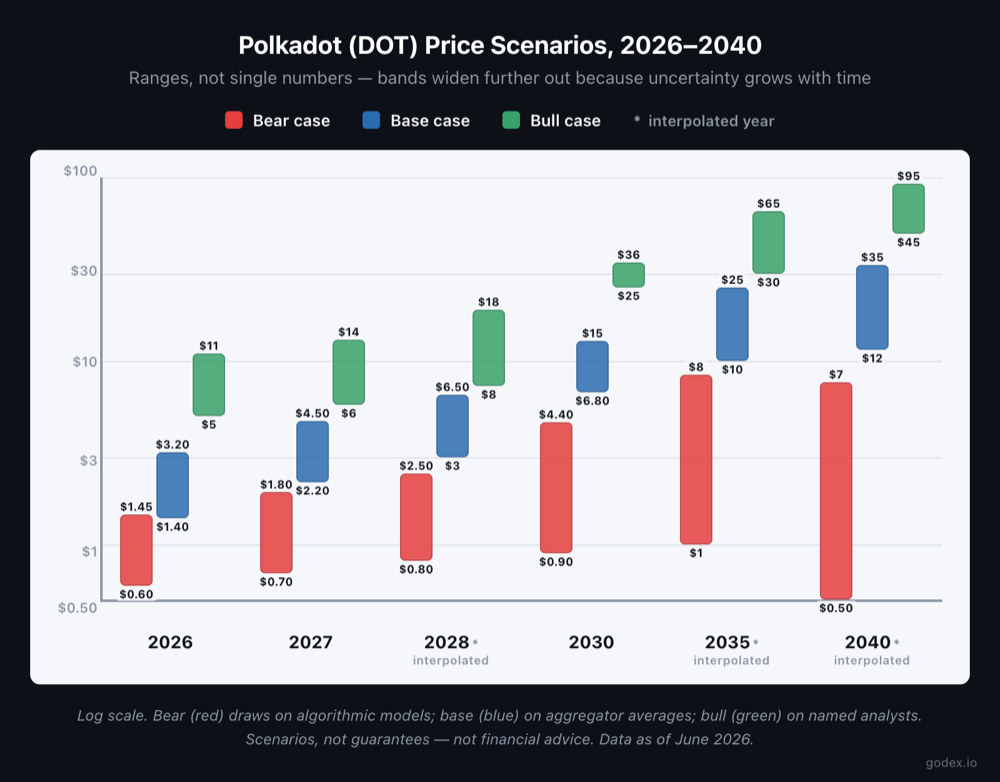
DOT’s outlook splits into three scenarios. The bear case assumes a prolonged altcoin winter and weak coretime demand, keeping DOT near or below $1. The base case assumes the March 2026 supply cap slowly tightens new issuance while JAM and Polkadot 2.0 adoption builds — a gradual re-rate, not a moonshot. The bull case assumes a full altseason plus the supply story compounding. The single most under-covered driver is the March 2026 tokenomics reset (tokenomics = the rules governing a coin’s supply and rewards) — a 2.1 billion DOT hard cap and a 53.6% cut to emissions (the new DOT minted each year as staking rewards) that most algorithmic forecasts still haven’t priced in. These are scenarios, not guarantees.
| Year | Bearish | Base case | Bullish |
|---|---|---|---|
| 2026 | $0.60 – $1.45 | $1.40 – $3.20 | $5 – $11 |
| 2027 | $0.70 – $1.80 | $2.20 – $4.50 | $6 – $14 |
| 2028* | $0.80 – $2.50 | $3 – $6.50 | $8 – $18 |
| 2030 | $0.90 – $4.40 | $6.80 – $15 | $25 – $36 |
| 2035* | $1 – $8 | $10 – $25 | $30 – $65 |
| 2040* | $0.50 – $7 | $12 – $35 | $45 – $95 |
Data as of June 2026 — scenarios, not guarantees, not financial advice. Cells marked with an asterisk (*) are interpolated between sourced near-term and long-range model points; the cents in source models are model artifacts, not precise claims. Ranges widen further out because uncertainty grows with time.
Quick view (phone-friendly): if the full grid above is hard to read on a small screen, here is one representative range per scenario over the whole horizon:
- Bear: DOT stays near or below ~$1–$8 through 2040 (weak demand, prolonged altcoin winter).
- Base: a gradual re-rate into the roughly $3–$35 zone by the 2030s–2040 (supply cap slowly tightens, adoption builds).
- Bull: a full altseason plus the supply story compounding pushes DOT into the ~$11–$95 range across the horizon.
Full year-by-year bands are in the grid above.
Sources for the ranges: Bear bands draw on algorithmic/statistical models — CoinCodex, Long Forecast, and WalletInvestor (down to ~$0.585 for 2026). Base bands reflect aggregator averages (~$2.25 average for 2026). Bull bands draw on named analysts including Tim Draper ($10.71) and InvestingHaven, whose conditional 2026 outlier reaches ~$36 only on a sustained break above ~$14.
What separates bull from bear: JAM mainnet delivery, how fast post-cut supply scarcity offsets the ~1 billion DOT already minted, coretime and dApp adoption, staking demand, and the broader altcoin cycle and regulatory clarity. The $60+ figures from 2030 onward and any $100+ scenario are low-probability tail cases, not consensus — treat them as such.
Not financial advice. Every price figure here is a scenario range based on named third-party analysts and current on-chain data, not a prediction. Cryptocurrency markets are volatile and past performance does not indicate future results. Do your own research. Nothing in this article is investment advice.
Is Polkadot Dead?
No — but it is deeply out of favor. DOT trades around 98% below its 2021 all-time high of $55 amid bearish sentiment, yet the network shipped the biggest fundamental changes in its history during 2026. “Dead” is a sentiment question; development status is the honest answer.
The drawdown is real. Price is down hard, attention has rotated to other narratives, and DOT sits at roughly rank ~#47 (CoinGecko) by market cap — a far cry from its top-10 days. That is exactly why “is Polkadot dead” is a live search query.
But the development side tells a different story. Polkadot 2.0 is essentially complete (Async Backing, Agile Coretime, and Elastic Scaling all shipped). The JAM testnet went live in January 2026. And in March 2026 the network executed a permanent supply cap and a 53.6% emissions cut. A chain shipping its largest-ever upgrades is not dead — it is unloved, which is not the same thing.
Polkadot Price and Performance: Where DOT Stands in June 2026
As of June 2026, DOT trades near $1.05 , with a market cap around $1.77B and a circulating supply of roughly 1.68 billion DOT. That places it near rank ~#47 (CoinGecko). Its all-time high was $55.00 on November 4, 2021 — so DOT currently sits about 98% below that peak. It is also trading near its all-time low of ~$1.01 — not just far from its high, but at the bottom of its range. (CoinGecko for live figures.)
The short version of how it got here: DOT peaked during the 2021 bull market and has spent the years since grinding lower alongside the broader altcoin sector. That is the context — not the forecast. What matters for 2026 onward is what changed this year.
What Changed in 2026? The March Tokenomics Reset
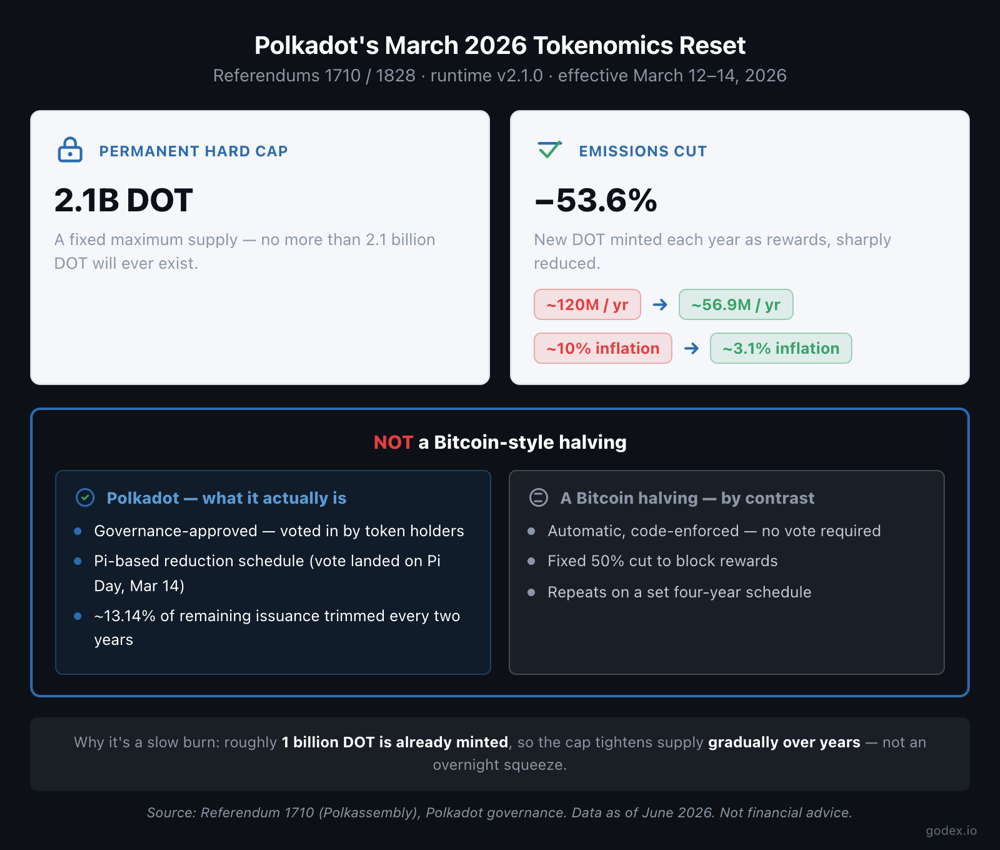
In March 2026, Polkadot governance executed the single biggest fundamental change in DOT’s history — and most algorithmic forecasts still haven’t priced it in. Through runtime upgrade v2.1.0 (referendums 1710 and 1828), effective March 12–14, 2026, the network adopted a permanent hard supply cap of 2.1 billion DOT and a 53.6% emissions cut, taking annual issuance (the amount of new DOT created each year) from roughly 120 million down to about 56.9 million DOT.
The effect on inflation was immediate: annual inflation dropped from about 10% to roughly 3.1%. Subsequent reductions of ~13.14% of remaining issuance every two years are scheduled to push inflation below 1% by the early 2030s. A new Dynamic Allocation Pool (DAP) now governs how issuance splits between staking rewards, treasury, and reserve. (Referendum 1710 on Polkassembly.)
This is not a “Bitcoin-style halving.” Some outlets loosely call it one, but the label is inaccurate. Bitcoin’s halving is an automatic, code-enforced 50% cut every four years. Polkadot’s change is a governance-approved, pi-based emissions reduction — voted in by token holders, with a reduction schedule built around the mathematical constant pi (the vote landed on Pi Day, March 14). Calling it a halving misrepresents how it works.
Why it matters for price: scarcer new supply plus a hard cap is the structural bull narrative. But roughly 1 billion DOT is already minted, so this is a long-term supply-dynamics shift, not an overnight catalyst. The supply story is a slow burn.
What Else Drives Polkadot’s Price in 2026 and Beyond?
Supply is only one input. Four other drivers shape the scenarios above.
Polkadot 2.0 — Agile Coretime and Elastic Scaling
Polkadot 2.0 is shipped, not upcoming. Async Backing improved block efficiency. Agile Coretime replaced the old parachain slot auctions (parachains are the independent blockchains that plug into Polkadot’s shared security) with an on-demand coretime market, lowering onboarding friction — a shift that coincided with a meaningful uptick in new dApps in early 2026 (~+150 in Q1, per Polkadot ecosystem reporting). Elastic Scaling (completed October 2025) lets parachains burst across multiple relay-chain cores. Together, these turned Polkadot’s “rent a blockchain” model into something closer to “buy compute when you need it” — a more practical pitch for builders.
JAM (Join-Accumulate Machine) — the Next Milestone
JAM, informally “Polkadot 3.0,” is the next major architectural step — and it is in progress, not live. The Gray Paper reached ~v0.8, multiple independent clients (Rust and Go) hit conformance, and the JAM testnet launched around January 2026 with dozens of implementation teams. Mainnet is not expected before late 2026 to 2027; 2026 is the window for testnet and testing milestones (and the first on-chain mainnet upgrade proposals through OpenGov), not for the mainnet itself. JAM is designed to replace the Relay Chain, support RISC-V plus smart contracts at the core layer, and target very high throughput. It is a potential catalyst — not a price guarantee, and not a delivered fact yet.
Staking and Yield
DOT staking historically paid around 11%, though native rates today run roughly ~5–15% depending on method and provider. Nominal yields are likely to drift lower as emissions fall under the pi-based reduction schedule — but because inflation is falling faster than the reward pool, real (inflation-adjusted) yield can hold up or even improve. That is the actual bull thesis: scarcer rewards plus a hard cap could make holding and staking DOT structurally more attractive over time. Present and future yields are variable, not fixed — and this is a thesis, not a certainty.
Macro and the Altcoin Cycle
DOT is a high-beta mid-cap. Its path tracks the broader cycle more than any single feature — risk appetite, altseason timing, and regulatory clarity will move it as much as anything Polkadot ships. For the wider 2026–2027 picture, see our broader crypto market outlook for 2026–2027. This piece stays DOT-specific.
Polkadot Price Prediction 2026–2028: The Near Term
For 2026, credible forecasts span an unusually wide band: bears around $0.60–$1.45 (algorithmic models from CoinCodex, Long Forecast, and WalletInvestor, whose low runs to ~$0.585), a base case of roughly $1.40–$3.20 (aggregator average near $2.25), and bulls at $5–$11 (Tim Draper’s $10.71 sits in this band), with a conditional InvestingHaven outlier near $36 that depends on a sustained break above ~$14.
By 2027 and 2028, the base case widens to roughly $2.20–$6.50 as the post-cut supply story has more time to matter and JAM mainnet either delivers or slips. The key honest caveat: the March 2026 supply cut is a slow-burn repricing, not an instant one. With ~1 billion DOT already circulating, reduced new issuance tightens the float (the supply of coins actively circulating and available to trade) gradually rather than triggering an overnight squeeze. The bear-to-bull spread stays very wide because the macro cycle, not Polkadot’s roadmap alone, dominates near-term price.
What Will Polkadot Be Worth in 2030?
Scenario range for 2030: bears under $1 to ~$4.40, base case ~$6.80–$15, and bulls $25–$36, attributed to the analyst clusters above. That is a range, not a number — anyone quoting a single 2030 price to the cent is selling false precision.
Over a four-year horizon, the drivers that compound are JAM mainnet delivery, post-cut supply scarcity meeting steady or rising demand, coretime and dApp adoption, staking demand, and the broader market cycle. Will DOT reach $60 by 2030? That would require an extraordinary bull run pushing DOT above its 2021 all-time high — it sits above even most bull-case ranges and is not a base-case expectation.
Polkadot Price Prediction 2035 and 2040: The Long View
Decade-out forecasts are directional scenarios, not models — treat them accordingly. For 2035, a midpoint most forecasters skip, scenarios span a bearish ~$1–$8, a base case of ~$10–$25, and a bullish ~$30–$65. For 2040, the spread is wider still — as it should be, since uncertainty grows with time: a conservative algorithmic floor under $1, a base case of roughly $12–$35, and a bullish band of ~$45–$95.
The honest framing: there is genuine irony in forecast bots quoting DOT “to the cent” for 2040. No one can model 14 years of crypto-market structure, regulation, and competition with that precision. These bands describe what would have to be true — sustained adoption, the supply cap mattering at scale, DOT staying relevant against cross-chain competitors — not what will happen.
Will Polkadot Reach $10, $60, or $100?
Short answer, scenario-framed and not a yes: $10 is reachable in a strong bull case this cycle, $60 would take an extraordinary multi-year run, and $100+ is unlikely on any realistic horizon.
- $10 — Within some bull-case ranges (Tim Draper’s $10.71 sits right at it). It is above the base case and requires a sustained altcoin rally plus the supply story playing out.
- $60 — Above DOT’s 2021 all-time high of $55. An extraordinary multi-year bull case, not a base expectation; it appears only in the upper bull bands from 2035 onward.
- $100+ — Explicitly unlikely on any realistic horizon. Sources that float it treat it as a tail case; we mention it only to debunk the headline, not to endorse it.
Each ties back to the table: the higher the target, the more it depends on conditions stacking in DOT’s favor over years, not months.
Is Polkadot a Good Investment in 2026?
That depends entirely on your risk tolerance and thesis — and this is not a recommendation. Here is the honest two-sided read.
The bull thesis: the March 2026 supply cap and 53.6% emissions cut structurally tighten future supply; development is active (Polkadot 2.0 shipped, JAM in testnet); the interoperability and coretime use case is real; staking still pays a (declining) yield; and DOT trades at a deep ~98% discount from its ATH.
The bear/risk side: sentiment has been bearish for years; DOT is a volatile mid-cap; ~1 billion DOT is already minted, so the cap bites slowly; JAM carries execution and timing risk; and cross-chain mindshare is contested by competitors. On near-term “DOT price tomorrow / this week” questions — this is a long-horizon scenario piece, not day-trading signals. For your specific situation, do your own research and see the disclaimer above. Nothing here is investment advice.
How to Swap Into or Out of Polkadot Without KYC
If you decide to move into or out of DOT, a non-custodial, no-KYC swap is the practical way to do it without tying an account or identity to the trade. Non-custodial swap services like Godex — which keep funds in your control throughout, require no KYC at any volume, and offer a fixed-rate option that locks the rate for the duration of the swap — let you move into or out of Polkadot without tying an account or identity to the trade. For a step-by-step walkthrough, see our guide on how to swap into Polkadot without KYC.
Godex.io is a non-custodial instant cryptocurrency exchange operating since 2017. It supports 936+ coins, requires no registration or KYC at any transaction size, and offers both fixed-rate and floating-rate swap modes. Processing time is 5–30 minutes after the deposit is received.
For a related single-coin forecast, see also our Ethereum price outlook.
Frequently Asked Questions
Is Polkadot dead?
No, but it is deeply out of favor. DOT trades around 98% below its November 2021 all-time high of $55 while the network shipped its biggest-ever upgrades in 2026 — Polkadot 2.0, the JAM testnet, and the March 2026 supply cap. Sentiment is bearish; development status is active. “Dead” describes the price mood, not the chain.
What will Polkadot be worth in 2030?
There is no single answer — credible forecasts span a wide range. Scenario bands for 2030 run from a bearish under $1 to ~$4.40, a base case of roughly $6.80–$15, and a bullish $25–$36, drawn from named analysts and algorithmic models. These are scenarios, not guarantees. Not financial advice.
Will Polkadot reach $60?
Only in an extraordinary bull case. $60 sits above DOT’s 2021 all-time high of $55 and above most bull-case ranges before the mid-2030s. It is not a base-case expectation. A $100+ DOT is explicitly unlikely on any realistic horizon and is mentioned by analysts only as a tail case.
What was the March 2026 Polkadot tokenomics change?
A governance-approved 2.1 billion DOT permanent hard supply cap plus a 53.6% emissions cut (referendums 1710/1828, effective March 12–14, 2026). Annual inflation fell from ~10% to ~3.1% immediately. It is a pi-based emissions reduction voted in by token holders — not a Bitcoin-style automatic halving, despite the loose “halving” label some outlets use.
What is JAM?
JAM (the Join-Accumulate Machine, informally “Polkadot 3.0”) is a planned re-architecture designed to replace the Relay Chain with RISC-V support and smart contracts at the core layer, targeting very high throughput. The testnet launched around January 2026 with multiple conformant clients; mainnet is not expected before late 2026 to 2027 — 2026 is for testnet and testing milestones, not the mainnet itself.
Is Polkadot a good investment in 2026?
It depends on your risk tolerance and thesis. The bull side cites the new supply cap, active development, and a deep discount from the ATH; the bear side cites years of weak sentiment, mid-cap volatility, ~1 billion DOT already minted, and JAM execution risk. This is not financial advice — do your own research.
What was Polkadot’s all-time high?
Polkadot’s all-time high was $55.00, set on November 4, 2021. As of June 2026, DOT trades roughly 98% below that level.
Start a Cryptocurrency exchange
Try our crypto exchange platform
Disclaimer: Please keep in mind that the content of this article is not financial or investing advice. The information provided is the author’s opinion only and should not be considered as direct recommendations for trading or investment. Any article reader or website visitor should consider multiple viewpoints and become familiar with all local regulations before cryptocurrency investment. We do not make any warranties about reliability and accuracy of this information.
Read more
You may well think that an article dedicated to a Tether price prediction or the Tether price in general is a little bit strange — it is a stablecoin after all. However, the price of Tether does fluctuate significantly, although it is nowhere near as volatile as non-stablecoin cryptos. This means that staying up to […]
In the article we share our vision at Zcash cryptocurrency main features and add several price predictions. As cryptocurrencies gain global acceptance and decentralisation slowly enters our lives, privacy becomes the main concern when talking about blockchain adoption. It is no secret that distributed ledger is by far the most secure and transparent technology ever […]
Chiliz coin (CHZ) offers a compelling opportunity for traders interested in the intersection of blockchain technology and sports. By enabling fans to influence team decisions through the Socios app, Chiliz directly monetizes fan engagement and connects with major sports teams like Juventus and Paris Saint-Germain. These partnerships not only enhance the platform’s visibility but also […]
The exponential growth of Bitcoin Satoshi Vision (BSV) against the general bear trend on the cryptocurrency market in autumn 2019 has impressed the community. Due to the increasing market capitalization, the newly emerged altcoin was ranked 5th on CoinMarketCap and managed to maintain its high position at the beginning of 2020. In the article we […]
EOS is definitely on the list of the strongest and most stable projects in the crypto world. Despite the fact that the currency entered the market less than 3 years ago, it consistently occupies one of the top 10 places in the rating for project capitalization. it is often called the “main competitor of Ethereum”. […]
XRP price prediction 2026-2027: bear, base, and bull scenarios with ranges and named sources, the resolved SEC case, live spot ETFs, and can XRP reach $10?