
 Alex Tamm

Table of Contents
Every new exchange in 2026 promises the same things: deep liquidity, zero fees, institutional-grade security. Most deliver none of them. Here’s how to tell the difference — and what to look for before you trust a platform with your funds.
The crypto exchange market in 2026 is noisier than ever. Barely a month passes without a new platform launching with a slick UI, a token incentive program, and a whitepaper full of the word “revolutionary.” Social media fills up with referral codes. Influencer partnerships get announced. And then, quietly, the order books run dry, withdrawals slow to a crawl, and the “institutional-grade” security blog post stays pinned at the top of a feed that hasn’t been updated in six weeks.
This isn’t cynicism — it’s pattern recognition. The cycle has repeated enough times that it has a shape: a launch-day surge of token-farming users, a marketing-inflated trading volume, a bear week that exposes the thin order books, and then the slow, quiet attrition of users migrating back to platforms that actually work. What links many high-profile failures isn’t bad luck or bear-market timing — it’s the same playbook: sell the dream to retail, negotiate different terms with insiders, and let liquidity evaporate once the music stops.
Not every new exchange is a trap — some genuinely build better infrastructure or serve users the giants ignore. The question is how to tell the difference before you hand over assets you can’t afford to lose.
Why New Crypto Exchanges Keep Launching — and Why Most Fail
New exchanges launch because the barrier to entry is low, the potential upside is enormous, and the market is large enough that even a small slice looks attractive. Building on white-label infrastructure, you can spin up a functional-looking exchange in weeks. Add a token, run a liquidity mining campaign, and you have the appearance of a thriving platform.
The failure rate, however, is brutal. Most new platforms discover this the hard way: without proprietary liquidity relationships they depend on aggregated feeds that evaporate during volatility; without real compliance infrastructure they face account freezes the moment they gain traction; without operational depth their support teams collapse under load. The FBI recorded $11.36 billion in cryptocurrency-related fraud losses in 2025 alone — a 22% year-over-year increase — a reminder that the environment new exchanges enter is unforgiving.
The platforms that survive share a short list of qualities: real liquidity depth, a clear custody model, an honest fee structure, and an operational track record that predates their current marketing campaign.
The 5 Red Flags That Expose a Hyped Exchange
Before evaluating any specific platform, it helps to know what the warning signs look like in practice. These five patterns appear, in some combination, in almost every exchange that overpromises and underdelivers.
1. Liquidity Numbers That Don’t Hold Up Under Scrutiny
An exchange can claim any trading volume it wants. Wash trading — where the platform trades with itself — is cheap and produces impressive-looking charts. The real test is order book depth: what happens to the price when you try to execute a mid-size trade? Established platforms are benchmarked by independent services like Kaiko; new platforms rarely publish equivalent data. When claimed volume has no corresponding depth, that’s the answer.
Practical check: Before depositing anything significant, try placing a limit order slightly off the mid-price. How wide is the spread? How quickly does it fill?
2. Token Incentives Masking Empty Infrastructure
Token incentive programs are the 2026 equivalent of the teaser rate. The exchange distributes its native token as a reward for trading, depositing, or referring others. Early users see returns that look spectacular — until the token price drops, the incentive pool runs dry, or the platform unilaterally changes the reward structure. Volume is inflated by incentive-farming, user growth is driven by airdrop hunters who won’t stay, and when the campaign ends the real platform emerges — usually much smaller.
The question to ask is simple: if you strip away the token rewards, would you still use this exchange? If the answer is no, the token program is a subsidy for a product that can’t stand on its own.
3. Custody Models That Aren’t Clearly Disclosed
Where are your funds when they sit on the exchange? A surprising number of new platforms in 2026 are vague about the answer. “Institutional-grade security” and “advanced encryption” are marketing phrases, not custody models. What matters is whether the exchange holds your private keys, what percentage is in cold storage, and whether they publish proof-of-reserves attestations with cold storage ratios above 90%. An exchange that refuses to disclose these figures — or buries them in footnotes — is telling you something important.
4. Roadmaps That Function as Marketing, Not Engineering Plans
Every new exchange in 2026 has a roadmap. Most are indistinguishable from each other: Q1 mobile app, Q2 staking, Q3 derivatives, Q4 “institutional services.” These items are chosen because they sound impressive, not because there’s a concrete engineering plan behind them.
The tell is specificity. A real roadmap has shipping dates, names milestones in terms of observable functionality, and is updated when things change — including when they slip. A vague roadmap is a promise of features that may never arrive, designed to keep users engaged long enough for the platform to build its user base before the reality becomes obvious.
5. Registration and KYC Requirements That Appear Mid-Process
Some platforms advertise themselves as no-KYC or low-friction, then introduce identity verification requirements after users have already deposited funds. Springing mandatory verification on users who were told it wasn’t required is not just a breach of trust — it can strand funds for weeks during compliance reviews.
Legitimate platforms are upfront about their compliance model before you deposit. If the KYC policy is buried in terms of service or emerges as a “special case” when you try to withdraw, treat that as a structural warning, not a one-time inconvenience.
What Legitimate New Exchanges in 2026 Are Actually Building
Not every new platform is chasing hype. Some are solving real problems. Here’s where genuine innovation is happening in 2026.
Faster Execution Infrastructure
The execution gap between established platforms and newer entrants has narrowed significantly. In 2026, the fastest exchanges process withdrawals to the blockchain in under 45 seconds — a meaningful benchmark for active traders. Some newer platforms have built latency advantages by co-locating their matching engines with major blockchain nodes, cutting confirmation time for on-chain settlements.
Hybrid Custody Models
The FTX collapse in 2022 permanently changed how sophisticated users think about custody. A growing segment of new platforms in 2026 are experimenting with hybrid models: order-book trading with non-custodial settlement, where the exchange matches trades but never holds the underlying assets. It’s technically harder to build, but it eliminates the single most catastrophic failure mode — a platform insolvency that wipes out user funds.
On-Chain Transparency
Some newer platforms are publishing real-time proof-of-reserves with cryptographic verification, allowing users to confirm that their funds exist and aren’t being rehypothecated. This is increasingly a differentiator rather than a baseline, because many legacy platforms still rely on quarterly audits that can miss intra-period exposure.
Specialized Asset Coverage
Established exchanges move slowly on new listings — for compliance reasons as much as operational ones. A genuine niche for new platforms is faster, more comprehensive access to long-tail assets. The risk is that speed-to-listing creates exposure to illiquid or fraudulent tokens. The platforms doing this responsibly combine fast listing with transparent risk disclosures.
Instant Swap Platforms: A Different Model Entirely
Not all crypto exchanges compete on the same battlefield. A category that has grown substantially in 2026 is the non-custodial instant swap — platforms that don’t operate traditional order books at all, but instead route swaps through aggregated liquidity at the time of execution.
These platforms solve a different problem than a full trading terminal. Their users want to convert one asset to another quickly, privately, and without the friction of account creation, KYC verification, or custody risk — a single step: select a pair, enter a wallet address, send crypto, receive swapped coins.
The non-custodial architecture means the platform never holds your funds in a pooled wallet. Coins flow through the swap process and arrive at the destination wallet you specify. There’s no account to hack, no assets to freeze, and no custodial relationship to worry about if the platform experiences financial difficulties.
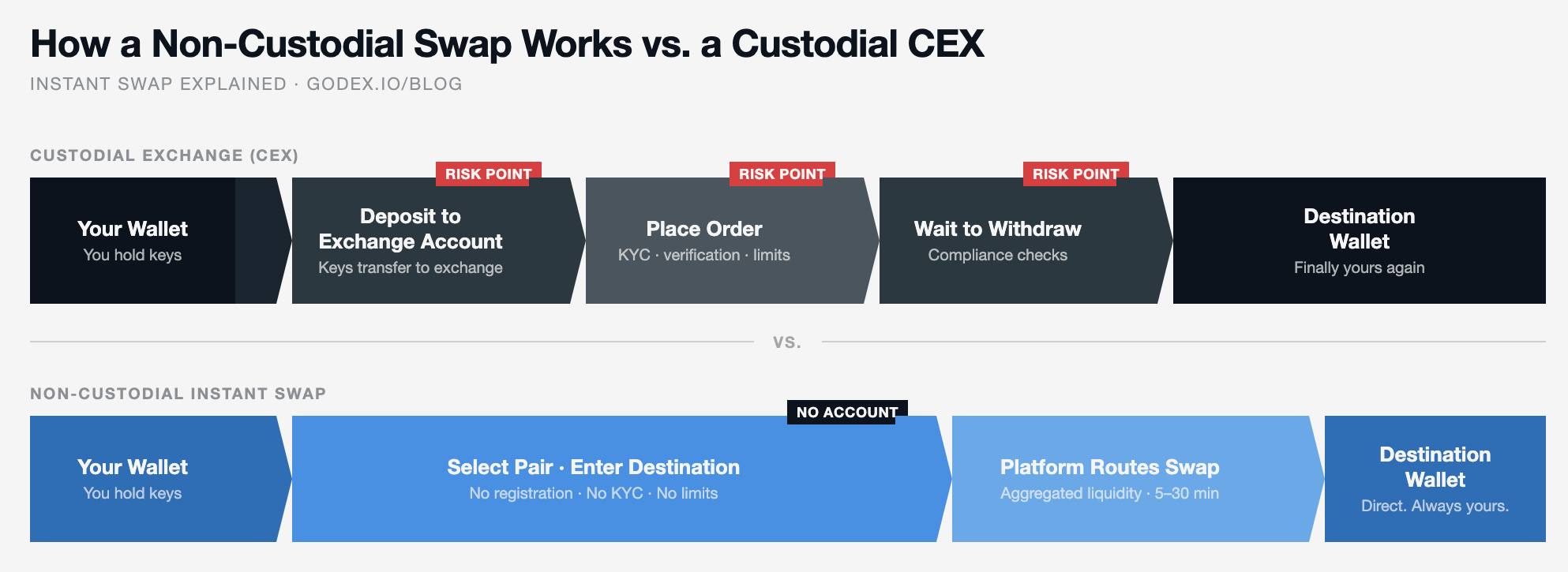
Godex is a case study worth examining here. Operating since 2018, it has built its model around non-custodial, no-registration swaps with no upper transaction limits. Users choose a pair, enter a destination wallet address, and complete the swap — no registration, no email, no KYC, no personal data collected. Godex supports 900+ cryptocurrencies and has operated continuously through multiple market cycles without a hack, without custody of user funds, and without the lock-up risks that have burned users on newer, higher-profile platforms. It isn’t a full trading terminal, doesn’t offer margin or derivatives, and doesn’t pretend to. That clarity of purpose is itself a signal.
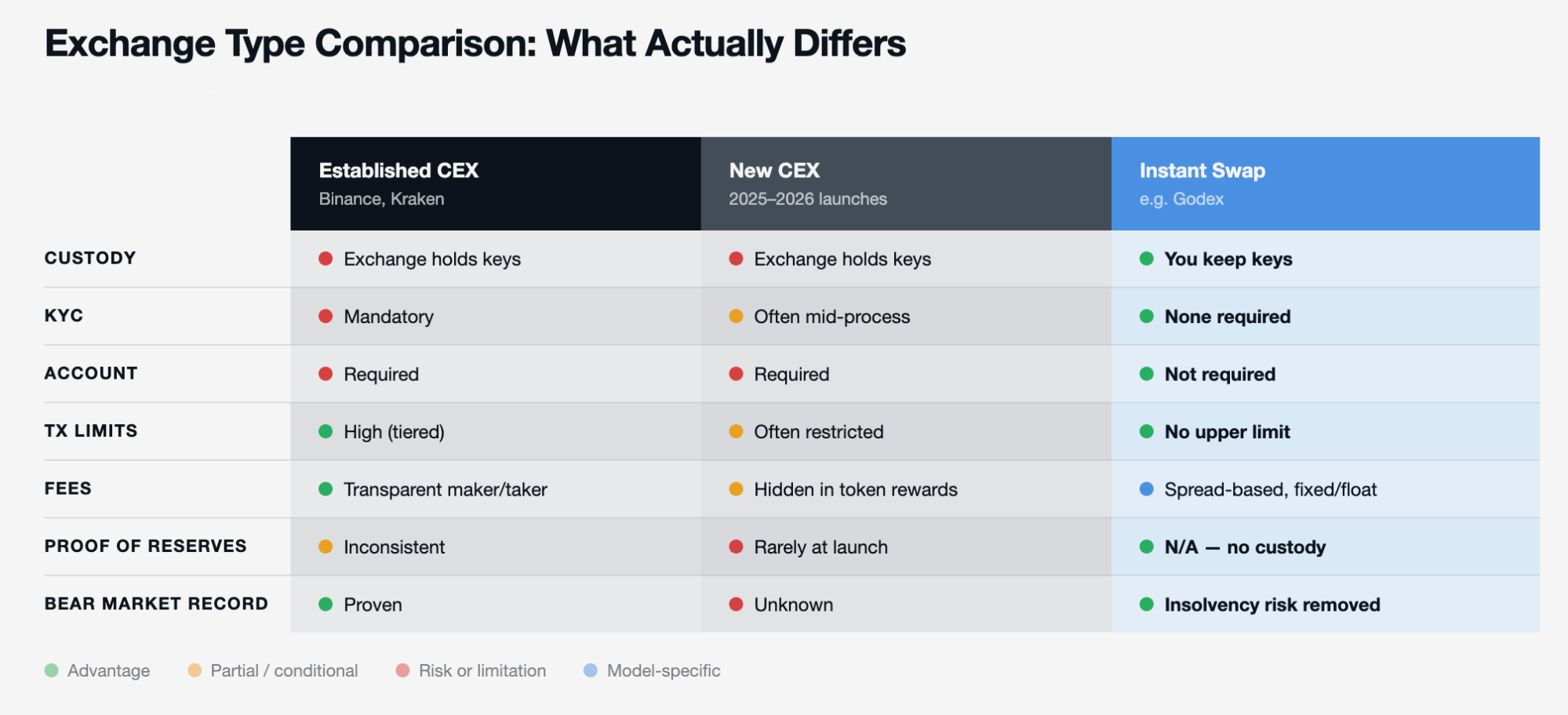
2026 Crypto Exchange Comparison: New vs. Established vs. Non-Custodial Swap
The infographic below organizes the key decision criteria across three platform types. No single type is best for every user — the right choice depends on what you’re actually trying to do.
How to Evaluate a New Exchange Before You Trust It With Real Money
The evaluation framework below applies to any exchange you’re considering in 2026, but it’s especially important for platforms that launched in the last 12–18 months. Run through these checks before depositing anything you can’t afford to lose.
Step 1: Verify the custody model Find the actual answer to where your funds sit. Look for cold storage percentages and proof-of-reserves documentation, not marketing language about “military-grade security.”
Step 2: Check independent liquidity data Don’t rely on the platform’s own volume figures. Third-party liquidity data from providers like CoinGecko (free) or Kaiko (institutional) gives a more accurate picture of actual order book depth than self-reported numbers.
Step 3: Read the compliance policy before depositing If the exchange will require KYC at any point — for withdrawals above a certain threshold, during “risk reviews,” or upon account upgrade — that should be disclosed upfront. Test the policy explicitly by reading the terms, not the marketing copy.
Step 4: Look for operational history How long has the platform been running? Has it survived a bear market? Has it published an incident report after any downtime? A platform that launched in 2024 and has only operated in bull conditions has never been stress-tested.
Step 5: Search for user experience outside official channels Reddit threads, Trustpilot reviews, and BitcoinTalk posts from real users tell you things that no review article will. Look specifically for patterns around withdrawals — that’s where operational problems tend to surface first.
Step 6: Start with a test transaction Before committing a significant amount, run a small transaction end-to-end. Check execution time, confirm the fee structure, and verify that what arrived in your wallet matches what was quoted. This costs a small amount in fees and saves potential losses from discovering a problem at scale.
The Exchanges Actually Worth Watching in 2026
Rather than a definitive ranking — which would be premature given how quickly conditions change — here are the categories where legitimate value is being created in 2026’s new exchange landscape.
Platforms building hybrid custody infrastructure The most interesting technical development in 2026 is non-custodial settlement on top of traditional matching engines. This architecture combines the liquidity depth of a centralized order book with the custody safety of a DEX. It’s harder to build and operationally more complex, but it represents where the category should be heading.
Specialized institutional-grade platforms A growing wave of crypto users now prioritize self-custody — the principle that only you should hold your private keys, and therefore your assets. Some new platforms are targeting institutional users who need compliance-grade reporting, audit trails, and enterprise-level SLAs. This is a legitimate gap — the largest established exchanges weren’t built for institutional workflows, and newer entrants with regulatory clarity in specific jurisdictions are filling it credibly.
Non-custodial instant swap services with proven track records The instant swap category has matured. Platforms that have been operating for multiple years, survived market downturns, and maintained a clean security record offer something that high-hype 2025/2026 launches simply can’t: proof. In a category where operational history is the most meaningful form of trust, longevity matters more than features.
What 2026 Gets Right That Earlier Cycles Didn’t
There are real improvements in the 2026 landscape worth acknowledging. Proof-of-reserves has moved from a differentiator to an expectation. Exchanges now compete on derivatives, staking, regular audits, and regulatory licenses in ways that would have been unusual three years ago.
Regulatory clarity in several jurisdictions has created a path for exchanges to operate with genuine legal standing rather than jurisdictional ambiguity. The EU’s MiCA framework has been fully in force since December 2024, establishing a uniform licensing regime across all 27 member states. US regulatory guidance continues to evolve under SEC and CFTC frameworks, while Singapore and the UAE have established clearer licensing regimes of their own. Platforms that have invested in compliance infrastructure can now point to licenses as a verifiable quality signal, not just a marketing claim.
On the technical side, execution speed and cross-chain interoperability have improved substantially. Users who remember bridging assets between chains in 2021 or 2022 will find the friction has dropped significantly.
What hasn’t improved: the incentive to launch vaporware remains high, the ability to audit a new platform’s real infrastructure remains low, and the gap between a polished UI and a functional exchange remains wide. The tools for evaluating platforms have gotten better; the motivation to cut corners hasn’t gone away.
The Bottom Line: New Isn’t Better or Worse — It’s Unproven
A new exchange in 2026 should be approached the way you’d approach any unproven counterparty: with interest, but with proportional caution. New platforms can and do build better products. The question is whether they’ve had enough time and enough adversity to demonstrate it.
Before trusting any exchange with funds that matter to you, ask the questions the marketing doesn’t answer. Where are my assets right now? What happens to them if this platform has a problem? How do I get them back?
The platforms that answer those questions clearly, without making you dig through footnotes, are the ones worth trusting. In 2026, that standard doesn’t eliminate new exchanges from consideration — it just requires that they’ve earned it.
FAQ
What actually makes a new crypto exchange trustworthy in 2026? Three things that can’t be faked: a custody model disclosed upfront, verifiable proof-of-reserves, and a track record through at least one bear market. Everything else is marketing.
How do I know if an exchange’s trading volume is real? Check order book depth, not reported volume. Wash trading inflates charts cheaply. Test with a small limit order off the mid-price — wide spreads and slow fills reveal thin liquidity instantly.
What is a non-custodial instant swap and how is it different from a CEX? A non-custodial swap converts your crypto wallet-to-wallet without holding your funds. No account, no KYC, no custody risk. A CEX holds your assets on your behalf — creating three distinct risk points.
Is it safe to use a crypto exchange with no KYC in 2026? Non-custodial, no-KYC platforms are legal in most jurisdictions and carry less counterparty risk than custodial exchanges — your funds are never pooled. The risk profile is different, not higher.
What happened to exchanges that launched during the 2021 bull run? Most failed when conditions reversed. Without real liquidity depth or operational infrastructure, thin order books collapsed, withdrawals slowed, and users left. Survivor bias makes launch-era marketing look credible; the actual failure rate is high.
What are the biggest red flags when evaluating a new crypto exchange? KYC appearing after deposit, token incentives inflating all metrics, no proof-of-reserves, vague roadmaps without shipping dates, and claimed volume with no matching order book depth
How is Godex different from other instant swap platforms? Godex has operated since 2017 without custody, mandatory registration, or a reported hack — across multiple market cycles. No upper transaction limits and 900+ supported assets distinguish it from newer entrants with less track record.
What is proof-of-reserves and why does it matter? PoR is cryptographic verification that an exchange actually holds the assets it claims. Without it, you’re trusting a balance sheet. In 2026 it’s an expectation, not a bonus — platforms that don’t publish it are a flag.
Can a new exchange in 2026 be better than an established one? Yes — in specific ways. Faster listings, lower fees, newer infrastructure. But “better” only matters if the platform survives. Evaluate operational history and custody model before features.
Start a Cryptocurrency exchange
Try our crypto exchange platform
Disclaimer: Please keep in mind that the content of this article is not financial or investing advice. The information provided is the author’s opinion only and should not be considered as direct recommendations for trading or investment. Any article reader or website visitor should consider multiple viewpoints and become familiar with all local regulations before cryptocurrency investment. We do not make any warranties about reliability and accuracy of this information.
Read more
Chiliz coin (CHZ) offers a compelling opportunity for traders interested in the intersection of blockchain technology and sports. By enabling fans to influence team decisions through the Socios app, Chiliz directly monetizes fan engagement and connects with major sports teams like Juventus and Paris Saint-Germain. These partnerships not only enhance the platform’s visibility but also […]
The exponential growth of Bitcoin Satoshi Vision (BSV) against the general bear trend on the cryptocurrency market in autumn 2019 has impressed the community. Due to the increasing market capitalization, the newly emerged altcoin was ranked 5th on CoinMarketCap and managed to maintain its high position at the beginning of 2020. In the article we […]
EOS is definitely on the list of the strongest and most stable projects in the crypto world. Despite the fact that the currency entered the market less than 3 years ago, it consistently occupies one of the top 10 places in the rating for project capitalization. it is often called the “main competitor of Ethereum”. […]
XRP price prediction 2026-2027: bear, base, and bull scenarios with ranges and named sources, the resolved SEC case, live spot ETFs, and can XRP reach $10?
In this article we will talk about Ripple (XRP) and its price prediction. What is Ripple (XRP) Ripple is a San Francisco-based startup that was launched in 2012 by Ripple Labs as a global network both for cross-currency and gross payments. Ripple history began in 2004 with the discussions around the digital coin in the […]
You may well think that an article dedicated to a Tether price prediction or the Tether price in general is a little bit strange — it is a stablecoin after all. However, the price of Tether does fluctuate significantly, although it is nowhere near as volatile as non-stablecoin cryptos. This means that staying up to […]