
 Alex Tamm
Table of Contents
Every week, someone loses funds to a shady crypto swap service that looked perfectly legitimate on the surface. No registration required, fast trades, competitive rates — and then, silence. The coins never arrive. The support chat goes dark. And because there’s no KYC, there’s no account to freeze, no name to trace, no recourse.
Here’s the uncomfortable truth: the same privacy features that make no-KYC exchanges appealing to legitimate users also make them attractive to bad actors. That doesn’t mean anonymous exchanges are inherently dangerous, far from it. But it does mean you need to know the difference between a platform that’s genuinely trustworthy and one that’s wearing legitimacy as a costume.
This guide breaks down exactly what to look for, and how to trust a no-KYC exchange based on evidence, not marketing copy.
Why “No KYC” Doesn’t Automatically Mean “Not Safe”
A no-KYC exchange is safe when its business model doesn’t require your data to function responsibly. The privacy-versus-security framing that dominates mainstream crypto commentary is largely a false binary. Non-custodial exchanges — platforms that never actually hold your funds — eliminate the most common attack vector: a centralized pool of user assets waiting to be hacked or misappropriated.
Consider the numbers: in 2025, centralized exchange hacks resulted in over $2.7 billion in stolen cryptocurrency, with private key compromises accounting for the majority of that figure. The Bybit breach alone — a supposedly institutional-grade multi-signature setup — accounted for a $1.46 billion ETH wallet exploit, though it was resolved without client loss. Centralized, custodial exchanges hold pooled assets. That concentration is a target. Non-custodial, no-KYC platforms don’t have that problem by structural design.
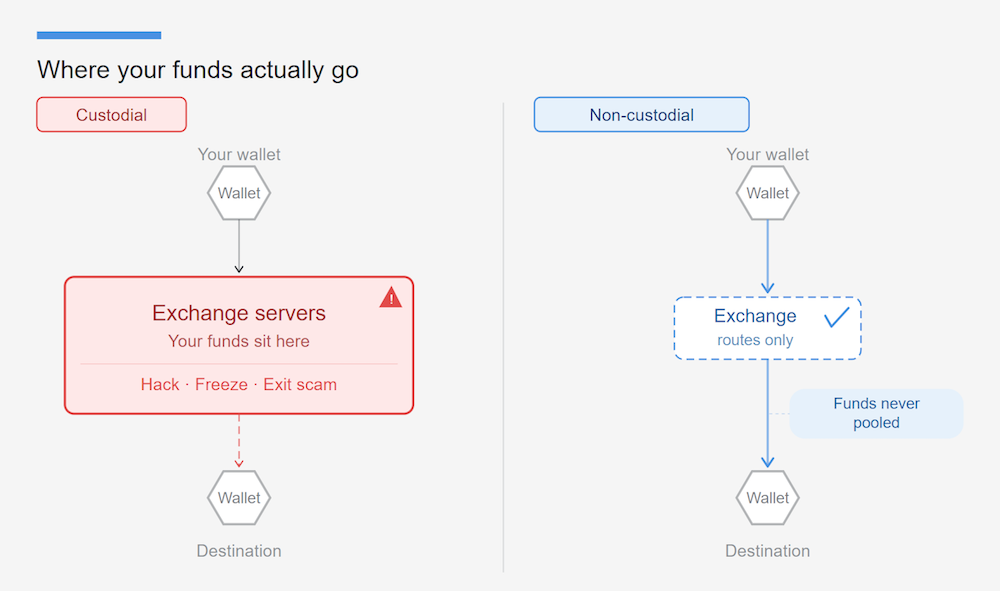
So the question isn’t really is no KYC exchange safe? The question is: which no-KYC exchanges are actually built with safety as a foundation, and which ones are exploiting the privacy narrative to avoid accountability entirely?
7 Signs a No-KYC Exchange Is Actually Trustworthy
1. It’s Non-Custodial by Design
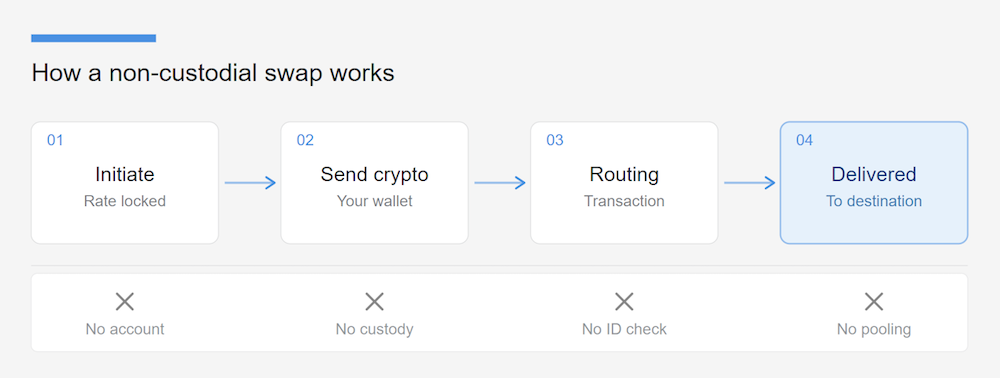
The most important safety signal of a legitimate anonymous exchange is that it never takes custody of your funds. On a genuine non-custodial platform, your assets move directly from your wallet to the destination — the exchange is a routing mechanism, not a vault. Non-custodial platforms are generally safer because they never hold your funds; you maintain custody throughout.
Look for this explicitly in the platform’s technical description. If it’s not clearly explained how swaps execute, that’s a signal to dig deeper before sending anything.
2. A Verifiable Operating History
Legitimacy accumulates over time. A safe anonymous exchange will have a track record that can be independently verified — years of user reviews across Reddit, crypto forums, and third-party comparison sites, not just testimonials hosted on its own domain. Long operating histories suggest reliability; recent complaints may indicate current problems.
Check for:
- Consistent presence on platforms like CoinGecko, CoinMarketCap, or Trustpilot
- Community discussions that predate the current year
- No gaps in operational history that coincide with regulatory crackdowns
3. Published Terms of Service and a Real Privacy Policy
This sounds basic, but it eliminates a shocking percentage of sketchy services. A trustworthy no-KYC exchange publishes its terms clearly — not a vague one-pager, but a document that outlines what data (if any) is collected, how it’s used, and under what circumstances the platform might restrict a transaction.
A privacy policy that says “we collect no personal data” is marketing copy until it’s backed by a coherent technical and operational explanation. A credible policy will acknowledge the platform’s approach to anti-money laundering (AML) compliance — even in a privacy-preserving model, responsible platforms have one.
4. SSL Encryption and Transparent Security Infrastructure
For personal security, look for platforms with valid SSL encryption technology, 2FA support where applicable, and connection with authenticator apps. Every reputable exchange — KYC or not — will display an HTTPS padlock in the browser. That’s table stakes. What separates trustworthy platforms is whether they go further: publishing security audits, disclosing wallet architecture, or using verifiable rate aggregation from major exchanges.
Bonus signal: platforms that voluntarily undergo third-party security reviews and publish the results publicly.
5. Fixed Rates or a Clear Rate-Lock Mechanism
Scam exchanges love vague rate structures. They quote attractive rates, take your funds, and deliver considerably less on the other end — blaming “slippage” or “network conditions.” A safe anonymous exchange either offers fixed rates for a defined window or provides explicit, upfront disclosure of the exchange rate before you confirm a transaction.
The ability to lock in a rate for even 15–30 minutes demonstrates that the platform has the liquidity and operational discipline to honor its commitments. That’s not a small thing.
6. Structural Privacy — Not Just a Marketing Claim
There’s a meaningful difference between a platform that says it doesn’t require KYC and one that is architecturally built so that collecting your identity is unnecessary or impossible. The former might introduce KYC requirements retroactively (a trend that accelerated in 2024–2025, as several major platforms that once championed privacy quietly introduced verification requirements). The latter cannot, because the system was never designed to store identity data.
Look for: no mandatory account creation, no email required to initiate a swap, wallet-to-wallet transaction flow. These are structural features. They’re harder to walk back than a policy statement.
7. The Platform Can Articulate Its AML Stance — Without Using Your Data to Enforce It
This is the non-obvious one, and it’s the most telling signal of genuine legitimacy.
Most people assume privacy and compliance are mutually exclusive — that any exchange operating without KYC must be winking at money laundering. That’s incorrect, and platforms that understand this are the ones worth trusting. A genuinely safe no-KYC exchange will have a clear, published approach to transaction screening that doesn’t require your passport to implement. This might mean:
- Blockchain analytics integration to flag transactions from known illicit wallet clusters
- Transaction monitoring for unusual patterns
- Published restrictions on sanctioned jurisdictions or high-risk wallet addresses
When an exchange has thought through how to be both private and responsible, it shows. When it hasn’t, you’ll find either a wall of silence on the compliance question or aggressive dismissiveness toward it. Neither is reassuring.
A Case Study: How Godex Approaches This
Godex has maintained its position as a high-privacy instant exchange with 900+ coins since 2018, building its reputation on confidential trading practices without mandatory registration. It’s a useful example of the non-custodial model in practice because it illustrates several of the trustworthiness markers above simultaneously.
Platforms like Godex provide instant swaps across hundreds of cryptocurrencies without ever taking custody of funds — the absence of KYC requirements also protects against data breaches that could expose personal information. On the structural privacy point: Godex requires no account creation and no email to execute a swap. The transaction goes wallet-to-wallet, with the platform acting as the exchange layer. It offers fixed-rate exchanges for 30 minutes after order creation, protecting users from market volatility during transactions, with no upper limits on exchange amounts — only minimum thresholds exist to cover network fees.
Importantly, Godex aggregates rates from major platforms including Binance, Bitfinex, and HitBTC — a transparency signal that its pricing isn’t a black box.
None of this is presented here as a recommendation. It’s presented as an illustration of what the trustworthiness checklist above looks like when applied to a real, operating platform with a multi-year track record.
No-KYC Exchange Safety: At a Glance
| Safety Indicator | Why It Matters | What to Look For |
|---|---|---|
| Non-custodial model | Your funds never pool on their servers | Wallet-to-wallet swap architecture |
| Operating history | Scam platforms rarely survive long-term scrutiny | 3+ years of verifiable presence |
| Published ToS + Privacy Policy | Accountability through transparency | Specific, detailed documents — not boilerplate |
| SSL + security infrastructure | Basic but eliminates many fly-by-night services | HTTPS, disclosed security audits |
| Fixed or locked rates | Prevents bait-and-switch on exchange value | Rate lock window stated before confirmation |
| Structural no-registration | Policy-level privacy can be reversed; architecture can’t | No account or email required to swap |
| AML transparency | Demonstrates legitimate operation without identity collection | Published compliance approach or blockchain analytics use |
3 No-KYC Exchange Red Flags to Run From Immediately
Red Flag #1: Anonymous Team, No Verifiable Company Information
Privacy-focused doesn’t mean untraceable at the corporate level. A legitimate no-KYC exchange may protect user privacy zealously while still having a publicly registered company, identifiable founders, or a known team presence in the crypto space. Platforms that offer zero verifiable information about who is operating them — no LinkedIn, no registered entity, no named team members anywhere — have structurally eliminated accountability.
This is distinct from personal anonymity (founders using pseudonyms has a long history in crypto). The question is whether anyone can be held accountable if things go wrong. If the answer is genuinely no one, that’s your answer.
Red Flag #2: Mid-Transaction KYC Demands
This is one of the most reported scam patterns in the anonymous exchange space. The flow goes like this: you initiate a swap, send your crypto, and then receive a message stating that your transaction has been flagged and you must complete identity verification before funds are released. The “verification portal” is either a data-harvesting phishing page or simply a delay tactic while the platform keeps your funds.
The question “is no KYC crypto exchange safe?” doesn’t have a single simple answer — but safety varies significantly between platforms, and centralized no-KYC exchanges carry higher risk due to reduced regulatory oversight and potential exit scenarios.
Legitimate platforms may occasionally restrict transactions from high-risk wallet clusters, but they do not hold completed inbound transactions hostage behind surprise KYC walls. Read the terms before you swap. If the platform reserves broad, vaguely-worded rights to freeze funds pending “review,” assume the worst.
Red Flag #3: No Consistent External Reputation
Key safety practices include verifying the exchange’s reputation across multiple sources before depositing. A platform that has only positive reviews on its own site, a freshly created subreddit with no organic discussion, and a Trustpilot page with 11 five-star reviews from accounts created last month is not demonstrating social proof, it’s manufacturing it.
Genuine reputation is messy. It includes critical reviews, occasional complaints about transaction delays, debates about fee transparency, and responses from the platform itself. The absence of that texture, especially for a platform claiming years of operation, is a fabrication signal.
Your Pre-Swap Checklist for Any No-KYC Exchange
Before you initiate a swap on any anonymous exchange, run through this:
- Custody check: Does the platform hold your funds at any point, or is it wallet-to-wallet?
- History check: Can you find discussions about this platform from at least 12–18 months ago on independent forums?
- Rate transparency: Is the exchange rate shown before you send funds, with a lock-in window?
- Terms check: Does a published ToS exist? Does it describe the AML/compliance approach?
- SSL and security: Is the site HTTPS? Are there any third-party security disclosures?
- No surprise KYC: Have other users reported mid-transaction KYC demands anywhere in external reviews?
- Team or entity verifiability: Is there any identifiable entity, even a registered company, behind the platform?
If you can check all seven boxes, you’re working with a meaningful level of due diligence. If you can’t check three or more, the risk profile shifts substantially — and the convenience of avoiding KYC isn’t worth recovering undelivered funds that may be genuinely unrecoverable.
The Bigger Picture
The narrative that no-KYC automatically means dangerous is as wrong as the narrative that it automatically means safe. Safety varies between no-KYC platforms, with non-custodial options generally offering better security through their structural design. The exchanges that are genuinely worth trusting are those that have solved the hard problem: delivering real financial privacy without using anonymity as cover for zero accountability.
That balance is achievable, and it’s demonstrably achieved by platforms with years of operation, transparent technical architecture, and a coherent answer to the question every serious user should ask: “How do you prevent illicit use without knowing who I am?”
Platforms that can answer that question clearly are operating in good faith. The ones that can’t, or won’t, are the ones to run from.
Frequently Asked Questions
Okay but if there’s no KYC, what’s actually stopping this from being an exit scam? A verifiable multi-year track record is the primary protection. Platforms active since 2018–2019, listed on CoinGecko, with organic forum history on BitcoinTalk and r/CryptoCurrency are structurally harder to quietly vanish. Scams don’t survive five-plus years of public scrutiny. New platforms with no history carry significantly higher risk — test with a small amount first.
These platforms say “no KYC” now — but what stops them from flipping like KuCoin and Kraken did? Non-custodial architecture is more durable than no-KYC policy. Regulatory pressure forced several formerly no-KYC platforms to introduce verification with little notice in 2024–2025. Platforms that never held funds and never created accounts have nothing to retroactively verify. Favor structural non-custody over policy promises — and always keep a backup option.
What happens if the exchange goes down mid-swap? Is my crypto just gone? On a non-custodial platform, exposure is limited to the minutes the swap is in transit. A failed swap on a legitimate platform triggers a support process and a refund. Custodial no-KYC exchanges carry higher risk: if they go offline, there is no account identity to tie a recovery claim to. The custody model matters more than the KYC policy in this scenario.
How do I know a platform is actually non-custodial and not just claiming to be? Non-custodial exchanges are verifiable through their mechanics: a one-time deposit address, wallet-to-wallet flow, and no account creation. Legitimate platforms publish technical documentation or audit history explaining how swaps execute. No published architecture, no audit trail, and no open-source code are concrete red flags, marketing copy is not a substitute.
Some platforms have no swap limit. Others cap me at $1,000. Is unlimited actually legit? Unlimited swap caps are a feature of the non-custodial model, not a scam signal. When a platform never holds funds and creates no account relationship, there is no threshold to trigger verification. Low caps typically indicate a centralized platform with optional KYC tiers. Verify the platform’s track record before testing high-value swaps regardless of the stated limit.
This article is for informational purposes only and does not constitute financial or legal advice. Always conduct your own due diligence before using any cryptocurrency exchange.
Start a Cryptocurrency exchange
Try our crypto exchange platform
Disclaimer: Please keep in mind that the content of this article is not financial or investing advice. The information provided is the author’s opinion only and should not be considered as direct recommendations for trading or investment. Any article reader or website visitor should consider multiple viewpoints and become familiar with all local regulations before cryptocurrency investment. We do not make any warranties about reliability and accuracy of this information.
Read more
You may well think that an article dedicated to a Tether price prediction or the Tether price in general is a little bit strange — it is a stablecoin after all. However, the price of Tether does fluctuate significantly, although it is nowhere near as volatile as non-stablecoin cryptos. This means that staying up to […]
In the article we share our vision at Zcash cryptocurrency main features and add several price predictions. As cryptocurrencies gain global acceptance and decentralisation slowly enters our lives, privacy becomes the main concern when talking about blockchain adoption. It is no secret that distributed ledger is by far the most secure and transparent technology ever […]
Chiliz coin (CHZ) offers a compelling opportunity for traders interested in the intersection of blockchain technology and sports. By enabling fans to influence team decisions through the Socios app, Chiliz directly monetizes fan engagement and connects with major sports teams like Juventus and Paris Saint-Germain. These partnerships not only enhance the platform’s visibility but also […]
The exponential growth of Bitcoin Satoshi Vision (BSV) against the general bear trend on the cryptocurrency market in autumn 2019 has impressed the community. Due to the increasing market capitalization, the newly emerged altcoin was ranked 5th on CoinMarketCap and managed to maintain its high position at the beginning of 2020. In the article we […]
EOS is definitely on the list of the strongest and most stable projects in the crypto world. Despite the fact that the currency entered the market less than 3 years ago, it consistently occupies one of the top 10 places in the rating for project capitalization. it is often called the “main competitor of Ethereum”. […]
XRP price prediction 2026-2027: bear, base, and bull scenarios with ranges and named sources, the resolved SEC case, live spot ETFs, and can XRP reach $10?