
 Alex Tamm
Table of Contents
There’s a question circulating in nearly every crypto forum, Telegram group, and Discord server right now: is using a no-KYC exchange actually legal? The honest answer isn’t a simple yes or no: it depends on where you live, how the platform is structured, and what you’re doing with your funds. Getting this wrong can mean frozen assets, regulatory scrutiny, or worse.
This guide cuts through the noise. You’ll get a practical country-by-country breakdown, an explanation of why platform structure matters as much as your location, and a clear picture of what no-KYC trading legally allows, and doesn’t allow, in 2026.
What “No-KYC Exchange” Actually Means (And What It Doesn’t)
A no-KYC crypto exchange is a platform that allows users to swap one cryptocurrency for another without requiring identity documents, account registration, or personal data submission. No passport scans, no selfies, no proof of address — just a wallet address, a swap, and a destination.
That simplicity is the appeal. But it’s also the source of enormous regulatory confusion.
It’s important to understand what a no-KYC exchange is not. It is not, by default:
- A tool for tax evasion (your tax obligations remain regardless of whether an exchange collected your ID)
- An automatic red flag for law enforcement (millions of privacy-conscious users transact on them legally every day)
- The same as an unregulated exchange — non-custodial, no-registration platforms operate under a very different legal model than, say, a shady offshore CEX
The distinction between non-custodial instant swap services and centralized no-KYC exchanges is perhaps the most important structural concept in this entire debate — and we’ll return to it shortly.
The Core Legal Question: User vs. Platform
Here’s the distinction most articles miss: the legality of operating a no-KYC exchange and the legality of using one are two different questions.
In most jurisdictions, regulators target platforms, not individual users swapping crypto privately. When a government agency shuts down a no-KYC exchange, the enforcement action is almost always directed at the business — for operating as an unlicensed money service business, violating AML requirements, or facilitating sanctions evasion.
For users, using a no-KYC crypto exchange is not illegal in most countries, but it exists in a legal grey area. That grey area is shaped by three factors:
- Your country’s crypto regulations — some jurisdictions explicitly prohibit using unregistered VASPs
- The exchange’s legal structure — non-custodial protocols face different rules than custodial services
- What you do with the funds afterward — tax reporting obligations remain universal
Country-by-Country: The 2026 Legal Landscape
🇺🇸 United States — Highly Restricted
The U.S. is one of the most challenging jurisdictions for no-KYC activity. Cryptocurrency is legal but heavily regulated in the United States; therefore, non-KYC exchanges are very difficult to find and function in America due to strong AML rules. US federal agencies, like the Financial Crimes Enforcement Network (FinCEN) and the Securities and Exchange Commission (SEC), require all crypto exchanges to integrate proper AML/KYC programs.
The 2025 GENIUS Act created the first federal stablecoin framework, and decentralized exchanges (Uniswap, dYdX, Bisq) occupy a legal grey area — they haven’t been formally classified as money service businesses, but that doesn’t mean they’re unambiguously legal. Front-end operators, website hosts, and developers associated with these platforms have faced regulatory scrutiny, and the SEC has actively investigated DEX-adjacent entities. Using offshore CEXs without identity verification may also violate terms of service in your jurisdiction and could trigger regulatory attention.
Also critical for 2026: tax obligations remain — in the US (1099-DA, 2026), UK, and EU, all crypto trades are taxable events regardless of whether the exchange collected your identity. You are responsible for self-reporting.
Bottom line for US users: DEX usage sits in a legal grey area but is generally tolerated. Offshore no-KYC CEXs are high-risk. Self-reporting of gains is mandatory.
🇪🇺 European Union — Tightening Fast
The EU entered 2026 with the most comprehensive crypto regulatory framework in the world. The Markets in Crypto-Assets Regulation (MiCA) introduces sweeping compliance obligations for cryptoasset service providers (CASPs), including expanded Know Your Customer (KYC) and due diligence, enhanced transaction monitoring and suspicious transaction reporting obligations.
Additionally, CARF/DAC8 requires CASPs to begin collecting and recording user tax data from January 2026 — with the actual automatic exchange of that data between national tax authorities scheduled to begin in 2027. The two-stage timeline matters: collection starts now, but cross-border reporting comes later. Either way, this marks a structural shift — centralized platforms are now data-gathering infrastructure for tax authorities, whether or not the sharing has fully commenced.
However, MiCA does carve out an exemption — but it’s narrower than often assumed. Under Recital 22, the regulation excludes fully decentralized crypto-asset services with no identifiable operator or intermediary. The key word is “fully”: a non-custodial service run by an identifiable company can still fall under MiCA’s CASP licensing requirements, regardless of its custody model. True custody-free architecture alone doesn’t guarantee exemption. The EU’s new Anti-Money Laundering Authority (AMLA), launched July 2025, has signaled it will increase scrutiny on DeFi in the coming years.
Bottom line for EU users: Licensed CEXs must be fully KYC compliant. Only truly operator-less decentralized protocols are exempt from MiCA — most non-custodial services with identifiable operators are not. CASP data collection under CARF/DAC8 began January 2026; cross-border tax authority data exchange follows in 2027.
🇬🇧 United Kingdom — New Gateway Incoming
In the United Kingdom, crypto businesses have been required to register with the Financial Conduct Authority (FCA) since January 2020, under the Money Laundering Regulations 2017. This framework is now set to change significantly with the introduction of the FCA’s new cryptoasset authorization gateway — the application window opens September 30, 2026 and closes February 28, 2027, with the full new regulatory regime commencing October 25, 2027.
For users, this means the structural transition is underway but the new rules don’t bite in full until late 2027. As in the EU, services run by identifiable operators remain in regulatory scope regardless of custody model, but regulators have made clear that the scope of oversight will only expand from here.
Bottom line for UK users: The FCA authorization gateway opens in late 2026, but the substantive new regime takes effect October 2027. The direction of travel is unambiguous — plan accordingly.
🇦🇪 UAE — Strict Compliance, Clear Framework
The UAE is crypto-friendly, but not permissive about KYC. The UAE Central Bank leads enforcement, supported by free-zone regulators such as the Financial Services Regulatory Authority (FSRA) in the Abu Dhabi Global Market (ADGM), which adopted the FATF Travel Rule in 2023 and issued guidance in 2025 requiring firms to avoid anonymous counterparties.
The UAE, the Cayman Islands, and Singapore do not impose personal income or capital gains tax on cryptocurrencies. The appeal of low taxes comes paired with a robust compliance framework — the UAE wants to be a crypto hub, but a regulated one.
Bottom line for UAE users: Zero crypto tax, but exchanges must be licensed and KYC compliant. Non-custodial swaps aren’t explicitly targeted.
🇨🇭 Switzerland — Strict Travel Rule, Narrow Carve-Outs
Switzerland’s “Crypto Valley” in Zug has a well-earned reputation, but it’s worth being precise about what that reputation actually reflects — because Swiss crypto regulation is stricter than commonly assumed. Switzerland operates one of the world’s most demanding Travel Rule implementations: a CHF 0 threshold, meaning the Travel Rule applies to all crypto transfers, with no minimum. Regulated Swiss entities can only transfer crypto to wallets whose owners have been KYC-verified.
Where Switzerland does allow tiered due diligence is in a narrow category: certain crypto ATMs and exchange-type kiosks may apply simplified due diligence for transactions up to CHF 1,000. This doesn’t extend to exchange trading platforms broadly. The broader Swiss regulatory picture is one of structured compliance with clear rules — pragmatic and well-defined, but not permissive.
Bottom line for Swiss users: Switzerland is an innovation-friendly jurisdiction with a mature legal framework, but one of the strictest Travel Rule implementations globally. Tiered due diligence applies only to specific narrow transaction types, not to trading generally.
🌍 El Salvador, Panama & Crypto-Open Jurisdictions
El Salvador, the first country to make Bitcoin legal tender, takes a notably open approach to crypto activity. While licensed exchanges must follow KYC rules, the broader regulatory environment is friendlier to non-custodial operations than most Western jurisdictions.
Panama and Portugal (for now) also maintain lighter-touch frameworks — though the EU’s influence is pushing Portuguese regulators toward tighter MiCA alignment.
Bottom line: These jurisdictions offer more operational freedom, but even they draw the line at facilitating clear financial crimes.
🇮🇳 🇨🇳 India, China & Restrictive Jurisdictions
At the other end of the spectrum: The Reserve Bank of India has imposed strict KYC and anti-money laundering laws on all cryptocurrency exchanges and service providers operating within the country. Every exchange must register with the Financial Intelligence Unit of India (FIU-IND).
China maintains a near-total ban on crypto trading. In some countries, governments have moved to block access to no-KYC exchanges entirely. China and India, for example, restrict cryptocurrency trading heavily and block known exchange websites.
Bottom line: In these jurisdictions, any no-KYC crypto activity carries meaningful legal risk for users, not just platforms.
Country Comparison Table: No-KYC Exchange Legality 2026
| Country/Region | Crypto Legal? | No-KYC CEX for Users | Non-Custodial Swaps | Tax Reporting Required |
|---|---|---|---|---|
| 🇺🇸 United States | ✅ Yes | ⚠️ High risk / grey area | ⚠️ Generally tolerated | ✅ Yes (1099-DA, 2026) |
| 🇪🇺 European Union | ✅ Yes | ❌ Restricted (MiCA) | ⚠️ Grey zone | ✅ Yes (CARF/DAC8, 2026) |
| 🇬🇧 United Kingdom | ✅ Yes | ⚠️ FCA gateway opens Sept 2026; full regime Oct 2027 | ⚠️ Grey zone | ✅ Yes |
| 🇦🇪 UAE | ✅ Yes | ❌ KYC mandatory for VASPs | ⚠️ Not explicitly targeted | ✅ Yes |
| 🇨🇭 Switzerland | ✅ Yes | ⚠️ Strict Travel Rule (CHF 0) | ⚠️ Tiered due diligence (narrow cases only) | ✅ Yes |
| 🇸🇻 El Salvador | ✅ Yes | ⚠️ Licensed CEXs need KYC | ✅ More open | ⚠️ Evolving |
| 🇮🇳 India | ⚠️ Regulated | ❌ Restricted | ❌ High risk | ✅ Yes |
| 🇨🇳 China | ❌ Banned | ❌ Banned | ❌ Banned | N/A |
| 🇹🇭 Thailand | ✅ Yes | ❌ Licensed only | ⚠️ Grey zone | ✅ Yes (0% CGT til 2029) |
This table reflects the regulatory landscape as of early 2026. Laws change — always verify current rules in your jurisdiction.
Why Platform Structure Changes the Legal Equation
Not all no-KYC platforms are built the same — and regulators know it. The critical distinction in 2026 is between custodial and non-custodial architecture.
A custodial no-KYC exchange holds your funds during and after a transaction. From a regulatory standpoint, this looks very much like a money service business — and in most jurisdictions, operating one without AML/KYC procedures is illegal.
A non-custodial instant swap service works differently:
- It never holds user funds beyond the seconds required to route a swap
- It doesn’t maintain user accounts or balances
- It interacts with wallet addresses, not identities
- The user retains control of private keys throughout
This structural distinction matters enormously. Non-custodial protocols face genuinely different regulatory treatment than custodial exchanges — which is why platforms built on true non-custody have proven more durable in a tightening regulatory climate.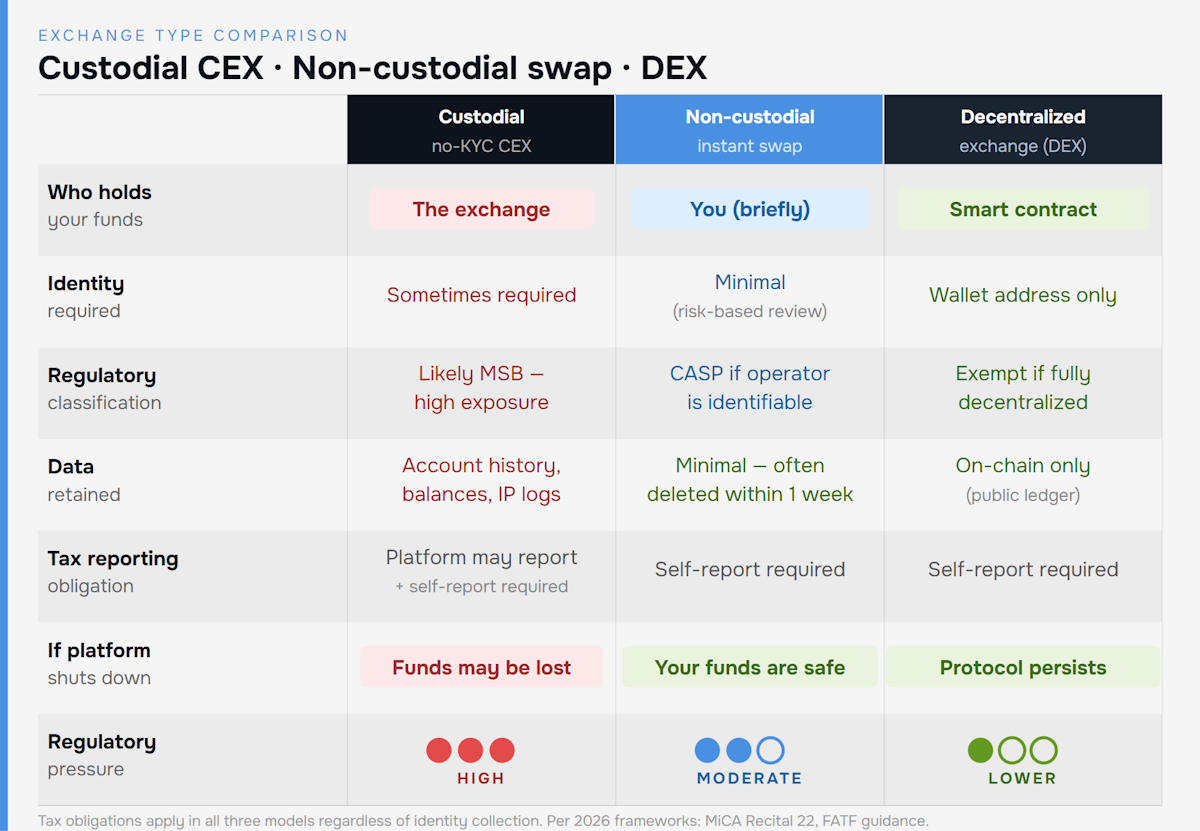
Where Godex Fits in This Picture
Godex (godex.io) is a privacy-focused, non-custodial instant swap service that’s been operating since 2018 — and it’s a useful real-world example of how a high-privacy platform navigates these regulatory questions through design rather than loopholes.
The platform’s architecture reflects the non-custodial model described above: it operates as an identity-light exchange with no long-term custody of user funds, no account dashboards, and a minimal data footprint. Godex.io holds coins only while executing the exchange — you regain full custody as soon as the swap finishes. Removing long-term custody greatly reduces the risk of losing funds to an exchange hack, legal seizure, or internal mismanagement.
Two additional features matter in a regulatory context. First, transaction data minimization: transaction data is erased from servers within one week, and fixed exchange rates lock in for 30 minutes after order creation. Second, breadth without borders: the platform supports 900+ cryptocurrencies across multiple chains, including privacy coins that many regulated exchanges have delisted under AML pressure. It’s worth noting that like most responsible platforms operating in this space, Godex applies risk-based review practices — meaning unusual or high-volume activity may be subject to additional scrutiny, consistent with global AML expectations.
What Godex represents isn’t a workaround to regulation — it’s a confidential trading platform built around non-custodial architecture that minimizes the data relationship between user and service. That’s a meaningful structural difference from both fully anonymous platforms and fully custodial KYC-mandatory exchanges, even if it doesn’t make any platform entirely immune to future regulatory shifts.
7 Things Privacy-Conscious Traders Get Wrong
Most mistakes made by no-KYC exchange users aren’t about the law — they’re about misunderstanding what anonymity actually protects.
- “Using no-KYC means I don’t owe taxes.” Wrong, in virtually every jurisdiction. The exchange not collecting your ID has no bearing on your obligation to report and pay tax on crypto gains. Tax agencies increasingly use blockchain analytics to identify unreported transactions.
- “Non-custodial means unregulated.” Not quite. Non-custodial platforms face a different (and currently lighter) regulatory burden — but they are not above the law. FATF has explicitly flagged DeFi and non-custodial services as an area for increased future scrutiny.
- “A VPN makes it all legal.” A VPN masks your IP address. It doesn’t change your legal obligations, and it doesn’t prevent blockchain analytics tools from tracing on-chain activity. Using a VPN to access a platform banned in your jurisdiction may itself violate local law.
- “No-KYC exchanges are all the same.” Important: KuCoin, OKX, Bybit, and Kraken now require mandatory KYC and should no longer be classified as no-KYC options. Many platforms that once advertised “no KYC” have quietly introduced verification at higher thresholds. Read the fine print.
- “Offshore registration protects a platform from enforcement.” The TradeOgre case in Canada — shut down with $40 million seized — demonstrated that offshore registration doesn’t provide immunity. Canadian authorities seized about $40 million in crypto and shut down TradeOgre, marking Canada’s biggest crypto bust. The RCMP led a yearlong investigation after a tip from Europol, finding TradeOgre operated without registration or KYC checks. The case sends a clear warning that exchanges must comply with local regulations or face severe consequences.
- “Decentralized means safe from regulators.” Regulators can still target front-end providers, website hosts, or developers associated with these platforms. Uniswap has faced SEC scrutiny precisely because front-end operators can be identified and targeted even when the smart contracts themselves are permissionless.
- The “Aha” moment — non-custodial swaps are often MORE compliant than they appear. Here’s what most people miss: a non-custodial instant swap service that never holds user funds, never creates accounts, and processes crypto-to-crypto exchanges only may actually sit outside the specific legal definitions that trigger mandatory KYC requirements in many jurisdictions — not because of a loophole, but because those laws were written for money service businesses and custodial financial entities. The challenge is that these definitions are actively being rewritten, and the window may be narrowing.
How to Navigate No-KYC Exchanges Legally in 2026
If you value financial privacy and want to stay on the right side of the law, a practical framework matters more than a list of platforms. Here’s how to approach it:
Before you trade:
- Research your country’s current regulations on Virtual Asset Service Providers (VASPs) — and whether non-custodial services fall under that definition
- Confirm you understand your tax reporting obligations — they exist regardless of whether an exchange collected your identity
- Prefer non-custodial platforms over custodial no-KYC services, both for security and regulatory risk
When choosing a platform:
- Verify the platform’s legal structure — is it custodial or non-custodial?
- Check whether it blocks users from your jurisdiction (a platform blocking your IP may be doing so precisely because serving you would violate its own legal obligations)
- Look for transparent data retention policies — how long does the platform store transaction data?
After you trade:
- Use a hardware wallet or non-custodial software wallet for storage
- Keep personal records of all transactions — dates, amounts, asset pairs
- Report gains according to your local tax rules; the exchange’s privacy practices do not exempt you
The broader principle: best practices for using anonymous crypto exchanges include favoring non-custodial options, verifying restrictions, limiting risk, and meeting tax reporting obligations.
The Bigger Picture: Privacy vs. Compliance Isn’t a Binary
The narrative that privacy and compliance are fundamentally opposed is increasingly outdated. The more useful frame for 2026 is this: what kind of data exposure do different services require, and what legal obligations apply to each?
Non-custodial swap services occupy a distinct position in that spectrum — one that preserves meaningful financial privacy without the custody relationship that regulators primarily target. That doesn’t make them invisible to regulators, but it does mean they operate under a different (and currently more permissive) legal logic than custodial platforms.
What’s clear from the 2025–2026 global regulatory wave is that the window for operating no-KYC custodial centralized exchanges is closing fast. By 2025, 92% of major centralized exchanges had full KYC in place, up from 85% in 2024. The platforms that remain relevant in a privacy context are those built on non-custodial architecture — not those trying to avoid regulation through offshore registration.
For users, the practical message is consistent across nearly every jurisdiction: using non-custodial platforms for crypto-to-crypto swaps is generally lower risk than using custodial no-KYC services, tax obligations always remain, and staying informed about your country’s evolving rules is not optional.
Key Takeaways
- No-KYC exchange use is not explicitly illegal in most countries, but operates in a legal grey area shaped by jurisdiction, platform structure, and your own activities
- The EU (MiCA + CARF/DAC8), US, UK, and UAE have the most stringent regimes; Switzerland and El Salvador remain more flexible
- Non-custodial instant swap services face fundamentally different regulatory treatment than custodial no-KYC CEXs
- Tax obligations apply everywhere, regardless of whether an exchange collected your identity
- The privacy-friendly platforms still operating reliably in 2026 are almost exclusively non-custodial by design — minimizing data exposure rather than eliminating compliance entirely
- Always verify your local regulations — this landscape is changing faster than any guide can fully track
Frequently Asked Questions
Is using a no-KYC exchange actually illegal? Using a no-KYC exchange is legal in most countries — regulators target platforms, not individual users. The grey area kicks in afterward: unreported gains are the actual legal risk, not the swap itself.
If no-KYC means no records, do I still owe taxes? Yes — tax obligations exist regardless of whether an exchange collected your ID. The IRS uses Chainalysis to track wallets, and 1099-DA rules require gains and losses records. The blockchain is public. Self-reporting is your responsibility, not the exchange’s.
Can they actually trace me if I use a no-KYC exchange and Monero? Blockchain analytics has made real progress on tracing Monero in certain scenarios. More critically, one KYC touchpoint breaks the chain: if you move crypto between a non-custodial wallet and a centralized exchange that reports to the IRS, your wallet address may be included in that data. Privacy only holds if it’s end-to-end.
Does MiCA kill all no-KYC options for EU users? MiCA exempts fully decentralized, operator-less protocols — but that carve-out is narrow. Any non-custodial service run by an identifiable company still falls under CASP licensing requirements. On top of that, CARF/DAC8 requires CASPs to collect user tax data from January 2026, with cross-border reporting to tax authorities starting in 2027.
Does a VPN solve geo-blocking on no-KYC exchanges? A VPN bypasses geo-blocks technically but doesn’t change your legal obligations. It also doesn’t prevent blockchain analytics from tracing on-chain activity. In some jurisdictions, using a VPN to access a legally prohibited platform is itself a violation. It’s a workaround, not a legal solution.
This article is for informational purposes only and does not constitute legal or financial advice. Cryptocurrency regulations vary by jurisdiction and evolve rapidly. Consult a qualified legal professional familiar with your country’s laws before making trading decisions.
Start a Cryptocurrency exchange
Try our crypto exchange platform
Disclaimer: Please keep in mind that the content of this article is not financial or investing advice. The information provided is the author’s opinion only and should not be considered as direct recommendations for trading or investment. Any article reader or website visitor should consider multiple viewpoints and become familiar with all local regulations before cryptocurrency investment. We do not make any warranties about reliability and accuracy of this information.
Read more
You may well think that an article dedicated to a Tether price prediction or the Tether price in general is a little bit strange — it is a stablecoin after all. However, the price of Tether does fluctuate significantly, although it is nowhere near as volatile as non-stablecoin cryptos. This means that staying up to […]
In the article we share our vision at Zcash cryptocurrency main features and add several price predictions. As cryptocurrencies gain global acceptance and decentralisation slowly enters our lives, privacy becomes the main concern when talking about blockchain adoption. It is no secret that distributed ledger is by far the most secure and transparent technology ever […]
Chiliz coin (CHZ) offers a compelling opportunity for traders interested in the intersection of blockchain technology and sports. By enabling fans to influence team decisions through the Socios app, Chiliz directly monetizes fan engagement and connects with major sports teams like Juventus and Paris Saint-Germain. These partnerships not only enhance the platform’s visibility but also […]
The exponential growth of Bitcoin Satoshi Vision (BSV) against the general bear trend on the cryptocurrency market in autumn 2019 has impressed the community. Due to the increasing market capitalization, the newly emerged altcoin was ranked 5th on CoinMarketCap and managed to maintain its high position at the beginning of 2020. In the article we […]
EOS is definitely on the list of the strongest and most stable projects in the crypto world. Despite the fact that the currency entered the market less than 3 years ago, it consistently occupies one of the top 10 places in the rating for project capitalization. it is often called the “main competitor of Ethereum”. […]
XRP price prediction 2026-2027: bear, base, and bull scenarios with ranges and named sources, the resolved SEC case, live spot ETFs, and can XRP reach $10?