
 Peter Moore
Table of Contents
Both Godex and ShapeShift are unconditional no-KYC crypto exchanges — neither asks for ID at any volume. The difference is architecture. ShapeShift is a non-custodial DEX aggregator: you hold a self-custody wallet, connect it, and execute on-chain across 46 chains with gas and slippage. Godex is a no-account swap: paste a destination address, lock a fixed rate, receive — no wallet, no gas, no slippage. This 2026 guide compares both honestly.
TL;DR — When Each Platform Makes Sense
Choose Godex if you:
- Want a fixed-rate lock — a single quote frozen for up to ~30 minutes, with no slippage exposure
- Don’t want to hold, connect, or fund a self-custody wallet to swap — just paste a destination address
- Want to skip DEX mechanics entirely (no gas estimation, slippage tolerance, route selection, or failed-tx risk)
- Want direct privacy-coin support (XMR/ZEC/DASH) in a simple flow and 24/7 human support
Choose ShapeShift if you:
- Want no platform fee for anyone — FOX holders additionally get gas-fee rebates — and are comfortable with gas + DeFi slippage
- Need the broadest reach — 46 chains, ~17 swappers, thousands of routable assets
- Already run a self-custody wallet and prefer fully on-chain, non-custodial execution
- Value DAO governance and a community-owned, anti-KYC platform
On the KYC axis, the two are equivalent. The decision is about which architecture fits the swap in front of you.
Godex vs ShapeShift at a Glance
The table below puts the two side by side. Several rows are clear ShapeShift wins — chain breadth, asset count, and platform fee — and they stay that way. Godex always sits in the first data column.
| Dimension | Godex | ShapeShift |
|---|---|---|
| Model | Non-custodial instant swap (operated service, since ~2017) | Non-custodial DEX aggregator (community-owned DAO) |
| KYC posture | None — unconditional, no threshold | None — explicitly anti-KYC, no threshold |
| Wallet required on platform | No — just a destination address | Yes — must hold/connect a self-custody wallet |
| On-chain interaction by user | Send deposit only | Execute on-chain DEX trade (gas + slippage) |
| Rate model | Fixed-rate lock (~30 min) + floating | Floating / market (on-chain execution) |
| Slippage exposure | None (locked quote) | Yes (DeFi route-dependent) |
| Chains / swappers | Operated service-side | 46 chains / ~17 swappers |
| Asset count | 936+ directly supported | Thousands routable (route-dependent) |
| Platform fee | ~1.67–2.14% spread (BTC→ETH) | No platform fee for anyone; gas + slippage + affiliate (FOX holders also get gas-fee rebates) |
| Volume cap | None (single locked quote) | None (subject to route liquidity / slippage) |
| Privacy coins (XMR/ZEC/DASH) | Direct in simple flow | Route / swapper-dependent |
| Support | 24/7 human | DAO + help center |
| Governance / structure | Operated platform | DAO + FOX governance (DEX since 2021) |
| Fiat on-ramp | No | Via 3rd-party partners (those carry KYC) |
Data verified June 2026. This comparison is published on the Godex blog; we’ve aimed to present both platforms accurately, but readers should verify independently. ShapeShift figures sourced from ShapeShift’s 46-chain / 17-swapper expansion announcement and the ShapeShift FOX/DAO page.
What Is ShapeShift in 2026? (DEX Aggregator, Not a Custodial Exchange)
ShapeShift is a community-owned, non-custodial multichain DEX aggregator governed by the ShapeShift DAO. It routes swaps through roughly 17 swappers — THORChain, 0x, CoW Swap, Jupiter, Maya, Chainflip, Relay, NEAR Intents, and others — across 46 blockchains. It does not hold user funds and does not require an account.
The DAO model is the structural core. FOX is the platform’s ERC-20 governance token, and the DAO treasury holds roughly 567 million FOX — about 56.7% of total supply — with holders voting through Snapshot.
One line of history explains the stale SERP claims: ShapeShift was a custodial exchange that required KYC before 2021, which is why some older articles still say “ShapeShift requires KYC.” That is no longer true.
“DEX aggregator” has a specific meaning for the user. ShapeShift does not swap your funds itself — it finds a route across on-chain liquidity, and the actual trade executes on-chain. The user pays gas and absorbs slippage on whichever route the aggregator selects. ShapeShift is also moving fast: per its 2026 expansion announcement, chains are up roughly 59% and swappers up 41% since November 2025. It is an influential, fast-growing platform — and a focused one by active-wallet count rather than a mass-market giant. That is context, not a knock.
Does ShapeShift Require KYC? (And Does Godex?)
No. ShapeShift does not require KYC, accounts, or identity verification for crypto-to-crypto swaps in 2026. It explicitly markets itself as an anti-KYC platform, and because it is a non-custodial DEX aggregator, there is no counterparty in the swap path that could request ID. Godex is also unconditional no-KYC — no account, no threshold, no risk-scoring engine. On the KYC axis, the two are equivalent.
This is worth stating plainly because the search results for “does ShapeShift require KYC” are still polluted with outdated answers. The pre-2021 custodial ShapeShift did require KYC. The current ShapeShift does not — and neither does Godex, at any swap size.
One honest caveat applies on each side. ShapeShift’s third-party fiat on/off-ramp partners carry their own KYC when you buy crypto with a card. That is the fiat rail, not the crypto-to-crypto swap path. Godex has no fiat on-ramp at all, so the question doesn’t arise for the swap itself.
Since KYC is a tie, the real decision comes down to architecture and experience — which is exactly what the next sections cover. Neither platform wins on privacy posture here. They win on different things.
Do You Need a Wallet to Use ShapeShift? (The Core Difference)
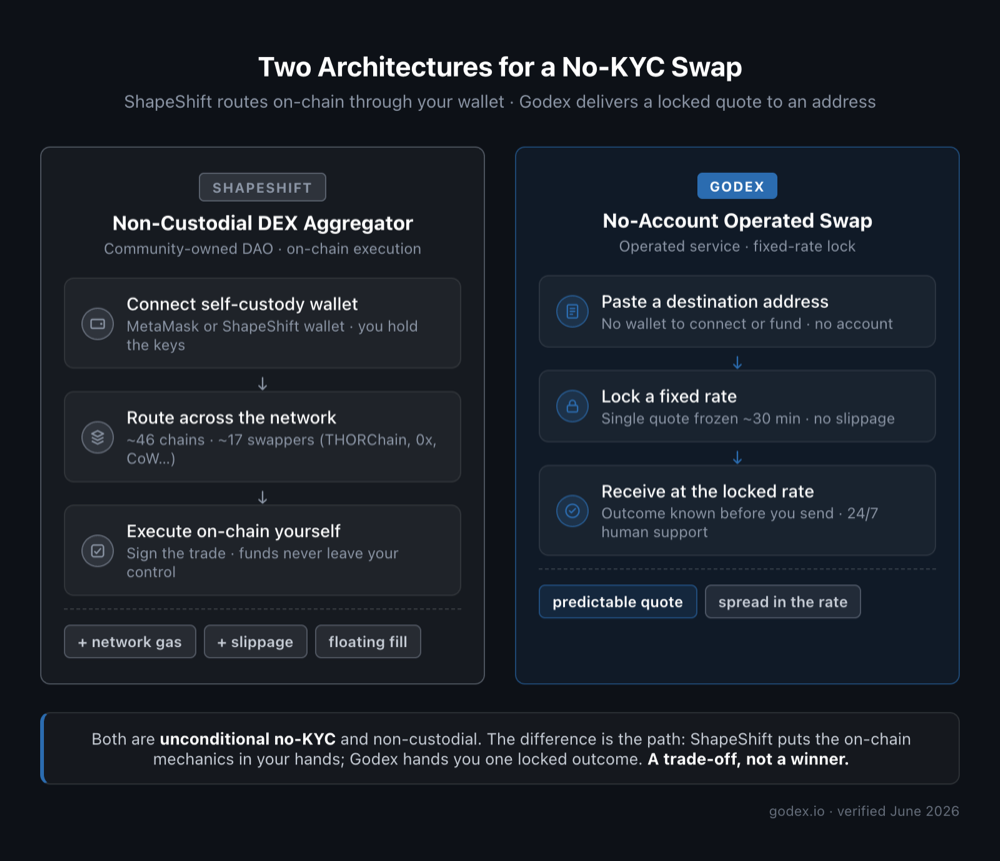
Yes. To swap on ShapeShift you must hold and operate a self-custody wallet — create a ShapeShift wallet, connect an external wallet like MetaMask, or otherwise control an on-chain address — and execute the trade on-chain yourself. Godex requires no wallet on the platform: you paste a destination address where you want to receive funds, send your deposit, and the swap is delivered. There is nothing to connect, fund with gas, or manage.
What ShapeShift asks of you operationally: a funded wallet, gas in the native token of the source chain, a signed on-chain transaction, a slippage-tolerance setting, and acceptance of route and failed-transaction risk. What Godex asks of you: a destination address and a deposit. No connection, no gas management, no slippage settings.
This is a trade-off, not a verdict. ShapeShift’s self-custody execution means funds never leave your control — a genuine advantage for self-custody purists, and one of the clearest reasons to use it. Godex’s no-wallet flow means a lower technical barrier and no on-chain mechanics to manage — a genuine advantage for anyone who wants a clean, predictable swap without DEX overhead. Both are legitimate; they serve different users.
The cleanest way to put it: Godex is an exchange you can use without connecting a wallet. If that’s your goal, an operated swap is the natural fit. There’s a support dimension here too. If a $140K swap stalls mid-process, Godex has 24/7 human support — a person who answers — whereas a DAO-run aggregator routes you to a help center or community channel. For a large, time-sensitive trade, that difference is not academic. (For the broader picture of how aggregator routing differs from a direct swap, see our aggregator vs direct swap explainer, and our non-custodial exchange explainer for the self-custody-vs-custody-free distinction.)
Fixed Rate vs Floating On-Chain Execution: Which Is More Predictable?
Godex offers a fixed-rate lock — the rate is frozen at initiation for up to about 30 minutes, so the quote you accept is the outcome you receive regardless of market movement. ShapeShift execution is floating and market-based: the price is set by on-chain DEX execution at settlement, exposed to slippage and route conditions. For predictability, the fixed-rate model gives a contractual outcome; for capturing favorable intra-swap movement, floating can win.
In practice, a fixed-rate lock means you know the result before you send anything. To be precise about where this matters: on deep-liquidity major pairs (BTC→ETH, ETH→USDC) through a good aggregator, realized slippage is usually well under 0.5% — small enough that the fixed-rate edge is modest. The edge grows on volatile pairs, congested chains, and large or thin-liquidity swaps, where slippage of 1–2% or worse is real money. On a 2 BTC swap at $85,000 ($170,000), a 3% market move during processing is roughly $5,100 — and a fixed-rate lock turns that swing of uncertainty into a known outcome you accept up front. That’s the value being priced, not a saving.
Floating on-chain execution works differently. The displayed quote is an estimate; the final fill depends on your slippage tolerance and the liquidity on the route the aggregator picks. On deep-liquidity major pairs, that slippage may be minimal. On thinner routes, or for whale-sized swaps, it can mean noticeable slippage or partial fills across DEX pools. There’s also failed-transaction risk: if the price moves past your slippage tolerance or route liquidity shifts, the trade can revert — you lose the gas, not the funds. Floating isn’t worse — it’s a different bet. The asymmetry is product philosophy: Godex treats a swap like a contract, while a DEX aggregator treats it like on-chain market execution.
How Do Godex and ShapeShift Compare on Coins and Chains?
ShapeShift covers far more ground: 46 blockchains, roughly 17 swappers, and thousands of routable assets, versus Godex’s 936+ directly supported coins. For long-tail assets and obscure chains, ShapeShift’s reach is the clear advantage. Godex’s catalog is smaller, but every supported pair runs through the same simple, fixed-rate-capable flow.
There’s no fighting the breadth win — if you need a specific asset on a niche chain, ShapeShift is more likely to route it. The honest nuance is that “thousands of assets” is route-dependent: actual availability depends on which swapper has liquidity for your pair at that moment, so a listed asset isn’t always a smooth swap.
Privacy coins are the exception worth naming. Godex supports XMR, ZEC, and DASH directly in the simple flow. On a DEX aggregator, privacy-coin availability depends on which swapper and chain carry them, and can be fragmented. If your actual swap is BTC→XMR, “does it route cleanly” matters more than total catalog size — which is where a direct BTC to Monero swap on Godex tends to be the simpler path.
How Do Their Fees Compare?
ShapeShift charges no platform fee — for anyone. That’s the baseline, not a perk: the cost of a swap is blockchain gas plus DeFi slippage plus an affiliate fee on the route. FOX holders additionally get gas-fee rebates (reimbursed in FOX, roughly 10% of relative value within a 30-day window) plus rFOX fee-sharing. Godex’s cost is a built-in spread of roughly 1.67–2.14% on a BTC→ETH swap (verified June 2026). On the headline, ShapeShift is cheaper for many swaps.
The honest way to read this is total cost of the swap, not the advertised fee. ShapeShift’s true cost is variable, and which variable dominates depends on size. For a small swap, gas and route slippage can erode the “no fee” advantage. For a large swap, the picture flips: gas is a rounding error at $170K, and the real cost is slippage and route depth — whether the aggregator can fill your size at a clean price, or has to split it across pools at worsening rates. Either way, the final outcome isn’t known until execution. Godex’s spread is higher but fixed and visible — the quote you lock is the outcome, with no gas to estimate and no slippage to absorb. (You still pay the network fee to send your deposit, as with any transaction — but there’s no on-swap gas to manage.)
So the verdict is use-case specific. For a small swap of a deep-liquidity major pair, ShapeShift’s cost advantage is real, and Godex does not beat it. For a large swap where a known, locked outcome and zero on-chain mechanics are worth a visible spread, Godex’s bundle can be the better deal. That’s a fit, not a price claim. Godex is not the cheaper option, and we’re not going to pretend it is.
Verdict — Which Should You Use?
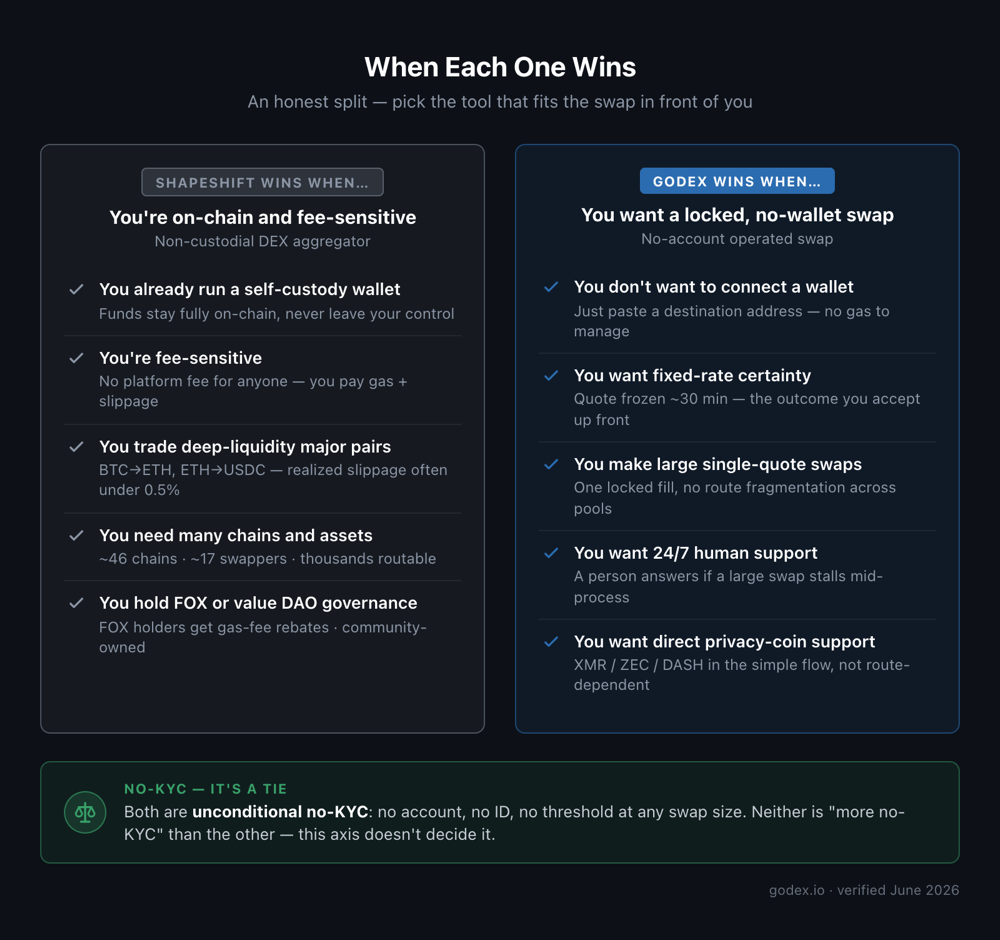
Use Godex if: you want a fixed-rate lock and a single predictable outcome; you’d rather not hold, connect, or fund a self-custody wallet to swap; you want to skip gas, slippage, and route mechanics; you want direct privacy-coin support and 24/7 human help. For a large, predictable swap with no on-chain surprises, swap on Godex is built for exactly that.
Use ShapeShift if: you want no platform fee (with gas-fee rebates on top if you hold FOX) and accept gas plus slippage; you need 46 chains and thousands of routable assets; you already run a self-custody wallet and want fully on-chain, non-custodial execution; you value DAO governance and the anti-KYC ethos (covered in Messari’s ShapeShift research). These are real strengths, and for the swaps that fit them, ShapeShift is the better tool.
Use both: many privacy-native users do. ShapeShift for broad-reach, fee-sensitive on-chain swaps where you’re already in a wallet; Godex for fixed-rate, no-wallet, predictable swaps — especially large ones and privacy-coin swaps where a known outcome beats a route-dependent one.
The choice is per-swap, not permanent. And on the one axis everyone worries about — neither platform asks for your ID. If you want the full landscape, see our list of no-KYC crypto exchanges tested in 2026.
Frequently Asked Questions
Does ShapeShift Require KYC in 2026?
No. ShapeShift requires no accounts, no ID, and no thresholds for crypto-to-crypto swaps. It markets itself as anti-KYC, and as a non-custodial DEX aggregator there’s no counterparty to request ID. Note: its third-party fiat on/off-ramp partners carry their own KYC — that’s the fiat rail, not the swap. The old “ShapeShift requires KYC” claim describes the pre-2021 custodial version.
Is ShapeShift Non-Custodial — Does It Hold My Funds?
No. ShapeShift is non-custodial; funds stay in the wallet you control throughout the swap. It routes the trade across on-chain liquidity rather than taking custody. This is one of its genuine strengths for self-custody-focused users.
Do You Need a Wallet to Use ShapeShift?
Yes. You must hold or connect a self-custody wallet and execute the swap on-chain yourself. Godex needs only a destination address to receive funds — there is no wallet to create, connect, or fund with gas on the platform.
Is ShapeShift Safe and Legit in 2026?
Yes. ShapeShift is a legitimate, community-owned DAO operating a non-custodial DEX aggregator. As with any self-custody tool, security depends on the user safeguarding their own wallet and keys, since no third party holds the funds.
Is Godex No-KYC at Any Volume?
Yes. Godex has no transaction-size threshold, no account, and no risk-scoring engine in the swap path — ID is not requested at any swap size. Note that godex.io is the only official domain; godex.pro is a confirmed scam.
What Does ShapeShift Cost?
ShapeShift charges no platform fee for anyone; cost is gas plus DeFi slippage plus an affiliate fee on the route, and FOX holders additionally get gas-fee rebates. Godex’s cost is a fixed, visible spread of roughly 1.67–2.14% on BTC→ETH. Each fits a different swap.
Start a Cryptocurrency exchange
Try our crypto exchange platform
Disclaimer: Please keep in mind that the content of this article is not financial or investing advice. The information provided is the author’s opinion only and should not be considered as direct recommendations for trading or investment. Any article reader or website visitor should consider multiple viewpoints and become familiar with all local regulations before cryptocurrency investment. We do not make any warranties about reliability and accuracy of this information.
Read more
You may well think that an article dedicated to a Tether price prediction or the Tether price in general is a little bit strange — it is a stablecoin after all. However, the price of Tether does fluctuate significantly, although it is nowhere near as volatile as non-stablecoin cryptos. This means that staying up to […]
In the article we share our vision at Zcash cryptocurrency main features and add several price predictions. As cryptocurrencies gain global acceptance and decentralisation slowly enters our lives, privacy becomes the main concern when talking about blockchain adoption. It is no secret that distributed ledger is by far the most secure and transparent technology ever […]
Chiliz coin (CHZ) offers a compelling opportunity for traders interested in the intersection of blockchain technology and sports. By enabling fans to influence team decisions through the Socios app, Chiliz directly monetizes fan engagement and connects with major sports teams like Juventus and Paris Saint-Germain. These partnerships not only enhance the platform’s visibility but also […]
The exponential growth of Bitcoin Satoshi Vision (BSV) against the general bear trend on the cryptocurrency market in autumn 2019 has impressed the community. Due to the increasing market capitalization, the newly emerged altcoin was ranked 5th on CoinMarketCap and managed to maintain its high position at the beginning of 2020. In the article we […]
EOS is definitely on the list of the strongest and most stable projects in the crypto world. Despite the fact that the currency entered the market less than 3 years ago, it consistently occupies one of the top 10 places in the rating for project capitalization. it is often called the “main competitor of Ethereum”. […]
XRP price prediction 2026-2027: bear, base, and bull scenarios with ranges and named sources, the resolved SEC case, live spot ETFs, and can XRP reach $10?