
 Linda Larsen
Table of Contents
Picture this: You’re swapping $5,000 worth of Bitcoin for Ethereum. You click “confirm,” wait for the transaction to process, and discover the exchange rate dropped 2%. Just like that, you’ve lost $100 — enough for a nice dinner or a month of streaming services.
Most crypto traders don’t even know they can control this. Fixed rate crypto exchanges lock in your price the second you initiate a swap, while floating rates change with the market in real-time. On larger trades, understanding this difference can mean saving or losing hundreds of dollars.
This guide explains what fixed and floating rates actually mean and compares their pros and cons. You’ll learn which type fits your trading needs and discover how GODEX gives you the flexibility to switch between these rate types with each transaction.
Understanding Fixed Rate vs Floating Rate Exchanges
Every crypto trader eventually runs into the same question: why did I receive more (or less) than the quote I saw five minutes ago?
The answer almost always comes down to price type.
On any crypto exchange platform, swaps are processed using either a fixed rate or a floating rate. The difference sounds subtle, but in practice, it directly affects how predictable or opportunistic your trade will be.
Fixed Rate
A fixed rate crypto exchange does exactly what the name suggests. The moment you start a swap, the rate is locked. As a result, you get a price you see.
Here’s what that looks like in real terms:
- You see the quote: 1 BTC = 15 ETH
- You confirm the swap
- This quote remains valid for the next 10–15 minutes
- You send BTC
- You receive exactly 15 ETH, minus fees
No surprises.
Example:
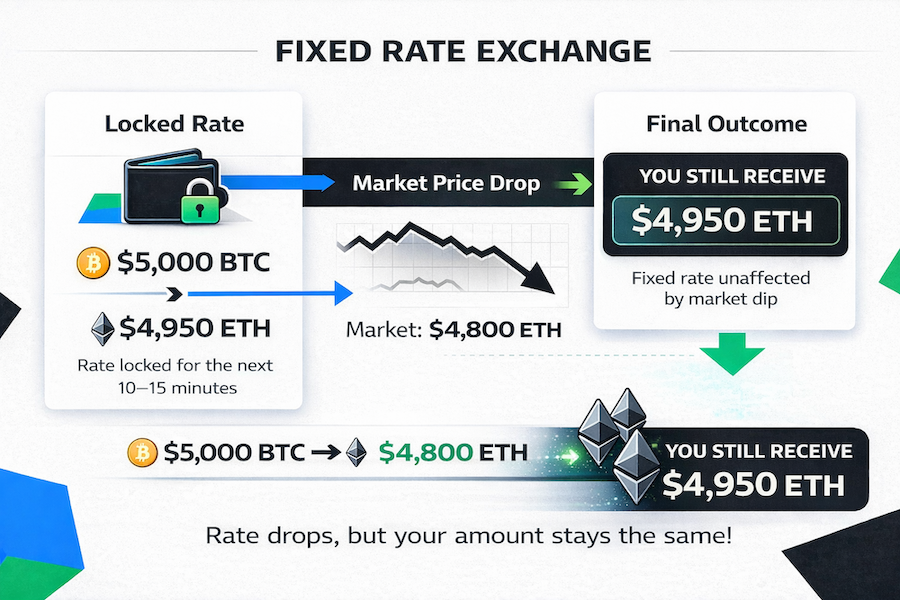
You lock a BTC swap worth $5,000, shown as $4,950 in ETH. Even if the market slips and the real-time price drops to $4,800, your outcome doesn’t change. You still receive $4,950.
Floating Rate
A floating rate crypto swap works differently. The rate you see upfront is only an estimate — the final price is determined at execution.
The process is simple:
- An estimated conversion shows: 1 BTC ≈ 15 ETH
- You send BTC
- The swap executes at the current market rate
- You receive whatever the market offers at that moment
Surprise, surprise.
Example:
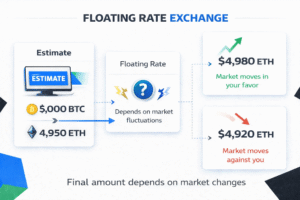
The cryptocurrency exchange platform shows an estimate of $5,000 BTC → $4,950 ETH. By the time the swap completes, you might get $4,980 if the market moves in your favor — or $4,920 if it doesn’t.
The Key Difference
Fixed rates give you certainty. You’re paying a small premium to protect yourself from price declines while the swap processes. Floating rates give you the current market price. There are no guarantees, but potential for better rates if the market moves in your favor.
Fixed Rate Crypto Swaps: When to Use
A fixed rate swap on a crypto exchange locks the price for a short period — usually 10–20 minutes. Behind the scenes, the exchange hedges the trade and sets aside liquidity for your transaction. If you don’t complete it in that window, the offer expires, and you’ll need a new quote.
Advantages of Fixed Rates
- Price certainty
You know the exact amount you’ll receive before sending anything. No math required, no surprises.
- Volatility protection
The market can crash 5% during your transaction, and you won’t lose a penny from that drop.
- Ideal for larger amounts
With $10,000+ swaps, just a 1% price shift translates to $100 lost or gained. Fixed rates eliminate that risk.
- Peace of mind
You can walk away from your computer knowing exactly what’s coming.
- Valuable during chaos
Bear markets, major news events, or wild price swings make fixed rates especially useful.
Drawbacks of Fixed Rates
- You miss favorable moves
If the market jumps 3% in your favor during the transaction, you don’t benefit. The price stays locked.
- Slightly higher fees
Most crypto swap platforms charge an extra 0.1-0.3% for the price guarantee.
- Time pressure
You have 10-20 minutes to complete everything. Miss the deadline, and you start over.
- Rates include a buffer
Exchanges build in a small cushion to protect themselves, so you might get a marginally worse rate than the absolute market price.
When Fixed Rates Make Sense
Fixed rates work best for:
- Large transactions ($5,000 and up)
- Trading during high volatility periods
- Risk-averse traders who hate uncertainty
- Business transactions where you need exact amounts for accounting
- Situations where you’re budgeting and can’t afford surprises
Real example: During the March 2024 Bitcoin crash, traders using fixed rates locked in Ethereum at $3,200. Those using floating rates on the same crypto exchange platform ended up with $3,050 by the time their transactions executed — a 5% loss in minutes.
Floating Rate Crypto Swaps: When to Use
Floating rate crypto swaps are simpler. There’s no price lock, no hedging, no countdown timer. The cryptocurrency exchange platform executes your transaction at whatever the live market rate is at that exact moment. You get the best available liquidity when your transaction processes. Send your coins now or in an hour — there’s no expiration window.
Advantages of Floating Rates
- Potential for better rates
If the market moves in your favor during the transaction, you benefit. That 1% uptick becomes extra money in your pocket.
- Lower fees
You’re not paying for rate-lock insurance. Most exchanges charge 0.1-0.3% less for floating rates.
- True market price
You get exactly what the market is trading at, not a buffered or hedged quote.
No time pressure
Take 5 minutes or 50 minutes to send your crypto. The offer doesn’t expire.
- Better in calm markets
When volatility is low, floating rates usually give you a slightly better deal than fixed pricing.
Drawbacks of Floating Rates
- Rate uncertainty
You won’t know the exact amount you’re receiving until the transaction completes.
- Slippage risk
Large orders can move the market, especially with less liquid trading pairs. Your final figure might be worse than the estimate.
- Market timing risk
The value could drop during the 10-30 minutes your transaction takes to confirm.
- Stressful for big swaps
Watching a $10,000 transaction process while the exchange price fluctuates isn’t relaxing.
When Floating Rates Make Sense
Floating rates work best for:
- Small transactions (under $1,000)
- Stable market conditions with minimal volatility
- Upward-trending markets where you want to ride the momentum
- Situations where you have flexible timing
- Experienced traders who understand and accept volatility
Real example: During a stable week in January 2025, floating rate users saved 0.3-0.5% compared to fixed rates. On a $5,000 swap, that’s an extra $15-25 in your wallet.
Fixed vs Floating Rate: Side-by-Side Comparison
Not sure which rate type to choose? This breakdown shows exactly how they differ.
| Feature | Fixed Rate | Floating Rate |
| Rate Guarantee | ✅ Yes (10-20 min) | ❌ No |
| Price Certainty | ✅ Know exact amount | ❌ Estimate only |
| Volatility Protection | ✅ Protected | ❌ Exposed |
| Upside Potential | ❌ Capped | ✅ Unlimited |
| Fees | Higher (~0.5-0.8%) | Lower (~0.3-0.5%) |
| Time Pressure | ⏰ 10-20 min window | ❌ None |
| Best in Volatile Market | ✅ Yes | ❌ No |
| Best in Stable Market | ❌ No | ✅ Yes |
| Large Transactions | ✅ Recommended | ⚠️ Risky |
| Small Transactions | ⚠️ Overkill | ✅ Fine |
Quick Decision Guide
Volatile market + Large amount = Fixed rate ✅
When the market is swinging wildly, and you’re moving serious money, pay the extra fee for certainty.
Stable market + Small amount = Floating rate ✅
Low volatility and smaller swaps make floating rates the obvious choice.
Still uncertain? = Go with fixed ✅
The small premium for a price guarantee beats the stress of watching your transaction value fluctuate.
Using Fixed & Floating Rates on GODEX Platform
GODEX is one of the few major instant exchanges offering both fixed and floating rates on the same crypto swap platform. You can switch between options with a single click. No account registration required for either pricing model. This makes it simple and flexible for traders of all experience levels.
Step-by-Step: How to Choose Your Rate on GODEX
- Go to GODEX.io
- Select your swap pair (example: BTC → ETH)
- Input how much crypto you’d like to swap
- Review both pricing options displayed:
- Fixed: “1 BTC = 28.794 ETH (guaranteed for 15 min)”
- Floating: “1 BTC ≈ 28.913 ETH (live rate when swap completes)”
- Click the option you prefer.
- Review the total amount, including fees
- Send your crypto to the provided address
- Receive your swapped coins
Real Comparison on GODEX
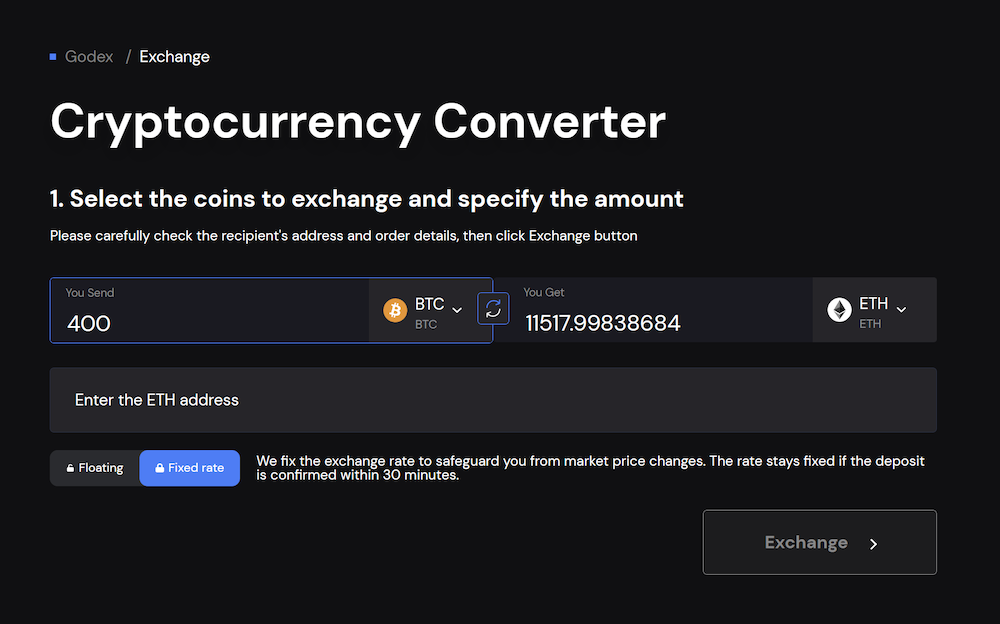
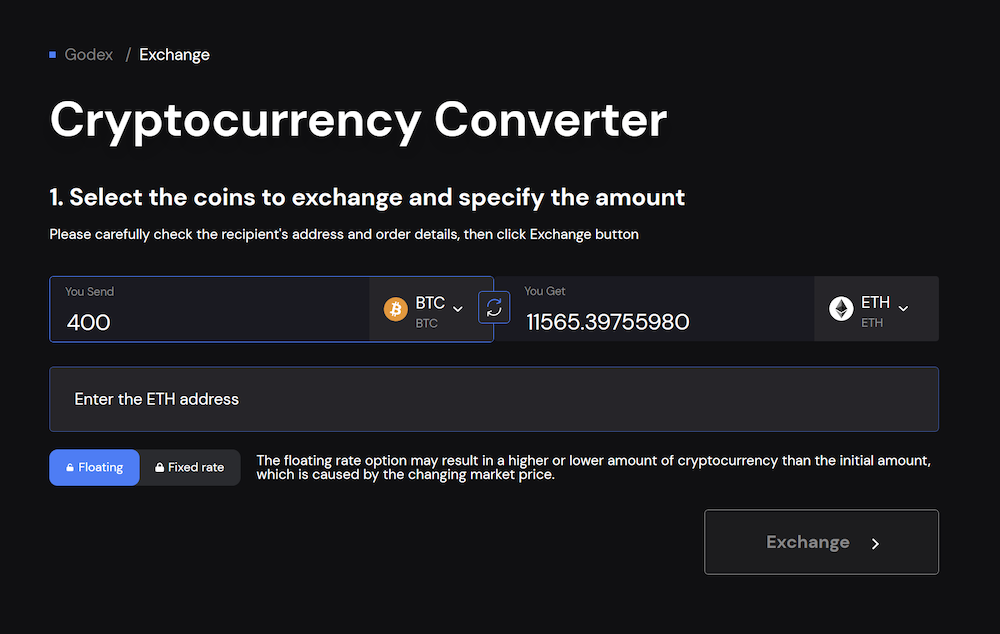
Swap: $400 BTC → ETH
Option A (Fixed Rate):
- Rate: 1 BTC = 28.794 ETH
- You receive: 11517.99838684 ETH (guaranteed)
- Fee: 0.7% ($35)
- Time limit: 30 minutes
Option B (Floating Rate):
- Rate: 1 BTC = ~ 28.913 ETH (estimate)
- You receive: 11565.39755980 ETH (depends on market at execution)
- Fee: 0.5% ($25)
- Time limit: None
Pro Tips for Choosing a Rate
Check market volatility on TradingView or CoinGecko before swapping.
High volatility? Go with Fixed. When prices are jumping 2-5% per hour, that price guarantee is worth the extra fee.
Market stable for days? Floating can save a bit on fees. If the exchange price has barely moved in 48 hours, you’ll likely get a better deal.
Large amounts? Always consider Fixed for certainty. When your swap reaches $5,000 or higher, predictability becomes more valuable than shaving off a few basis points in fees.
When unsure, choose Fixed. The extra cost is minimal compared to the confidence of knowing your exact outcome.
CONCLUSION
Both rate types have their place. Fixed rate crypto exchanges give you certainty and protection from volatility, at a slightly higher fee. Floating rates offer the best market price with potential savings but come with uncertainty. What sets GODEX apart is its dual-rate system, uncommon in the crypto exchange space.
Your decision comes down to your situation. Choose fixed rates for amounts over $5,000, during high volatility, when you need exact amounts for business purposes, or when the market is trending down. Go with floating rates for smaller swaps under $1,000, stable market conditions, upward trends, or when keeping fees low is a priority.
The general rule? When uncertain, pick fixed. That extra 0.2% fee (about $10 on a $5,000 swap) buys you peace of mind.
CTA: Ready to swap? GODEX supports 923+ coins with your choice of rate type. The best crypto exchange is one that adapts to your needs. [Start your swap now →]
FAQ
Q1: Which is better, fixed or floating rate?
There’s no universal winner — it depends on the situation. Fixed rates are better during volatile markets or when swapping large amounts, as they lock in the outcome and remove uncertainty. Floating rates work well in stable conditions and for smaller swaps, where minor price changes don’t matter as much and lower fees are attractive.
Q2: Does GODEX offer both rate types?
Yes. GODEX is one of the few instant crypto exchanges that support both fixed and floating rates. You choose the rate type at the moment of the swap, with no account or setup required.
Q3: What happens if I don’t send crypto within the fixed rate window?
The fixed rate expires. You’ll need to request a new fixed rate or switch to a floating rate and proceed at the current market price.
Q4: Can the floating rate change a lot?
In normal market conditions, the difference is usually small—around 0.1–0.5%. During extreme volatility, however, price moves of 2–5% are possible, especially on larger transactions.
Q5: Which rate has lower fees on GODEX?
Floating rates are cheaper, typically around 0.5%, compared to about 0.7% for fixed rates. The extra cost on fixed rates covers the price guarantee and hedging.
Q6: How long is the GODEX fixed rate valid?
Fixed rates are usually valid for about 15 minutes. A countdown timer is clearly shown on the swap page.
Q7: What if the market crashes during a floating rate swap?
You receive the worse rate. This is the main risk of floating swaps. Fixed rates protect you from sudden market drops.
Q8: Which rate do professional traders use?
Most professionals use both. Fixed rates are preferred for large or critical swaps, while floating rates are common for smaller, routine trades in stable markets.
Start a Cryptocurrency exchange
Try our crypto exchange platform
Disclaimer: Please keep in mind that the content of this article is not financial or investing advice. The information provided is the author’s opinion only and should not be considered as direct recommendations for trading or investment. Any article reader or website visitor should consider multiple viewpoints and become familiar with all local regulations before cryptocurrency investment. We do not make any warranties about reliability and accuracy of this information.
Read more
Chiliz coin (CHZ) offers a compelling opportunity for traders interested in the intersection of blockchain technology and sports. By enabling fans to influence team decisions through the Socios app, Chiliz directly monetizes fan engagement and connects with major sports teams like Juventus and Paris Saint-Germain. These partnerships not only enhance the platform’s visibility but also […]
The exponential growth of Bitcoin Satoshi Vision (BSV) against the general bear trend on the cryptocurrency market in autumn 2019 has impressed the community. Due to the increasing market capitalization, the newly emerged altcoin was ranked 5th on CoinMarketCap and managed to maintain its high position at the beginning of 2020. In the article we […]
EOS is definitely on the list of the strongest and most stable projects in the crypto world. Despite the fact that the currency entered the market less than 3 years ago, it consistently occupies one of the top 10 places in the rating for project capitalization. it is often called the “main competitor of Ethereum”. […]
XRP price prediction 2026-2027: bear, base, and bull scenarios with ranges and named sources, the resolved SEC case, live spot ETFs, and can XRP reach $10?
In this article we will talk about Ripple (XRP) and its price prediction. What is Ripple (XRP) Ripple is a San Francisco-based startup that was launched in 2012 by Ripple Labs as a global network both for cross-currency and gross payments. Ripple history began in 2004 with the discussions around the digital coin in the […]
You may well think that an article dedicated to a Tether price prediction or the Tether price in general is a little bit strange — it is a stablecoin after all. However, the price of Tether does fluctuate significantly, although it is nowhere near as volatile as non-stablecoin cryptos. This means that staying up to […]