
 Alex Tamm
Table of Contents
You’ve got crypto sitting in your Exodus wallet. You want to swap it for something else — quickly, privately, without the hassle of logging into a centralized exchange. The built-in swap button is right there. One click. Done.
But is that convenience actually costing you money?
The answer, in most cases, is yes. The Exodus wallet swap feature is genuinely useful — but it comes with a rate structure that quietly chips away at the value of every trade. Dedicated instant exchanges, meanwhile, have matured dramatically. Many now match Exodus on convenience while beating it significantly on rates, all without requiring registration or KYC.
This article breaks down exactly how Exodus swap works, where its costs hide, and compares it head-to-head against seven leading instant exchange alternatives — so you can decide where your next swap actually belongs.
What Is the Exodus Wallet Swap Feature?
The Exodus wallet swap is a built-in exchange function that lets users trade one cryptocurrency for another directly within the Exodus desktop app, mobile app, or browser extension — no external platform required. Rather than operating its own exchange infrastructure, Exodus routes trades through third-party API providers, acting as an aggregator of sorts sitting between the user and the actual liquidity source.
This model offers real benefits: the user never leaves their wallet interface, private keys stay on-device at all times, and there is no account registration required to swap. For beginners especially, the simplicity is a genuine selling point.
However, that simplicity comes at a structural cost — one that matters a great deal once you understand it.
How Exodus Swap Pricing Actually Works
Here is where things get nuanced. Exodus states it doesn’t charge any swap fees directly, noting that blockchain transaction fees go entirely to the network. That’s technically accurate — but the full picture is more complex.
The revenue Exodus earns from swaps comes from the spread built into the exchange rate — not a labeled “fee.” This spread typically runs somewhere in the range of 2–5% above the underlying market price, on top of the network transaction fees for both the outgoing and incoming assets.
In January 2025, Exodus announced a significant update. The new swap experience lowered fees starting at just 0.5%, with fixed rates guaranteeing users receive exactly the rates shown during the transaction preview. This is a meaningful improvement — but it applies primarily to the newer mobile swap experience and select supported pairs. The broader spread reality persists across many trading pairs on desktop.
For some token pairs, the effective swap cost can reach as high as 12%, and not all tokens can be swapped directly — some require intermediate trades, effectively doubling the fee impact.
The takeaway: Exodus swap is convenient and non-custodial, but cost-efficiency varies wildly depending on the pair and amount involved.
Why Traders Look for Exodus Exchange Alternatives
The case for exploring Exodus swap alternatives isn’t about distrust — it’s about math. Consider a $1,000 swap at a 3% spread: that’s $30 lost silently to the rate difference, compared to perhaps $5–10 on a dedicated instant exchange. On larger amounts, the gap grows proportionally.
Beyond rates, traders reach for alternatives because of:
- Coin availability: Exodus supports a broad but not unlimited set of assets; some altcoins and privacy coins may have limited or no swap support
- Swap limits: Third-party providers impose dynamic minimums and maximums that can disrupt planned trades
- No fiat off-ramp via swaps: Exodus swap is strictly crypto-to-crypto
- Rate lock duration: The fixed rate window on Exodus is not always clearly defined for all pairs
None of these are dealbreakers for everyday use. But for active traders, privacy-conscious users, or anyone moving larger amounts, the calculus shifts toward dedicated instant exchanges.
Top 7 Instant Exchange Alternatives to Exodus Wallet Swap
The following platforms were evaluated on four core criteria: exchange rate competitiveness, privacy (KYC policy), coin selection, and transaction speed. The blacklisted platforms have been excluded from this comparison.
1. Godex — Best Overall for Rates + Privacy
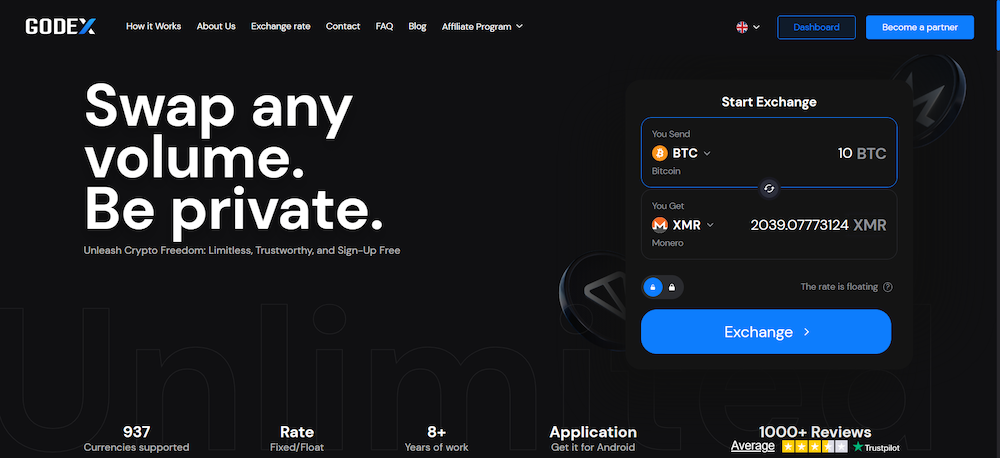
Godex delivers some of the most competitive rates among privacy-focused instant exchanges, with fees in the 0.5–1% range and a fixed-rate lock that holds for 30 minutes after order creation — protecting users from market volatility during the swap window.
Godex has operated as a high-privacy instant exchange since 2018, supporting over 919 cryptocurrencies including privacy coins, with no upper limits on exchange amounts — only minimum thresholds exist to cover network fees. Rate sourcing is one of the platform’s distinguishing features: Godex aggregates rates from major platforms including Binance, Bitfinex, and HitBTC, helping ensure competitive pricing across all trading pairs.
| ✅ Pros | ❌ Cons |
|---|---|
| Privacy-friendly, instant-access platform — swap without creating an account | Swaps on slower blockchains (e.g. Bitcoin) can take up to 30 minutes |
| Fixed rate locked for 30 minutes; rates aggregated from Binance, Bitfinex & HitBTC | |
| 919+ coins including privacy coins; non-custodial one-time address architecture |
Godex holds a 4.6/5 Trustpilot rating, has been named the #1 confidential trading platform for 2026 by Coinpedia, and maintains official Trezor integration following security audits.
For users migrating from Exodus swap who want comparable privacy with materially better rates, Godex is the most direct upgrade path.
2. SideShift — Best for Simplicity and Clean UX
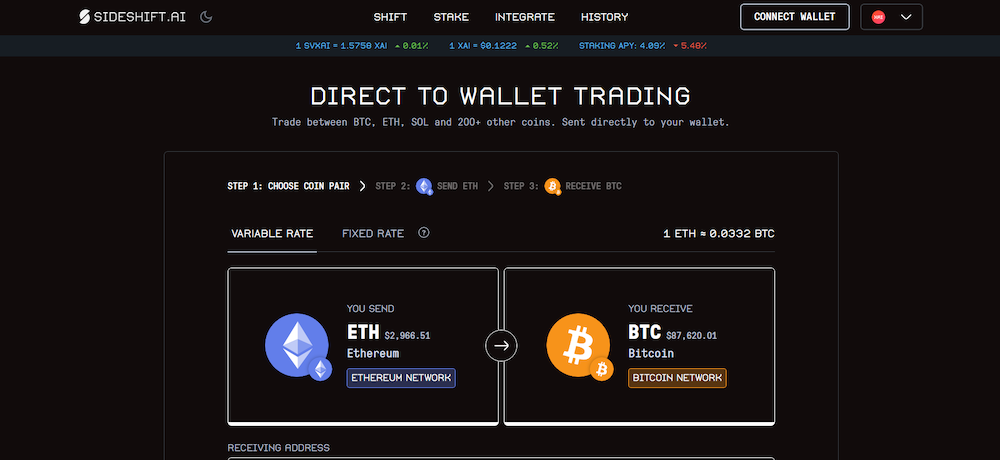
SideShift offers a minimalist, no-account instant exchange experience with AI-optimized routing that often produces better rates on less common trading pairs.
The platform maintains user privacy through a no-account model and automatically deletes transaction data after 90 days, while its AI systems operate without human oversight — reducing potential privacy breaches. The interface is deliberately clean, making it accessible to newer users without sacrificing functionality.
| ✅ Pros | ❌ Cons |
|---|---|
| AI-optimized routing delivers competitive rates on less common pairs | Narrow selection (~100+ pairs) — not suitable for obscure altcoins |
| No-account model; transaction data auto-deleted after 90 days | Web-only interface; no dedicated mobile app |
| Developer API available for bot and application integrations |
The trade-off with SideShift compared to Godex or Exolix is a narrower coin selection. Users trading major pairs will find excellent rates, but those seeking obscure altcoins may find the coverage limiting.
3. Exolix — Best for Fixed Rates and Cross-Chain Swaps
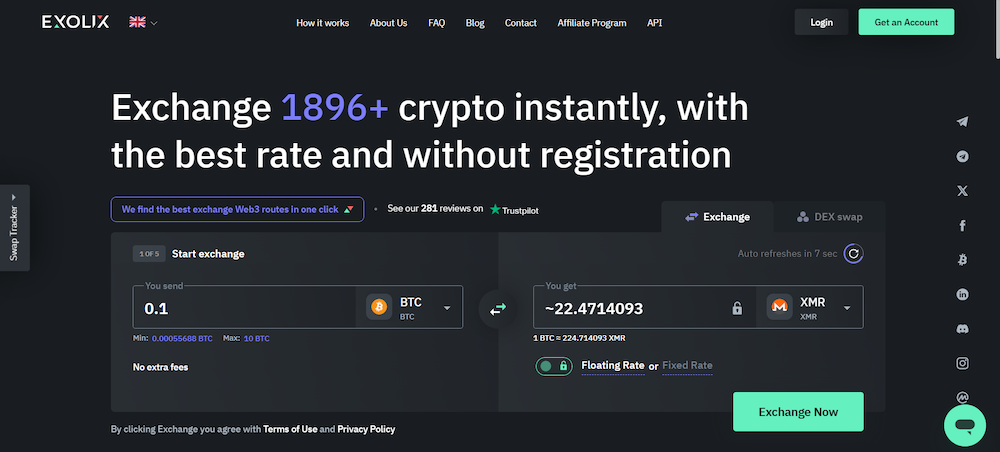
Exolix specializes in cross-chain exchanges with guaranteed fixed-rate execution, making it a reliable choice when rate certainty matters more than minimizing the spread to the last basis point.
Exolix supports over 400 cryptocurrencies and offers both floating and fixed-rate options, with processing times typically ranging from 5 to 45 minutes depending on network conditions. The platform operates on a non-custodial model throughout. One distinguishing feature is its optional KYC approach — users can swap without verification up to certain thresholds, and voluntarily verify for higher limits.
Independent analysis has found Exolix’s prices approximately 1.93% above or below market price depending on direction, reflecting a moderate spread structure — more competitive than Exodus swap at its default spread, though not as aggressive as Godex.
| ✅ Pros | ❌ Cons |
|---|---|
| Both fixed and floating rate modes; strong cross-chain support | Spread of ~1.93% is higher than Godex or SideShift |
| Non-custodial with zero-logs policy; 24/7 live chat support | “Optional KYC” means verification can be triggered at the platform’s discretion |
| Supports 400–700+ coins including privacy coins with no special restrictions |
4. Bisq — Best for Maximum Decentralization
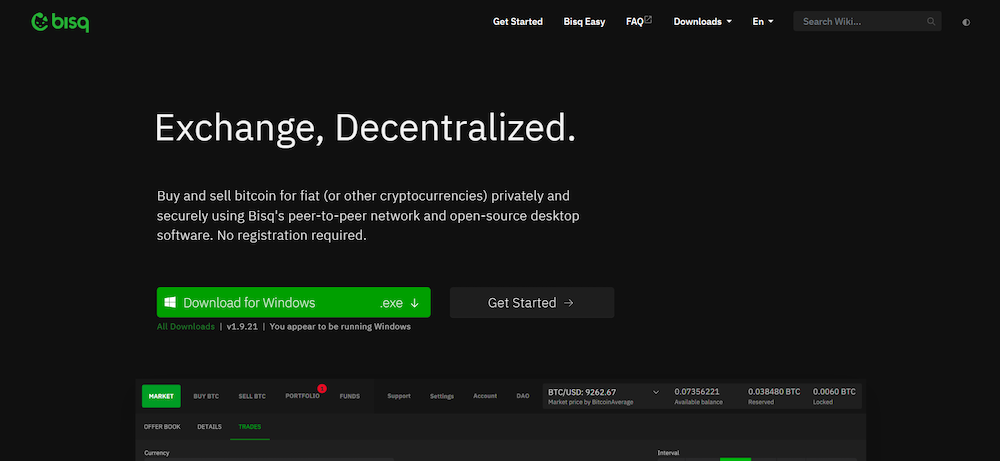
Bisq is a fully decentralized, peer-to-peer exchange where no central authority holds funds or processes orders — making it the gold standard for trustless, surveillance-resistant trading.
As a true P2P platform, Bisq cannot be shut down by authorities or experience traditional exchange failures, with users maintaining complete control over their funds throughout the trading process via multi-signature escrow contracts.
| ✅ Pros | ❌ Cons |
|---|---|
| Truly decentralized — cannot be shut down; multi-sig escrow protects both parties | Trades take hours to days depending on counterparty availability |
| Maximum privacy — no data collected, no central servers | Primarily Bitcoin-focused; altcoin pair coverage is very limited |
| Fully open-source and community-audited; transparent fee structure (~1.3%) | Requires desktop software installation — steep learning curve for newcomers |
The main limitation of Bisq is speed and convenience: trades can take hours to days depending on counterparty availability and payment method confirmation. It’s powerful, but not a like-for-like swap in the instant exchange category. Best suited to privacy maximalists and technical users comfortable with the P2P model.
5. MEXC — Best for Altcoin Depth
MEXC is the go-to destination for traders who need the broadest possible altcoin selection with minimal friction, listing over 3,000 cryptocurrencies and offering some of the lowest trading fees in the industry.
Operating since 2018 and serving over 40 million users across 170+ countries, MEXC has built its reputation squarely on early and extensive token listings — from established DeFi tokens and privacy coins to emerging altcoins and meme coins that don’t yet appear on more conservative platforms. Its tiered KYC model means unverified accounts can trade spot and futures markets immediately, with daily withdrawal limits in place rather than a hard registration wall.
| ✅ Pros | ❌ Cons |
|---|---|
| 3,000+ spot pairs; 0% maker / 0.05% taker fees — among the lowest available | Account registration required — not a pure instant swap experience |
| Advanced tools: futures up to 500×, copy trading, grid bots, DEX+ hybrid mode | Restricted in the US, UK, and Canada |
| Early access to new token listings before they appear on major platforms | Risk-control freezes can lock accounts during large withdrawal reviews |
| $100 million Guardian Fund plus Hacken audits for security assurance |
The trade-offs are worth noting: MEXC is currently restricted in the US, UK, and Canada, and risk-control freezes can occasionally lock accounts for large withdrawals pending manual review. It also requires account registration — making it a step up in complexity from pure instant swap platforms. But for traders who regularly hunt early-stage altcoins or want to execute high-frequency trades at near-zero cost, MEXC’s depth and fee structure are hard to match.
6. KuCoin — Best for Volume Traders Willing to Accept Partial KYC
KuCoin occupies a middle ground: it’s a full-featured centralized exchange that allows users to trade and withdraw up to 1 BTC per day without completing full identity verification. This makes it a practical option for traders who want access to advanced order types and deep liquidity while retaining a degree of privacy at lower volumes.
KuCoin offers a rich trading environment with thousands of crypto pairs, staking options, futures, and more, while supporting users who trade and withdraw up to 1 BTC per day without verification.
| ✅ Pros | ❌ Cons |
|---|---|
| 0.1% trading fees with deep liquidity; 700+ coins | Account creation and custodial model required |
| No KYC needed for withdrawals under 1 BTC/day | Full KYC mandatory for amounts above the daily limit |
| Advanced order types, portfolio tools, staking and earn products | Not available to US residents following regulatory action |
| Trezor hardware wallet integration for enhanced custody security | Staking, earn products, and advanced features locked behind verification tiers |
KuCoin is not a pure instant swap platform — it requires account creation and functions like a traditional exchange. But for larger-volume swaps where rate efficiency matters most, the 0.1% trading fee environment is considerably cheaper than the Exodus swap spread.
7. Symbiosis Finance — Best for DeFi Cross-Chain Speed
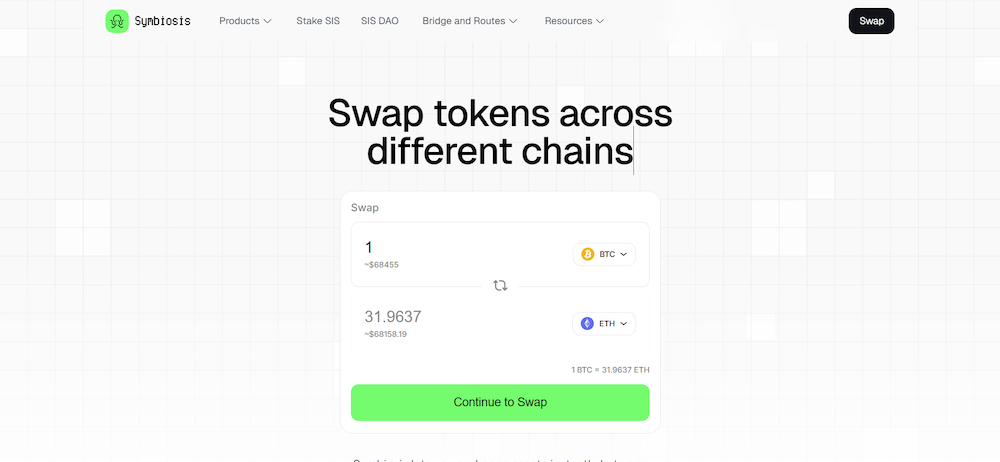
Symbiosis Finance is a decentralized cross-chain liquidity protocol that routes swaps across more than 30 blockchain networks — and it does so with remarkable speed. Unlike centralized instant exchanges, Symbiosis operates entirely through smart contracts with no custodial risk.
Symbiosis claims the title of fastest cross-chain swap platform in 2026, completing transactions in 45–60 seconds according to independent testing, with sophisticated smart routing that automatically identifies the fastest execution path across networks like Ethereum, BNB Chain, Solana, and Avalanche.
| ✅ Pros | ❌ Cons |
|---|---|
| Fastest cross-chain swaps available (45–60 sec); no KYC or registration | Requires a Web3 wallet connection — not accessible to beginners |
| Fully non-custodial smart contract architecture; no counterparty risk | No support for privacy coins or assets outside DeFi/EVM ecosystems |
| Smart routing automatically finds the optimal path across 30+ networks | Fees vary unpredictably with gas costs across supported chains |
| Covers Ethereum, BNB Chain, Solana, Avalanche and more in a single interface | No customer support desk — users are on their own if a swap stalls |
The trade-off is complexity: Symbiosis requires a Web3 wallet connection and some familiarity with DeFi. It is not a beginner-friendly replacement for Exodus swap, but for experienced users doing high-frequency cross-chain trades, the speed and fee efficiency can be compelling.
Head-to-Head Comparison: Exodus Wallet Swap vs 7 Instant Exchanges
| Platform | Effective Rate Cost | KYC Required | Coins Supported | Swap Speed | Fixed Rate Option |
|---|---|---|---|---|---|
| Godex | ~0.5–1% | Privacy-focused | 919+ | 5–30 min | Yes (30-min lock) |
| SideShift | ~0.5–1% | No | 100+ pairs | 5–25 min | Yes |
| Exolix | ~1.93% spread | Optional | 400–700+ | 5–45 min | Yes |
| Bisq | ~1.3% trading fee | No | BTC-focused | Hours–days | No (P2P market price) |
| MEXC | 0% maker / 0.05% taker | Tiered (optional up to limits) | 3,000+ | Minutes | No (order book) |
| KuCoin | 0.1% trading fee | Partial (1 BTC/day) | 700+ | Minutes | No (order book) |
| Symbiosis | Variable (~0.3–0.5% protocol fee) | No | 30+ chains | 45–60 sec | No |
| Exodus Swap | ~2–5% spread (select pairs from 0.5%) | No | 300+ | 5–30 min | Yes (new mobile experience) |
Rate costs are approximate and subject to change. Always check current rates before transacting.
When Does Exodus Swap Actually Make Sense?
The honest answer: Exodus swap isn’t always the wrong choice. There are genuine use cases where its built-in convenience wins.
Use Exodus swap when:
- You’re moving a small amount (under $100) where the absolute dollar cost of the spread is minimal
- You value never leaving your wallet interface and the risk of entering a wrong address on an external platform concerns you
- You’re swapping between assets on emerging or EVM-compatible chains where Exodus’s new routing performs competitively
- You’re a beginner and the simplicity of in-wallet swaps reduces the chance of user error
Consider an instant exchange alternative when:
- Your swap exceeds $200–$300 in value — at that range, a 2–3% spread difference is real money
- You need a coin that Exodus doesn’t support or that has limited swap liquidity
- You want the most transparent rate comparison before committing
- You want a fixed rate guarantee with a clear published lock window
For amounts over $100, using a dedicated exchange rather than Exodus swap typically saves real money — even after accounting for the convenience difference.
The Rate Efficiency Breakdown: A Practical Example
To make this concrete, consider a $500 BTC-to-ETH swap:
- Exodus Swap at a 3% effective spread: ~$15 lost in rate difference, plus network fees on both sides
- Godex at a 0.75% fee: ~$3.75 in fees, plus network fees on the outgoing transaction
- MEXC at 0.05% taker fee: ~$0.25 in fees, plus withdrawal fee
The difference between Exodus and a dedicated instant exchange like Godex is roughly $11 on a $500 trade — or $110 on a $5,000 trade. Not catastrophic for occasional use, but significant for anyone swapping regularly.
Final Verdict: Which Gives Better Rates?
Dedicated instant exchanges consistently offer better exchange rates than the Exodus wallet swap feature for most trade sizes and pairs. The structural reason is simple: Exodus earns its revenue through the spread, while platforms like Godex compete directly on rate to attract volume — pulling rates closer to market price.
That said, the gap has narrowed since Exodus’s January 2025 update introduced 0.5% fees on the new mobile swap experience. For users swapping on supported pairs through the new interface, the difference may be minimal on smaller amounts.
The broader point remains: if you’re already comfortable using a non-custodial wallet like Exodus and value privacy, you’re already positioned to use the best instant exchanges without changing your habits much. Platforms like Godex offer the same privacy-friendly, non-custodial experience you’re used to — just with rates pulled from multiple major exchanges rather than a single third-party API.
The self-custody ethos that Exodus users appreciate doesn’t have to come with a rate premium. In 2026, you can have both.
Frequently Asked Questions
Is Exodus swap actually ripping me off or am I just paranoid? Not paranoid — the spread runs 2–5% depending on the pair. It’s hidden in the rate, not labeled as a fee. The January 2025 update brought it down to 0.5% on mobile for select pairs, but desktop and obscure pairs still eat a bigger spread than any dedicated instant exchange. Check the quoted rate against CoinGecko before confirming.
Is it actually safe to send crypto to Godex or SideShift? Feels sketchy. These platforms are non-custodial — your crypto goes to a one-time address, swaps automatically, and lands in your wallet. Godex has run since 2018, passed Trezor security audits, and holds a 4.6/5 on Trustpilot. The real risk is user error (wrong address, wrong network), not the platform. Test with $50 first.
What’s the actual dollar difference between Exodus swap and an instant exchange? On a $500 swap: Exodus at 3% costs ~$15; Godex at 0.75% costs ~$4. That’s an $11 difference — and $110 on a $5,000 swap. The process is the same: open a tab, enter two addresses, send.
Do I need to create an account or give ID to use Godex or SideShift? No account, no KYC, no email required. You enter a destination address and send. SideShift auto-deletes transaction data after 90 days. The privacy model matches or beats Exodus — you’re not trading self-custody for surveillance.
What if the swap fails on an instant exchange — do I lose my crypto? No. If a swap fails, the platform refunds to the address you provided at the start. Always enter a refund address before sending — that single step is your only protection against an edge case. Failure rates on established platforms are low, but it happens.
Why do Exodus swap rates feel random — sometimes fine, sometimes awful? The spread is dynamic, set by whichever third-party provider Exodus routes your trade through, based on pair liquidity and market conditions. Exodus shows the rate before you confirm — compare it to the live market price. If the implied cost is over 1.5%, check Godex first.
Disclaimer: This article is for informational purposes only and does not constitute financial or investment advice. Cryptocurrency exchange rates, fees, and platform features change frequently. Always verify current terms directly with any platform before initiating a transaction.
Start a Cryptocurrency exchange
Try our crypto exchange platform
Disclaimer: Please keep in mind that the content of this article is not financial or investing advice. The information provided is the author’s opinion only and should not be considered as direct recommendations for trading or investment. Any article reader or website visitor should consider multiple viewpoints and become familiar with all local regulations before cryptocurrency investment. We do not make any warranties about reliability and accuracy of this information.
Read more
EOS is definitely on the list of the strongest and most stable projects in the crypto world. Despite the fact that the currency entered the market less than 3 years ago, it consistently occupies one of the top 10 places in the rating for project capitalization. it is often called the “main competitor of Ethereum”. […]
XRP price prediction 2026-2027: bear, base, and bull scenarios with ranges and named sources, the resolved SEC case, live spot ETFs, and can XRP reach $10?
In this article we will talk about Ripple (XRP) and its price prediction. What is Ripple (XRP) Ripple is a San Francisco-based startup that was launched in 2012 by Ripple Labs as a global network both for cross-currency and gross payments. Ripple history began in 2004 with the discussions around the digital coin in the […]
You may well think that an article dedicated to a Tether price prediction or the Tether price in general is a little bit strange — it is a stablecoin after all. However, the price of Tether does fluctuate significantly, although it is nowhere near as volatile as non-stablecoin cryptos. This means that staying up to […]
In the article we share our vision at Zcash cryptocurrency main features and add several price predictions. As cryptocurrencies gain global acceptance and decentralisation slowly enters our lives, privacy becomes the main concern when talking about blockchain adoption. It is no secret that distributed ledger is by far the most secure and transparent technology ever […]
Chiliz coin (CHZ) offers a compelling opportunity for traders interested in the intersection of blockchain technology and sports. By enabling fans to influence team decisions through the Socios app, Chiliz directly monetizes fan engagement and connects with major sports teams like Juventus and Paris Saint-Germain. These partnerships not only enhance the platform’s visibility but also […]