
 Alex Tamm
Table of Contents
Your cryptocurrency exchange is suddenly demanding identity documents, and your funds are frozen until you comply. This complete recovery guide explains exactly why exchanges request KYC verification, what to do when you’re stuck in verification limbo, and how to regain control of your crypto assets—whether you choose to complete verification or explore privacy-preserving alternatives.
If you’ve found yourself locked out of trades or withdrawals because your exchange is asking for KYC, you’re not alone. As regulations tighten globally, millions of crypto users face unexpected verification requests that can delay access to their funds for days, weeks, or even longer.
What Is KYC and Why Is Your Exchange Asking for It Now?
Know Your Customer (KYC) verification is a regulatory requirement that forces crypto exchanges to confirm user identities before allowing full platform access. Even if you’ve traded freely for months or years, exchanges can request KYC documentation at any time due to evolving compliance requirements, suspicious activity flags, or changes in local regulations.
The Regulatory Pressure Behind KYC Requests
Global financial watchdogs have dramatically increased oversight of cryptocurrency platforms. The EU’s Markets in Crypto-Assets (MiCA) regulation, which took full effect in December 2024, now mandates comprehensive identity verification for all crypto asset service providers operating in European markets. In the United States, the SEC and FinCEN require exchanges to maintain robust Anti-Money Laundering (AML) programs that include mandatory KYC procedures.
These regulatory shifts mean that exchanges once operating with minimal verification now face enormous pressure to collect user data. According to recent compliance statistics, 92% of centralized crypto exchanges worldwide now enforce KYC requirements, up from 85% just a year earlier.
Common Triggers for Unexpected KYC Requests
Several situations can trigger an exchange to suddenly ask for KYC verification:
- Transaction thresholds: Many platforms allow limited trading before requiring verification, often around 1,000 USDT or 10 BTC in 24-hour withdrawals
- Risk algorithm flags: Unusual trading patterns, rapid deposits/withdrawals, or connections to flagged wallet addresses
- Regulatory updates: Changes in local laws that require retroactive verification of existing users
- Geographic restrictions: VPN usage or location changes that suggest attempts to circumvent regional rules
- Account age requirements: Periodic re-verification for accounts older than certain timeframes
Understanding these triggers helps you anticipate when verification might be required and plan accordingly.
Why Users Get Stuck in KYC Verification
Getting stuck in KYC verification can transform a routine crypto transaction into weeks of frustration. The verification process involves multiple potential failure points, any of which can leave your funds inaccessible while support teams slowly work through ticket queues.
Technical Rejection Reasons
KYC rejections frequently stem from technical issues rather than actual problems with your identity. Common rejection causes include:
| Rejection Type | Cause | Solution |
|---|---|---|
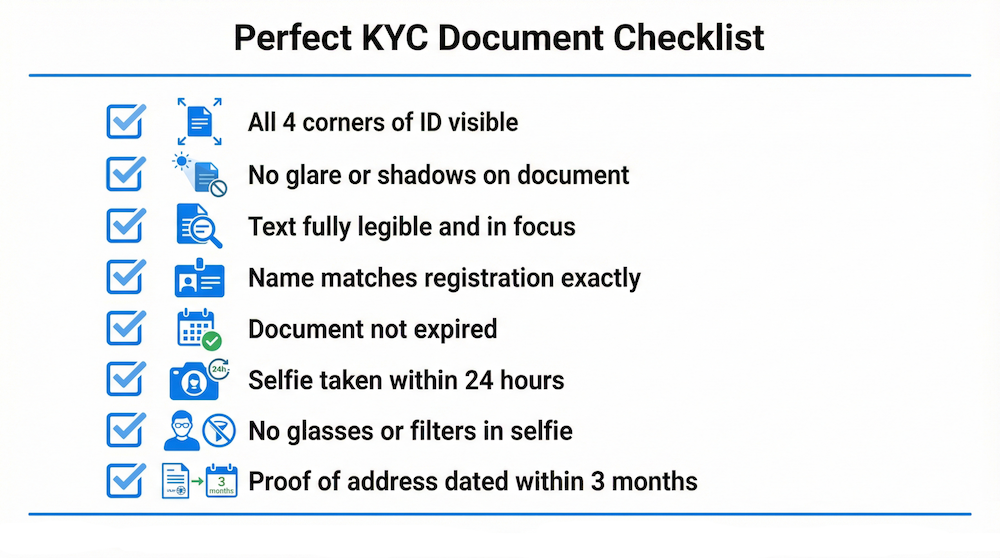
| Document quality | Blurry images, glare, cut-off corners | Retake photos in bright, indirect light |
| Data mismatch | Name spelling differs from ID | Ensure exact match with legal documents |
| Expired documents | Passport or ID past expiration date | Upload current, valid identification |
| Wrong document type | Unsupported ID format | Check accepted documents for your region |
| Selfie issues | Filters, glasses, poor lighting | Take fresh photo within 24 hours, no filters |
| Address proof | Document older than 3 months | Obtain recent utility bill or bank statement |
Many users report being caught in verification loops where automated systems repeatedly reject legitimate documents without clear explanation. One study found that average KYC verification times have improved to 3.5 minutes on major exchanges—but this only applies to straightforward cases. Complex situations can drag on indefinitely.
Regional and Documentation Challenges
Users in certain regions face disproportionate KYC difficulties. Those without “standard” government-issued IDs, residents of countries with limited banking infrastructure, or individuals whose names use non-Latin characters often experience extended verification delays. Some platforms simply cannot process documentation from certain jurisdictions, leaving users completely unable to verify even with perfect documents.
The Account Lockout Nightmare
When KYC verification fails repeatedly, many exchanges respond by locking accounts entirely. This creates a devastating Catch-22: you cannot withdraw your funds without completing verification, but the verification process itself keeps failing. Users have reported funds being frozen for months while support teams investigate, with little recourse beyond waiting.
Immediate Steps When Your Exchange Asks for KYC
Taking the right actions immediately can mean the difference between quick resolution and prolonged fund lockout. Start by assessing your situation calmly and gathering necessary materials before beginning any verification attempt.
Step 1: Understand Exactly What’s Required
Before uploading anything, carefully review the specific verification requirements. Different exchanges have different accepted documents, and submitting the wrong type wastes time and potentially triggers additional scrutiny. Look for:
- Accepted identity document types (passport, national ID, driver’s license)
- Proof of address requirements and acceptable document age
- Selfie or video verification specifications
- Any additional documentation for your region
Step 2: Prepare Perfect Documentation
Quality documentation dramatically increases first-attempt approval rates. Take the time to capture proper images that meet platform specifications. Ensure all four corners of documents are visible, text is completely legible, and there are no reflections or shadows obscuring information. For selfie verification, use good lighting, remove glasses, and take the photo fresh rather than using existing images.
Step 3: Match Everything Precisely
Even minor discrepancies between your submitted information and documents can cause rejection. If your ID shows “Robert” but you registered as “Rob,” update your profile to match exactly. Ensure your registered address matches your proof of residence document character-for-character.
Step 4: Document Your Submission
Screenshot everything you submit, including timestamps. If verification fails, this documentation helps support teams understand what went wrong and prevents you from needing to restart from zero.
What to Do When You’re Stuck in KYC Verification
Persistent verification failures require escalation beyond standard resubmission. Understanding your options helps you regain access to funds faster.
Escalating Through Official Channels
Most exchanges offer multiple support tiers. Start with standard support tickets but don’t hesitate to escalate. Look for:
- In-app chat support for immediate responses
- Email escalation to compliance or legal teams
- Social media outreach to official support accounts
- Community forums where staff members participate
When contacting support, provide your registered email, describe your verification attempts chronologically, and attach screenshots of any error messages. Clear, concise communication receives faster responses than emotional complaints.
Understanding Your Rights
Depending on your jurisdiction, you may have legal rights regarding access to your funds. Some exchanges are required to provide withdrawal options for users unable to complete verification, though these processes can be slow. Research whether your local regulators have authority over the exchange in question—some platforms maintain licenses that obligate them to resolve access issues within specific timeframes.
The Fund Return Option
Certain exchanges offer “return of funds” processes for users who cannot or will not complete KYC. These typically involve withdrawing assets back to the original deposit address, minus fees. While not ideal, this option at least recovers your crypto rather than leaving it perpetually frozen.
The Hidden Risks of KYC Compliance
Completing KYC verification isn’t without risk. Before uploading sensitive documents, understand what you’re potentially exposing yourself to.
Data Breach Reality
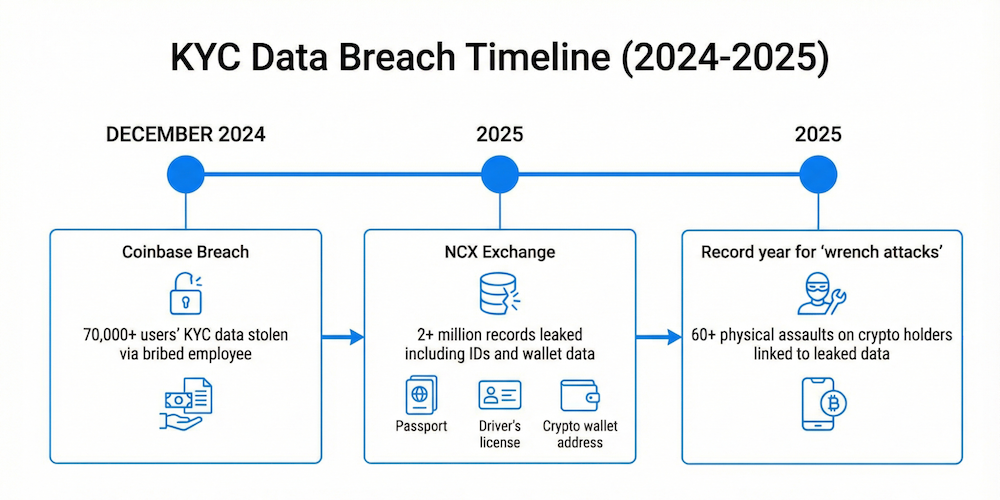
Cryptocurrency exchanges have become prime targets for data thieves. The 2024-2025 period saw devastating breaches at major platforms:
- Coinbase (December 2024): Rogue customer service agents accessed KYC data for approximately 70,000-100,000 users, including government IDs and home addresses
- NCX Exchange (2025): Over 2 million records leaked, including complete KYC document packages and internal keys
- Multiple incidents: An estimated 8.2 terabytes of financial app user data was exposed in what researchers called “probably the largest KYC data leak in history”
These breaches don’t just risk identity theft—they enable physical targeting. Security experts report 2025 was “a record year for wrench attacks,” with approximately 60 documented physical assaults on crypto holders, many facilitated by leaked KYC data revealing victim addresses and estimated holdings.
Long-Term Privacy Implications
Every KYC verification creates another copy of your identity documents in another database. Unlike passwords, you cannot change your face, fingerprints, or government ID numbers. Once this data leaks, criminals can use it indefinitely for identity theft, phishing attacks, SIM swapping, or even bypassing KYC at other platforms using your stolen documents.
Exploring No-KYC Alternatives
For users who value privacy or face persistent verification challenges, no-KYC cryptocurrency exchanges offer a compelling alternative. These platforms enable trading without identity verification, returning to cryptocurrency’s original vision of financial privacy.
How No-KYC Exchanges Work
Privacy-focused exchanges like Godex operate on a fundamentally different model than traditional platforms. Instead of account-based systems requiring identity verification, these services facilitate direct wallet-to-wallet swaps:
- Select your trading pair (e.g., BTC to ETH)
- Enter your destination wallet address
- Send funds to a unique deposit address
- Receive swapped assets directly to your wallet
No registration, no email verification, no document uploads. The entire process takes minutes rather than the days or weeks that stuck KYC verification can consume.
Why Traders Choose Privacy-Preserving Platforms
Beyond avoiding verification headaches, no-KYC exchanges offer several distinct advantages:
- Speed: No onboarding delays—initiate trades within minutes of first visiting the platform
- Security through minimization: Platforms cannot leak data they never collect
- Accessibility: Users in underserved regions or without standard documentation can participate fully
- Non-custodial operation: Funds remain in your control except briefly during the swap itself
- No arbitrary freezes: Without accounts, there are no accounts to lock or restrict
Godex: A Privacy-First Exchange Solution
Among no-KYC alternatives, Godex has established itself as a leading option for privacy-conscious traders. Operating since 2018 and registered in the Seychelles, the platform has built a reputation for reliable, anonymous cryptocurrency swaps. Key features include:
| Feature | Benefit |
|---|---|
| 928+ cryptocurrencies | Access to majors, altcoins, stablecoins, and privacy coins |
| No registration required | Start trading immediately without creating accounts |
| No KYC ever | Never requested, never collected, never leaked |
| Fixed and floating rates | Lock in guaranteed rates or capture market movements |
| No exchange limits | Swap any amount without volume restrictions |
| 24/7 customer support | Assistance available around the clock |
| Lowest market fees | Transparent pricing with no hidden costs |
| Fast transactions | Most swaps complete in minutes |
The platform has earned trust through 8+ years of reliable operation, 1000+ reviews on Trustpilot, and partnerships with respected industry names including Trezor, Monero, and Edge Wallet. An Android app extends accessibility for mobile users.
For traders tired of verification loops or concerned about data security, Godex represents what cryptocurrency exchange was always meant to be: fast, private, and user-controlled.
Making the Right Choice for Your Situation
Deciding between completing KYC verification and moving to a privacy-preserving alternative depends on your specific circumstances, priorities, and risk tolerance.
When to Complete KYC Verification
Traditional exchange verification makes sense when:
- You need fiat on/off-ramps (converting between crypto and bank money)
- Your jurisdiction legally requires using licensed platforms
- You’re comfortable with the data security practices of major exchanges
- You need features only available on centralized platforms (margin trading, specific assets)
If you choose this path, complete verification on one trusted platform and use it primarily for fiat conversion, keeping the rest of your activity on privacy-preserving services.
When to Choose No-KYC Alternatives
Privacy-focused exchanges become the better choice when:
- You’re stuck in verification limbo with frozen funds
- You value financial privacy and data security
- You primarily trade crypto-to-crypto rather than involving fiat
- You want faster transaction times without onboarding delays
- You’re concerned about physical security risks from data breaches
- Your documentation doesn’t meet standard KYC requirements
The Hybrid Approach
Many experienced users adopt a layered strategy:
- A regulated exchange (with KYC) for occasional fiat conversion
- Self-custody wallets for long-term storage
- No-KYC swap services like Godex for crypto-to-crypto trading and portfolio rebalancing
This approach minimizes identity exposure while maintaining necessary access to traditional financial rails.
Protecting Yourself Going Forward
Whether you complete KYC or switch to privacy-preserving platforms, implementing proper security practices protects both your assets and your identity.
Minimize KYC Exposure
If you do verify with exchanges, limit how many platforms hold your documents. Each verification creates another potential breach point. Use one trusted platform for fiat conversion and handle everything else through non-custodial services.
Practice Strong Operational Security
Beyond platform choice, protect yourself through:
- Hardware wallets: Keep significant holdings in self-custody, not on exchanges
- Minimal disclosure: Never discuss holdings or wallet addresses publicly
- Geographic separation: Consider using different addresses for crypto activities than personal residence
- Regular monitoring: Watch for signs of identity theft through credit monitoring services
Stay Informed About Exchange Policies
Exchange verification policies change frequently. Platforms once offering no-KYC trading have suddenly implemented requirements, sometimes freezing funds for existing users. Stay aware of policy updates for any platform where you hold assets.
Frequently Asked Questions
Is KYC mandatory for crypto exchanges?
Most centralized cryptocurrency exchanges now require mandatory KYC verification due to global AML regulations, with 92% of platforms enforcing identity checks as of 2025. However, decentralized exchanges and privacy-focused instant swap services operate without KYC requirements.
What to do if KYC verification failed?
If your KYC verification failed, carefully review rejection reasons, ensure document images are clear with all corners visible, verify that submitted information exactly matches your ID, and resubmit through the platform’s verification portal. Contact customer support with screenshots if repeated attempts fail or your funds remain frozen.
What happens if I refuse KYC?
Refusing KYC verification typically results in restricted account access, withdrawal freezes, and inability to trade on that platform until you comply. Some exchanges offer fund return processes for users who cannot complete verification, though this may take weeks and involve fees.
Are no-KYC crypto exchanges safe?
Reputable no-KYC crypto exchanges can be safer than traditional platforms because they cannot leak personal data they never collect—eliminating risks from data breaches, identity theft, and physical targeting. Choose established services like Godex with years of operation, transparent policies, and non-custodial swap architecture for maximum security.
Why does KYC verification keep failing?
KYC verification keeps failing due to blurry document photos, name mismatches between your registration and ID, expired identification documents, unsupported file formats, or selfies taken with filters or poor lighting. Automated verification systems often reject legitimate documents without clear explanation, requiring multiple careful resubmission attempts.
Taking Action Today
Being stuck with an exchange asking for KYC doesn’t mean accepting indefinite fund lockouts or exposing your identity to breach risks. You have options.
If you choose to complete verification, approach it systematically with perfect documentation and patience for support processes. If privacy and accessibility matter more, Godex offer immediate, verification-free trading across hundreds of cryptocurrencies.
The cryptocurrency industry was built on principles of financial sovereignty and privacy. While regulatory pressure has pushed many platforms toward invasive data collection, alternatives exist for users who refuse to accept this tradeoff. Whether recovering from verification frustration or proactively protecting your privacy, the power to control your financial information remains in your hands.
Start a Cryptocurrency exchange
Try our crypto exchange platform
Disclaimer: Please keep in mind that the content of this article is not financial or investing advice. The information provided is the author’s opinion only and should not be considered as direct recommendations for trading or investment. Any article reader or website visitor should consider multiple viewpoints and become familiar with all local regulations before cryptocurrency investment. We do not make any warranties about reliability and accuracy of this information.
Read more
XRP price prediction 2026-2027: bear, base, and bull scenarios with ranges and named sources, the resolved SEC case, live spot ETFs, and can XRP reach $10?
In this article we will talk about Ripple (XRP) and its price prediction. What is Ripple (XRP) Ripple is a San Francisco-based startup that was launched in 2012 by Ripple Labs as a global network both for cross-currency and gross payments. Ripple history began in 2004 with the discussions around the digital coin in the […]
You may well think that an article dedicated to a Tether price prediction or the Tether price in general is a little bit strange — it is a stablecoin after all. However, the price of Tether does fluctuate significantly, although it is nowhere near as volatile as non-stablecoin cryptos. This means that staying up to […]
In the article we share our vision at Zcash cryptocurrency main features and add several price predictions. As cryptocurrencies gain global acceptance and decentralisation slowly enters our lives, privacy becomes the main concern when talking about blockchain adoption. It is no secret that distributed ledger is by far the most secure and transparent technology ever […]
Chiliz coin (CHZ) offers a compelling opportunity for traders interested in the intersection of blockchain technology and sports. By enabling fans to influence team decisions through the Socios app, Chiliz directly monetizes fan engagement and connects with major sports teams like Juventus and Paris Saint-Germain. These partnerships not only enhance the platform’s visibility but also […]
The exponential growth of Bitcoin Satoshi Vision (BSV) against the general bear trend on the cryptocurrency market in autumn 2019 has impressed the community. Due to the increasing market capitalization, the newly emerged altcoin was ranked 5th on CoinMarketCap and managed to maintain its high position at the beginning of 2020. In the article we […]