
 Peter Moore
Table of Contents
Ethereum Classic is the asset most crypto coverage stopped paying attention to around 2018. The price chart doesn’t help — ETC spent the past several years in a band that was uninteresting to speculators and unthreatening to Ethereum. The story that most articles still run is some version of “ETC is frozen in time.” It’s wrong, and it has been wrong since the Merge.
Here’s what actually happened to ETC between 2022 and 2026:
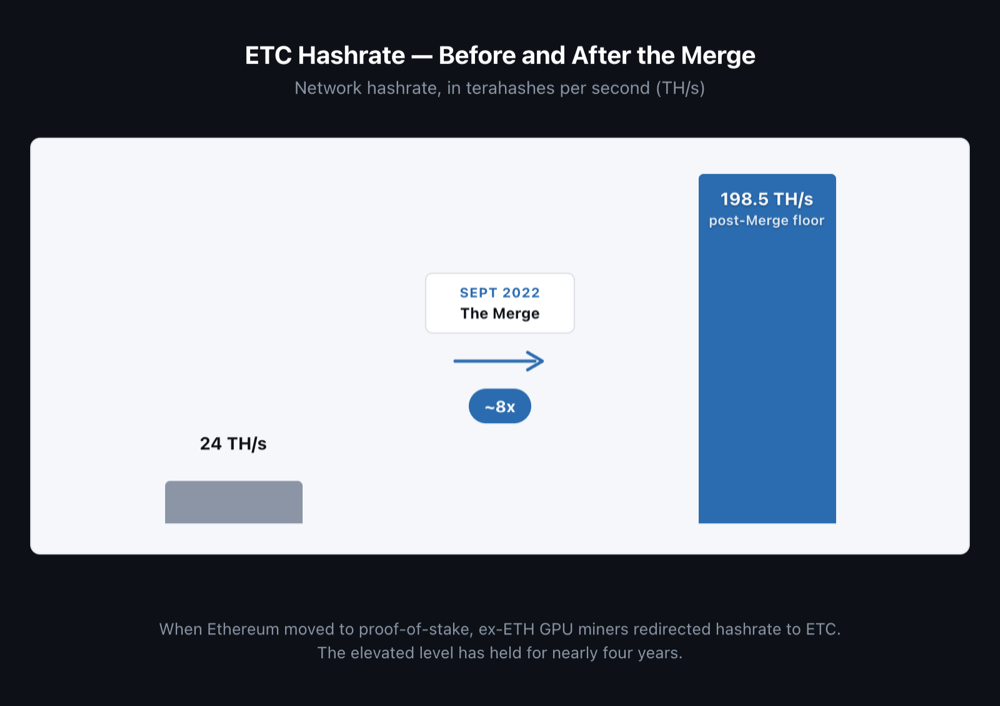
When Ethereum switched from proof-of-work to proof-of-stake in September 2022, every GPU miner in the ETH ecosystem had a choice: shut down the rig, sell the GPUs, or redirect hashrate to another proof-of-work chain. A significant portion of that hashrate pointed at ETC. The network’s hashrate went from roughly 24 TH/s before the Merge to nearly 200 TH/s today — an eight-fold increase that has remained structurally elevated ever since. ETC is now the largest proof-of-work Ethereum descendant by a wide margin, and it has the ex-ETH mining base to back it up.
And in 2026, ETC is shipping a real upgrade. The Olympia upgrade, targeted for late 2026, introduces EIP-1559 dynamic gas pricing, an on-chain treasury funded by base fees, DAO governance for treasury spending, and a formal funding proposal process. If Olympia delivers, ETC stops being “the unchanged chain” and becomes “the post-Merge PoW Ethereum with modern economics.”
This forecast takes both the hashrate story and the Olympia roadmap seriously. Where ETC stands, what Olympia actually does, three scenarios for 2026–2030, and a year-by-year table.
Where ETC Stands in April 2026
ETC has been trading in a range around the $9–$10 band through the early months of 2026, with various sources citing the mid-February price at approximately $9.30. Market cap and circulating supply place ETC outside the top fifteen by market cap — a mid-tier asset, not a blue chip, not a microcap.
The more interesting data point is the hashrate. At approximately 198.5 TH/s as of early 2026, the network is operating at a level that would have been considered impossible before the Merge. This matters for the forecast for two distinct reasons.
First, the hashrate floor. Miners with sunk capital in GPU rigs don’t leave a chain voluntarily unless the economics force them to. As long as ETC produces enough block reward to cover the operating cost of the hashrate currently pointed at it, the miners stay. That creates a persistent demand for block rewards that supports a persistent floor on price, because block rewards are denominated in ETC and miners need to sell some portion to cover operating costs — but they also need the price to stay above the level where operating costs exceed rewards. Below that level, hashrate exits and the miners’ political interest shifts to maintaining the chain’s viability.
Second, the security budget. A hashrate of ~200 TH/s is enough to make a 51% attack economically expensive. ETC had 51% attack incidents in its earlier history, before the post-Merge hashrate migration. It has not had one since. Those two facts are connected.
The current price is pricing in a chain that’s not going anywhere and a roadmap that hasn’t landed. If Olympia lands, the second part of that pricing updates.
What Olympia Actually Does
Olympia is the 2026 upgrade targeted for late this year. It’s a protocol overhaul that brings ETC’s economic model closer to modern blockchain best practices while preserving the proof-of-work consensus and the ETC philosophical commitment to immutability. The headline changes:
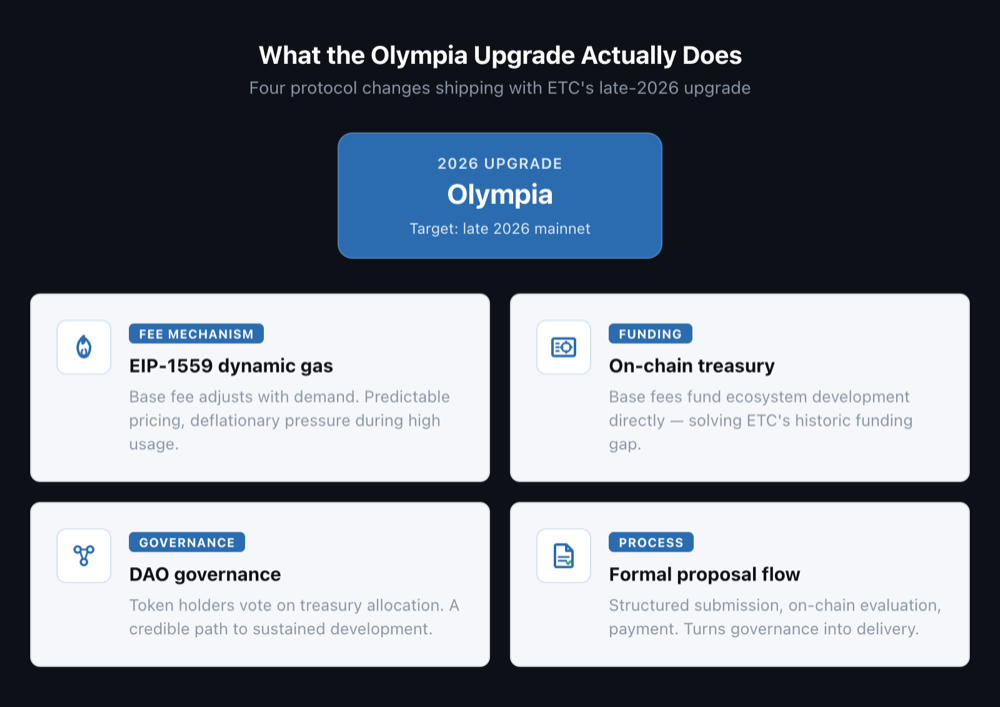
EIP-1559 dynamic gas pricing. The same upgrade Ethereum shipped in 2021 comes to ETC. A base fee that adjusts with network demand, with the base fee portion of transaction costs burned or otherwise removed from circulation. This replaces the older auction-style gas pricing with a more predictable mechanism and, depending on the specific implementation, introduces a deflationary pressure on ETC supply during periods of high network usage.
On-chain treasury funded by base fees. Instead of burning base fees as Ethereum does, Olympia directs them to an on-chain treasury. This treasury becomes the funding source for development, maintenance, and ecosystem grants. For ETC specifically, this is a meaningful change — the chain has historically struggled with development funding compared to ETH, and the treasury mechanism addresses that directly.
DAO governance for treasury spending. Token holders can vote on how treasury funds are allocated. This is the governance layer that turns “ETC has a treasury” into “ETC has a credible path to sustained development and ecosystem investment.”
Formal funding proposal process. A structured path for teams proposing work, with on-chain evaluation and payment. This is the operational machinery that makes the DAO governance actually produce outcomes rather than simply existing as a voting mechanism.
The combined effect: ETC transitions from “an unchanged chain that absorbed ex-ETH hashrate” to “a modern proof-of-work chain with treasury, governance, and dynamic fees.” That’s a different asset from the one the 2023 coverage described.
Whether Olympia actually delivers on schedule and as designed is the core forecasting question. The development work is in progress, the specification is public, and the target is late 2026. Treat that date as a directional estimate rather than a hard commitment — consensus upgrades slip more often than they land on time.
The Proof-of-Work Revival Angle
There’s a second tailwind for ETC that most coverage hasn’t connected to the Olympia story: regulatory attention is increasingly focused on proof-of-stake staking as a potential securities question. Staking products have been subject to enforcement actions in multiple jurisdictions. The legal treatment of validators and staking rewards is contested.
Proof-of-work chains don’t have the same exposure. Mining rewards are more clearly established as non-securities in most jurisdictions. Miners are not functionally similar to securities intermediaries in the same way staking providers can be.
None of this means PoW chains get a regulatory free pass. It means that if the staking question becomes a sustained regulatory headwind for PoS chains, PoW chains with real hashrate and real development become a compliance-lighter alternative for specific institutional use cases. ETC is the largest asset that fits that profile outside of Bitcoin — and Bitcoin is not smart-contract-capable.
This is a soft tailwind, not a hard catalyst. Don’t build a forecast on it. But don’t ignore it either, especially if the regulatory direction in 2026–2027 continues on its current trajectory.
Bull Case — Why ETC Could Outperform Through 2030
The bull case for ETC requires two things to go right: Olympia delivers as spec’d, and the PoW niche finds its second wind.
Olympia lands on time or close to it. The upgrade is executed cleanly, the treasury activates, and the governance process starts producing funded development proposals. Within six to twelve months of the upgrade, there’s visible ecosystem investment that wasn’t there before.
Hashrate remains elevated or grows. Ex-ETH miners stay on ETC rather than migrating to other PoW chains or shutting down. The hashrate floor holds.
The PoW regulatory tailwind materializes. Institutional allocators looking for smart-contract-capable PoW exposure add ETC as a position. This doesn’t require mass adoption — it just requires a handful of specific allocators choosing ETC for the niche it uniquely fills.
Developer attention. Olympia’s treasury mechanism successfully attracts developers to build on ETC. The ecosystem starts to feel alive rather than static.
A narrative shift. ETC moves from “the chain that didn’t change” to “the chain that finally caught up.” This narrative shift is the necessary condition for any meaningful repricing — fundamentals rarely drive price changes without a story that makes the fundamentals legible.
Bull-case numbers at the bottom. This outcome requires a lot to go right simultaneously.
Base Case — The Most Likely Path
The base case assumes Olympia ships with some delay and some partial achievement of its goals, rather than full on-time execution or outright failure.
ETC hashrate stays elevated through the forecast window. Miners remain economically aligned with the chain. Price trades in a range that reflects the chain’s security budget and the modest ecosystem growth.
Olympia reaches mainnet — possibly a quarter or two later than the late-2026 target — and functions roughly as intended. The treasury accumulates base fee revenue. The governance mechanism produces some funded work but not at the pace the most optimistic Olympia supporters hoped for. Development accelerates modestly but ETC does not become a major smart contract destination.
Price appreciates from current levels over the forecast window, driven by a combination of upgrade delivery, narrative improvement, and the gradual reduction of the “ETC is frozen” discount. It does not reach the ambitious targets some analysts have floated, but it meaningfully exceeds the conservative ones.
Through 2029 and 2030, ETC’s position in the asset hierarchy depends on whether the PoW niche hardens into something durable or whether it remains a small carve-out. The base case assumes modest durability.
Bear Case — What Would Break the Forecast
Olympia delays or disappoints. The upgrade is pushed into 2027 or beyond, or it ships but the treasury mechanism doesn’t function as designed, or the governance process produces disputes rather than funded development. Any of these turns the “ETC is catching up” narrative back into “ETC is not catching up.”
Hashrate declines. ETC mining economics deteriorate — either because of ETC price weakness, or because another PoW chain becomes more attractive to the ex-ETH mining base, or because GPU mining profitability declines generally. If hashrate drops back toward pre-Merge levels, the security budget and the political alignment of miners both weaken.
A new 51% attack incident. ETC has a history with this specific risk. A repeat in the post-Merge era would be devastating to the narrative, regardless of what caused it or how it was resolved.
PoW regulatory tailwind fails to materialize. The staking regulatory concern either resolves in favor of PoS or doesn’t escalate, and PoW doesn’t get a relative advantage.
Asset rotation continues. ETC loses mindshare to newer assets and stays flat in a range while the broader market moves higher.
None of these is catastrophic on its own. All of them can compound.
Year-by-Year Forecast (2026–2030)
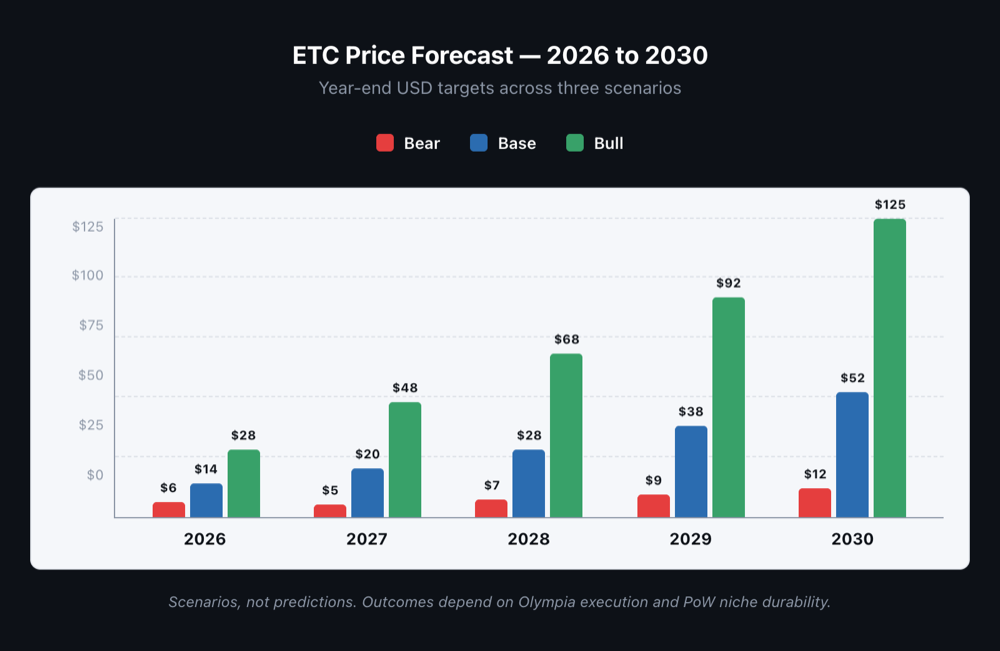
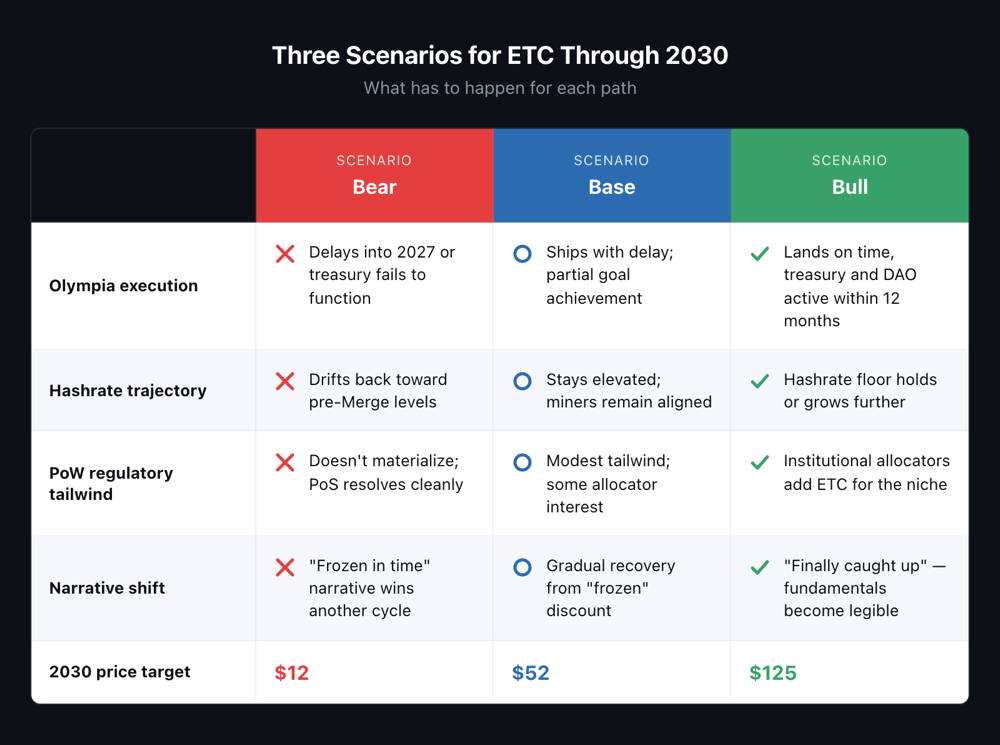
| Year | Bear | Base | Bull |
|---|---|---|---|
| 2026 | $6 | $14 | $28 |
| 2027 | $5 | $20 | $48 |
| 2028 | $7 | $28 | $68 |
| 2029 | $9 | $38 | $92 |
| 2030 | $12 | $52 | $125 |
Scenarios, not predictions. Notes on reading the table:
- The bear case does not assume the chain fails — it assumes Olympia disappoints or delays and ETC drifts in a lower range.
- The base case reflects partial Olympia success and a gradual narrative recovery.
- The bull case requires Olympia to land well, hashrate to hold or grow, and the PoW niche to harden. It’s plausible but not the most likely outcome.
- The 2030 bull case at around $125 is the upper end of what we consider defensible. Numbers higher than that appear in other forecasts — we don’t think the reasoning behind them is solid.
How to Acquire ETC in 2026
ETC is available on most centralized exchanges that support a broad asset list, and through non-custodial swap services. For users who want to acquire ETC without creating an account, a non-custodial swap like Godex.io supports ETC among its 934+ pairs with a fixed-rate option and no volume caps. For a walk-through of the process, see the step-by-step Godex guide.
Risks
- Upgrade execution. Olympia is a non-trivial protocol change. Consensus upgrades slip and occasionally break things.
- Hashrate. The current hashrate is a function of ex-ETH GPU economics. Those economics can change.
- 51% attack history. Pre-Merge ETC had multiple such incidents. The current hashrate level makes them much harder, but “harder” is not “impossible.”
- Mindshare. ETC has low cultural visibility in 2026. Even a successful Olympia rollout requires a narrative shift to translate into price.
- Liquidity. ETC order books are adequate but not deep. Large positions should account for slippage.
The Bottom Line
Ethereum Classic is an asset most coverage dismissed in 2018 and never re-evaluated. The 2026 version of ETC — post-Merge hashrate inheritance, Olympia upgrade pending, a specific niche in the post-Merge PoW landscape — is a different asset from the one the dismissive coverage describes. The forecast through 2030 depends on whether Olympia delivers and whether the PoW niche hardens.
If Olympia ships on time and works as designed, ETC has a credible path to the base case and possibly the lower end of the bull case. If Olympia slips significantly or disappoints in execution, ETC stays in the bear-to-lower-base range and the “frozen in time” narrative wins another cycle.
The reasoning above is what should inform any ETC position. The numbers in the table are illustrations of that reasoning. Revisit after Olympia’s mainnet launch, whenever that is.
Last updated: April 8, 2026. Nothing in this article is financial advice. Verify the current state of the Olympia upgrade and the ETC hashrate before acting on any forecast that is more than a few weeks old.
Start a Cryptocurrency exchange
Try our crypto exchange platform
Disclaimer: Please keep in mind that the content of this article is not financial or investing advice. The information provided is the author’s opinion only and should not be considered as direct recommendations for trading or investment. Any article reader or website visitor should consider multiple viewpoints and become familiar with all local regulations before cryptocurrency investment. We do not make any warranties about reliability and accuracy of this information.
Read more
You may well think that an article dedicated to a Tether price prediction or the Tether price in general is a little bit strange — it is a stablecoin after all. However, the price of Tether does fluctuate significantly, although it is nowhere near as volatile as non-stablecoin cryptos. This means that staying up to […]
In the article we share our vision at Zcash cryptocurrency main features and add several price predictions. As cryptocurrencies gain global acceptance and decentralisation slowly enters our lives, privacy becomes the main concern when talking about blockchain adoption. It is no secret that distributed ledger is by far the most secure and transparent technology ever […]
Chiliz coin (CHZ) offers a compelling opportunity for traders interested in the intersection of blockchain technology and sports. By enabling fans to influence team decisions through the Socios app, Chiliz directly monetizes fan engagement and connects with major sports teams like Juventus and Paris Saint-Germain. These partnerships not only enhance the platform’s visibility but also […]
The exponential growth of Bitcoin Satoshi Vision (BSV) against the general bear trend on the cryptocurrency market in autumn 2019 has impressed the community. Due to the increasing market capitalization, the newly emerged altcoin was ranked 5th on CoinMarketCap and managed to maintain its high position at the beginning of 2020. In the article we […]
EOS is definitely on the list of the strongest and most stable projects in the crypto world. Despite the fact that the currency entered the market less than 3 years ago, it consistently occupies one of the top 10 places in the rating for project capitalization. it is often called the “main competitor of Ethereum”. […]
XRP price prediction 2026-2027: bear, base, and bull scenarios with ranges and named sources, the resolved SEC case, live spot ETFs, and can XRP reach $10?