
 Alex Tamm
Table of Contents
Privacy in crypto isn’t what it used to be. In 2024, it was a feature you could choose. In 2026, it’s something you have to fight for. Between the EU’s MiCA regulation reaching full enforcement, centralized exchanges tightening their KYC dragnet, and blockchain analytics firms getting better at linking wallets to identities, the question of where you trade has become inseparable from the question of who knows about it.
This guide breaks down the three dominant exchange models — and the dex vs cex privacy debate — through a single lens: which one actually protects your privacy? Not in marketing copy. Not in theory. In practice, right now, when real money is on the line.
The Privacy Problem Most Traders Don’t See Coming
Most crypto users assume that choosing a DEX over a CEX solves their privacy problem. It doesn’t, at least not completely. Privacy in cryptocurrency trading is a layered challenge that involves identity exposure, transaction traceability, data storage, and custodial risk, and no single exchange model handles all of these layers equally well. Understanding the distinction between a decentralized vs non-custodial exchange is essential — the terms are often used interchangeably, but the privacy implications differ substantially.
Consider what happens when you trade on a major centralized exchange. You’ve submitted your passport, a selfie, proof of address, and in some cases a video interview. That data now lives on a server controlled by a company that could be hacked, subpoenaed, or simply change its policies overnight. According to CoinGecko’s 2026 Trading Activity Report, CEXs lost over $2 billion to hacks in the past year alone, with 71% stemming from the Bybit breach in February 2025. Every one of those breaches carries the potential to expose not just funds but identities.
Now consider a DEX. You connect a wallet, approve a smart contract, and swap tokens. No ID required. But here’s the part that gets overlooked: every transaction you make is permanently recorded on a public blockchain. Anyone, including analytics firms like Chainalysis, can trace your wallet activity, link transactions together, and, with enough data points, connect that wallet to a real-world identity.
Then there’s a third category that often gets lumped in with DEXs but operates quite differently: instant non-custodial exchanges. These platforms sit in a unique architectural space, no accounts, no KYC, no on-chain footprint tied to a smart contract interaction, and the distinction matters more than many realize.
How Centralized Exchanges Handle Your Data
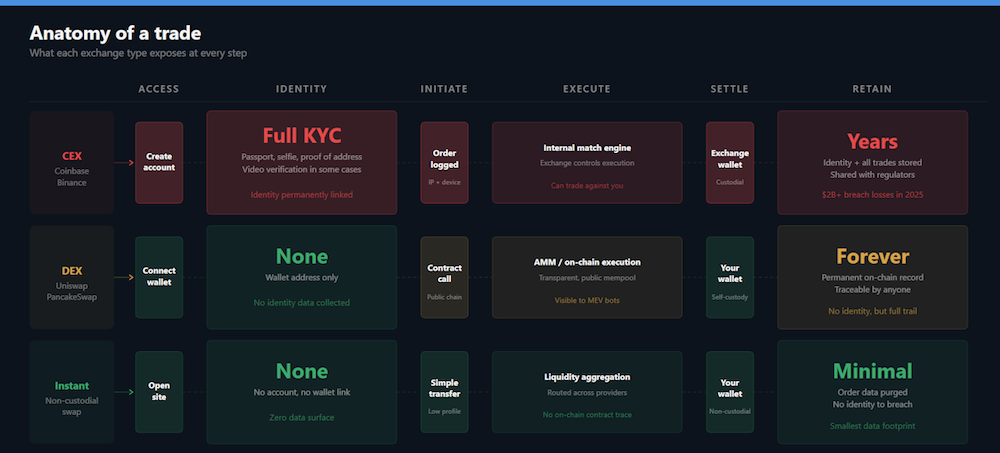
CEXs collect and store extensive personal information as a condition of access. Every major centralized exchange — Binance, Coinbase, Kraken, and their peers — requires users to complete Know Your Customer verification before trading. This typically means submitting government-issued identification, proof of address, and sometimes biometric data.
This isn’t optional, and the requirements are only getting stricter. The EU’s MiCA regulation, now in its final enforcement phase with a July 2026 deadline for all remaining crypto-asset service providers, mandates robust AML/KYC procedures for every licensed exchange operating in the bloc. Over 90% of EU-based crypto exchanges have updated their compliance processes accordingly. In the US, the IRS has implemented new reporting rules for digital-asset brokers, expanding transaction-level reporting obligations. Similar regulatory tightening is happening across Hong Kong, Singapore, and the UAE.
What this means for privacy-conscious traders:
- Your identity is permanently linked to every trade. CEXs maintain complete records of your trading history, wallet addresses, deposit and withdrawal activity, and IP logs, all tied to your verified identity.
- Your data is shared with third parties. Exchanges share information with analytics providers, regulators, and law enforcement. This isn’t a possibility; it’s a regulatory requirement.
- Your data survives you leaving the platform. Even after closing an account, exchanges retain records for years to comply with regulatory obligations.
- Your data can be breached. The Bybit hack demonstrated that even major platforms aren’t immune. When a CEX is compromised, attackers get not only funds but the personal information of millions of users.
CEXs do offer some advantages — high liquidity, fiat on-ramps, advanced trading tools, and customer support — but privacy is simply not among them. If you trade on a CEX, you are trading with the understanding that your financial activity is fully visible to the exchange, its partners, and potentially any government that asks.
Decentralized Exchanges: Private by Design, Transparent by Nature
DEXs eliminate the need for identity verification by replacing the centralized intermediary with smart contracts. Platforms like Uniswap, PancakeSwap, and Hyperliquid allow anyone with a compatible wallet to trade directly on-chain, and this architectural difference has driven explosive growth, DEX spot market share doubled from 6.9% to 13.6% between January 2024 and January 2026, according to CoinGecko.
But “no KYC” and “private” are not synonyms. And this is where the DEX privacy story gets complicated.
What DEXs get right:
- No account creation or identity verification required
- No centralized database of user information to breach
- Self-custody throughout the trading process: your funds never leave your control
- Censorship resistance, no single entity can freeze your account or block your trades
What DEXs get wrong on privacy:
- Full on-chain transparency. Every swap you execute on Uniswap, for example, is recorded permanently on Ethereum’s public blockchain. Your wallet address, the tokens involved, the amounts, the timestamps, all of it is visible to anyone who looks. As Uniswap’s own support documentation states, “public wallet addresses and wallet transactions are public.”
- Wallet screening. Uniswap Labs has confirmed it screens connected wallets using blockchain analytics providers to identify wallets associated with illicit activity. In a notable earlier incident, the platform blocked over 250 crypto addresses linked to Tornado Cash.
- Front-end data collection. While Uniswap’s protocol is decentralized, its front-end interface collects off-chain data including device type, browser information, and data from localStorage. Other DEX front-ends operate similarly.
- MEV and transaction ordering. On transparent chains, your pending transactions can be observed in the mempool and exploited through front-running or sandwich attacks, which not only costs you money but reveals your trading intent in real time.
The core tension is structural: DEXs run on public blockchains, and public blockchains are, by definition, transparent. Your wallet might not have your name on it, but the trail of transactions it leaves can be remarkably revealing. Blockchain analytics firms have become sophisticated enough to cluster wallets, identify patterns, and in many cases de-anonymize users by linking on-chain behavior to off-chain data points.
Privacy-enhancing layers are emerging, some L2 networks now offer shielded transactions and hidden balances, but for the majority of DEX trading happening today, pseudonymity is the ceiling, not anonymity.
Instant Non-Custodial Exchanges: The Third Model
When comparing a DEX vs instant exchange, the architectural differences are significant. Instant non-custodial exchanges process crypto-to-crypto swaps without requiring accounts, identity verification, or direct on-chain smart contract interactions visible in the same way as DEX trades. This model works fundamentally differently from both CEXs and DEXs.
Here’s how the architecture typically works: you select a trading pair, enter a receiving wallet address, and send funds to a deposit address generated by the platform. The exchange aggregates liquidity from multiple sources, executes the swap, and sends the converted funds to your designated wallet. The entire process is wallet-to-wallet, with no custodial period where your funds sit on a platform balance sheet.
From a privacy standpoint, this model has distinct advantages:
- No identity data collected. No accounts, no registration, no KYC documents, no email addresses. There is no database of personal information to breach.
- No smart contract interaction on your wallet. Unlike DEX swaps, which leave a clear trail of contract approvals and token swaps on-chain, instant exchanges typically use simple transfers. Your wallet sends crypto to one address and receives crypto from another — a pattern far less distinctive on a block explorer.
- Non-custodial design. Your funds pass through the exchange’s routing layer but are never held in a user-associated account. This eliminates the risk of frozen accounts or seized balances.
- Cross-chain capability. Unlike most DEXs, which operate within a single blockchain ecosystem (or require bridges), instant exchanges can swap across entirely different networks — BTC to XMR, ETH to SOL — without the user managing bridge contracts or wrapped tokens.
The trade-off is that you’re trusting the platform’s routing layer to execute your trade honestly and deliver funds to your receiving address. This is a real consideration, and it’s why reputation, track record, and security audits matter in this space.
Godex, for instance, operates as an instant non-custodial exchange that has maintained a no-KYC, no-registration policy since 2018, through multiple regulatory cycles and market crashes. Supporting over 930 cryptocurrencies including privacy coins that many centralized platforms have delisted, it demonstrates how this model functions in practice. Its Trezor hardware wallet integration, which required passing Trezor’s security audits, adds another practical privacy layer: users can initiate swaps directly from hardware wallet environments without exposing keys or creating software wallet footprints.
The non-custodial instant exchange model doesn’t solve every privacy challenge — blockchain transactions are still traceable, and users should practice good operational security — but it minimizes the data surface area in ways that neither CEXs nor standard DEXs can match.
The Privacy Comparison: Feature by Feature
The following table compares the three exchange models across the privacy dimensions that matter most in practice:
| Privacy Factor | CEX (e.g., Coinbase, Binance) | DEX (e.g., Uniswap, PancakeSwap) | Instant Exchange (e.g., Godex) |
|---|---|---|---|
| Identity Verification | Full KYC required | None | None |
| Account Creation | Required | Not required (wallet connection) | Not required |
| Personal Data Stored | Extensive (ID, address, biometrics) | Minimal (some front-ends log device/browser data) | None |
| Transaction Visibility | Private to exchange, visible to regulators | Fully public on-chain | Simple transfers; less distinctive pattern |
| Wallet Screening | Standard practice | Increasingly common on major front-ends | Generally not practiced |
| Fund Custody | Exchange holds funds | Self-custody throughout | Non-custodial; wallet-to-wallet |
| Cross-Chain Swaps | Supported via platform | Limited; requires bridges | Native support |
| Privacy Coin Support | Declining (regulatory delistings) | Depends on chain/liquidity | Typically supported |
| Risk of Account Freeze | Yes | No (but front-end can block wallets) | No |
| Data Breach Exposure | High (identity + financial data) | Low (no personal data) | Very low (no data to breach) |
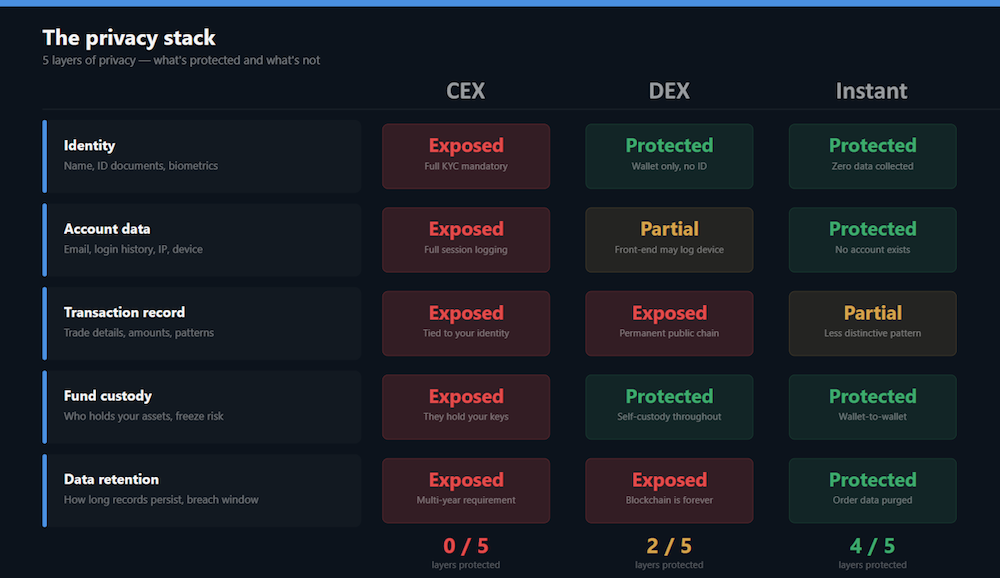
A Uniswap vs Godex comparison illustrates the contrast clearly: one offers pseudonymous on-chain trading with full transparency, the other offers off-chain routing with no data collection.
No single column is “perfect.” Each model involves trade-offs. But the pattern is clear: CEXs sacrifice privacy for compliance and convenience, DEXs offer pseudonymity with full on-chain transparency, and instant exchanges minimize the data footprint across both dimensions.
The Regulatory Landscape Reshaping Privacy in 2026
Understanding where privacy stands today requires understanding the regulatory forces actively reshaping it. The regulatory environment is not hostile to all crypto, it’s specifically hostile to anonymous crypto activity on platforms that fall under its jurisdiction.
The EU’s MiCA regime has been the most transformative force. With full enforcement reaching its July 2026 deadline, all crypto-asset service providers operating in the EU must hold proper licenses, implement AML/KYC procedures, and comply with the Transfer of Funds Regulation’s “travel rule,” which requires sender and receiver information to accompany every crypto transfer between regulated entities. DeFi platforms saw a 16% drop in EU usage as a result of this regulatory pressure.
In the United States, the landscape is more fragmented but trending in the same direction. The IRS has expanded reporting requirements for digital-asset brokers. The GENIUS Act, signed in July 2025, established strict stablecoin regulations. The SEC, CFTC, and FinCEN continue to divide oversight responsibilities, but the overall trend is toward more comprehensive surveillance of on-exchange activity.
Globally, the OECD’s Crypto-Asset Reporting Framework (CARF) is targeting adoption across member countries by 2026-2027, creating an international standard for tax authorities to exchange information about crypto transactions.
What does this mean for privacy?
- CEXs are fully within the regulatory net. Trading on them means full transparency to governments. This is by design.
- DEXs exist in a legal gray area. MiCA doesn’t currently cover DeFi protocols with no identifiable intermediary, but regulators are watching closely, and front-end operators face increasing pressure.
- Instant non-custodial exchanges operate in a structurally different space. By not holding user funds and not collecting identity data, they occupy a position that existing regulations struggle to address, though this could change.
The Canadian seizure of TradeOgre in early 2026 — approximately $40 million frozen in what was described as the country’s largest crypto enforcement action — serves as a reminder that operating without registration doesn’t guarantee immunity from law enforcement. Users should understand the legal landscape in their jurisdiction.
Practical Privacy: What You Can Actually Do
Privacy isn’t just about which exchange you choose, it’s about how you use it. Even the most privacy-respecting platform can’t protect users who make operational mistakes. Here are practices that meaningfully improve your trading privacy regardless of the platform you’re on:
Wallet hygiene matters. Use separate wallets for different purposes. A wallet used for DEX trading on Uniswap should not be the same wallet you use for salary payments or linked to your ENS name. Each connection between wallets narrows your anonymity.
Consider the on-ramp and off-ramp. The most privacy-vulnerable moments in crypto are where fiat meets crypto. If you buy Bitcoin on a KYC exchange and then send it to a DEX wallet, that initial KYC link follows you. Thinking about privacy means thinking about the full transaction chain, not just one hop.
Privacy coins still serve a purpose. Despite delistings from major CEXs, Monero, Zcash, and other privacy-focused cryptocurrencies remain functional and traded on DEXs and instant exchanges. Converting to and from privacy coins can break the on-chain link between different phases of your transaction history, though this practice exists in a complex legal environment that varies by jurisdiction.
Hardware wallets add a layer. Initiating trades from a hardware wallet environment, particularly one that integrates with non-custodial exchanges, means your private keys never touch a browser extension or software wallet that could be compromised.
VPNs and Tor are table stakes, not silver bullets. They protect your IP address from being logged, but they don’t address on-chain transparency. Think of them as necessary but not sufficient.
Who Should Use What, And When
There’s no universal answer to the privacy question, because privacy needs vary dramatically based on individual circumstances. Here’s a framework for thinking about which model fits which situation:
CEXs make sense when you need fiat on/off-ramps, require advanced trading tools like margin or futures, want institutional-grade liquidity for large orders, or operate in a jurisdiction where regulatory compliance is a priority. Just be clear-eyed: you are trading privacy for convenience.
DEXs make sense when you want self-custody, need access to long-tail tokens or new DeFi protocols, are building positions within a single blockchain ecosystem, or want to participate in liquidity provision and yield farming. Remember that your activity is publicly visible and potentially linkable.
Instant non-custodial exchanges make sense when privacy is a primary concern, you need to swap across different blockchains without bridges, you want no account and no data trail, or you’re rebalancing a portfolio and speed matters more than advanced order types.
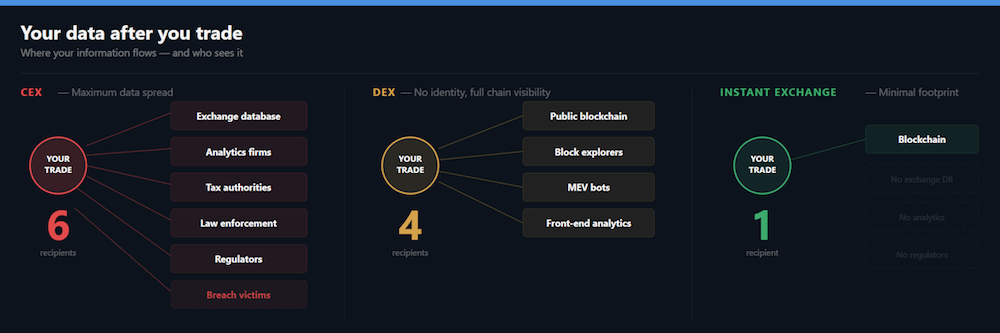
Many experienced traders use all three in combination: a CEX for fiat conversion, a DEX for DeFi participation, and an instant exchange for private cross-chain swaps. The key is understanding what each model exposes and making deliberate choices rather than defaulting to convenience.
The Bottom Line
The honest answer to “which is actually private?” is that none of them are perfectly private, but they fail in very different ways, and those differences matter.
CEXs know exactly who you are and share that information with regulators by design. DEXs don’t know who you are, but the blockchain remembers everything your wallet does. Instant non-custodial exchanges minimize both identity exposure and on-chain traceability, but they require trust in the platform’s execution.
The trajectory is also clear. Regulation is expanding, blockchain analytics are improving, and the window for easy anonymous trading is narrowing. The users who maintain meaningful privacy in 2026 and beyond won’t be the ones who found a single perfect platform — they’ll be the ones who understood the trade-offs, combined tools intelligently, and practiced consistent operational discipline.
Privacy in crypto was never a feature someone else could give you. It was always a practice. That hasn’t changed. What’s changed is the cost of not taking it seriously.
Frequently Asked Questions
What’s an “instant non-custodial exchange” and how is it different from a DEX? An instant non-custodial exchange routes your swap through a liquidity layer without smart contract interactions tied to your wallet. You send crypto to a deposit address, receive converted funds at your wallet: no account, no KYC, no on-chain contract call. On a block explorer, it looks like two regular transfers. A DEX swap leaves a distinctly traceable smart contract interaction pattern.
Is using a no-KYC exchange actually legal? Using a no-KYC exchange is legal in most jurisdictions. The obligation that applies regardless of platform is tax reporting — capital gains are taxable whether or not a platform reports you. The legal risk rises specifically when no-KYC platforms are used to evade taxes or circumvent sanctions, not from privacy-motivated trading itself.
Why did Uniswap block wallets if it’s supposed to be decentralized? Uniswap the protocol is decentralized and uncensorable. Uniswap Labs’ front-end at app.uniswap.org is not — they’ve blocked wallets flagged by analytics providers, including 250+ Tornado Cash addresses. Most users never interact with the protocol directly, only through the front-end. Decentralized protocol and decentralized user experience are not the same thing.
Can Chainalysis actually trace my Uniswap trades back to me? Yes, if your wallet ever connected to a KYC platform. Chainalysis traces fund flows through DEX swaps, bridges, and mixers, clustering wallet addresses across chains. A wallet that once withdrew from Binance carries that identity link into every subsequent trade. Wallet hygiene, never reusing a wallet that touched a KYC exchange, is the only practical mitigation.
Isn’t it a problem that a CEX hack leaks my passport photo? CEX breaches expose identity data, not just funds. Over $2 billion was lost to CEX hacks in the past year, and KYC documents for millions of users go with it. Non-custodial platforms eliminate this risk structurally — with no account database, there is no identity data to breach.
Why use an instant exchange instead of a bridge + DEX swap? An instant exchange collapses a bridge interaction, source chain transaction, destination chain transaction, and DEX swap into two simple wallet transfers. The on-chain footprint is cleaner, fees are lower, and execution is faster. The trade-off is trusting the platform’s routing layer rather than interacting directly with audited contracts.
What’s the real difference between “no KYC” on a CEX vs a DEX? A no-KYC CEX is a centralized company that chooses not to require ID — it still holds your IP, email, and trading history, and can change its policy under regulatory pressure. A DEX structurally cannot collect identity data because no company operates it. The failure modes differ: a no-KYC CEX keeps trades off the public ledger but retains operational data; a DEX exposes everything on-chain but stores nothing about you.
Disclaimer: This article is for informational purposes only and does not constitute financial, legal, or investment advice. Cryptocurrency trading carries significant risk. Users should research applicable regulations in their jurisdiction before using any exchange platform. Always conduct your own due diligence.
Start a Cryptocurrency exchange
Try our crypto exchange platform
Disclaimer: Please keep in mind that the content of this article is not financial or investing advice. The information provided is the author’s opinion only and should not be considered as direct recommendations for trading or investment. Any article reader or website visitor should consider multiple viewpoints and become familiar with all local regulations before cryptocurrency investment. We do not make any warranties about reliability and accuracy of this information.
Read more
EOS is definitely on the list of the strongest and most stable projects in the crypto world. Despite the fact that the currency entered the market less than 3 years ago, it consistently occupies one of the top 10 places in the rating for project capitalization. it is often called the “main competitor of Ethereum”. […]
XRP price prediction 2026-2027: bear, base, and bull scenarios with ranges and named sources, the resolved SEC case, live spot ETFs, and can XRP reach $10?
In this article we will talk about Ripple (XRP) and its price prediction. What is Ripple (XRP) Ripple is a San Francisco-based startup that was launched in 2012 by Ripple Labs as a global network both for cross-currency and gross payments. Ripple history began in 2004 with the discussions around the digital coin in the […]
You may well think that an article dedicated to a Tether price prediction or the Tether price in general is a little bit strange — it is a stablecoin after all. However, the price of Tether does fluctuate significantly, although it is nowhere near as volatile as non-stablecoin cryptos. This means that staying up to […]
In the article we share our vision at Zcash cryptocurrency main features and add several price predictions. As cryptocurrencies gain global acceptance and decentralisation slowly enters our lives, privacy becomes the main concern when talking about blockchain adoption. It is no secret that distributed ledger is by far the most secure and transparent technology ever […]
Chiliz coin (CHZ) offers a compelling opportunity for traders interested in the intersection of blockchain technology and sports. By enabling fans to influence team decisions through the Socios app, Chiliz directly monetizes fan engagement and connects with major sports teams like Juventus and Paris Saint-Germain. These partnerships not only enhance the platform’s visibility but also […]