
 Linda Larsen
Table of Contents
KuCoin is a legitimate, large cryptocurrency exchange — not a scam. Operating since 2017, it lists 1,000+ coins, charges around 0.10% spot fees, and publishes Proof of Reserves above 100% on major assets, with BTC at 109% and ETH at 117% in the September 2026 snapshot. But it now requires mandatory KYC and holds your funds as a custodian. This review covers what’s real, what’s risky, and who it does and doesn’t fit — including its full US exit.
TL;DR — Is KuCoin Legit or a Scam?
Verdict: legit, not a scam — with real caveats. KuCoin is a real exchange (since 2017, 1,000+ coins, ~0.10% spot fees, cold storage, Proof of Reserves above 100% on major assets per the September 2026 snapshot).
- The strengths: deep altcoin selection, genuinely low trading fees, a strong security architecture, public Proof of Reserves, and a full recovery from its 2020 hack.
- The caveats: mandatory KYC since August 2023, a custodial model (KuCoin holds your keys), a complete US exit (January 2025, made permanent in March 2026), and a Trustpilot complaint cluster around account freezes, forced KYC at withdrawal, and dormancy fees.
If the caveats are dealbreakers for you, the alternative isn’t a “better KuCoin” — it’s a different kind of tool. More on that below.
Is KuCoin a Scam? (Why People Ask)
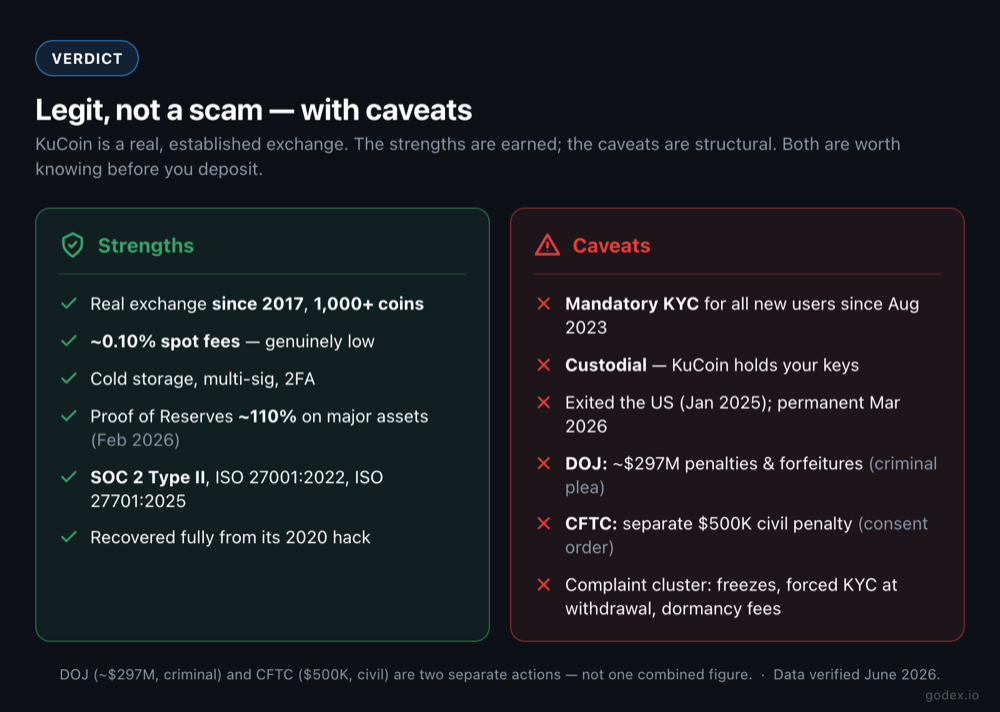
No. KuCoin is not a scam. It is a real, operational exchange that has run since 2017, serves millions of users, and publishes on-chain Proof of Reserves. The “scam” question comes from specific, documentable friction — not fraud.
So why does the question keep trending? A few reasons, all real and all worth knowing before you deposit:
- The 2020 hack. Attackers stole roughly $280 million in 2020; KuCoin recovered about 84% on-chain, and insurance covered the rest, so no users lost funds (CoinDesk ).
- The 2025 US case. In January 2025, KuCoin’s operator pleaded guilty to running an unlicensed money-transmitting business and agreed to roughly $297 million in penalties and forfeitures. A guilty plea attached to a brand name reads, to a skeptical searcher, like trouble.
- A Trustpilot complaint cluster. Documented user complaints center on account freezes, dormancy fees, forced KYC at the withdrawal stage, and slow support. Trustpilot has also posted a review-manipulation notice on the page at points.
None of that makes KuCoin a scam. It makes it a large custodial exchange with regulatory history and a normal volume of unhappy users. The honest read: legit company, real complaints worth knowing about first.
Is KuCoin Safe to Use in 2026?
Yes, KuCoin is technically safe to use in supported regions when you enable its security features — but “safe” depends on what you’re worried about. Its security architecture is strong; its custody model and regulatory exposure are the real risks.
On the technical side, KuCoin checks the boxes you’d expect from a top-tier exchange:
- Cold storage and multi-signature wallets for the bulk of held funds.
- Two-factor authentication (2FA), anti-phishing codes, and withdrawal whitelists at the account level.
- Proof of Reserves at ~110% on major assets, with BTC at 109% and ETH at 117% in the September 2026 snapshot, verifiable via Merkle-tree attestation.
- SOC 2 Type II, ISO 27001:2022, and ISO 27701:2025 certifications, plus an AAA rating on CER.live — among the strongest independent security postures of any major exchange.
Then the honest “but.” KuCoin is custodial — you do not hold your own keys. While your coins sit on the exchange, they can be frozen, restricted, or geo-locked by policy or court order, and they are exposed to whatever happens to the platform itself. This isn’t only a criminals’-problem: the account-freeze and forced-KYC-at-withdrawal complaints below come from ordinary users who got walled at the exit. That is the structural risk the 2020 hack illustrated: the security held up and funds were recovered, but the coins were the exchange’s responsibility, not yours, for the duration.
So distinguish two questions. Is the technology safe? Yes — among the stronger setups in the industry. Is your money fully under your control? No — not while a custodian holds it. “Safe” here means “well-secured, with named caveats,” not “100% safe.”
Does KuCoin Require KYC?
Yes. KuCoin has required mandatory KYC for all new users since August 31, 2023. New accounts must complete identity verification — a government ID plus a facial scan — to deposit, trade spot or futures, or use most products. Unverified legacy accounts are restricted to sell and redeem actions only.
This is the single fact that breaks the old 2021 framing of KuCoin as a “no-KYC option.” That framing was accurate then; it is not accurate now. A few specifics for 2026:
- Unverified legacy accounts face reduced withdrawal limits, set at 1 BTC per 24 hours in a 2021 KuCoin notice, and cannot place new buy orders.
- Dormancy fees now apply to inactive non-KYC and non-KYB accounts; accounts that complete verification are exempt. The signal is plain: verify or pay — the policy nudges holdouts toward handing over an ID.
- Some users report being prompted for KYC at the withdrawal stage specifically — verification requested after funds are already on the platform rather than at signup.
If your reason for using a no-account exchange was avoiding exactly this, the practical takeaway is below, in the contrast section — not here. Here, the point is simply factual: KuCoin is a KYC exchange in 2026.
Can US Residents Use KuCoin?
No. KuCoin exited the US market in January 2025 after pleading guilty to operating an unlicensed money-transmitting business and agreeing to roughly $297 million in penalties and forfeitures. In March 2026, a CFTC consent order made the US ban permanent. US residents cannot legally use the platform.
The detail matters here, because two separate enforcement actions are easy to conflate:
- The DOJ case (January 2025). KuCoin’s operating entity, Peken Global Limited, pleaded guilty to running an unlicensed money-transmitting business. The total exposure was roughly $297 million in penalties and forfeitures, settled with the Department of Justice in the Southern District of New York: about $184.5 million in forfeiture plus a criminal fine of about $112.9 million. As part of the plea, KuCoin agreed to exit the US market for at least two years.
- The CFTC case (March 2026). A federal court approved a separate CFTC consent order carrying a $500,000 civil penalty and a permanent bar on serving US participants unless KuCoin registers as a foreign board of trade — which it has not. This converted the earlier temporary withdrawal into an indefinite ban.
To be precise: the $297 million is the DOJ figure; the $500,000 is the separate CFTC penalty. They are different actions with different legal weight — a criminal guilty plea versus a civil consent order — and should not be combined into a single number. As of October 2026, this is a live, settled status: US residents are barred. Other regions differ: KuCoin registered with AUSTRAC as a digital currency exchange in Australia in November 2025, and its EU entity, KuCoin EU Exchange GmbH, received a MiCA authorisation from Austria’s FMA on 27 November 2025, although the FMA’s May 2026 notice said commencement of business operations remained prohibited until outstanding governance conditions are met.
How Much Does KuCoin Charge? (KuCoin Fees in 2026)
KuCoin’s trading fees are genuinely low: around 0.10% spot maker and taker, roughly 0.02%/0.06% futures maker/taker, with up to a 20% discount when fees are paid in KCS, KuCoin’s native token.
This is a real KuCoin win, and it’s worth saying plainly: that 0.10% spot fee is cheaper than the swap margin on an instant non-custodial exchange — including Godex, whose BTC→ETH margin runs roughly 1.67–2.14% depending on volume. Low trading fees are a structural advantage of the centralized order-book model, where market makers compete on price. An instant swap doesn’t operate that way and doesn’t compete on that number. If raw trading cost is your only metric, a high-volume CEX like KuCoin will win it.
One honest footnote on that number: the 0.10% is the trading cost. It doesn’t price in handing over your ID and your keys — the custody and KYC you accept to get it. For a one-off swap, that’s the part of the bill that doesn’t show up on the fee schedule.
There’s also a coin-breadth asterisk. KuCoin’s 1,000+ listing is genuinely deep, but privacy coins sit under delisting pressure across centralized venues — Monero (XMR) in particular has been pulled or restricted on exchange after exchange — and a non-custodial swap is one of the few easy ways left to move XMR.
KuCoin Pros and Cons (Honest Summary)
Pros
- 1,000+ coins and deep altcoin liquidity
- ~0.10% spot fees — genuinely low
- Cold storage, multi-signature, and 2FA
- Proof of Reserves above 100% on major assets, September 2026 snapshot
- Recovered fully from its 2020 hack — no net user loss
- Order books, futures, leverage, and trading bots
Cons
- Mandatory KYC for all new users since August 2023
- Custodial — you do not hold your own keys
- Exited the US; permanently barred as of March 2026
- Documented complaints: account freezes, forced KYC at withdrawal, dormancy fees
- Ongoing regulatory overhang
The pros are real, and they come first because they’re earned. KuCoin is a capable, established trading platform. The cons aren’t disqualifying for most users — but three of them (KYC, custody, geo-gating) are structural, not bugs that get patched. That distinction is the whole point of the next section.
KuCoin vs a Non-Custodial Swap — A Different Tool for a Different Need
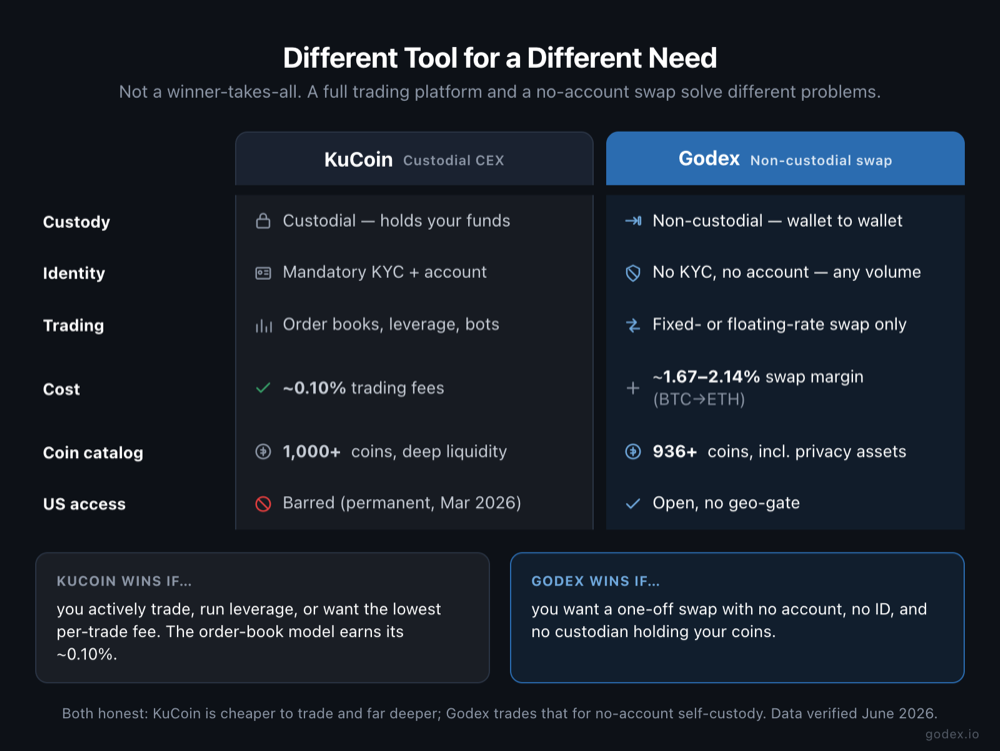
KuCoin and a non-custodial instant swap solve different problems. KuCoin is a full trading platform — order books, leverage, low spot fees, 1,000+ coins. A non-custodial swap does one thing: move crypto-to-crypto without an account or identity file. If your only hesitation about KuCoin is the KYC, the account, or a custodian holding your coins, that’s a preference KuCoin can’t serve by design — and a swap can.
Godex.io is a non-custodial instant swap operating since 2017. It supports 936+ coins, requires no registration, keeps ID checks out of the standard swap flow, sets no upper volume limit, and offers both fixed-rate and floating-rate swap modes. Like other services, it runs risk-based AML checks and may ask for more information on a flagged transaction. Processing time is 5–30 minutes after the deposit is received.
Here’s the honest concession: a swap like Godex won’t give you KuCoin’s order books, leverage, trading bots, ~0.10% fees, or coin depth — and it shouldn’t pretend to. What it offers instead is narrow and specific:
- No account and no email — if your hesitation is signing up at all, there’s nothing to register and nothing that can be locked out of.
- No ID in the standard flow — if your hesitation is handing over an ID, ID is not part of the standard swap flow, whether you swap $1,000 or $100,000. Like other services, Godex runs risk-based AML checks and may ask for more information on a flagged transaction, but Godex doesn’t hold a stored balance that a later check could lock, so a surprise ID request won’t surface at the withdrawal stage.
- Funds never held — if your hesitation is a custodian holding your coins, they move wallet-to-wallet; there’s no custodial balance to freeze.
- A fixed-rate option — the rate you see at the start is the rate you get, even if the market moves during processing.
This isn’t “KuCoin bad, Godex good.” It’s matching the tool to the need. If you want to actively trade, run leverage, or chase the lowest per-trade fee, a CEX is the right tool. If your priority is a one-off swap without filing your identity or trusting a custodian, an instant swap is. For more options in that second category, see our guides to crypto exchanges that don’t require KYC and the best non-KYC crypto exchanges. And if you’re vetting custodial security more broadly, our Coinbase Wallet safety analysis covers the same questions for a different platform.
One note worth stating once: godex.io is the only official domain. A lookalike at godex.pro is a confirmed scam — bookmark the real one.
KuCoin at a Glance (2026)
Data verified October 2026. Review published on the Godex blog; readers should verify platform details independently. Competitor data sourced from each platform’s published policy and third-party reviews.
| Dimension | KuCoin (2026) | Honest read |
|---|---|---|
| Legitimacy | Real exchange since 2017, 1,000+ coins | Legit, not a scam |
| Fees | ~0.10% spot; 0.02%/0.06% futures; 20% KCS discount | Genuinely cheap — a real win |
| Security | Cold storage, multi-sig, 2FA, PoR above 100%, Sept 2026; SOC 2 Type II, ISO 27001:2022, ISO 27701:2025 | Strong technically |
| 2020 hack | ~$280M stolen, ~84% recovered + insurance | Recovered; custodial risk is real |
| KYC | Mandatory for new users since Aug 2023 | The privacy and account cost |
| Custody | Custodial — KuCoin holds your funds | You don’t hold your keys |
| US access | Exited Jan 2025; permanent CFTC bar Mar 2026 | Hard blocker for US readers |
| Complaints | Freezes, forced KYC at withdrawal, dormancy fees | Real friction, reported fairly |
Frequently Asked Questions
Is KuCoin legit?
Yes. KuCoin is a real cryptocurrency exchange operating since 2017, with 1,000+ coins, around 0.10% spot fees, and public Proof of Reserves above 100% on major assets, with BTC at 109% and ETH at 117% in the September 2026 snapshot. It is not a scam, though it carries custodial and regulatory risks worth understanding before you deposit.
Is KuCoin safe in 2026?
In supported regions, yes — with 2FA enabled. Its security is strong: cold storage, multi-signature wallets, and verifiable Proof of Reserves. The caveats are that it’s custodial (it holds your keys) and has been permanently barred from the US market as of March 2026.
Does KuCoin require KYC?
Yes — mandatory for all new users since August 31, 2023. You must verify your identity with a government ID plus a facial scan to deposit, trade, or use most products. Unverified legacy accounts are limited to sell and redeem orders, and inactive non-KYC accounts now incur dormancy fees.
Can US residents use KuCoin?
No. KuCoin exited the US in January 2025 after a roughly $297 million DOJ settlement, and a separate CFTC consent order in March 2026 (a $500,000 civil penalty) made the bar permanent. US residents cannot legally access the platform.
What happened with the KuCoin 2020 hack?
Attackers stole roughly $280 million in 2020. KuCoin recovered about 84% of the funds on-chain, and insurance covered the remainder, so no users lost money. It’s one line of history now — but it illustrates the custodial risk of any exchange holding your keys.
What’s a no-KYC alternative to KuCoin?
Non-custodial instant swaps such as Godex let you trade crypto-to-crypto with no account and no ID in the standard swap flow, with funds never held by the platform; like any service, they may run risk-based AML checks on flagged transactions. They don’t offer order books, leverage, or KuCoin’s low spot fees — they’re a different tool for users whose priority is privacy and self-custody.
Start a Cryptocurrency exchange
Try our crypto exchange platform
Disclaimer: Please keep in mind that the content of this article is not financial or investing advice. The information provided is the author’s opinion only and should not be considered as direct recommendations for trading or investment. Any article reader or website visitor should consider multiple viewpoints and become familiar with all local regulations before cryptocurrency investment. We do not make any warranties about reliability and accuracy of this information.
Read more
Chiliz coin (CHZ) offers a compelling opportunity for traders interested in the intersection of blockchain technology and sports. By enabling fans to influence team decisions through the Socios app, Chiliz directly monetizes fan engagement and connects with major sports teams like Juventus and Paris Saint-Germain. These partnerships not only enhance the platform’s visibility but also […]
The exponential growth of Bitcoin Satoshi Vision (BSV) against the general bear trend on the cryptocurrency market in autumn 2019 has impressed the community. Due to the increasing market capitalization, the newly emerged altcoin was ranked 5th on CoinMarketCap and managed to maintain its high position at the beginning of 2020. In the article we […]
EOS is definitely on the list of the strongest and most stable projects in the crypto world. Despite the fact that the currency entered the market less than 3 years ago, it consistently occupies one of the top 10 places in the rating for project capitalization. it is often called the “main competitor of Ethereum”. […]
XRP price prediction 2026-2027: bear, base, and bull scenarios with ranges and named sources, the resolved SEC case, live spot ETFs, and can XRP reach $10?
In this article we will talk about Ripple (XRP) and its price prediction. What is Ripple (XRP) Ripple is a San Francisco-based startup that was launched in 2012 by Ripple Labs as a global network both for cross-currency and gross payments. Ripple history began in 2004 with the discussions around the digital coin in the […]
You may well think that an article dedicated to a Tether price prediction or the Tether price in general is a little bit strange — it is a stablecoin after all. However, the price of Tether does fluctuate significantly, although it is nowhere near as volatile as non-stablecoin cryptos. This means that staying up to […]