
 Alex Tamm
Table of Contents
Seventy-three cryptocurrency exchanges delisted Monero in 2025. Binance, Kraken, OKX, and Poloniex all removed XMR from their platforms or restricted access in key jurisdictions. Kraken pulled Monero for EEA users ahead of EU MiCA enforcement. Poloniex delisted it globally, citing pressure from the U.S. Treasury.
Monero’s on-chain transaction volume stayed above pre-2022 levels through all of it.
The people who want XMR still get it. They’ve just had to change where they look. This guide covers how: no registration, no ID checks, no bank approval needed, whether you’re swapping from Bitcoin, stablecoins, or another altcoin.
Why Monero Remains the Privacy Standard in 2026
Monero (XMR) is a cryptocurrency that makes all transactions private by default — sender identity, recipient identity, and amount are all concealed at the protocol level. No other top-20 cryptocurrency offers this by default. Bitcoin, Ethereum, and most altcoins publish full transaction histories on a public ledger that anyone can inspect.
As of June 2026, XMR trades around $338, with a market cap near $6.35 billion, which puts it in roughly the top 20 by market cap. It’s held that position through years of delistings — which tells you something about who’s buying it and why.
The demand comes from specific places. Journalists protecting financial sources. People in countries where asset seizure is a real risk. Anyone who has looked up what chain analysis firms like Chainalysis and Elliptic can reconstruct from Bitcoin’s public ledger and decided they’d prefer their finances to stay opaque.
How Monero’s privacy actually works
Three cryptographic mechanisms stack together to make XMR transactions opaque:
- Ring signatures — your transaction is bundled with several decoy outputs from the blockchain. The network can verify the transaction is valid, but outside observers cannot determine which output is yours.
- Stealth addresses — every payment generates a one-time, single-use address on the recipient’s side. No two payments to the same wallet are publicly linked, even if you receive XMR repeatedly.
- RingCT (Ring Confidential Transactions) — transaction amounts are hidden using Pedersen commitments, a cryptographic technique that lets the network confirm funds exist and are valid without revealing their value.
All three apply to every Monero transaction, automatically. There’s no transparent mode, no opt-in privacy. This is what separates XMR from privacy-optional coins like Zcash, where the vast majority of transactions remain fully transparent because users never activate the shielded feature.
Why Buying XMR Without KYC Is Getting Harder — and Why It Still Works
The Financial Action Task Force (FATF) recommends that virtual asset service providers apply enhanced due diligence to privacy coins — assets that block the “travel rule,” which requires exchanges to pass identifying sender and recipient information with each transaction. Monero, by design, makes that impossible.
Centralized exchanges have largely complied, treating delisting as the path of least resistance. The EU’s MiCA framework, which came into force in late 2024, codified similar expectations. Proposed anti-money laundering rules would require all custodial exchange operators to remove privacy coins by July 2027.
Centralized exchanges are VASPs: they hold customer funds, maintain account balances, and are subject to financial licensing requirements. Non-custodial platforms work differently. They never hold your funds. No deposit account, no user balance, no identity to register. Transactions pass directly between user wallets, with the platform routing rather than custodying.
That puts non-custodial swap platforms in a different regulatory category. And since no account is ever created, there’s no identity to collect.
This is where most XMR trading has moved. Platforms like Godex, a non-custodial instant exchange running since 2017, support Monero natively, require no registration, and process swaps in minutes. They didn’t set out to fill this role — the space opened up when the bigger exchanges stepped back.
Your Options for Getting XMR Without Verification
Not all no-KYC methods work the same way. The right choice depends on whether you’re starting from crypto or fiat, how much privacy you need, and how much technical setup you’re willing to do.
| Method | Speed | Privacy Level | Needs Fiat? | Technical Skill |
| Non-custodial instant swap (e.g., Godex) | 5–30 min | High | No | Low |
| P2P marketplace (e.g., Haveno via Tor) | Minutes–hours | Very high | Yes | Medium |
| Atomic swap (e.g., BasicSwap DEX) | 30 min–2 hours | Maximum | No | High |
| Bitcoin ATM → swap to XMR | 15–60 min | Medium | Yes | Low |
| Buy BTC/LTC with card → swap to XMR | 10–40 min | Medium | Partial | Low |
What each involves:
- Non-custodial instant swap — You send one crypto (Bitcoin, USDT, ETH, or hundreds of others) and receive XMR directly in your wallet. No account, no KYC at any step. The fastest option for anyone who already holds crypto.
- P2P marketplace — You trade directly with another user using cash, bank transfer, or gift cards. Haveno, which runs over the Tor network, is the primary no-KYC P2P option for Monero. More private for fiat entry, but requires finding a counterparty.
- Atomic swap — A trustless protocol where two blockchains exchange assets simultaneously, with no intermediary involved at any point. Technically demanding; genuinely the most private option for those who want it.
- Bitcoin ATM → swap — Purchase Bitcoin from a physical ATM (many still operate below ID thresholds for small amounts), then swap BTC for XMR on a non-custodial platform.
- Buy crypto with card → swap — Acquire a standard asset like Litecoin or USDT through a fiat on-ramp, then swap for XMR. KYC applies to the first step; the swap itself remains private.
For most people with existing crypto holdings, a non-custodial instant swap is the most direct path: no account, no setup, and XMR in your wallet within 30 minutes.
How to Buy Monero Instantly: Step-by-Step
The setup takes under five minutes. Most swaps complete within 5 to 30 minutes of deposit confirmation, depending on which crypto you’re sending.
Before you start, you need two things: any supported cryptocurrency to send (Bitcoin, ETH, USDT, LTC, and hundreds of others work), and a Monero wallet address to receive your XMR.
Get a Monero wallet first. The official wallet at getmonero.org is the most widely audited option. Feather Wallet (desktop, lightweight) and Cake Wallet (iOS/Android) are well-regarded alternatives. Do not use an exchange address as your receive address — holding XMR on an exchange defeats the purpose, and many exchanges that still technically list Monero apply restrictions to withdrawals.
Step 1: Go to a non-custodial swap platform
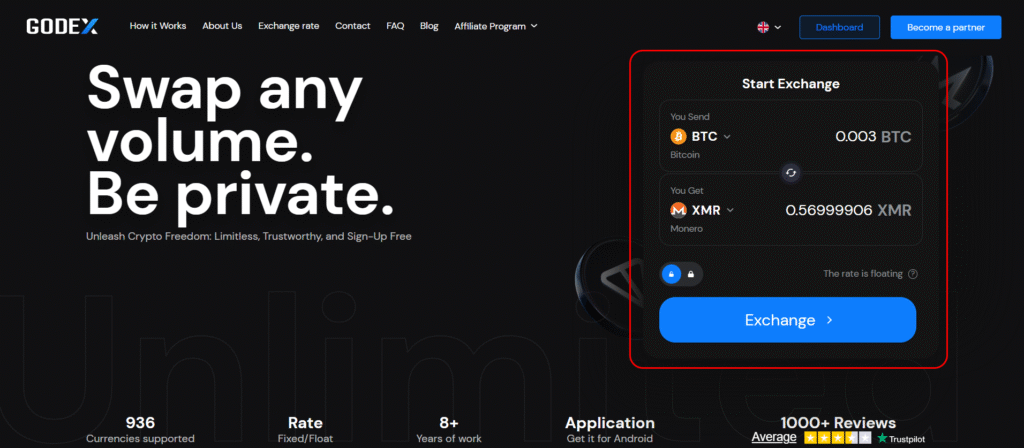
Navigate to Godex or a comparable non-custodial platform. No sign-up page will appear because no account is required.
Step 2: Select your trading pair
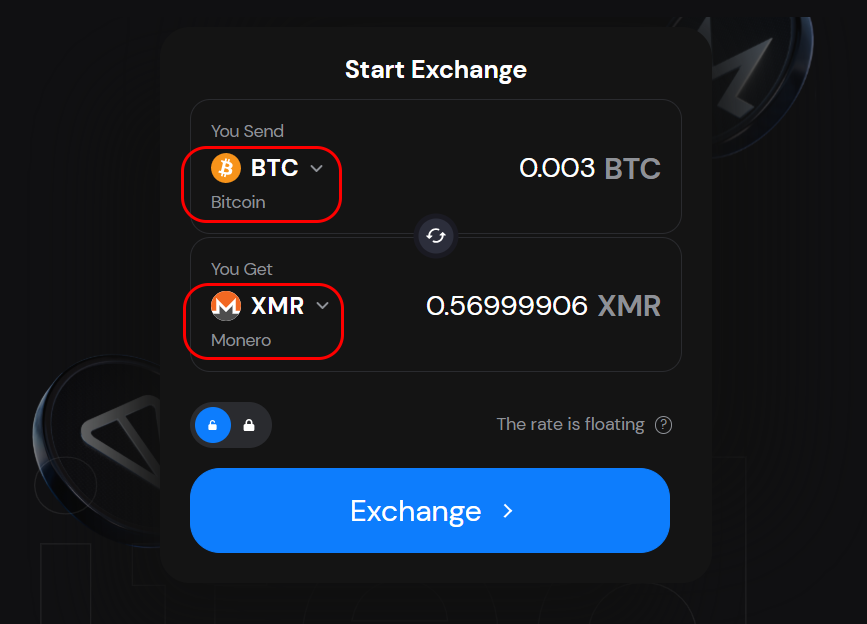
Choose the asset you’re sending in the “You Send” field — say, BTC — and set XMR in the “You Get” field. Enter your amount. The platform will display how much XMR you’ll receive.
Step 3: Choose your rate type
Two options are available on most platforms:
- Fixed rate — the exchange rate locks the moment you confirm the swap. You know exactly how much XMR arrives regardless of price movement while the transaction processes. On Godex, fixed rates are locked for a full 30 minutes.
- Floating rate — the rate adjusts to market conditions at the time your deposit confirms. Generally marginally cheaper in calm markets; can work against you during volatility.

For XMR specifically, fixed rate is worth considering. Monero’s price can move sharply, and a 20-minute wait for Bitcoin confirmations can turn a favorable rate into an unfavorable one. The small premium on fixed rates is usually cheaper than absorbing a sudden swing.
Step 4: Enter your Monero wallet address
Paste your XMR wallet address in the recipient field. Check it twice. Monero wallet addresses are long (95 characters, starting with “4” or “8”), and there’s no way to reverse a swap once it’s submitted.

Step 5: Send your deposit
The platform generates a one-time deposit address. Send your crypto to that address from your own wallet — not from an exchange account. Some exchanges apply additional scrutiny to outbound transfers; sending from your own wallet keeps the process clean and faster.

Step 6: Wait for network confirmations
Bitcoin typically requires 1–3 confirmations before the swap triggers, meaning a minimum 10–30 minute wait at the deposit stage alone. Faster base assets cut this significantly:
- USDT on TRC-20 — confirms in under 2 minutes
- Litecoin (LTC) — confirms in 2–5 minutes
- Ethereum — confirms in 1–3 minutes
If speed is your priority, avoid BTC as the send asset.
Step 7: Receive your XMR
Monero arrives directly in your wallet. No withdrawal step, no email confirmation, no record tied to any identity.
Practical Details Most Guides Skip
The platform’s speed is mostly not the bottleneck — your deposit is. Non-custodial exchanges process the swap almost instantly once your deposit confirms; the waiting is network confirmation time, not the platform. Switch from Bitcoin to USDT/TRC-20 or LTC and the total drops from around 30 minutes to under 10.
Non-custodial swap platforms embed their margin in the exchange rate rather than listing it as a separate fee — around 0.5% on platforms like Godex. The advertised rate can look fine while the actual XMR you receive is lower than expected. Compare the final output amount for a given input, not just the headline rate.
Godex automatically deletes order data after two weeks. No account means no login history; no history means nothing to hand over if someone asks. Worth checking the retention policy of any platform before you transact.
These platforms don’t collect identity data, but your IP is still visible to them unless you route through a VPN or Tor Browser. Closing that gap takes a few minutes of setup.
Frequently Asked Questions
Is it legal to buy Monero without KYC? In most jurisdictions — including the US, EU, and UK — there is no law that prohibits individuals from owning or acquiring Monero. Regulatory restrictions apply to licensed exchange operators, not to end users making transactions. Always verify the rules in your specific country before proceeding.
Can I buy Monero directly with a credit card? Non-custodial swap platforms work crypto-to-crypto only. To use fiat, acquire any standard cryptocurrency (Bitcoin, USDT, ETH) through a fiat on-ramp first, then swap to XMR. The fiat-to-crypto step may involve KYC; the subsequent swap to XMR does not.
Is Monero actually untraceable? Monero transactions are opaque on-chain under standard conditions. Unlike Bitcoin — where chain analysis firms can trace a coin’s entire spending history — Monero’s ring signatures, stealth addresses, and RingCT make it computationally infeasible to determine sender, recipient, or amount from public blockchain data alone. No blockchain analysis firm has demonstrated the ability to reliably trace standard XMR transactions at scale.
What’s the minimum swap amount? Minimums vary by platform and trading pair. On Godex, they’re set dynamically based on current network fees — typically in the $10–$20 equivalent range for BTC-to-XMR swaps. Check at the time of your transaction; minimums fluctuate with Bitcoin fee levels.
How do I verify a swap platform is legitimate? Look for: years of documented operation, non-custodial architecture (the platform doesn’t hold your funds), and independent reputation. Godex has been operating since 2017 and has processed millions of swaps. Check independent reviews on crypto forums and avoid platforms with no verifiable history or transparent fee structure.
The Bottom Line
Seventy-three delistings in a single year didn’t stop Monero. They redirected it — away from compliance-heavy centralized platforms and toward wallet-to-wallet channels that don’t need a middleman keeping records.
Getting XMR in 2026 comes down to three steps: get a self-custody Monero wallet, pick a non-custodial swap platform, and exchange whatever crypto you already hold. No document upload, no approval queue.
The privacy isn’t a feature you configure. It’s the default state of every transaction.
This article is for informational purposes only and does not constitute financial or legal advice. Cryptocurrency regulations vary by jurisdiction — consult local laws before making any transactions.
Start a Cryptocurrency exchange
Try our crypto exchange platform
Disclaimer: Please keep in mind that the content of this article is not financial or investing advice. The information provided is the author’s opinion only and should not be considered as direct recommendations for trading or investment. Any article reader or website visitor should consider multiple viewpoints and become familiar with all local regulations before cryptocurrency investment. We do not make any warranties about reliability and accuracy of this information.
Read more
You may well think that an article dedicated to a Tether price prediction or the Tether price in general is a little bit strange — it is a stablecoin after all. However, the price of Tether does fluctuate significantly, although it is nowhere near as volatile as non-stablecoin cryptos. This means that staying up to […]
In the article we share our vision at Zcash cryptocurrency main features and add several price predictions. As cryptocurrencies gain global acceptance and decentralisation slowly enters our lives, privacy becomes the main concern when talking about blockchain adoption. It is no secret that distributed ledger is by far the most secure and transparent technology ever […]
Chiliz coin (CHZ) offers a compelling opportunity for traders interested in the intersection of blockchain technology and sports. By enabling fans to influence team decisions through the Socios app, Chiliz directly monetizes fan engagement and connects with major sports teams like Juventus and Paris Saint-Germain. These partnerships not only enhance the platform’s visibility but also […]
The exponential growth of Bitcoin Satoshi Vision (BSV) against the general bear trend on the cryptocurrency market in autumn 2019 has impressed the community. Due to the increasing market capitalization, the newly emerged altcoin was ranked 5th on CoinMarketCap and managed to maintain its high position at the beginning of 2020. In the article we […]
EOS is definitely on the list of the strongest and most stable projects in the crypto world. Despite the fact that the currency entered the market less than 3 years ago, it consistently occupies one of the top 10 places in the rating for project capitalization. it is often called the “main competitor of Ethereum”. […]
XRP price prediction 2026-2027: bear, base, and bull scenarios with ranges and named sources, the resolved SEC case, live spot ETFs, and can XRP reach $10?