
 Alex Tamm
Table of Contents
If you’ve tried to trade on Binance lately without completing full identity verification, you already know how that story ends: a locked screen, a stern prompt for your passport, and a selfie. Binance, once the go-to platform for frictionless crypto trading, now enforces mandatory KYC for virtually all account functions, trading, withdrawals, P2P, and beyond. For privacy-conscious traders, that’s a dealbreaker.
The good news? The no-KYC ecosystem is alive, diverse, and more capable than many realize. Whether you’re a retail trader who simply doesn’t want a corporate database holding scans of your government ID, or a seasoned market participant prioritizing financial sovereignty, the alternatives listed below offer real solutions. This guide breaks down the top Binance alternatives with no KYC in 2026, covering instant swap platforms, privacy-first CEXs, decentralized exchanges, and peer-to-peer markets, so you can find the right fit for how you actually trade.
Comparison Table: Top No-KYC Binance Alternatives at a Glance
| Platform | Type | Privacy Stance | Swap Limits | Supported Assets | Custodial? | Best For |
|---|---|---|---|---|---|---|
| Godex | Instant Swap | Privacy-first | No upper limits | 934+ coins | No | Discreet swaps, all sizes |
| GhostSwap | Instant Swap | No KYC | No limits | 1,600+ coins | No | Multi-chain, XMR swaps |
| MEXC | CEX | Optional KYC | 1,000 USDT/day | 1,500+ coins | Yes | High-liquidity spot/futures |
| CoinEx | CEX | Optional KYC | $10,000/day | 700+ coins | Yes | Beginners, DeFi tokens |
| Bybit | CEX | Optional KYC | Limited withdrawal | 300+ assets | Yes | Derivatives, leverage |
| dYdX | DEX (Perps) | No KYC | No limits | Major perp pairs | No | Decentralized derivatives |
| PancakeSwap | DEX (AMM) | No KYC | No limits | BNB Chain tokens | No | BNB ecosystem trading |
| Bisq | P2P / DEX | No KYC | Varies by offer | BTC + select coins | No | Maximum decentralization |
| Hodl Hodl | P2P | Optional KYC | Varies by offer | Bitcoin only | No | Fiat-to-BTC, P2P trades |
| BYDFi | CEX | Optional KYC | Limited withdrawal | 300+ assets | Yes | Beginner-friendly CEX |
Why Binance Is No Longer a Privacy-Trader’s Home
Binance built its empire partly on accessibility, minimal friction, rapid onboarding, and historically light identity requirements. That era is over. Trading on Binance now requires at least intermediate KYC verification, and unverified accounts face strict limitations or essentially no trading access. The platform also enforces service restrictions in several major jurisdictions, including the United States and Canada, as part of its alignment with international sanctions and AML frameworks.
The shift wasn’t arbitrary. Regulators worldwide have tightened the screws on centralized exchanges under FATF guidelines, and Binance, facing scrutiny from the U.S. DOJ, IRS, and other bodies, had little choice but to comply. The result: a platform that now resembles a traditional financial institution more than the disruptive exchange it once was.
For traders who value privacy, this creates a real problem. When your identity is tied to a wallet on a centralized platform, your entire transaction history becomes traceable — not just to the exchange, but potentially to any entity that requests user data. Blockchain analytics firms are increasingly linking on-chain activity to real identities. Once your ID is tied to a wallet, your full transaction history becomes traceable, a level of financial surveillance most people would never accept from a bank.
This is precisely why demand for anonymous Binance alternatives has surged in 2026. Let’s look at who’s actually delivering.
What Makes a Genuinely No-KYC Exchange?
Not every platform that claims “no KYC” actually delivers on it. Before diving into the list, here are the criteria that matter:
- No mandatory identity verification — at least for standard swap sizes and use cases
- Non-custodial operation — your funds aren’t held by the platform
- No forced account creation — email registration at minimum should be optional
- Transparent fee structure — no hidden spreads obscuring the real cost
- Consistent policy — KYC requirements shouldn’t trigger unpredictably mid-swap
- Track record — operational history and community reputation count
With those benchmarks set, here are the ten platforms that genuinely pass the test in 2026.
Top 10 No-KYC Binance Alternatives in 2026
1. Godex — Best Overall Anonymous Instant Swap Platform
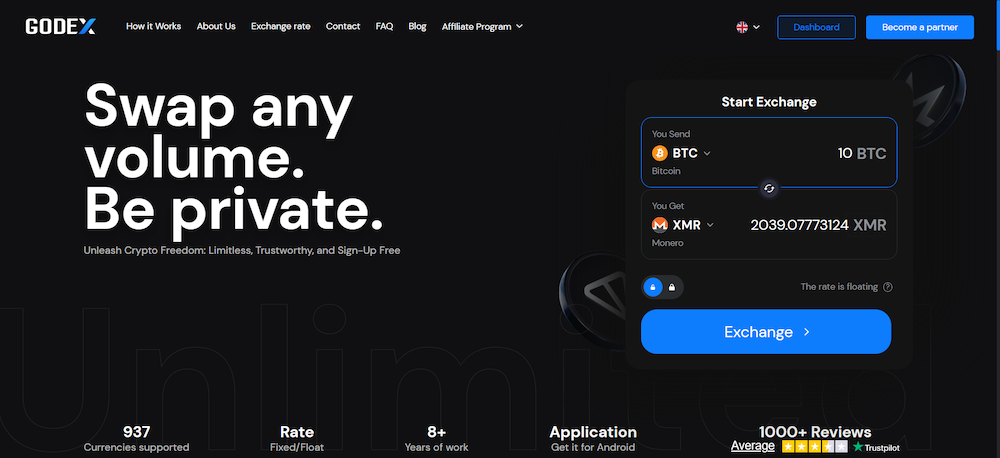
Godex is a non-custodial, privacy-focused crypto swap platform built for traders who want to exchange assets quickly, with minimal friction and maximum discretion. Launched in 2017 and purpose-built around the principle that financial privacy is a right, not a privilege, Godex has quietly established itself as one of the most reliable anonymous Binance alternatives available.
Godex supports 934 cryptocurrencies and is designed as an instant-access exchange — no account dashboard to manage, no identity queue to wait through for routine swaps. Fees are approximately 0.5–0.8%, displayed transparently before you confirm the swap, no surprises. The platform explicitly states no volume ceilings, and has been confirmed to handle transactions up to $15,000 and beyond. Godex is non-custodial, meaning your funds never sit on their platform between origin and destination wallet.
What makes Godex particularly compelling among binance alternatives in 2026 is the combination of fixed-rate swaps (locking your rate for 30 minutes after order creation) and the absence of any upper transaction limits, something most instant swap competitors can’t honestly claim. Godex aggregates rates from major platforms including Binance, Bitfinex, and HitBTC, ensuring competitive pricing across all trading pairs.
- Instant-access swaps with minimal onboarding friction
- Fixed-rate and floating-rate swap options
- 934+ supported cryptocurrencies
- No upper transaction limits
- Non-custodial: funds go directly wallet-to-wallet
- Operating since 2017 with a strong privacy-first track record
For anyone who just wants to swap crypto quietly and move on, Godex is where the search tends to end.
Website: godex.io
2. GhostSwap — Best for Multi-Chain Anonymous Swaps
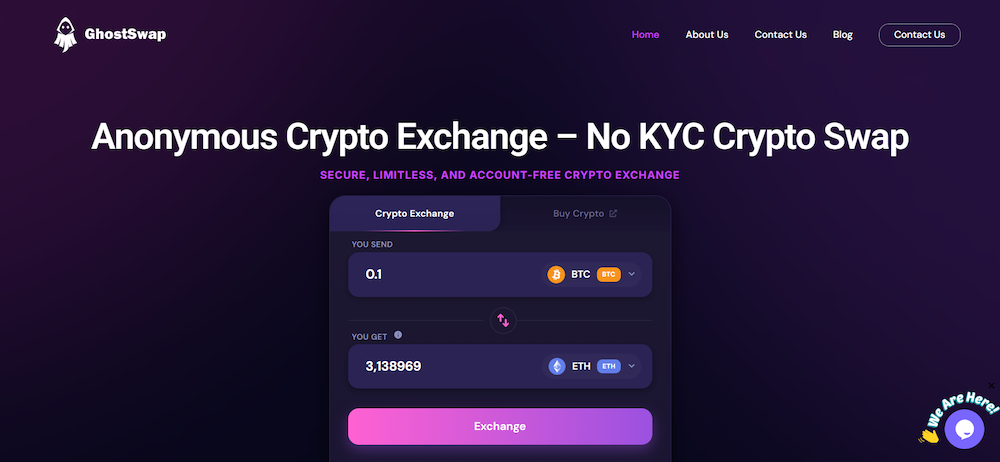
GhostSwap is a fully anonymous, non-custodial swap platform covering 1,600+ cryptocurrencies across 25+ blockchains, with no accounts, no registration, and no KYC requirements. Since launch, GhostSwap has processed over $750 million in trading volume and served more than 1.5 million users worldwide. Users simply choose swap details, enter a receiving address, and complete the exchange, with live status updates throughout.
GhostSwap’s differentiator is its deep multi-chain infrastructure, which makes cross-chain swaps frictionless for users dealing in assets across Ethereum, BNB Chain, Solana, and beyond. The platform also stands out for its dedicated Monero (XMR) swap infrastructure, featuring optimized routing for selected XMR pairs, a notable feature for users who want privacy-coin-level on-chain obfuscation added to their workflow.
- 1,600+ coins, 25+ blockchains
- Fully non-custodial; no account creation required
- Fee spread: 0.2%–1% built into the exchange rate
- Optimized Monero routing for XMR pairs
- Fiat on-ramp available via bank card
Website: ghostswap.io
3. MEXC — Best No-KYC CEX for High-Volume Traders
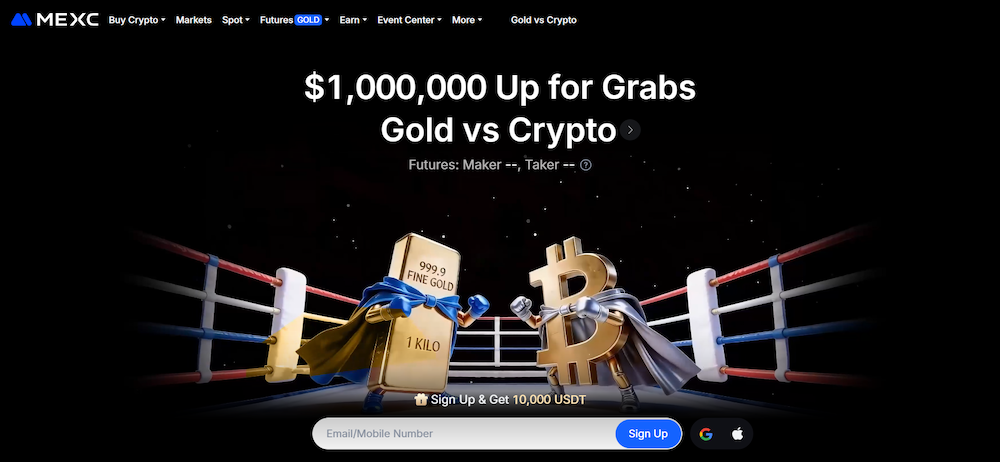
MEXC is a centralized exchange that does not enforce mandatory KYC, making it one of the most liquid no-KYC trading venues available for spot and derivatives. The platform offers three account tiers: unverified, primary KYC, and verified plus. In most regions, the withdrawal limit for unverified users is 1,000 USDT per day.
That daily limit is a real constraint for high-volume activity. But for traders operating within those bounds, MEXC delivers access to hundreds of trading pairs, low maker/taker fees, and a mature trading interface, without a passport scan. It’s a pragmatic middle ground: the liquidity and tooling of a major CEX with minimal identity friction for standard use cases.
- No mandatory KYC for basic trading
- 1,000 USDT/day withdrawal limit for unverified users
- Broad altcoin selection including low-cap tokens
- Futures and spot trading available
- Available to users in most global regions
Website: mexc.com
4. CoinEx — Best No-KYC CEX for Beginners

CoinEx is a privacy-oriented centralized exchange where KYC remains optional, supporting up to $10,000 in daily withdrawals for unverified users. From a security standpoint, CoinEx has implemented robust asset safety measures including 2FA, 100% reserves, cold storage, risk alerts, and multiple withdrawal confirmations.
What sets CoinEx apart in the no-KYC landscape is its transparency. Unlike some exchanges that obscure their no-KYC policies, CoinEx is clear and consistent about its limits, making it a strong option for users who want to buy crypto without KYC and access a wide range of DeFi tokens. The interface is notably beginner-friendly, and the platform has maintained a solid operational record since its 2017 launch.
- KYC optional; $10,000 USD equivalent daily withdrawal limit without it
- 700+ supported coins including DeFi tokens
- 0.1% maker/taker fees (discounts with CET token)
- Third-party fiat on-ramps available (Simplex, Mercuryo)
- Clean, beginner-accessible interface
Website: coinex.com
5. Bybit — Best No-KYC Option for Derivatives Traders
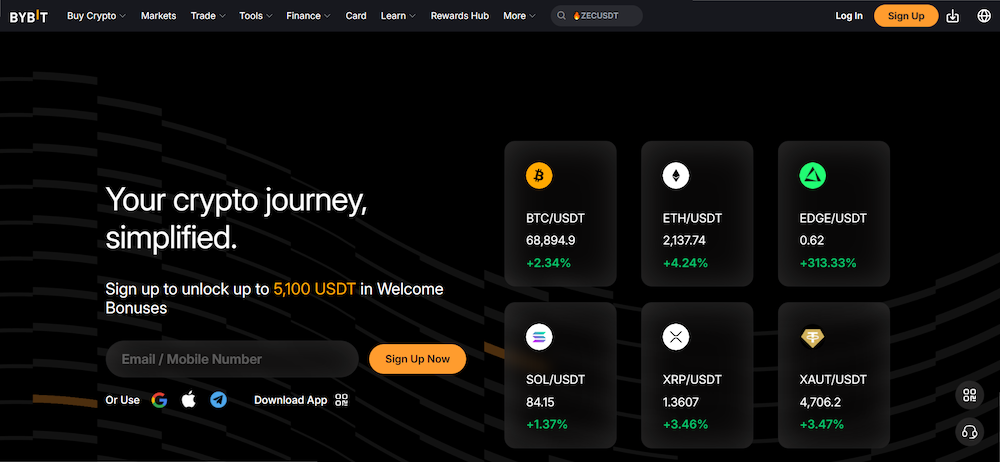
Bybit allows unverified users to register with an email address and access spot and derivatives trading under limited conditions, making it one of the few major derivatives venues with a credible no-KYC tier. Higher-risk products such as P2P, Launchpad, and fiat on-ramps, along with increased withdrawal limits, require verification. Full access typically begins at Standard KYC Level 1, while unverified accounts retain small-value withdrawals.
For active derivatives traders who want leverage exposure without full identity verification for smaller positions, Bybit remains a compelling option. Bybit supports derivatives depth outside of Binance, offering inverse, USDT/USDC-margined, and options contracts with leverage up to 125×, along with built-in copy trading and automation.
- Email registration sufficient for basic spot and derivatives access
- Leverage up to 125× on select contracts
- One of the deepest derivatives order books available without full KYC
- Withdrawal limits apply for unverified accounts
- Strong post-2025 audit cycle and transparency record
Website: bybit.com
6. dYdX — Best Decentralized Derivatives Alternative
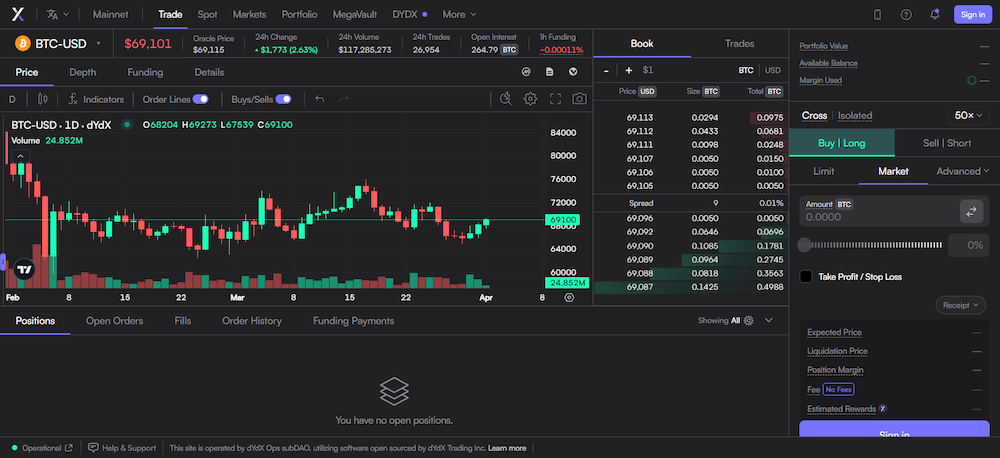
dYdX is a decentralized perpetual futures exchange that allows users to trade directly from a self-custody wallet with no KYC, no account creation, and no identity documents. Built on its own dedicated blockchain (dYdX Chain, a Cosmos-based L1), it’s the closest thing to Binance’s derivatives suite in a fully decentralized format.
Trading on dYdX requires connecting a non-custodial wallet such as MetaMask or Keplr, your wallet address is your identity, and no personal information is ever collected. The tradeoff is that the interface demands more technical familiarity than a centralized platform, and liquidity, while substantial for major pairs, doesn’t yet match Binance’s deepest books.
- Fully decentralized; no KYC, no account required
- Wallet-connected trading (MetaMask, Keplr, and others)
- Perpetual futures with leverage on BTC, ETH, and major altcoins
- Non-custodial by design — you hold your keys
- Note: geo-restrictions may apply depending on your region and interface
Website: dydx.trade
7. PancakeSwap — Best DEX for BNB Chain Tokens
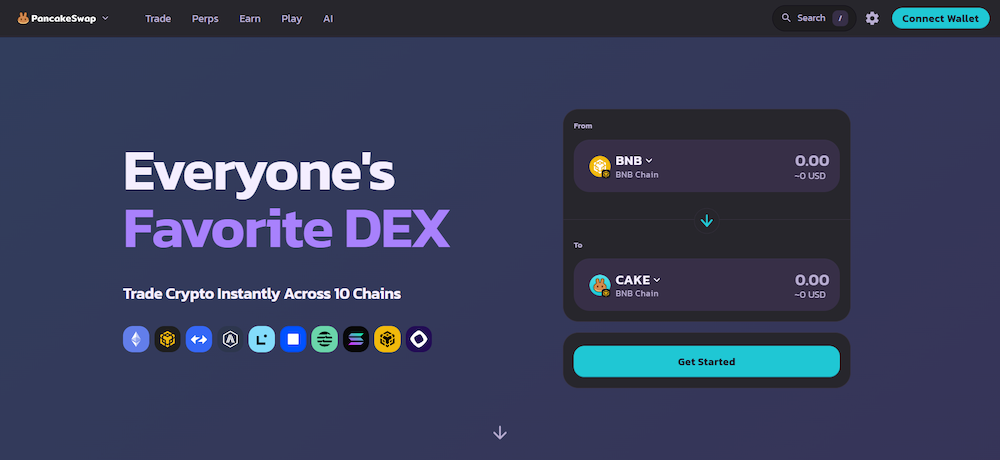
PancakeSwap is the largest decentralized exchange by trading volume on BNB Smart Chain, allowing users to swap tokens directly from a non-custodial wallet with no registration or KYC. It is the most popular decentralized trading platform on the Binance Smart Chain for swapping cryptocurrencies without KYC verification.
For traders focused on BNB Chain-native assets, PancakeSwap delivers deep liquidity for majors and emerging tokens alike, all through a simple AMM interface. Connect a wallet, approve the swap, done. The platform also supports yield farming, liquidity provision, and perpetuals, again, all without identity documents.
- No KYC, no registration — wallet connection only
- Deep liquidity for BNB Chain tokens
- Yield farming, staking, and LP positions available
- Simple AMM interface, accessible to beginners
- Smart contract risk applies as with all DEXs
Website: pancakeswap.finance
8. Bisq — Best for True Peer-to-Peer Privacy
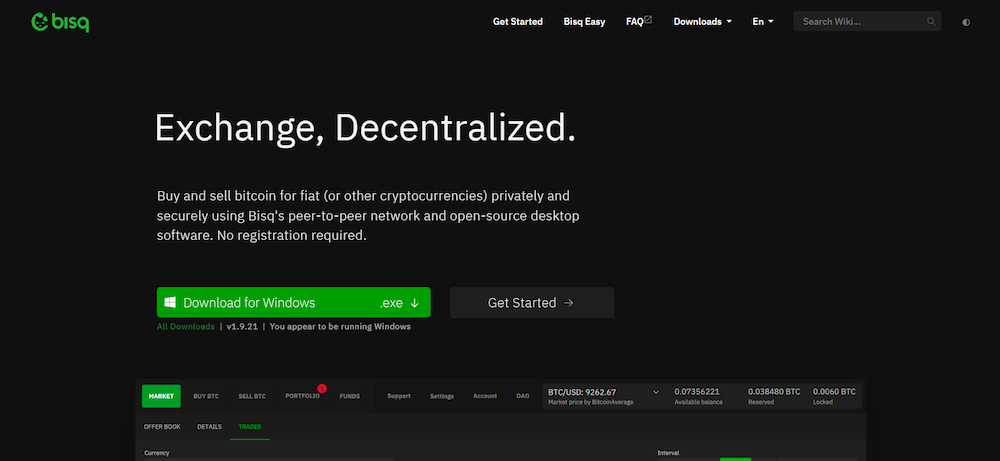
Bisq is a fully open-source, decentralized peer-to-peer Bitcoin exchange that operates without any central server, account registration, or KYC, ever. Terms explicitly state KYC will never be requested, earning it a perfect privacy score among community evaluators. Unlike every other platform on this list, Bisq has no company behind it in the traditional sense — it’s a DAO-governed protocol running on its own network.
Trades occur via encrypted P2P connections, with funds secured in multisig wallets until both parties confirm. The tradeoff is speed and convenience: Bisq supports BTC and select altcoins, trade volumes tend to be smaller, and the desktop application requires more setup than a browser-based swap. But for users who consider anything less than complete decentralization a compromise, Bisq sets the standard.
- Zero KYC — by protocol design, not just policy
- DAO-governed; no central operator that can be coerced
- Supports fiat-to-Bitcoin trades via various payment methods
- Multisig escrow protects both parties
- Requires desktop application installation and some technical comfort
Website: bisq.network
9. Hodl Hodl — Best P2P Platform for Bitcoin-Focused Users
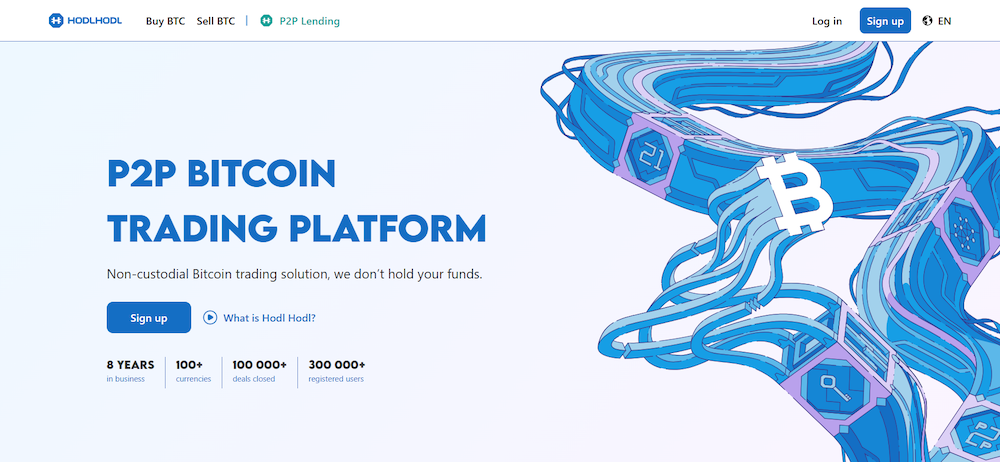
Hodl Hodl is a non-custodial peer-to-peer Bitcoin exchange that connects buyers and sellers directly using multisig escrow, requiring no KYC for most trades. Where Bisq is purely software, Hodl Hodl offers a polished web-based interface that makes P2P trading significantly more accessible while preserving the core privacy advantages of the model.
Sellers set their own terms, including accepted payment methods (bank transfer, cash, gift cards, and more), prices, and trade limits. Buyers browse offers and initiate trades through the platform’s multisig contract system, Hodl Hodl never holds your Bitcoin. For users who need to on-ramp fiat to Bitcoin without a KYC-gated exchange, Hodl Hodl is one of the most practical options available.
- Non-custodial multisig escrow, funds never held by the platform
- No mandatory KYC for peer-to-peer Bitcoin trades
- Wide variety of accepted payment methods
- Web-based interface; no installation required
- Bitcoin-only; not suitable for altcoin trading
Website: hodlhodl.com
10. BYDFi — Best Entry-Level No-KYC CEX
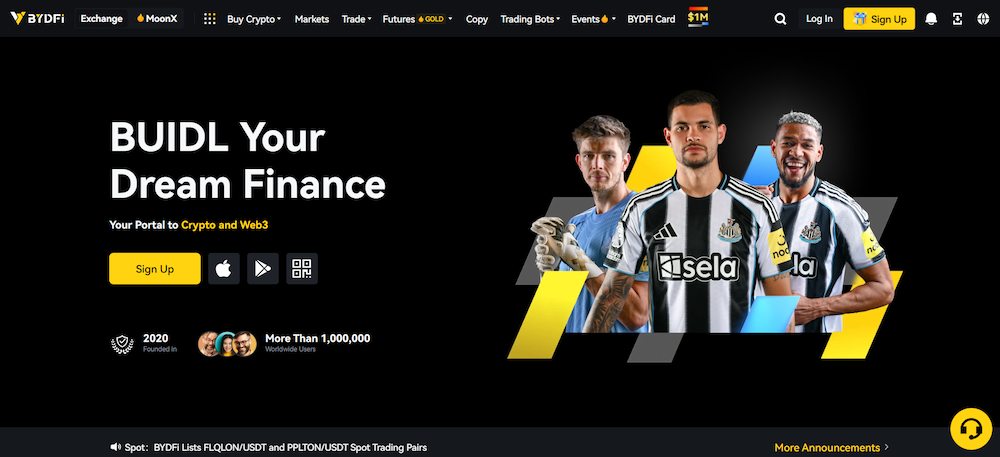
BYDFi is a Singapore-based centralized exchange founded in 2020 that operates an optional KYC model, appealing to traders who want a mainstream CEX experience with minimal identity friction. BYDFi appeals to both newcomers and advanced traders with its low fees and optional KYC model.
BYDFi supports spot trading, futures, copy trading, and a suite of automated tools, giving it a feature profile that competes meaningfully with larger CEXs. For users who want something closer to the Binance experience (a full-featured centralized exchange with a wide asset range) but without the mandatory passport-and-selfie ritual, BYDFi fills that gap at the entry to mid-level trading tier.
- Optional KYC; full features accessible without mandatory verification for basic trading
- Spot, futures, and copy trading available
- Competitive fee structure
- Singapore-based with a growing global user base
- Withdrawal limits apply for unverified accounts
Website: bydfi.com
How to Use No-KYC Exchanges Safely
Choosing a platform without KYC doesn’t automatically mean choosing privacy. On-chain activity is still publicly visible, and blockchain analytics firms are increasingly sophisticated. Here’s how to make the most of what these platforms actually offer:
Use a fresh wallet address for each transaction. Reusing the same address repeatedly creates a traceable pattern that can link your activity even when no personal data was ever submitted to an exchange.
Consider routing through Monero (XMR) for sensitive swaps. Privacy coins like Monero employ ring signatures, stealth addresses, and RingCT to make transactions genuinely untraceable at the protocol level. Privacy-focused platforms like Godex and GhostSwap support BTC↔XMR swaps with a streamlined, low-friction process.
Access via VPN or Tor. Your IP address can be logged even on platforms that collect no identity data. Using a reputable VPN or the Tor browser adds a meaningful layer of network-level privacy.
Avoid moving funds directly from a no-KYC swap to a KYC exchange. This creates a clear on-chain link between your anonymous activity and your verified account, defeating the purpose of using a no-KYC platform in the first place.
Be realistic about withdrawal limits. If you’re operating within $1,000–$5,000 per swap, most instant swap platforms and non-KYC CEX tiers will serve you without friction. Larger volumes may require strategic use of multiple platforms or P2P routes.
Understand that tax obligations don’t disappear. Even when using no-KYC crypto exchanges, most tax authorities have issued clear guidance that crypto is subject to tax, and any attempt to avoid tax on cryptocurrency is a criminal offense with steep penalties. Privacy from exchanges is not privacy from your legal obligations.
The Bottom Line
The narrative that privacy-focused crypto trading is dead isn’t accurate — it’s just that the landscape has changed. Binance’s pivot to full KYC compliance has pushed a meaningful segment of users toward alternatives that put discretion first, and that shift has only accelerated in 2026.
Among the options explored in this guide, Godex stands out as a consistently strong starting point. It’s non-custodial, supports 934+ cryptocurrencies, offers both fixed and floating rates, and imposes no upper transaction limits, all without requiring you to open an account or sit in a verification queue for routine swaps. For traders who want a reliable binance alternative built around privacy-first principles rather than regulatory minimums, that combination is hard to beat.
The right choice ultimately depends on your use case: swap size, asset preferences, and how deeply you prioritize privacy versus convenience. What this list demonstrates is that seeking a binance alternative no KYC is not a compromise, it’s simply a different set of trade-offs, and in 2026, those trade-offs increasingly favor the user.
Frequently Asked Questions
Okay but isn’t “no KYC” just a red flag at this point? Every exchange that promised it eventually got shut down or added verification anyway.
This pattern is real, but the reason matters. Custodial no-KYC exchanges are structurally vulnerable — regulators can pressure them because they hold funds. Non-custodial platforms like Godex have nothing to enforce KYC on: funds go wallet-to-wallet and never touch the platform. DEXs are the same — the protocol can’t collect data. If a no-KYC platform is custodial and centralized, treat it as “no KYC for now.”
Wait — “no KYC” doesn’t actually mean anonymous? My wallet address is still public on-chain…
Correct: blockchain transactions are pseudonymous, not anonymous. No-KYC means the exchange doesn’t link your name to your wallet address in their database — but every transaction is still visible on-chain to anyone with a block explorer. Reusing the same wallet across swaps creates a traceable fingerprint. Fresh addresses per transaction, or routing through Monero, are the only ways to add real on-chain privacy on top of no-KYC access.
Do I still owe taxes when trading on a no-KYC exchange? The IRS doesn’t know about it…
Yes — crypto gains are taxable regardless of whether an exchange collected your ID. The IRS and most tax authorities have issued explicit guidance on this. “The exchange didn’t know who I was” is not a legal defense. Blockchain analytics firms increasingly match wallet addresses to real identities through secondary data points, and enforcement has intensified since 2024. No-KYC trading and tax obligations are completely separate questions.
Platforms always say “no upper limits” — but people report swaps getting flagged at $5K. What’s actually true?
“No upper limit” means no published threshold, not that internal AML flags don’t exist. Some platforms quietly pause large or unusual-pattern transactions even without a formal KYC policy. Godex has documented handling transactions above $15,000 without issue. For any significant amount, test with a smaller transaction first and verify the platform’s current policy directly — not just marketing copy.
If no-KYC exchanges keep getting shut down, is the whole space just dying?
The custodial no-KYC CEX model is under pressure — that part is accurate. What’s surviving is the layer that’s structurally hard to regulate: non-custodial swap platforms, DEXs with permissionless smart contracts, and fully decentralized P2P like Bisq. Privacy-focused trading isn’t disappearing; it’s concentrating in architectures where KYC compliance is technically impossible to impose.
Disclaimer: This article is for informational purposes only and does not constitute financial or legal advice. Tax obligations apply regardless of whether an exchange requires KYC. Always comply with the laws of your jurisdiction.
Start a Cryptocurrency exchange
Try our crypto exchange platform
Disclaimer: Please keep in mind that the content of this article is not financial or investing advice. The information provided is the author’s opinion only and should not be considered as direct recommendations for trading or investment. Any article reader or website visitor should consider multiple viewpoints and become familiar with all local regulations before cryptocurrency investment. We do not make any warranties about reliability and accuracy of this information.
Read more
You may well think that an article dedicated to a Tether price prediction or the Tether price in general is a little bit strange — it is a stablecoin after all. However, the price of Tether does fluctuate significantly, although it is nowhere near as volatile as non-stablecoin cryptos. This means that staying up to […]
In the article we share our vision at Zcash cryptocurrency main features and add several price predictions. As cryptocurrencies gain global acceptance and decentralisation slowly enters our lives, privacy becomes the main concern when talking about blockchain adoption. It is no secret that distributed ledger is by far the most secure and transparent technology ever […]
Chiliz coin (CHZ) offers a compelling opportunity for traders interested in the intersection of blockchain technology and sports. By enabling fans to influence team decisions through the Socios app, Chiliz directly monetizes fan engagement and connects with major sports teams like Juventus and Paris Saint-Germain. These partnerships not only enhance the platform’s visibility but also […]
The exponential growth of Bitcoin Satoshi Vision (BSV) against the general bear trend on the cryptocurrency market in autumn 2019 has impressed the community. Due to the increasing market capitalization, the newly emerged altcoin was ranked 5th on CoinMarketCap and managed to maintain its high position at the beginning of 2020. In the article we […]
EOS is definitely on the list of the strongest and most stable projects in the crypto world. Despite the fact that the currency entered the market less than 3 years ago, it consistently occupies one of the top 10 places in the rating for project capitalization. it is often called the “main competitor of Ethereum”. […]
XRP price prediction 2026-2027: bear, base, and bull scenarios with ranges and named sources, the resolved SEC case, live spot ETFs, and can XRP reach $10?