
 Alex Tamm
Table of Contents
India has over 100 million crypto holders. Using a registered domestic exchange in 2026 means a live biometric selfie with eye-blink detection, GPS coordinates logged at signup, and a flat 30% tax on every gain before you see a return. The government’s automated surveillance program has already issued 44,000 tax notices and identified Rs. 888.82 crore in unreported income.
This is what the domestic landscape looks like now. It isn’t a ban — crypto is legal in India. But the compliance architecture around registered exchanges has turned them into something closer to financial surveillance than financial tools.
For traders who value speed and privacy, a different set of platforms exists: non-custodial, no-registration services operating outside the FIU-IND framework. This guide covers 7 of the best options available to Indian users in 2026, including decentralized P2P networks with Monero/INR pairs and instant swap services with 900+ assets. You’ll also get context on India’s regulatory direction, the legal status of privacy coins, and a practical breakdown of what each platform actually offers.
Nothing here is financial advice. India’s crypto tax rules are real and actively enforced. Any gains from crypto trading (including on offshore platforms) may carry reporting obligations. Consult a tax professional before acting.
India’s KYC Wall in 2026: What You’re Actually Agreeing To
Registering with a domestic crypto exchange in India now requires more personal data than opening a bank account in most countries. FIU-IND’s updated guidelines, effective January 8, 2026, under the Prevention of Money Laundering Act (PMLA), made domestic exchange onboarding among the most surveillance-intensive in the world.
All 49–50 exchanges registered on the FINgate portal now require:
- A live selfie with eye-blink or head-movement liveness detection
- GPS coordinates, IP address, and timestamp recorded at the moment of account creation
- A Re 1 penny-drop transaction to confirm an active, named Indian bank account
On top of that sits the tax framework, unchanged since 2022 and reconfirmed in Budget 2026:
- 30% flat capital gains tax (Section 115BBH), with no ability to offset losses against other assets and no deductions permitted
- 1% TDS on every transaction above threshold (Section 194S), withheld by the exchange before funds are transferred
- From April 1, 2026: Rs. 200/day for failing to file transaction statements (Section 446, Income Tax Act 2025)
The Central Board of Direct Taxes runs a program called NUDGE, an automated surveillance system that cross-references TDS filings from exchanges, exchange transaction reports, and income tax returns. By December 2025, it had issued 44,057 notices and identified Rs. 888.82 crore (~$104 million) in unreported income, as disclosed by the Minister of State for Finance in the Lok Sabha. On a registered domestic exchange, there is no meaningful transaction privacy.
Monero in India: Technically Legal, Practically Absent
Privacy coins like Monero (XMR) are not formally banned in India as of mid-2026. Claims that FIU-IND issued a binding prohibition specifically naming Monero and Zcash failed verification against primary sources. No gazette notification explicitly prohibiting XMR has been found.
What has happened is subtler. PMLA compliance makes listing privacy coins commercially impossible for registered exchanges. Exchanges must show they can trace transactions and file suspicious transaction reports. Monero’s ring signatures, stealth addresses, and RingCT make that architecturally impossible, because every transaction is private by default with no opt-out. So no major domestic exchange lists XMR. Not because a law says no. Because the compliance cost is effectively infinite.
Monero is the most privacy-preserving asset in crypto by design, and it’s inaccessible through every domestic channel. The platforms in this guide fill that gap.
One thing worth watching: India has committed to joining the OECD Crypto-Asset Reporting Framework (CARF) from April 2027, though implementation timelines sometimes slip. CARF creates automatic cross-border transaction data sharing, meaning foreign exchanges serving Indian users would report that activity back to Indian tax authorities. India’s accession isn’t yet finalized, but it narrows the window for offshore privacy options.
7 Best No-KYC Crypto Exchanges for Indian Users: At a Glance
| Exchange | Type | KYC Required | XMR Support | INR/Fiat | Best For |
| Bisq | Decentralized P2P | Never (by architecture) | Yes | Yes (INR) | Max privacy, XMR/INR P2P |
| Godex | Non-custodial swap | No (standard swaps) | Yes | No | Fast multi-coin swaps, XMR pairs |
| Exolix | Non-custodial swap | No | Yes | No | Quick swaps, clean UI |
| SideShift | Automated swap | No | Yes | No | BTC/XMR swaps, transparent ops |
| Crypton Exchange | Privacy-native exchange | No | Partial | No | Order book trading, no surveillance |
| Peach Bitcoin | P2P Bitcoin | No (below limits) | BTC only | Yes | BTC ↔ INR or cash |
| Vexl | Contact-network P2P | No | BTC only | Yes | Mobile P2P, trusted networks |
1. Godex — Privacy Coins, No Account, Swap in Minutes
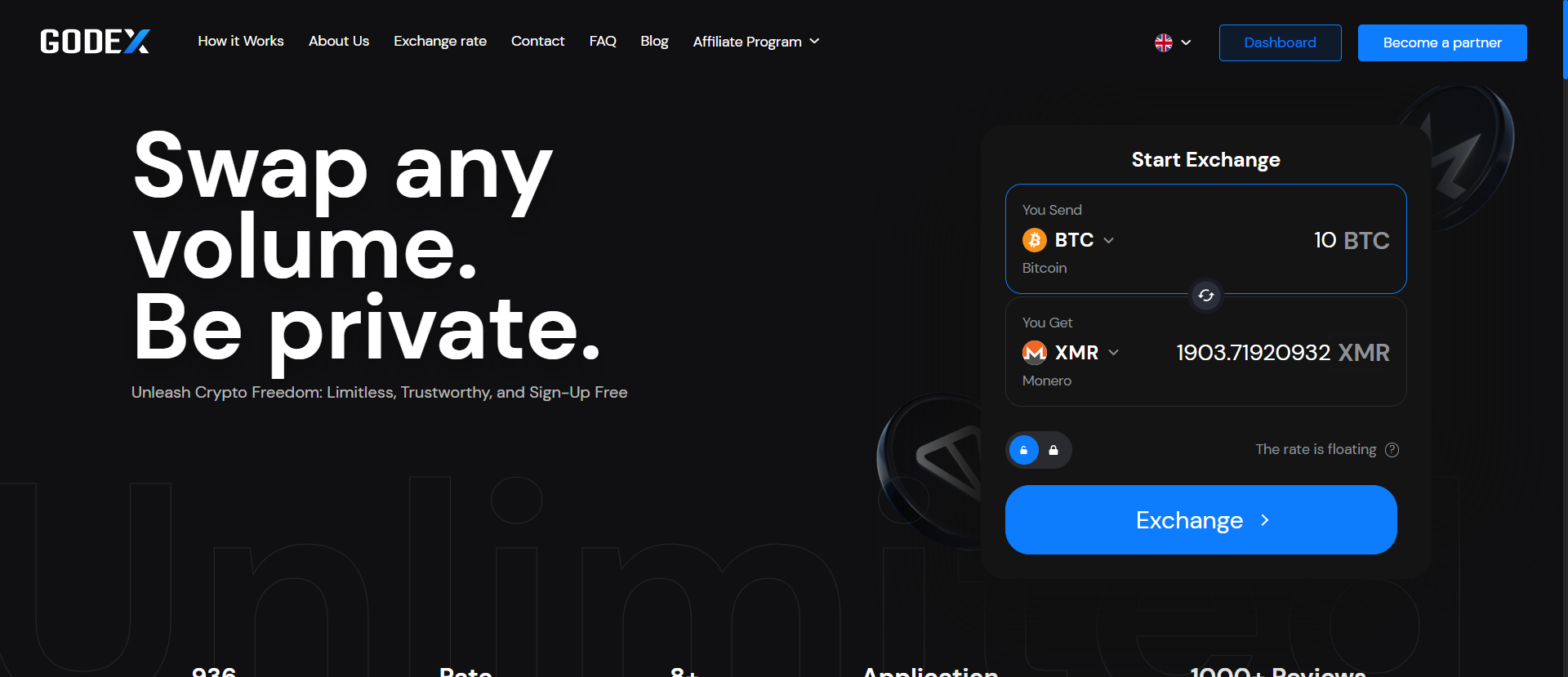
Godex is a non-custodial crypto swap service supporting 936+ cryptocurrencies, including native Monero (XMR) pairs, without account creation. You arrive, select a pair (BTC → XMR, ETH → XMR), enter a destination wallet address, and the swap executes. No login, no email, no stored funds on the platform.
For Indian users, the XMR access is the main draw. Domestic exchanges cannot list Monero under PMLA compliance pressure. Godex, operating as an offshore non-custodial service, handles XMR pairs natively, which makes it one of the most practical single-step routes from any major asset into Monero.
Godex offers both fixed-rate and floating-rate options. Fixed rate locks in the amount you’ll receive before you confirm, useful when XMR volatility is high and execution certainty matters more than squeezing the best price.
2. Bisq — Decentralized by Architecture, Private by Guarantee
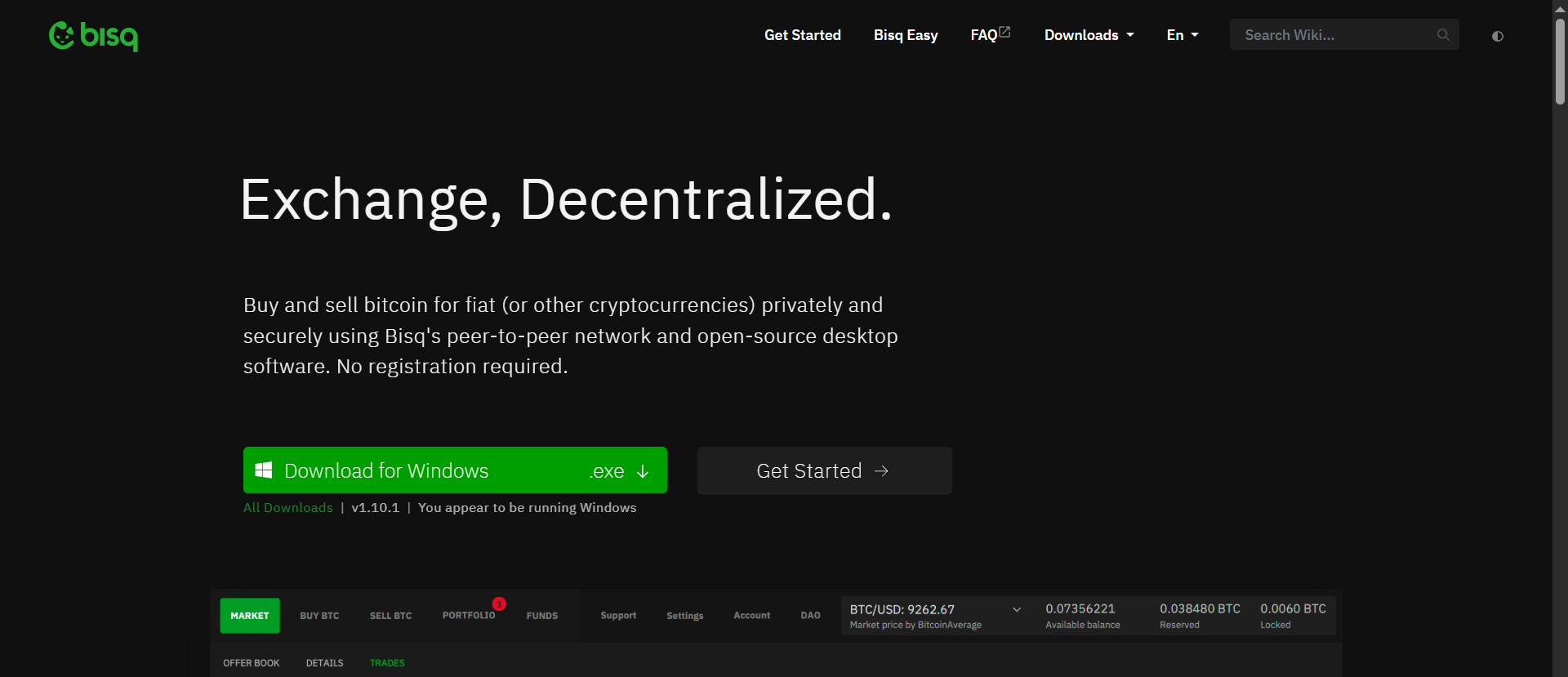
Bisq is the most private exchange available to Indian users because no-KYC isn’t a policy here — it’s a structural impossibility. There’s no company, no server, and no central entity that could request your identity even if it wanted to. The software runs locally, all peer-to-peer communication routes through Tor automatically, and your IP address is never exposed to the counterparty.
KYCnot.me assigns Bisq its top designation: KYC-0 with a 10/10 privacy score, meaning “KYC will never be requested,” as of June 2025. That rating is architectural, not just policy-based. No future management change, legal demand, or acquisition can change it, because no one controls the network.
For Indian users, Bisq covers the two things domestic exchanges cannot:
- XMR trading pairs, with active P2P liquidity and a dedicated Monero trading section in the Bisq wiki
- INR fiat pairs for rupee-to-crypto trades via bank transfer or cash, without routing through a PMLA-registered exchange
The trade-offs are real. The learning curve is steeper than an instant swap service. P2P trade settlement takes longer than an automated swap. Liquidity for INR-denominated XMR pairs is thin compared to BTC markets, and the Tor routing adds latency. Bisq launched mobile apps in April 2026 (Bisq Easy Mobile for Android and Bisq Connect for iOS and Android), though the desktop client remains the full-featured version.
For anyone for whom architecture-level privacy is the non-negotiable factor, especially for Monero, Bisq has no equivalent. The guarantee isn’t a promise from a team. It’s enforced by code.
3. Exolix — Non-Custodial Speed for Everyday Swaps
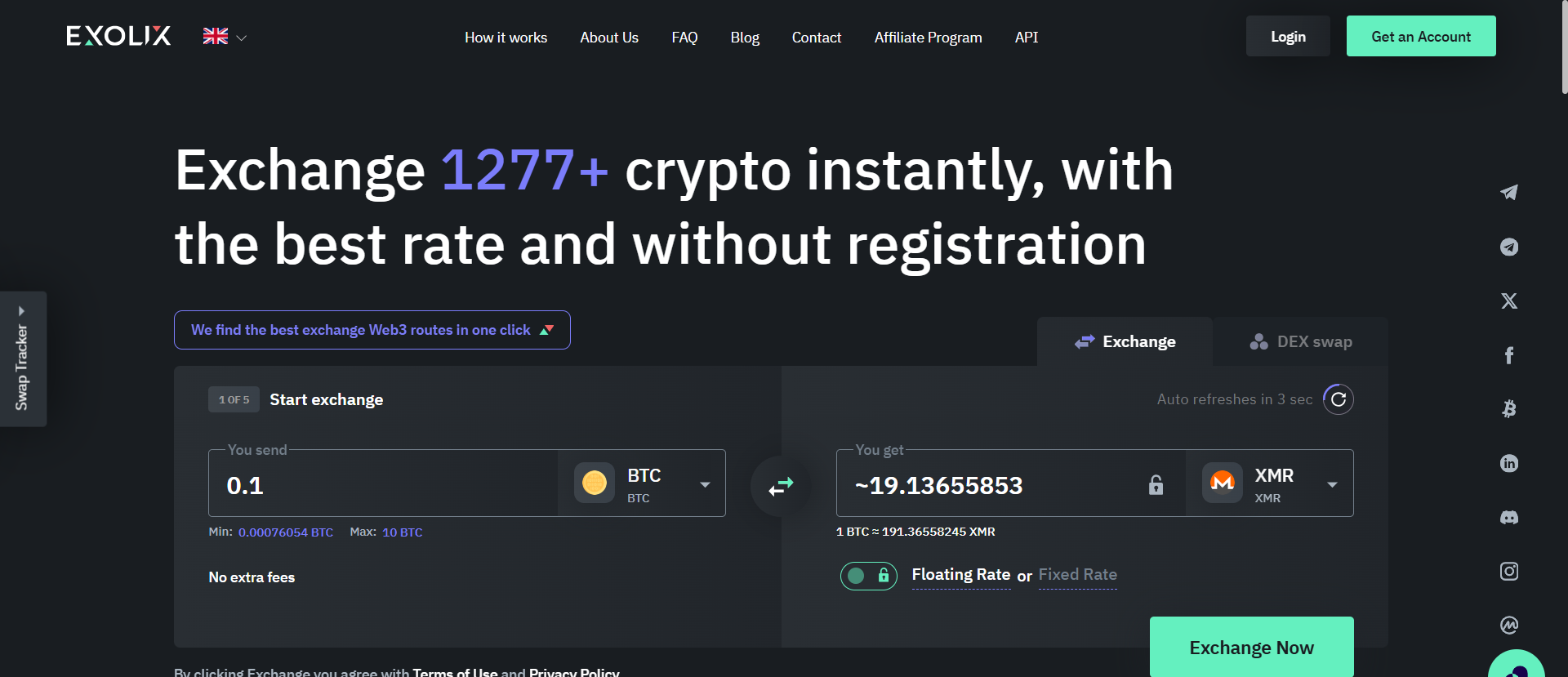
Exolix supports 1,200+ cryptocurrencies and over 4 million trading pairs, with no registration or account creation required. For routine swaps (BTC to ETH, ETH to XMR, stablecoins to privacy coins), no personal data is needed for standard transactions.
- Fixed and floating rate options on each swap
- No signup, no email, no minimum order on most pairs
- Native XMR support across multiple pairs
- Swaps route directly wallet-to-wallet, no custody
Exolix describes itself as infrastructure rather than an exchange, which shapes how it approaches compliance. It doesn’t operate as a registered VDA service provider under FIU-IND rules, putting it in the same offshore category as other non-custodial services on this list.
The interface tends to be cleaner than most swap services, which matters when you’re running multiple swaps or exploring less common pairs.
4. SideShift — Automated Shifting with Transparent XMR Depth
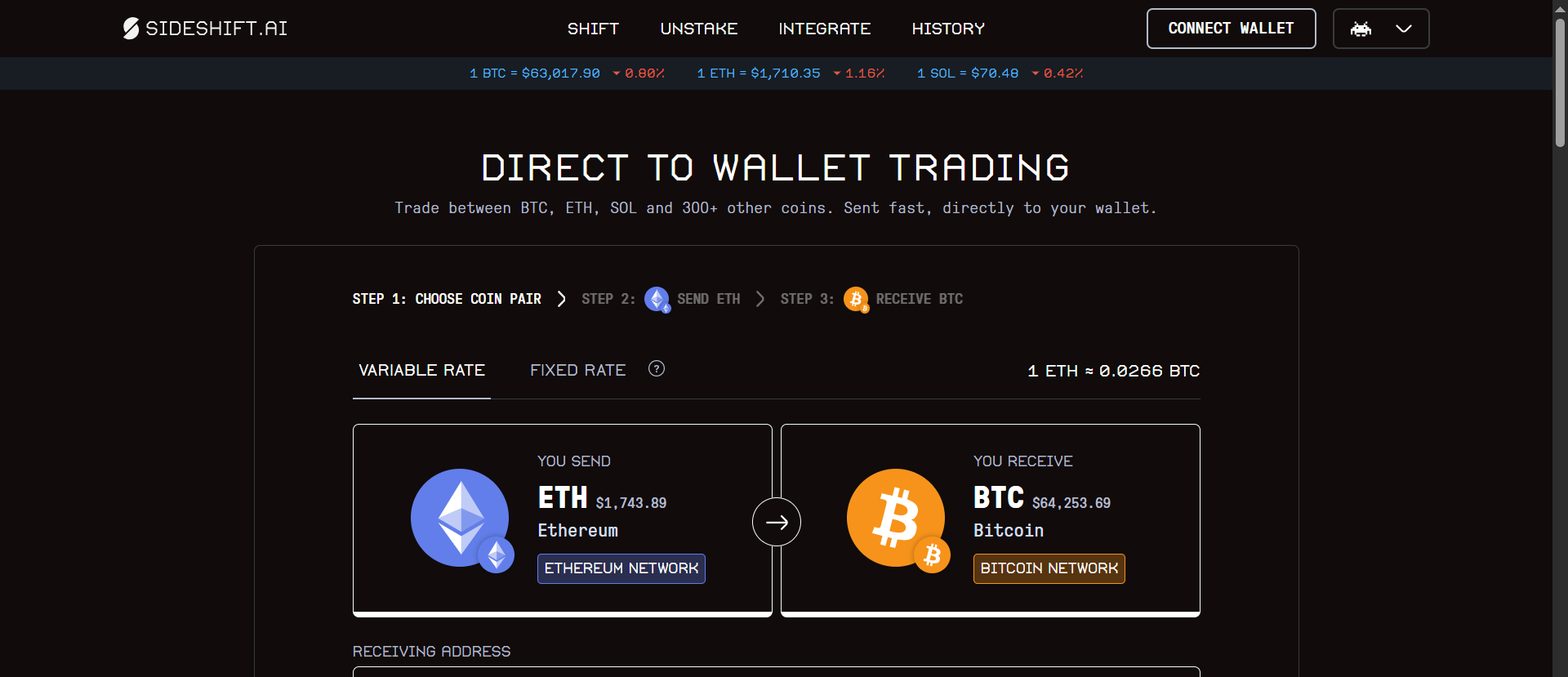
SideShift is a no-account automated swap service supporting 280+ assets, with XMR pairs among its most actively used routes.
The shift model works the same as other swap services: deposit asset A to a generated address, receive asset B at your wallet. No accounts, no email, no order history tied to an identity. What separates SideShift is that it publishes its order flow data publicly, something most services don’t do. In an industry where liquidity depth claims are usually unverifiable, that’s a meaningful trust signal.
For Indian users doing mid-sized BTC or ETH to XMR conversions, SideShift is a reliable, auditable option.
5. Crypton Exchange — Privacy-Native Order Book Trading
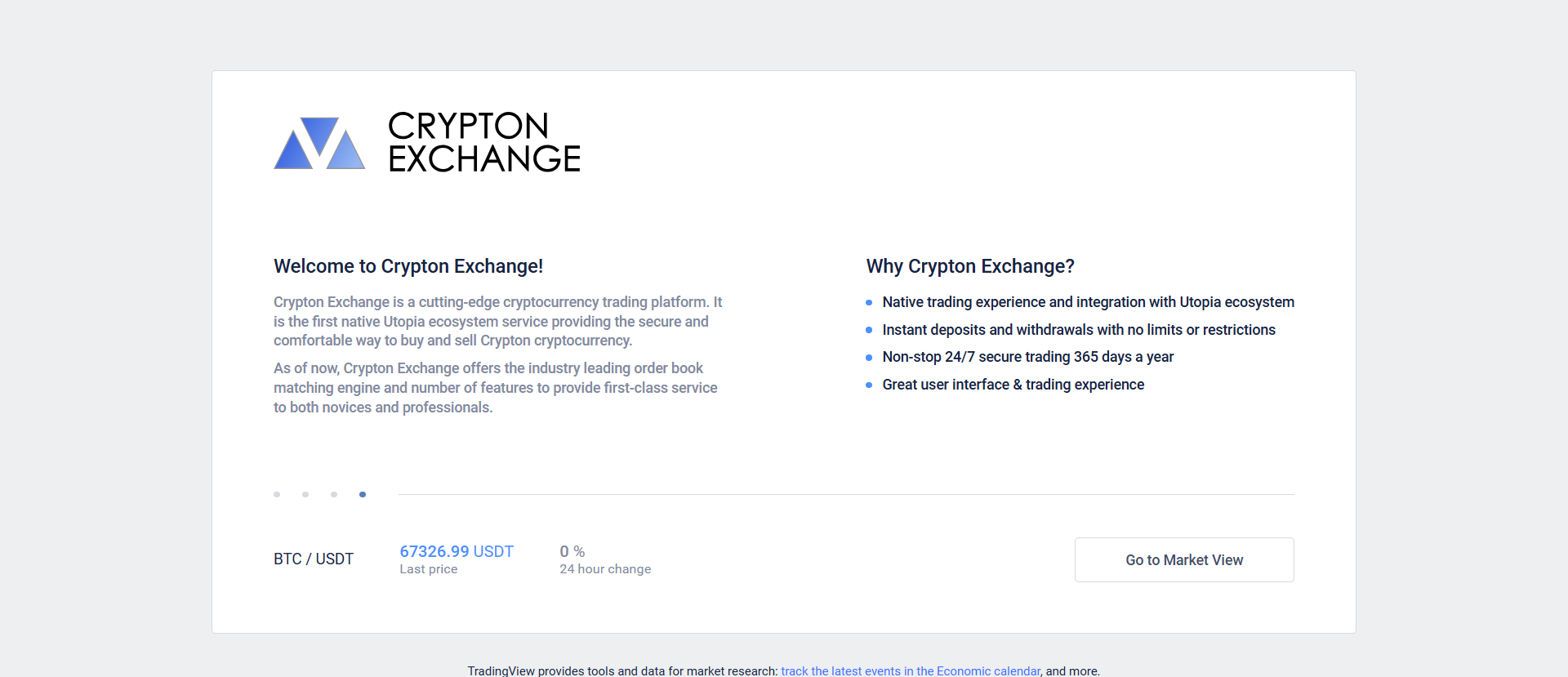
Crypton Exchange treats financial privacy as a default, not a compliance exception. No mandatory registration for spot trading, no stored IP addresses linked to activity, and an anonymous account option where no email is required. It also has its own native CRP token.
Unlike the instant swap services above, Crypton has an order book, which suits traders who want more control over execution price than a fixed-rate swap allows. You’re setting a limit order at your target price, not accepting whatever the algorithm quotes.
Crypton is less well-known than the major swap services, but it has a steady user base among traders who want order book depth without a surveillance-heavy onboarding process.
6. Peach Bitcoin — P2P Bitcoin with Rupee Support
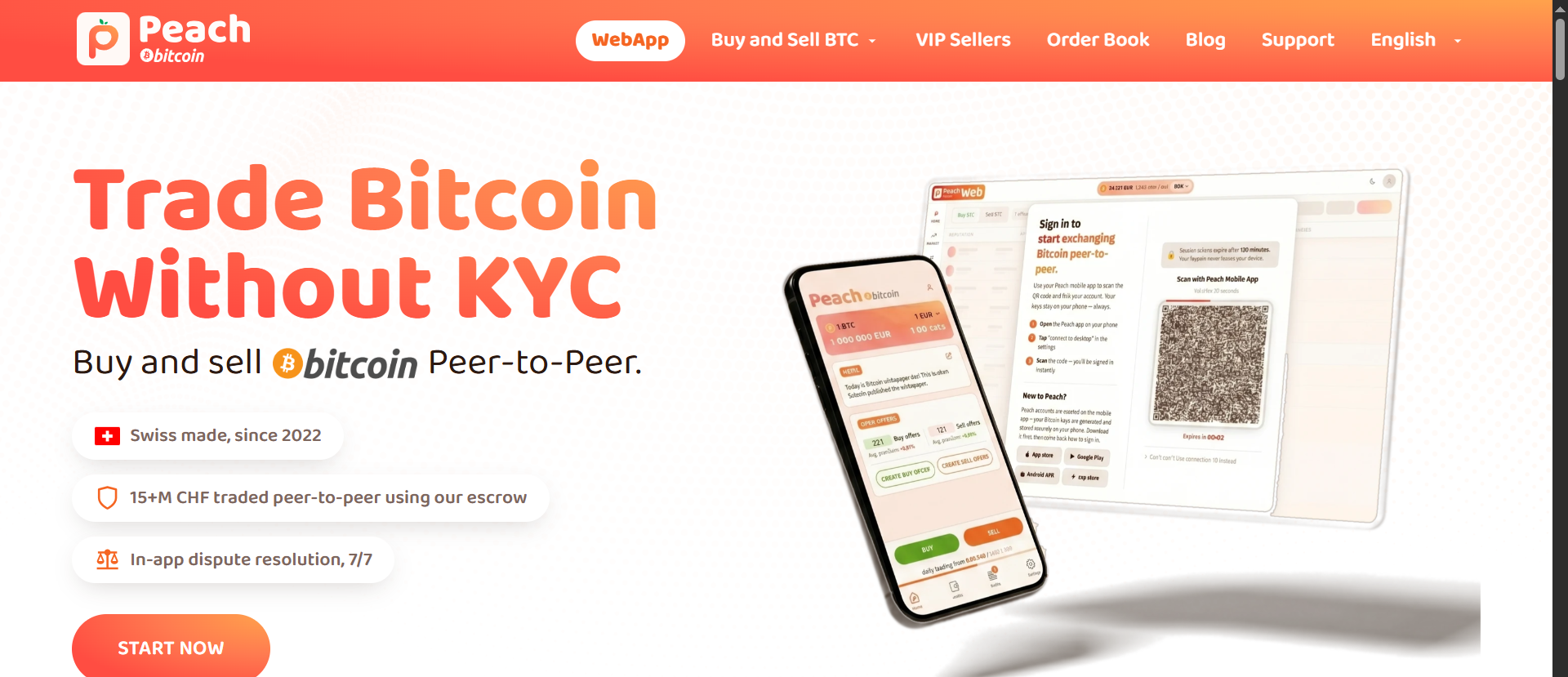
Peach Bitcoin covers the fiat leg that pure crypto-to-crypto services skip. It’s a mobile-first peer-to-peer Bitcoin exchange connecting buyers and sellers directly, supporting payment methods that work in India, including bank transfers and cash. No KYC below platform thresholds, and funds never pass through a custodian.
For Indian users who want to move between rupees and Bitcoin without touching a PMLA-registered exchange, Peach handles the on-ramp. Bitcoin only, no other assets. You’re matching with individual counterparties, which adds some settlement uncertainty a swap service doesn’t have.
- Available on Android (Google Play) and iOS (TestFlight beta)
- Cash-in-person trades available for fully off-grid transactions
- P2P with no exchange custody or central counterparty risk
- No mandatory account creation below trading limits
7. Vexl — Trusted-Network P2P for Mobile Users
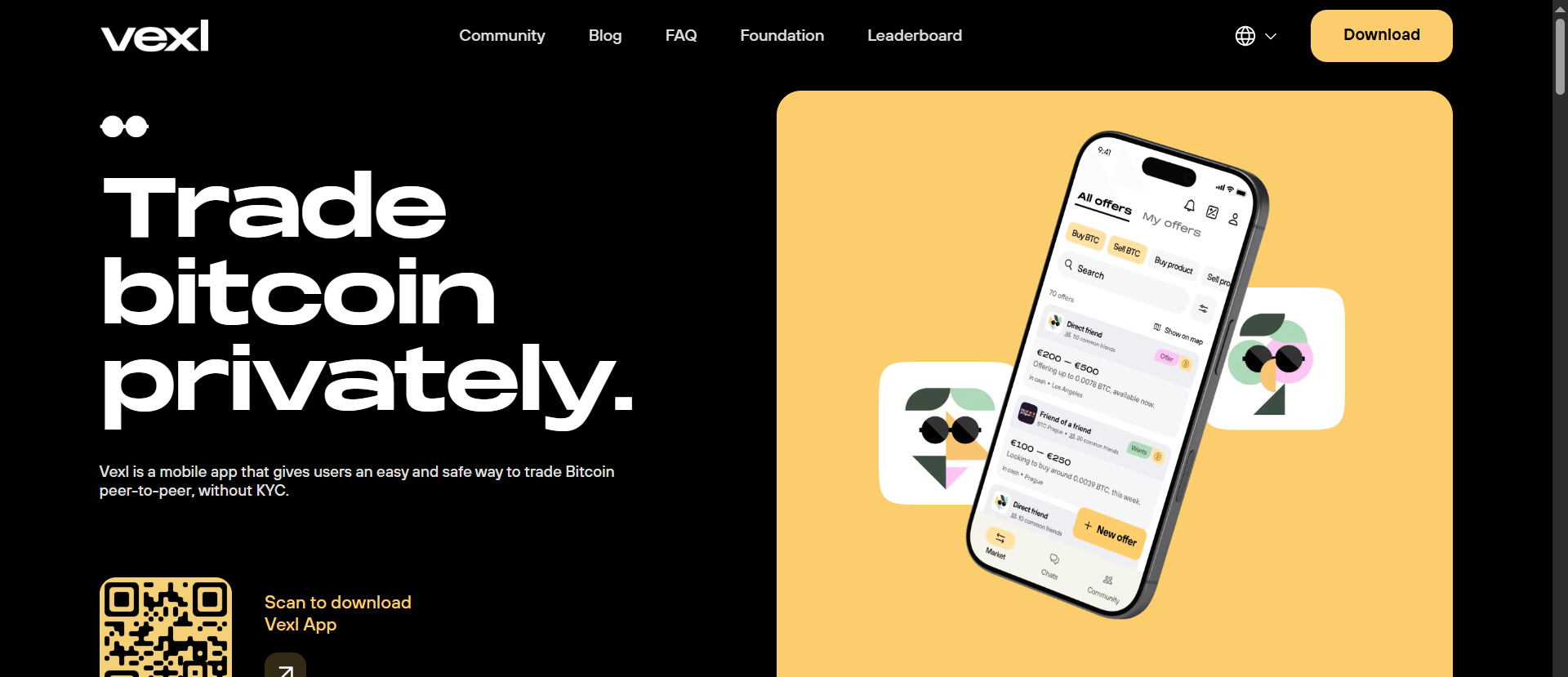
Vexl takes a different approach to the counterparty trust problem that KYC is usually deployed to solve. Instead of asking for your identity, it connects you with people from your phone contacts and social network. The underlying idea: trading with someone you already know reduces risk without needing a surveillance apparatus.
The app is fully open source, no central company stores user data, and all trades are Bitcoin-only. For Indian users in communities where crypto adoption is spreading organically (developer networks, startup ecosystems, university groups), Vexl can be a natural fit. The catch: it requires an existing contact network of Bitcoin traders to be useful.
- Bitcoin only
- Mobile-first, no desktop client
- Your social graph determines your counterparty pool
- Open source
Why Monero Specifically: The Technical Case
Monero is the most private transferable asset in crypto by design, not by configuration. Unlike Bitcoin, where all transactions are publicly visible on-chain and traceable by blockchain analytics tools, XMR uses three layered privacy technologies simultaneously:
- Ring signatures mix each transaction with a ring of other possible signers, making sender attribution impossible
- Stealth addresses generate a unique one-time address for every incoming transaction, so no outside party can link a recipient’s wallet to a specific payment
- RingCT (Ring Confidential Transactions) hides the transaction amount entirely. No third party can see how much moved.
XMR transactions are unlinkable and untraceable by default, for every user, on every transaction. Not as a premium feature, not with a mixer. That’s the baseline behavior of the network.
For Indian users navigating an exchange infrastructure that logs GPS coordinates at signup and cross-references transaction records with income tax returns, Monero is a fundamentally different model of what owning an asset can look like. Getting access requires going outside the registered domestic system, but the path exists. Bisq handles INR → XMR directly via P2P. Godex converts any supported asset to XMR without KYC. SideShift and Exolix both support XMR pairs without registration.
The 2027 Horizon: What CARF Means for Offshore Privacy
India has committed to joining the OECD Crypto-Asset Reporting Framework from April 2027, though implementation timelines sometimes slip. CARF requires participating countries to automatically share transaction-level data, meaning a foreign exchange serving an Indian user would report that activity back to Indian tax authorities, even without domestic registration.
This doesn’t criminalize offshore non-custodial trading today. Non-custodial platforms don’t hold funds or operate as traditional service providers in ways that fall cleanly under current FIU-IND jurisdiction. But CARF changes the information picture.
The accession isn’t finalized, and timelines can shift. Users relying on offshore services should treat it as a real risk on a defined timeline rather than a distant regulatory possibility.
Practical Guidance for Indian Users
When you swap on Godex, SideShift, Exolix, or any similar platform, funds go directly to the wallet address you provide. There’s no exchange wallet. You control the keys. A hardware wallet adds meaningful security if you’re holding larger amounts.
These platforms give access to assets without surveillance at the point of exchange. They don’t change Indian tax law. Gains from crypto, including from offshore swaps, are technically subject to Indian reporting and tax obligations. Consult a tax advisor who understands crypto before acting on anything significant.
Check that a platform is accessible from your location before initiating a swap you can’t reverse. Some platforms implement IP-based geo-restrictions under regulatory pressure.
Before moving significant funds through any new platform, run a small test transaction to confirm delivery time, wallet compatibility, and any unexpected behavior.
If you’re using XMR specifically, verify wallet compatibility before transacting. Some exchanges require specific XMR wallet configurations (payment ID requirements, subaddress support). A mismatch can delay or strand funds. Check the platform’s XMR documentation before your first swap.
Final Thoughts
India’s crypto regulatory environment in 2026 is sophisticated, actively enforced, and getting stricter. The domestic exchange infrastructure is effectively a financial data collection system. That’s not editorializing — it’s what the FIU-IND January 2026 circular requires, what the 1% TDS regime operationalizes, and what 44,000+ NUDGE notices demonstrate.
The 7 platforms in this guide are the accessible alternative: non-custodial, offshore, decentralized, or architecturally private services where Indian users can access crypto, including Monero, without submitting to that system. None are frictionless. None operate in a regulatory vacuum. And CARF means the window for offshore privacy options without cross-border data sharing is finite.
The tools exist now. Using them is each user’s call, with full knowledge of what they enable and what they don’t protect against.
Frequently Asked Questions
No KYC means no taxes, right?
No — KYC and tax are entirely separate obligations. India’s 30% VDA tax applies to all crypto gains regardless of which platform you used or whether any exchange collected your ID. The exchange not filing TDS on your behalf doesn’t eliminate your reporting obligation; it shifts the compliance burden to you. Using a non-custodial service removes the surveillance infrastructure, it doesn’t remove the law. If you realize gains from an offshore swap and don’t report them, you’re in the same legal exposure as someone who hid gains on WazirX.
CARF 2027 — is offshore privacy even worth it anymore?
CARF changes the information picture but doesn’t make non-custodial swaps immediately visible. The framework targets “Reporting Crypto-Asset Service Providers” — entities that hold user data. Non-custodial platforms like Bisq and Godex don’t collect identity data to report. The risk CARF creates is indirect: if you use a CARF-participating custodial exchange anywhere in the chain, that exchange reports you. The window for meaningful offshore privacy is narrowing, but it runs through non-custodial architecture specifically — not through hoping CARF jurisdictions stay quiet.
Why not just use a DEX like Uniswap instead of Bisq or Godex?
Uniswap solves a different problem. It lets you swap ERC-20 tokens on Ethereum, but it doesn’t give you XMR, it doesn’t support INR fiat entry, and it requires gas fees and an ETH wallet to begin. Bisq handles INR → crypto directly via P2P bank transfer. Godex converts into Monero without any account or EVM wallet setup. If your goal is XMR access or rupee on-ramp without a domestic exchange, Uniswap doesn’t get you there. If your goal is cheap ERC-20 swaps, Uniswap is better than anything on this list.
How do I actually cash out back to INR if there’s no KYC?
This is the real bottleneck. Godex, Exolix, and SideShift are crypto-to-crypto only — they don’t touch fiat. The INR off-ramp options on this list are Bisq (P2P bank transfer with an Indian counterparty), Peach Bitcoin (BTC ↔ INR via bank or cash), and Vexl (contact-network BTC trades). All three involve matching with individual counterparties rather than an exchange, which adds settlement time and counterparty risk. Cash-in-person via Peach is the most off-grid option. Any route that ends with rupees in an Indian bank account creates a transaction trail that can be questioned later.
India already blocked Binance and other offshore apps. Won’t they just block these too?
India blocked app store listings for Binance, Kucoin, and others in early 2024 under FIU-IND compliance enforcement. That approach targets centralized apps with large Indian user bases and identifiable corporate structures to pressure. Bisq has no company to pressure and no app store listing to remove — it’s software downloaded directly. Godex and similar services are web-based without app store dependency. The blocking mechanism that worked on Binance doesn’t map cleanly onto decentralized or non-custodial infrastructure. ISP-level DNS blocking is technically possible but is a different enforcement action that India hasn’t applied to this category at scale.
The article says India has 100M+ crypto holders. If everyone’s doing this, why is the government bothering with such aggressive KYC?
The scale of offshore migration is exactly why enforcement tightened. The Esya Centre documented that Indian users moved over $42 billion in trading volume to offshore platforms in the year after 1% TDS was introduced — 90% of their total volume. The government collected $31 million in TDS from domestic exchanges and roughly $840,000 from offshore platforms. That gap is the enforcement problem NUDGE, CARF, and the January 2026 FIU-IND circular are all responding to. The 44,000 notices aren’t random — they’re the opening move of a system that cross-references exchange data, TDS filings, and ITR submissions at scale. The more people who migrated offshore, the more the government needed infrastructure to follow.
Start a Cryptocurrency exchange
Try our crypto exchange platform
Disclaimer: Please keep in mind that the content of this article is not financial or investing advice. The information provided is the author’s opinion only and should not be considered as direct recommendations for trading or investment. Any article reader or website visitor should consider multiple viewpoints and become familiar with all local regulations before cryptocurrency investment. We do not make any warranties about reliability and accuracy of this information.
Read more
You may well think that an article dedicated to a Tether price prediction or the Tether price in general is a little bit strange — it is a stablecoin after all. However, the price of Tether does fluctuate significantly, although it is nowhere near as volatile as non-stablecoin cryptos. This means that staying up to […]
In the article we share our vision at Zcash cryptocurrency main features and add several price predictions. As cryptocurrencies gain global acceptance and decentralisation slowly enters our lives, privacy becomes the main concern when talking about blockchain adoption. It is no secret that distributed ledger is by far the most secure and transparent technology ever […]
Chiliz coin (CHZ) offers a compelling opportunity for traders interested in the intersection of blockchain technology and sports. By enabling fans to influence team decisions through the Socios app, Chiliz directly monetizes fan engagement and connects with major sports teams like Juventus and Paris Saint-Germain. These partnerships not only enhance the platform’s visibility but also […]
The exponential growth of Bitcoin Satoshi Vision (BSV) against the general bear trend on the cryptocurrency market in autumn 2019 has impressed the community. Due to the increasing market capitalization, the newly emerged altcoin was ranked 5th on CoinMarketCap and managed to maintain its high position at the beginning of 2020. In the article we […]
EOS is definitely on the list of the strongest and most stable projects in the crypto world. Despite the fact that the currency entered the market less than 3 years ago, it consistently occupies one of the top 10 places in the rating for project capitalization. it is often called the “main competitor of Ethereum”. […]
XRP price prediction 2026-2027: bear, base, and bull scenarios with ranges and named sources, the resolved SEC case, live spot ETFs, and can XRP reach $10?