
 Alex Tamm

Table of Contents
Anonymous crypto exchange in 2026 is not what it was in 2020. MiCA is in force across the European Union. The United States has the 1099-DA broker reporting form. Every licensed centralized exchange has either completed KYC migration or lost its license. LocalBitcoins is gone. LocalMonero is gone. Several familiar venues have removed privacy coins entirely.
That’s the bad news, and most articles on this topic stop there — usually with a sales pitch attached.
The good news is that almost every method that actually delivered privacy in 2020 still delivers it in 2026, and several of them have improved. Non-custodial swap services are faster, support more pairs, and have longer track records. Atomic swap DEXs have shipped real products. Tor-native P2P platforms are still running. The user base for these tools got more selective, not smaller, and the tools got more capable.
This is a methods guide, not a platform listicle. We’ll start with what “anonymous” actually means at the protocol level — because that’s the part most articles get wrong — then walk through the routes that survive 2026 regulation, with honest tradeoffs for each. By the end you should be able to look at any swap you’re about to do and pick the right method for what you’re actually trying to accomplish.
What “Anonymous” Actually Means in 2026
This is the most important section in the article. Get this right and the rest follows.
There are three words that get used interchangeably and shouldn’t be: anonymous, private, and pseudonymous.
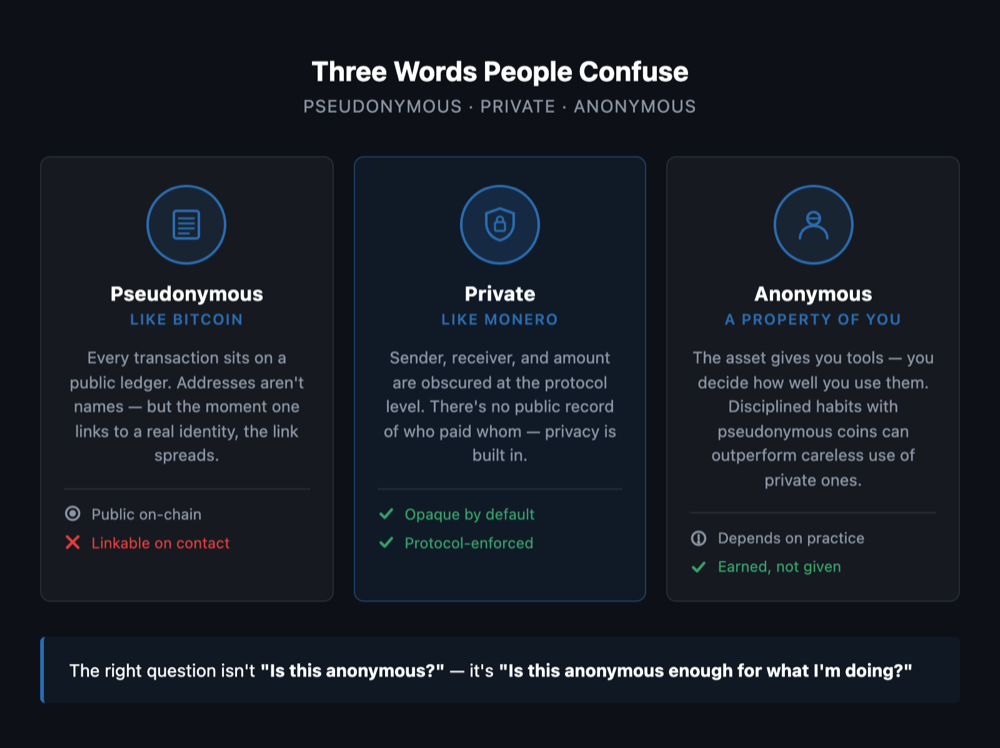
Pseudonymous is what Bitcoin is. Every transaction is on a public ledger. Every address is visible to anyone with an internet connection. Identities are not directly attached to addresses, but the moment any address gets linked to a real-world identity — by a KYC exchange, a merchant payment, a public donation, anything — the link propagates. Chainalysis and similar firms exist to do exactly this propagation at scale, professionally.
Private is what Monero is. Transactions are opaque by default at the protocol level. Sender, receiver, and amount are all obscured through ring signatures, RingCT, and stealth addresses. There’s no public record of who paid whom, and no way for an outside observer to construct one. Privacy is a property of the protocol, not a property of how you use it.
Anonymous is a property of the user, not the asset. You can hold private cryptocurrency in a way that’s still linkable to you (slip up on operational privacy and the link forms anyway). You can hold pseudonymous cryptocurrency in a way that’s effectively anonymous (good wallet hygiene, separation of identity from address, careful operational practices). The asset gives you tools; you decide how well you use them.
Now, “no-KYC” vs “anonymous.” A no-KYC platform doesn’t ask for your ID. That’s a property of the platform. It does not, by itself, make the resulting transaction anonymous on-chain. A pool DEX is no-KYC, but every transaction is recorded on a public blockchain forever, and the wallet you connected becomes permanently associated with the trade. No-KYC and anonymous are different concepts that overlap.
And operational privacy is the third axis nobody talks about. Wallet separation, IP anonymization, behavioral linkage, timing analysis. The platform you use is one variable in your privacy outcome. You are several others. A perfectly anonymous platform combined with sloppy operational habits will produce a mediocre result. A mediocre platform combined with disciplined operational habits will often outperform it.
The single most useful reframing in this whole topic: the right question is not “is this anonymous?” but “is this anonymous enough for what I’m doing?” Privacy is a spectrum. Different methods deliver different levels at different costs. The article that follows is a tour of where the methods sit on that spectrum and what they cost you in convenience, speed, and liquidity.
The 2026 Regulatory Reality (Without the Drama)
Some context, presented as facts rather than crisis:
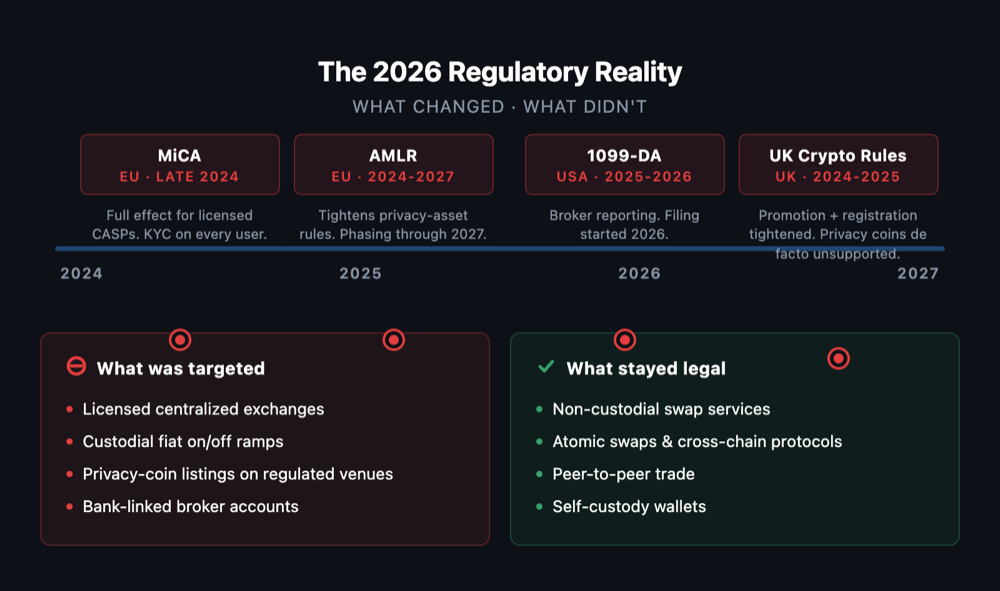
MiCA — the Markets in Crypto-Assets regulation — reached full effect in the European Union in late 2024 for licensed crypto-asset service providers. Practical effect: every centralized European exchange that wants to keep its license runs KYC on every user. No grey area, no opt-out.
AMLR — the Anti-Money Laundering Regulation — was adopted in 2024 and is phasing in through 2027. It tightens rules on privacy-enhancing assets and is the legal basis for the wave of privacy-coin delistings on European venues throughout 2024 and 2025.
1099-DA in the United States is the broker reporting form effective for the 2025 tax year. Centralized US-facing venues report user transactions to the IRS. Filing started in 2026.
United Kingdom rules on crypto promotion and registration tightened through 2024 and 2025. Privacy coins are not directly banned in the UK but are de facto unsupported on registered platforms.
What hasn’t changed: non-custodial services, atomic swaps, peer-to-peer trade, and self-custody all remain legal in every major jurisdiction. The regulatory wave targeted licensed intermediaries — the centralized venues that sit between users and the network. The unlicensed and non-custodial paths, the ones that don’t custody your funds in the first place, are unaffected by the rules that targeted custodians.
One important framing to set before the methods section: this article describes legal methods that don’t require KYC. It does not describe ways to evade existing legal obligations like tax reporting. Privacy is not the same as evasion. Know the rules of your jurisdiction; comply with the ones that apply to you; use whichever methods give you the privacy you need within those rules.
Method 1 — Non-Custodial Instant Swap Services
This is the broadest, easiest non-KYC method, and for most users in 2026 it’s the right starting point.
The model is straightforward: you send one cryptocurrency to a swap service, the service exchanges it at the current market rate, and you receive the target cryptocurrency at a wallet address you control. No account creation. No email. No identity profile stored anywhere. The service never custodies your funds in any meaningful sense — they pass through. There’s no balance sitting in your name on their books, because there are no books in your name.
The reasons this works as a privacy method in 2026:
- No account means no KYC, no identity profile, and nothing for a regulator or attacker to subpoena
- No fiat banking system involved means no bank record of the transaction
- No deposit balance means nothing to freeze, restrict, or audit
- Transactions complete in minutes rather than hours or days
- Pair coverage is broader than any other non-KYC category
Godex.io is one of these services. The specifics worth knowing:
- 934+ supported coins. Almost any pair you might want, including the obvious privacy pairs.
- Fixed-rate option. Locks the rate at the moment you initiate the swap, for the full duration. No slippage risk if the market moves while your transaction is confirming. This is unusual in the category — most services default to floating rate, which is fine when the market is calm and unpleasant when it isn’t.
- Floating rate also available for users who want market exposure during the swap.
- No volume caps. Exchange any amount. There is no tiered KYC trigger that activates above a threshold — no “no-KYC up to $X.” The same rules apply at $100 and at $100,000.
- Unconditional no-KYC. This is worth saying twice. Several competitors operate “no-KYC up to a limit, then KYC kicks in.” Godex does not. The same anonymity profile applies to all transactions regardless of size.
- Processing time: 3 to 15 minutes after the deposit confirms on-chain.
- Operating since approximately 2017. A multi-year track record matters in a category where venues come and go.
- 24/7 customer support for the cases where something does need a human.
The honest tradeoff: the service sees the transaction. It sees the input address you sent from, the output address you’re receiving to, and the amount. It does not see you — there’s no name attached to those addresses on Godex’s side — but the on-chain footprint exists, as it does with any on-chain transaction. If the input address has ever touched a KYC source, the link to that source still exists. The service is a strong privacy tool combined with operational hygiene; it is not a magic wand that retroactively cleans a KYC-linked wallet.
There are several other services in this category — ChangeNOW, SimpleSwap, StealthEX, FixedFloat, Exolix. They differ in coin selection, rate model, and operating history. Godex’s distinguishing features are the fixed-rate availability across pairs, the unconditional no-KYC posture at any volume, and the longest operating history in the category. For most users wanting fast, broad-coverage non-KYC swaps, this category is the answer and Godex is a strong default within it.
Method 2 — Atomic Swap DEXs
If you want to remove the swap service from the equation entirely, atomic swaps are the structural answer.
The mechanism: cryptographic locks (HTLCs — hash time-locked contracts) enable two parties to trade two different cryptocurrencies directly, without an intermediary holding either side. The trade is atomic — either both sides complete or both sides revert to their starting states. No trusted third party. No counterparty risk in the conventional sense, because the protocol enforces the trade.
The venues that matter in 2026:
Haveno — the Tor-native, decentralized exchange that is the spiritual successor to LocalMonero (which shut down in November 2024 under regulatory pressure). Haveno specializes in BTC ↔ XMR atomic swaps with strong privacy properties. It runs on Tor by default, has no central operator that can be subpoenaed, and uses multi-sig escrow to protect both sides. The privacy ceiling is high. The convenience floor is low — you’ll need to install client software, learn the model, and accept slower settlement than centralized alternatives.
THORChain — a cross-chain liquidity protocol that supports native swaps between chains, including BTC, ETH, BCH, LTC, and others. No account, no KYC. Pairs are deeper than Haveno on average. Tradeoffs: smart contract risk (THORChain has had incidents in the past, though the protocol has matured), gas fees on the chains involved, and varying liquidity by pair.
Bisq — the decentralized P2P platform that handles both crypto-to-crypto trades and fiat-to-crypto trades. Multi-sig escrow, no registration, no central server. Slower than instant-swap services because settlement depends on the payment method used. Best for users with patience and a strong preference for trustless execution.
The general tradeoffs across atomic-swap DEXs: smaller liquidity than centralized or instant-swap options, steeper learning curve, slower settlement, and pair availability varies by venue. The privacy ceiling is the highest in the article. The convenience cost is real.
Best for: users with technical comfort who want fully trustless execution and are willing to trade convenience for it.
Method 3 — Decentralized Exchanges (Pool-Based)
AMM-based DEXs — Uniswap, PancakeSwap, Curve, the various forks — match trades against liquidity pools rather than order books. No account, no KYC, transactions executed by smart contracts.
Useful, but with an important limitation that the privacy framing of this article forces us to be honest about: every transaction on a pool DEX is recorded on a public blockchain forever. The wallet you connected to the DEX becomes permanently associated with the trade. If that wallet has ever touched a KYC source — a centralized exchange, a verified merchant, anything — the trade is linked to that source. No-KYC at the platform layer does not erase on-chain traceability.
This makes pool DEXs a good fit for users trading inside a single ecosystem (ERC-20 to ERC-20 on Uniswap, BEP-20 to BEP-20 on PancakeSwap) where the wallet and the asset are already chain-native and the privacy story is about avoiding centralized intermediaries rather than breaking on-chain trails.
The cross-chain limitation is also worth noting: most pool DEXs are chain-native. You can swap ETH for WBTC on Uniswap, but WBTC is wrapped Bitcoin — a tokenized representation, not native BTC. If you actually want native Bitcoin, a pool DEX is not the right tool.
Tradeoffs: gas fees can be significant on Ethereum mainnet, slippage on large orders, smart-contract risk (the contract code is the law and code can have bugs), and complexity for non-DeFi users.
Best for: DeFi-comfortable users trading within an ecosystem they’re already using, where pool depth is good and the privacy goal is “don’t go through a centralized intermediary.”
Method 4 — Peer-to-Peer (P2P)
P2P is the oldest method in the article and the one that has changed the most. LocalBitcoins shut down in February 2023. LocalMonero shut down in November 2024. The two largest names in the category are gone. What replaced them is smaller, more technical, and in several ways better.
Bisq appears here for a second time because it handles both atomic swaps and fiat-to-crypto P2P trades. The mechanism is the same: multi-sig escrow, no central server, individual users on either side of the trade. Bisq is not a company — it’s a protocol with a desktop client. Trades happen between people; Bisq enforces escrow and dispute resolution via the protocol.
Robosats is a Lightning Network-based P2P platform that runs on Tor. Users get disposable robot avatars instead of accounts. No registration, no email, no persistent identity. Privacy is very high. Liquidity is smaller than legacy LocalBitcoins, and trade sizes lean toward the small-to-medium range. It has a learning curve, but the learning curve is the price of the privacy ceiling.
Hodl Hodl offers non-custodial multi-sig escrow for Bitcoin. Web-based interface, no mandatory KYC for most regions. Less decentralized than Bisq but easier to use for newcomers.
Peach Bitcoin is a mobile-first P2P app focused on European users. No KYC for trades within its supported payment methods.
The tradeoffs for P2P generally: lower liquidity than centralized options, slower settlement that depends on the payment method, counterparty selection matters more than on automated venues, and the learning curve is real.
Best for: users acquiring crypto with fiat for the first time without involving a bank link, or experienced users who want fully person-to-person trade.
Method Comparison — At a Glance
| Method | Account / KYC | Privacy Level | Speed | Pair Coverage | Best For |
|---|---|---|---|---|---|
| Non-custodial instant swap (Godex) | None | High | 3–15 min | Very broad (934+) | Most users wanting fast crypto-to-crypto |
| Atomic swap DEX (Haveno, THORChain, Bisq) | None | Very High | Minutes–hours | Limited but growing | Technical users, BTC↔XMR, fully trustless |
| Pool DEX (Uniswap, PancakeSwap) | None | High vs platform, low on-chain | Minutes | Single-chain | DeFi users within an ecosystem |
| P2P (Robosats, Bisq, Hodl Hodl) | None | Very High | 30 min – 24 hrs | Limited | Fiat-to-crypto, max privacy, technical users |
A few things worth noting about the table. “Privacy Level” is not a single number — it’s a profile. A pool DEX has high privacy versus the platform (no KYC) but low privacy on-chain (every trade visible forever). The right cell to look at depends on what you’re optimizing for. Speed and pair coverage trade against each other in this category: instant swaps win on both, atomic swaps and P2P win on privacy ceiling.
Operational Privacy — The Part Most Articles Skip
The platform is one variable. You are several others. Here is the short list of habits that determine whether your “anonymous” exchange is actually anonymous in practice.

Wallet separation. Don’t reuse a wallet that has ever been linked to a KYC source. Funds from a KYC exchange wallet that pass through a swap and back to the same wallet are still linked — the swap moved the assets, but the wallet identity propagates. Maintain a clean wallet for privacy-sensitive activity. Don’t mix it with your KYC-linked wallets ever.
Network privacy. Use a VPN or Tor when transacting. The exchange or DEX may not know who you are at the application layer, but your ISP and the destination service can correlate IP, timing, and behavior. Tor is the strongest option; a reputable VPN is a meaningful improvement over nothing.
Address hygiene. Don’t reuse receiving addresses across different transactions. Most modern wallets generate a new address per transaction by default — keep that behavior on. Reusing addresses is the single most common operational mistake.
Timing. Avoid patterns that link you across services — same time of day, same amounts, same sequencing. Chainalysis-style firms profile users by behavior as much as by identity.
Self-custody, immediately. Move funds off any temporary venue as soon as the transaction completes. If a swap service held your funds for an hour, that’s an hour during which they could in principle be subject to legal process. Less time on the venue = less exposure. Self-custody is the foundation; everything else is layered on top.
Don’t deposit anonymous funds into a KYC-linked account. This is the most common single mistake users make. They go through the whole process of acquiring crypto privately, then they deposit it into a centralized exchange where they have a verified account, and the link is forged in one step. AML systems flag exactly this pattern. The entire privacy effort gets undone.
Privacy coins as a routing layer. If your goal is breaking an existing on-chain trail, swapping into Monero via any of the methods above, holding briefly, and swapping out is the most effective approach. The trail breaks at the privacy-coin layer because Monero transactions are opaque by default. This is the architectural reason XMR matters even to people who don’t want to hold it long-term — it’s the disposable privacy layer for the broader ecosystem. (For more on Monero’s trajectory and why it’s likely to remain available through the regulatory window, see our Monero (XMR) Price Prediction 2026–2030.)
Choosing the Right Method for What You’re Actually Doing
A short decision section.

Match the method to the need:
- You already hold crypto and want to swap to a different crypto without an account → non-custodial instant swap (Godex is the obvious choice for breadth of pairs and fixed-rate availability)
- You want maximum trustless execution and you’re technically comfortable → atomic swap DEX (Haveno for BTC↔XMR, THORChain for cross-chain, Bisq for either)
- You’re trading inside one DeFi ecosystem and the assets are already chain-native → pool DEX
- You’re acquiring crypto with fiat and don’t want a bank link → P2P (Bisq, Robosats, Hodl Hodl)
- You want to break an existing on-chain trail → swap into XMR via any of the above, hold briefly, swap out
The right method depends on what you’re moving, where it’s coming from, where it’s going, and how much friction you’re willing to accept. There is no universally best answer because the question changes with the circumstances.
The Bottom Line
The methods for anonymous crypto exchange in 2026 are narrower than they were in 2020, but the ones that survived survived for a reason. Non-custodial instant swaps give you the broadest pair coverage and the lowest friction, and they remain unaffected by the regulations that targeted licensed custodians. Atomic swap DEXs give you maximum trustlessness if you’re willing to handle the tools. Pool DEXs work cleanly within their ecosystems. P2P remains the right answer for fiat-to-crypto without a bank link.
Privacy is a spectrum, not a switch. Pick the method that delivers the level of privacy you actually need for the transaction in front of you. Combine it with basic operational hygiene — wallet separation, network privacy, address rotation, immediate self-custody. Avoid the one mistake that undoes everything else, which is bridging anonymous funds into a KYC-linked account at the end.
Do those things and you can exchange crypto in 2026 with a level of privacy that the regulated alternative cannot match. The tools didn’t go away. The user base just got more selective.
Last updated: April 8, 2026. This article describes legal methods that do not require identity verification. It is not advice on how to evade legal obligations such as tax reporting, which apply independently of how you choose to transact. Know the rules of your jurisdiction and comply with the ones that apply to you. Verify platform availability and pair status at your chosen venue before sending funds — the landscape of supported services and pairs changes faster than most articles can be updated.
Start a Cryptocurrency exchange
Try our crypto exchange platform
Disclaimer: Please keep in mind that the content of this article is not financial or investing advice. The information provided is the author’s opinion only and should not be considered as direct recommendations for trading or investment. Any article reader or website visitor should consider multiple viewpoints and become familiar with all local regulations before cryptocurrency investment. We do not make any warranties about reliability and accuracy of this information.
Read more
You may well think that an article dedicated to a Tether price prediction or the Tether price in general is a little bit strange — it is a stablecoin after all. However, the price of Tether does fluctuate significantly, although it is nowhere near as volatile as non-stablecoin cryptos. This means that staying up to […]
In the article we share our vision at Zcash cryptocurrency main features and add several price predictions. As cryptocurrencies gain global acceptance and decentralisation slowly enters our lives, privacy becomes the main concern when talking about blockchain adoption. It is no secret that distributed ledger is by far the most secure and transparent technology ever […]
Chiliz coin (CHZ) offers a compelling opportunity for traders interested in the intersection of blockchain technology and sports. By enabling fans to influence team decisions through the Socios app, Chiliz directly monetizes fan engagement and connects with major sports teams like Juventus and Paris Saint-Germain. These partnerships not only enhance the platform’s visibility but also […]
The exponential growth of Bitcoin Satoshi Vision (BSV) against the general bear trend on the cryptocurrency market in autumn 2019 has impressed the community. Due to the increasing market capitalization, the newly emerged altcoin was ranked 5th on CoinMarketCap and managed to maintain its high position at the beginning of 2020. In the article we […]
EOS is definitely on the list of the strongest and most stable projects in the crypto world. Despite the fact that the currency entered the market less than 3 years ago, it consistently occupies one of the top 10 places in the rating for project capitalization. it is often called the “main competitor of Ethereum”. […]
XRP price prediction 2026-2027: bear, base, and bull scenarios with ranges and named sources, the resolved SEC case, live spot ETFs, and can XRP reach $10?