
 Alex Tamm
Table of Contents
Finding a cryptocurrency exchange with lowest fees directly impacts your trading profits. Every percentage point saved on fees means more crypto stays in your wallet. Whether you’re a day trader or long-term holder, fee structures matter.
This guide covers the top platforms where you can trade crypto without overpaying. We’ve analyzed trading fees, withdrawal costs, and hidden charges across major exchanges. Some platforms offer maker-taker models. Others provide flat-rate pricing. A few even waive fees entirely under certain conditions.
From industry giants to privacy-focused alternatives, each exchange has unique advantages. Your ideal platform depends on trading volume, preferred coins, and privacy needs. Let’s explore the best options to minimize your trading costs in 2025.
Understanding Cryptocurrency Exchange Fee Structures
Exchange fees fall into three main categories: trading fees, network fees, and hidden costs. Understanding these differences helps you choose the most cost-effective platform for your needs.
Trading Fees
Trading fees are charged when you buy or sell cryptocurrency. Most exchanges use a maker-taker model. Makers add liquidity by placing limit orders. They typically pay 0.02%–0.10%. Takers remove liquidity with market orders. They pay slightly more—usually 0.05%–0.20%.
Network Fees
Network fees go to blockchain miners or validators. These aren’t set by exchanges. They fluctuate based on network congestion. Bitcoin and Ethereum fees can spike during busy periods. Some exchanges absorb partial network costs.
Hidden Fees
Watch for spread markups, currency conversion charges, and inactivity fees. Spread is the difference between buy and sell prices. Some platforms advertise “zero fees” but widen spreads instead. Always check the final transaction amount before confirming.
| Fee Type | Who Sets It | Typical Range |
|---|---|---|
| Trading Fee | Exchange | 0%–0.60% |
| Network Fee | Blockchain | Variable |
| Withdrawal Fee | Exchange | Fixed or % |
| Spread | Exchange | 0.5%–2% |
1. GODEX
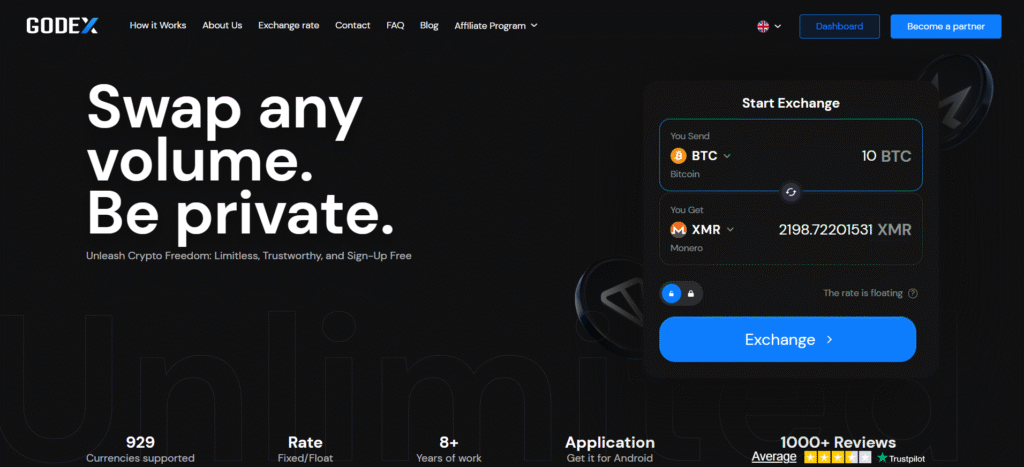
GODEX stands out as a privacy-focused exchange with competitive instant-swap rates. This identity-light platform requires no account creation for standard transactions.
The fee structure is straightforward. GODEX charges a small percentage included in the displayed rate. What you see is what you get—no hidden costs. The platform aggregates rates from major exchanges like Binance and Bitfinex. This ensures competitive pricing across 300+ supported cryptocurrencies.
Transaction speed impresses. Most swaps complete within 5–30 minutes. The fixed-rate option locks your price for 30 minutes. This protects against volatility during confirmation. Network fees are transparently included in quotes.
GODEX excels for users prioritizing speed and confidentiality. There’s no registration process. No email required. No trading limits. The instant-access model suits those who want to exchange crypto without lengthy verification procedures. Transaction data is erased from servers within one week.
For traders seeking a crypto exchange with lowest fees and minimal friction, GODEX delivers genuine value. The transparent pricing model eliminates surprise charges.
| Pros | Cons |
|---|---|
| No registration required | No fiat currency support |
| Transparent all-inclusive rates | Fewer advanced trading features |
| 300+ cryptocurrencies supported | No mobile app currently |
| Fast 5–30 minute swaps | Not for margin/futures trading |
2. Binance
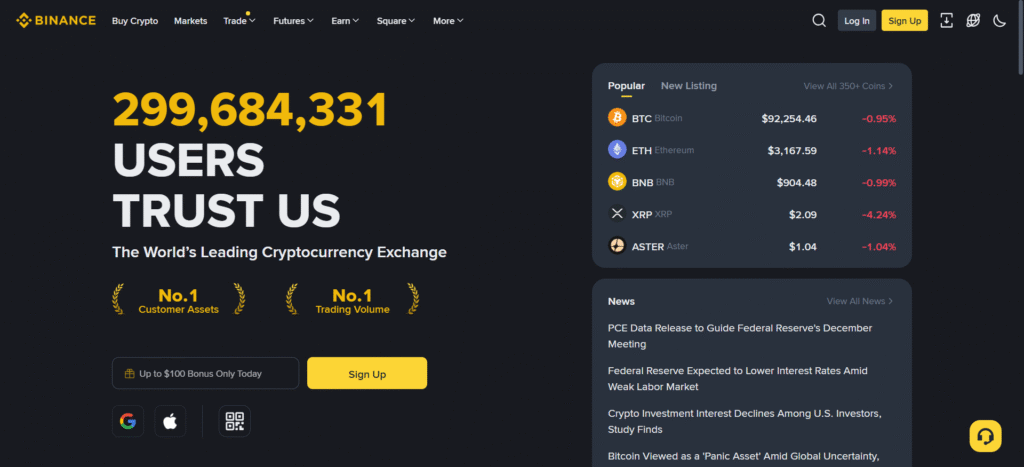
Binance offers some of the lowest trading fees in the cryptocurrency industry. As the world’s largest exchange by volume, it leverages scale to minimize user costs.
Standard spot trading fees start at 0.10% for both makers and takers. This already undercuts most competitors. But discounts stack quickly. Holding BNB (Binance Coin) reduces fees by 25%. High-volume traders access VIP tiers with rates as low as 0.02% maker and 0.04% taker.
The platform supports over 350 cryptocurrencies. Liquidity is excellent across major pairs. Tight spreads mean you get fair prices on large orders. Futures trading fees start at 0.02% maker and 0.05% taker—among the lowest available.
However, Binance isn’t available everywhere. U.S. users must use Binance.US, which has fewer features and slightly higher fees. Verification requirements have increased in recent years. Some users find the interface overwhelming.
| Pros | Cons |
|---|---|
| Lowest fees with BNB discounts | Complex interface for beginners |
| Massive coin selection | Geographic restrictions apply |
| High liquidity, tight spreads | Mandatory KYC verification |
| VIP tiers for active traders | Customer support delays reported |
3. Kraken
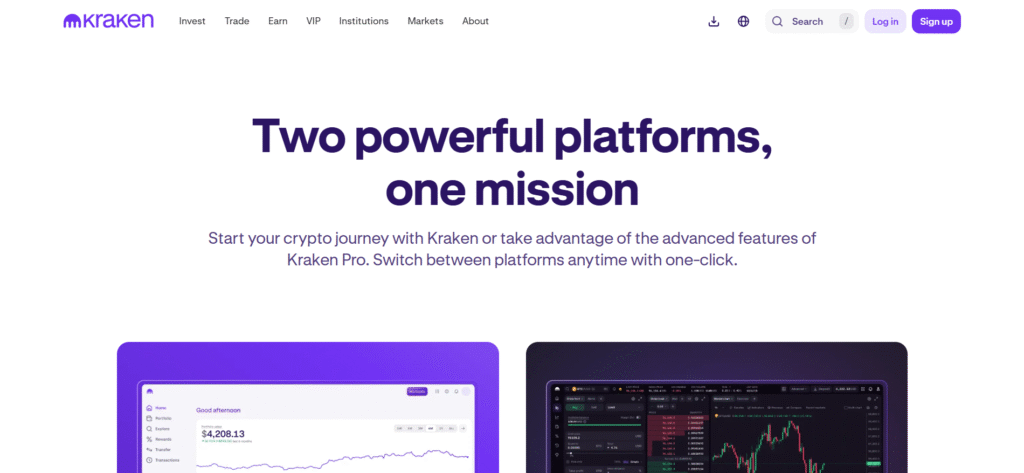
Kraken combines low fees with strong security and regulatory compliance. This U.S.-based exchange has operated since 2011 without major security incidents.
Spot trading fees range from 0.16% maker to 0.26% taker for standard users. Volume-based discounts reduce costs significantly. Pro traders accessing $10M+ monthly volume pay just 0% maker and 0.10% taker. Even mid-tier users see meaningful savings.
The platform offers excellent fiat support. Bank transfers (ACH, wire, SEPA) have low or zero fees depending on method. Staking rewards are available for multiple proof-of-stake coins. Margin trading and futures are accessible in supported regions.
Kraken‘s interface comes in two versions. The basic platform suits beginners. Kraken Pro provides advanced charting and order types. Both share the same competitive fee structure.
Security remains a key strength. Kraken has never been hacked. Cold storage protects the majority of assets. Regulatory compliance means thorough KYC, which some users find intrusive.
| Pros | Cons |
|---|---|
| Strong 13-year security record | Extensive verification required |
| Competitive volume discounts | Fewer altcoins than competitors |
| Excellent fiat on/off ramps | Higher fees for instant buy |
| Staking available | Limited in some U.S. states |
4. KuCoin
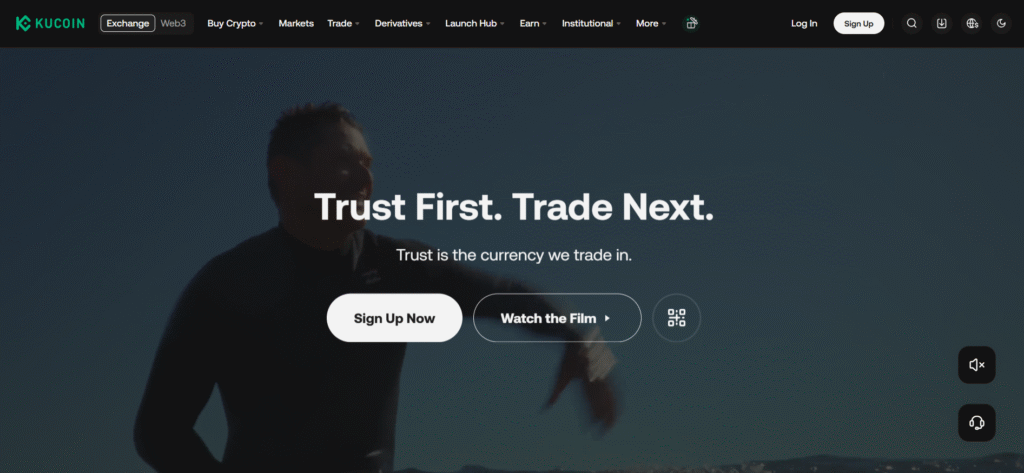
KuCoin provides access to 900+ cryptocurrencies with fees starting at just 0.10%. This Hong Kong-based exchange focuses on altcoin variety and trading features.
The fee structure mirrors Binance. Spot trading costs 0.10% for makers and takers at base level. Holding KCS tokens provides up to 20% discount. VIP tiers based on 30-day volume can reduce fees to 0.03% maker and 0.06% taker.
KuCoin shines for altcoin hunters. New tokens list here before reaching larger platforms. The trading bot marketplace offers automated strategies. Futures, margin, and lending services expand earning options.
Importantly, KuCoin has maintained more flexible verification policies than many competitors. Basic trading is accessible with email registration only. This makes it popular among privacy-conscious users seeking a cryptocurrency exchange with lowest fees and minimal barriers.
The 2022 security incident raised concerns, though affected users were reimbursed. The exchange has since strengthened security protocols.
| Pros | Cons |
|---|---|
| 900+ cryptocurrencies listed | 2022 hack damaged reputation |
| Flexible verification tiers | Interface can feel cluttered |
| Built-in trading bots | No fiat deposits in all regions |
| Competitive altcoin liquidity | Customer support inconsistent |
5. OKX
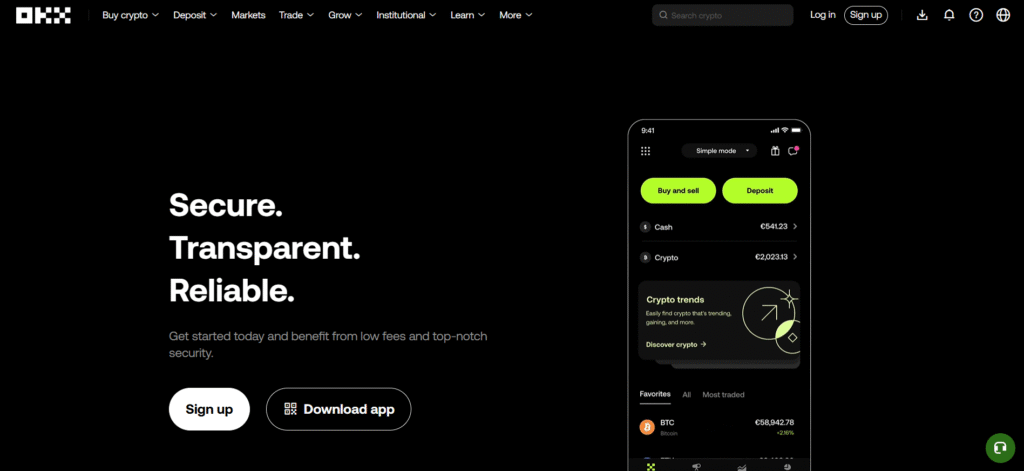
OKX delivers institutional-grade trading with retail-friendly fees. This Seychelles-based exchange ranks among the top five globally by volume.
Standard spot fees are 0.08% maker and 0.10% taker—lower than most competitors. Holding OKB tokens and increasing volume unlock additional discounts. Top-tier users pay just 0.02% maker and 0.05% taker. Futures fees start even lower.
The platform excels in derivatives. Perpetual swaps, options, and futures markets offer deep liquidity. Copy trading lets beginners follow experienced traders. The Web3 wallet integrates DeFi access directly.
OKX supports 300+ cryptocurrencies with strong fiat options. P2P trading enables local currency purchases. The mobile app is highly rated for its smooth experience.
Some regulatory uncertainty exists. OKX exited certain markets amid changing compliance landscapes. U.S. users cannot access the platform. KYC requirements vary by jurisdiction and trading limits.
| Pros | Cons |
|---|---|
| Very low base trading fees | Not available in U.S. |
| Excellent derivatives markets | Regulatory concerns in some regions |
| Integrated Web3 wallet | Complex for new traders |
| Strong mobile experience | Verification for higher limits |
6. Bybit
Bybit has evolved from a derivatives-focused platform to a full-service exchange with competitive spot fees. The maker-taker model starts at 0.10% for both.
VIP tiers offer substantial discounts. Active traders reaching $50M monthly volume access 0% maker fees and 0.02% taker fees. The platform also runs frequent zero-fee promotions on selected pairs.
Derivatives remain Bybit‘s strength. Perpetual contracts and options have deep liquidity. Fees start at 0.02% maker with rebates for some tiers. The trading engine handles 100,000 transactions per second.
Spot trading now includes 600+ cryptocurrencies. The launchpad features new token offerings. Earn products provide passive income options. The interface balances power with usability.
Bybit operates from Dubai with global reach, though U.S. users are restricted. KYC requirements exist but verification tiers offer flexibility for smaller trades.
| Pros | Cons |
|---|---|
| Industry-leading derivatives | U.S. users restricted |
| Frequent zero-fee promotions | KYC required for withdrawals |
| High-performance trading engine | Spot market less developed |
| Strong VIP fee discounts | Limited fiat options |
7. Gate.io
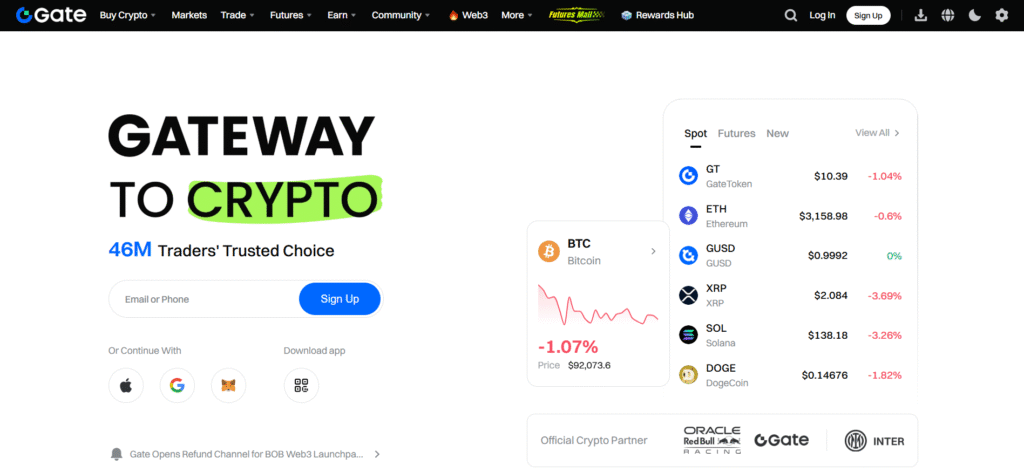
Gate.io lists over 1,700 cryptocurrencies—more than almost any competitor. This makes it essential for traders seeking obscure altcoins with reasonable fees.
Base spot fees are 0.20% for makers and takers. Holding GT tokens provides up to 25% discount. VIP levels based on GT holdings and volume can reduce fees to 0.055% maker and 0.065% taker.
The platform pioneered many features. Startup (IEO) launches give early token access. NFT marketplace and DeFi integrations expand options. Copy trading and trading bots serve different skill levels.
Security has improved after past incidents. The platform maintains proof-of-reserves. Insurance funds protect against extreme events. However, regulatory status remains ambiguous in some regions.
For a crypto exchange with lowest fees on rare altcoins, Gate.io is often the only option. The tradeoff is slightly higher base fees than major competitors.
| Pros | Cons |
|---|---|
| 1,700+ cryptocurrencies | Higher base fees than leaders |
| Early access to new tokens | Past security incidents |
| Multiple earning products | Regulatory uncertainty |
| Strong altcoin liquidity | Interface can overwhelm |
8. Crypto.com

Crypto.com pairs competitive fees with an extensive rewards ecosystem. The exchange charges 0.075% maker and 0.075% taker at base level—among the lowest standard rates available.
Staking CRO tokens unlocks significant benefits. Fee discounts reach up to 100% for top-tier stakers. The Visa card provides crypto cashback on purchases. Earn products offer attractive yields.
The platform supports 250+ cryptocurrencies. The mobile app is intuitive and feature-rich. Fiat on-ramps work smoothly in most regions. NFT marketplace and DeFi wallet expand the ecosystem.
However, recent changes reduced some benefits. Card staking rewards were cut significantly in 2022. Some users feel the CRO requirements are too high for meaningful discounts.
For users committed to the ecosystem, Crypto.com delivers excellent value. Casual traders may find better options without staking requirements.
| Pros | Cons |
|---|---|
| Very low base trading fees | Best rewards require CRO stake |
| Excellent mobile app | Reduced card benefits recently |
| Strong fiat integration | Spread can be high on app |
| Comprehensive ecosystem | U.S. exchange has fewer pairs |
9. Coinbase
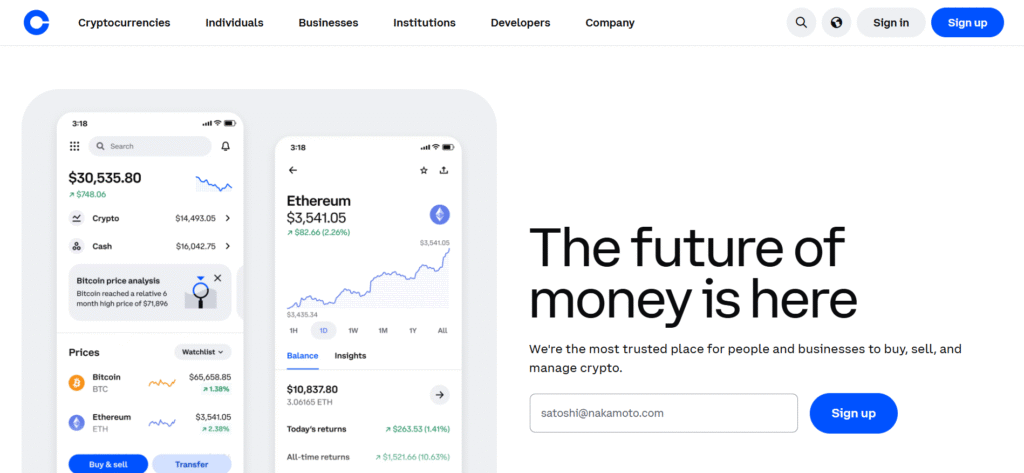
Coinbase offers the most beginner-friendly experience, though fees require careful navigation. The standard app charges spreads around 0.50% plus transaction fees up to 1.49%.
However, Coinbase Advanced (formerly Pro) dramatically cuts costs. Fees start at 0.60% taker and 0.40% maker. High-volume traders access rates as low as 0.05% maker and 0.08% taker. It’s the same account—just switch to Advanced trading mode.
Security and regulatory compliance are unmatched. Coinbase is publicly traded on NASDAQ. Institutional-grade custody protects assets. Insurance covers certain losses. Fiat integration is seamless across the U.S.
The platform supports 250+ cryptocurrencies. Staking rewards are available. The learning program pays crypto for educational modules. Customer support has improved significantly.
For U.S. users prioritizing security and compliance, Coinbase delivers peace of mind. Just avoid the basic interface to save on fees.
| Pros | Cons |
|---|---|
| Highest regulatory compliance | High fees on basic interface |
| Publicly traded, transparent | Fewer altcoins than competitors |
| Excellent fiat on-ramps | Account freezes reported |
| Strong educational resources | Advanced UI less intuitive |
10. Gemini
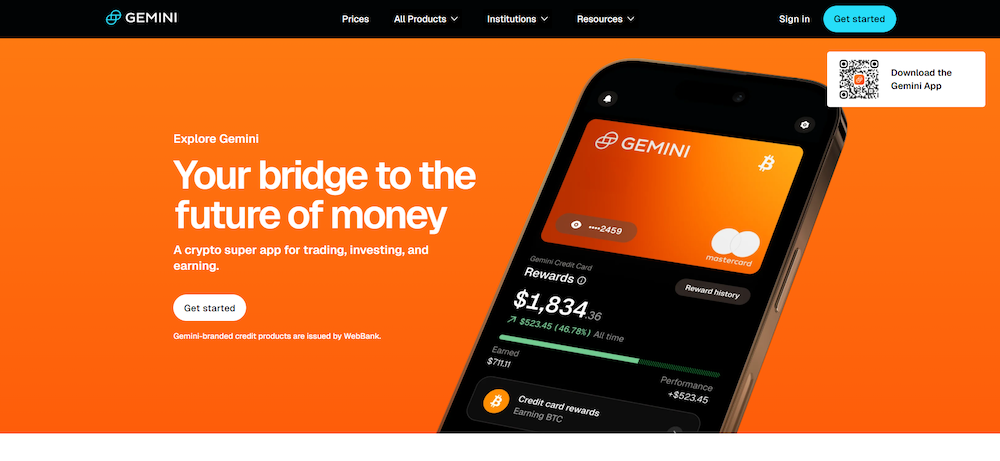
Gemini prioritizes security and compliance with competitive ActiveTrader fees. The platform is founded by the Winklevoss twins and operates under strict U.S. regulations.
Standard mobile/web transactions charge 1.49% plus fixed fees. This is expensive. However, ActiveTrader mode offers 0.20% maker and 0.40% taker fees. Volume discounts reduce this further for active users.
The exchange supports 100+ cryptocurrencies. Gemini Earn provides yield opportunities. The credit card offers crypto rewards. Custody services attract institutional clients.
Security is exceptional. SOC 2 Type 2 certification validates controls. All crypto is insured. The company maintains full reserves and regular audits.
Gemini suits security-conscious U.S. traders willing to use ActiveTrader. The main platform’s high fees make it unsuitable for cost-focused users.
| Pros | Cons |
|---|---|
| Top-tier security standards | Very high basic fees |
| Full regulatory compliance | Limited cryptocurrency selection |
| ActiveTrader competitive rates | Fewer features than competitors |
| Strong institutional services | ActiveTrader required for value |
How to Save Money on Crypto Trading: 5 Simple Steps
Reducing fees requires strategy, not just choosing the right exchange. Follow these steps to maximize savings on every trade.
Step 1: Use Limit Orders Always place limit orders instead of market orders. Limit orders make you a maker, not a taker. Maker fees are typically 50–75% lower. You also control your entry price.
Step 2: Hold Platform Tokens Most exchanges discount fees for native token holders. BNB, KCS, GT, and CRO all provide 10–25% reductions. The savings compound over time.
Step 3: Reach Volume Tiers Consolidate trading on one platform. Reaching higher volume tiers unlocks significant discounts. VIP rates can be 5–10x lower than standard fees.
Step 4: Compare All-In Costs Low trading fees mean nothing if spreads are wide. Always check the final amount received. Instant-swap platforms like GODEX show all-inclusive pricing upfront.
Step 5: Batch Transactions Combine multiple small trades into fewer large ones. Withdrawal fees are usually fixed amounts. Moving $1,000 costs the same as moving $100.
Crypto Exchange Fee Comparison: Key Metrics
Choosing the right platform depends on your priorities. This comparison highlights what matters for different user types.
| Exchange | Base Fee | Token Discount | Min VIP Fee | Best For |
|---|---|---|---|---|
| GODEX | Included | N/A | N/A | Privacy, instant swaps |
| Binance | 0.10% | 25% (BNB) | 0.02% maker | High-volume traders |
| Kraken | 0.16%/0.26% | None | 0% maker | Security-focused users |
| KuCoin | 0.10% | 20% (KCS) | 0.03% maker | Altcoin variety |
| OKX | 0.08%/0.10% | Yes (OKB) | 0.02% maker | Derivatives trading |
| Bybit | 0.10% | None | 0% maker | Futures, promotions |
| Gate.io | 0.20% | 25% (GT) | 0.055% maker | Rare altcoins |
| Crypto.com | 0.075% | 100% (CRO) | 0% | Ecosystem users |
| Coinbase | 0.40%/0.60% | None | 0.05% maker | U.S. compliance |
| Gemini | 0.20%/0.40% | None | 0.03% maker | Security priority |
Key Insight: No single exchange wins every category. Active traders benefit from volume tiers. Privacy-focused users prefer instant-access platforms. Security-conscious investors accept higher fees for compliance.
When to Use Instant-Swap vs. Traditional Exchanges
Understanding when each platform type makes sense optimizes your overall costs.
Choose Instant-Swap Platforms When:
Instant swaps work best for one-time conversions and privacy-focused transactions. Platforms like GODEX provide all-inclusive pricing without account requirements. You see the final amount upfront. No deposit, wait, trade, withdraw sequence required.
Speed matters here. Traditional exchanges require deposits, confirmations, order placement, and withdrawals. Instant swaps consolidate this into a single action. For users converting one cryptocurrency to another without active trading, the simplicity provides real value.
The transparent fee structure eliminates surprises. Network fees, trading costs, and exchange spreads are bundled into one quoted rate. This confidential trading approach suits users who value time and privacy over maximum cost optimization.
Choose Traditional Exchanges When:
Active traders benefit from maker-taker models. Placing limit orders and reaching volume tiers reduces costs significantly. The extra steps are worthwhile when trading frequently.
Fiat on-ramps also favor traditional platforms. Buying crypto with bank transfers or cards requires verified accounts. The infrastructure exists for these transactions.
The Bottom Line: Use instant-swap platforms for occasional conversions and privacy needs. Use traditional exchanges for active trading and fiat transactions. Many users benefit from both.
Conclusion
Finding a cryptocurrency exchange with lowest fees requires matching platforms to your specific needs. High-volume traders save most with Binance or OKX volume tiers. Privacy-focused users and security-conscious investors benefit from instant-access platforms like GODEX.
The lowest headline fee doesn’t always mean the lowest total cost. Consider spreads, withdrawal fees, and convenience. Maker-taker models reward patience with limit orders. Native tokens provide easy discounts.
Start by identifying your primary use case. Then choose one or two platforms that excel there. Use the fee comparison strategies outlined above. Small percentage savings compound dramatically over time. Whether you’re trading thousands or millions, every basis point matters. Choose wisely, and keep more crypto in your wallet where it belongs.
FAQ
- Which crypto exchange has the lowest trading fees?
Leading platforms charge 0.02%–0.10% maker fees. Volume tiers, native tokens, and VIP programs unlock the deepest discounts for active traders.
- Which crypto has the least amount of fees?
Nano (XNO) has zero fees. Stellar, Ripple, and Solana cost under $0.01 per transaction. These low-fee cryptos are ideal for frequent transfers.
- Which crypto has 0 transaction fees?
Nano is the leading zero-fee cryptocurrency. Its feeless design makes it perfect for micropayments and frequent transfers without network costs.
- How much is a $1000 bitcoin transaction fee?
Bitcoin fees depend on data size, not value. A $1,000 transfer typically costs $1–$5, though network congestion can push costs above $20.
- Is there a crypto exchange with no fees?
Truly zero-fee exchanges don’t exist—costs hide in spreads. Privacy-friendly platforms like GODEX show all-inclusive rates with no hidden charges.
Start a Cryptocurrency exchange
Try our crypto exchange platform
Disclaimer: Please keep in mind that the content of this article is not financial or investing advice. The information provided is the author’s opinion only and should not be considered as direct recommendations for trading or investment. Any article reader or website visitor should consider multiple viewpoints and become familiar with all local regulations before cryptocurrency investment. We do not make any warranties about reliability and accuracy of this information.
Read more
Every \"no-KYC\" crypto exchange has a verification limit. See exactly where Changelly, ChangeNOW, StealthEX & more trigger ID in 2026 — and which has none.
Your no-KYC exchange just asked for your ID. Here's why conditional KYC triggers catch users off guard — and how to swap crypto without verification.
Crypto exchange aggregator or direct swap? How each tool works in 2026, when to choose which, and why thoughtful traders keep both bookmarked at once.
The exponential growth of Bitcoin Satoshi Vision (BSV) against the general bear trend on the cryptocurrency market in autumn 2019 has impressed the community. Due to the increasing market capitalization, the newly emerged altcoin was ranked 5th on CoinMarketCap and managed to maintain its high position at the beginning of 2020. In the article we […]
EOS is definitely on the list of the strongest and most stable projects in the crypto world. Despite the fact that the currency entered the market less than 3 years ago, it consistently occupies one of the top 10 places in the rating for project capitalization. it is often called the “main competitor of Ethereum”. […]
You may well think that an article dedicated to a Tether price prediction or the Tether price in general is a little bit strange — it is a stablecoin after all. However, the price of Tether does fluctuate significantly, although it is nowhere near as volatile as non-stablecoin cryptos. This means that staying up to […]