
 Alex Tamm
Table of Contents
Finding the cheapest crypto exchange can save traders thousands of dollars annually in transaction costs.
Trading fees directly impact your bottom line. Every percentage point matters when you’re buying and selling digital assets. This comprehensive guide compares the lowest fee crypto exchanges available in 2025. We’ll examine fee structures, hidden costs, and strategies to minimize expenses.
Whether you’re a day trader executing dozens of transactions or a long-term investor making occasional purchases, understanding cryptocurrency exchange fees is essential. The difference between a 0.1% fee and a 1.5% fee might seem small. However, on a $10,000 trade, that’s the difference between paying $10 and $150.
This article covers everything you need to know about crypto exchange fees. We’ll explore maker-taker models, spread costs, withdrawal charges, and more. By the end, you’ll know exactly how to find the crypto exchange with lowest fees for your specific needs.
Understanding Crypto Exchange Fee Structures
Crypto exchange fees come in multiple forms, and understanding each type helps you calculate true trading costs.
Most cryptocurrency exchanges generate revenue through various fee mechanisms. These include trading fees, deposit charges, withdrawal costs, and spread markups. Some fees are clearly displayed. Others are hidden in the fine print or built into exchange rates.
A crypto exchange with lowest fees on paper might actually cost more due to hidden charges. That’s why examining the complete fee structure matters more than focusing on a single metric.
Maker-Taker Fee Model Explained
The maker-taker model rewards traders who add liquidity to the order book with lower fees. Maker fees apply when you place limit orders that don’t execute immediately. Your order sits on the order book, providing liquidity for other traders. Exchanges reward this behavior with lower fees, typically ranging from 0% to 0.2%.
Taker fees apply when you execute market orders or limit orders that fill instantly. You’re removing liquidity from the order book. Taker fees are usually higher, ranging from 0.05% to 0.6% on major platforms.
Understanding this distinction helps you save money. Simply using limit orders instead of market orders can cut your trading costs significantly. Some exchanges offer 0% maker fees, making limit orders essentially free.
Volume-Based Fee Discounts
High-volume traders unlock progressively lower fees through tiered pricing structures. Most cryptocurrency exchanges use 30-day rolling volume to determine fee tiers. Entry-level traders might pay 0.1% per trade. Those trading millions monthly might pay as little as 0.01% or receive rebates.
Volume discounts make a substantial difference for active traders. Binance, for example, reduces maker fees from 0.1% to 0.011% at the highest tier. KuCoin offers negative maker fees (rebates) for top-tier traders. These savings compound quickly with frequent trading.
Hidden Fees and Spread Costs
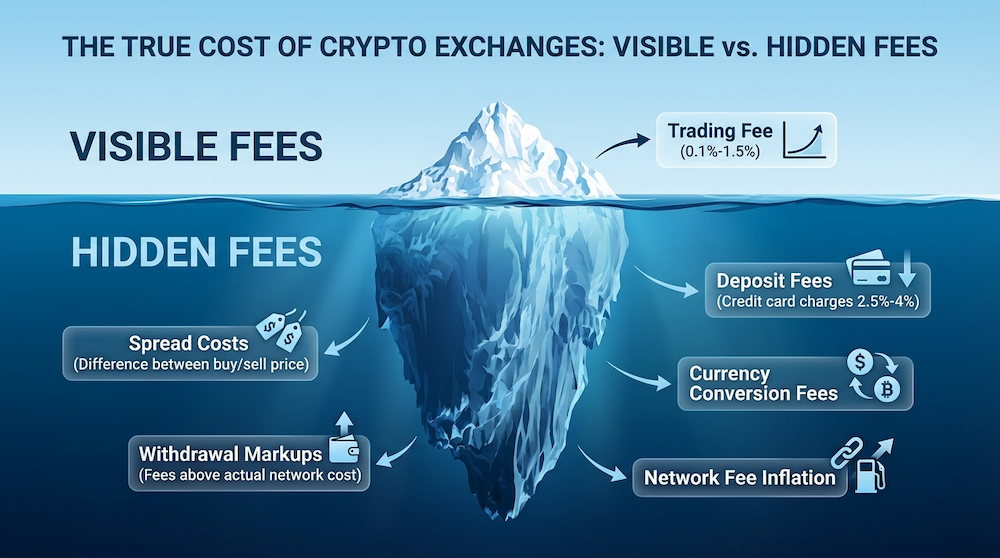
Hidden fees can double or triple your actual trading costs without appearing in advertised fee schedules. The spread represents the difference between buy and sell prices. Some exchanges advertise zero trading fees but compensate with wider spreads. If Bitcoin’s market price is $100,000 but the exchange shows $100,500 to buy and $99,500 to sell, you’re paying 0.5% in hidden spread costs.
Withdrawal fees are another often-overlooked cost. Fixed withdrawal fees (like 0.0005 BTC) can represent significant percentages on smaller transactions. A $500 BTC withdrawal with a $25 fee means you’re losing 5% just to move your funds.
Currency conversion fees also add up. Converting between cryptocurrencies or from crypto to fiat often includes hidden markups. Always compare the exchange’s rate to market rates to identify these costs.
Comparing the Cheapest Crypto Exchanges in 2025
The lowest fee crypto exchange varies based on your trading style, volume, and preferred features.
Our analysis covers major centralized exchanges and instant swap platforms. Each serves different user needs. Day traders prioritize low maker-taker fees. Casual investors might value simplicity over marginal fee savings. Privacy-focused users seek platforms with streamlined onboarding.
Major Centralized Exchanges
Binance and KuCoin offer the lowest trading fees among major centralized exchanges at around 0.1%.
Binance uses a base fee of 0.1% for both maker and taker trades. Volume-based discounts can reduce fees to 0.011% for makers and 0.023% for takers. Paying fees with BNB tokens provides an additional 25% discount.
KuCoin matches Binance’s 0.1% base fees. High-volume traders can achieve negative maker fees (rebates). Holding KCS tokens unlocks discounts up to 60% on trading fees.
MEXC stands out with 0% maker fees on spot trading. Taker fees start at 0.05%, among the lowest in the industry. The platform also offers a zero-fee conversion program for swapping between supported cryptocurrencies.
Kraken offers competitive fees starting at 0.16% for makers and 0.26% for takers. While not the absolute cheapest, Kraken’s strong regulatory compliance and security track record justify slightly higher costs for risk-averse traders.
Coinbase remains the most expensive major exchange, with fees reaching 1.49% for standard trades. However, Coinbase Advanced Trader offers lower fees: 0.40% maker and 0.60% taker for entry-level traders, decreasing with volume.
Instant Swap Platforms
Instant swap services eliminate account management overhead while offering competitive exchange rates. Unlike traditional exchanges with lengthy registration processes, instant-access platforms let you start trading within minutes. This model appeals to users who value speed and simplicity over advanced trading features.
GODEX exemplifies this approach. The platform aggregates rates from multiple liquidity providers, automatically finding favorable prices without manual comparison. Users see the exact amount they’ll receive before confirming, with rates locked during the transaction window. Clear terms and transparent policies mean no surprises mid-transaction.
The trade-off is straightforward: instant swaps typically cost slightly more than limit orders on high-volume exchanges, but less than market orders on platforms like Coinbase. For users making occasional trades or prioritizing convenience, this middle ground often represents the best value.
Decentralized Exchanges and Gas Fees
DEXs offer low trading fees but require careful gas fee management to maintain cost efficiency. Decentralized exchanges like Uniswap charge around 0.3% per swap. This is often lower than centralized alternatives. However, blockchain network fees (gas) can make DEX trading expensive, especially on Ethereum during congestion.
Layer 2 solutions and alternative blockchains reduce gas costs significantly. Trading on Polygon, Arbitrum, or Solana-based DEXs can cost pennies per transaction. This makes DEXs competitive with centralized exchanges for cost-conscious traders.
DEX aggregators like 1inch help find optimal rates across multiple platforms. They split orders across liquidity pools to minimize slippage and maximize value. For large trades, aggregators often outperform single-exchange executions.
How to Calculate Your True Trading Costs
Accurate cost calculation requires adding all fees: trading, deposit, withdrawal, spread, and conversion charges.
Many traders focus exclusively on trading fees while ignoring other costs. A complete analysis includes every expense from depositing funds to withdrawing profits. This holistic view reveals which platform truly offers the cheapest crypto exchange experience.
The Comparison Calculator Approach
Calculate total costs by simulating a complete trading cycle from deposit to withdrawal. Start with your deposit method. Credit card deposits typically cost 2.5-3.99%. Bank transfers are often free but slower. Crypto deposits are usually free except for network fees.
Next, calculate trading fees based on your order type and volume tier. Remember that multiple trades compound fees. Ten trades at 0.1% equals 1% total cost.
Factor in spread costs by comparing buy and sell prices to market rates. Some platforms show tight spreads on popular pairs but wider spreads on altcoins.
Finally, add withdrawal costs. Fixed crypto withdrawal fees favor larger transactions. Percentage-based fiat withdrawal fees favor smaller amounts. Match your typical transaction size to the most cost-effective structure.
Real-World Cost Example
A $1,000 trading cycle can cost anywhere from $5 to $50 depending on platform choice. Consider buying $1,000 of Bitcoin on different platforms. On Coinbase using a card, you’d pay roughly 3.99% deposit fee ($39.90) plus 1.49% trading fee ($14.90) totaling $54.80.
On Binance via bank transfer, deposit is free. Trading at 0.1% costs $1. Withdrawal might add another $5-10 in network fees. Total: approximately $6-11.
For crypto-to-crypto swaps on instant platforms, you’d pay the exchange rate difference plus network fees only. Rate aggregation algorithms typically find competitive prices, resulting in total costs between $10-20 for $1,000 swaps.
These differences multiply with trading frequency. A trader making $10,000 monthly in transactions could save $400-500 per month simply by choosing the right platform.
Strategies to Minimize Crypto Trading Fees
Smart traders use multiple strategies to reduce fees, from order type selection to platform-specific discounts.
Fee optimization isn’t about finding a single cheapest exchange. It’s about matching your trading patterns to the most cost-effective options. Different strategies suit different trading styles.
Use Limit Orders Instead of Market Orders
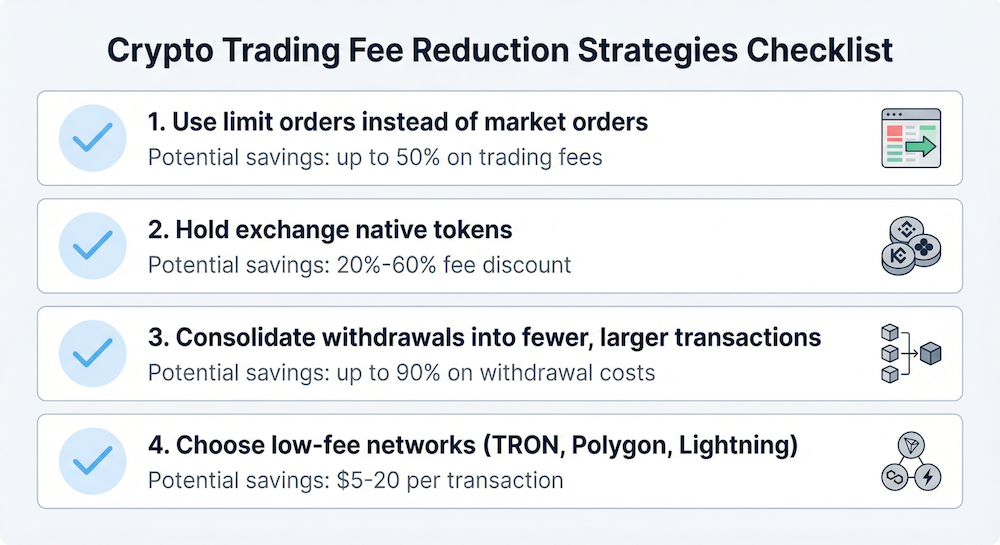
Switching from market to limit orders can cut trading fees by 50% or more on many exchanges. Market orders execute immediately at the current price. They’re convenient but expensive. Limit orders execute when your target price is reached. This slight delay rewards you with lower maker fees.
On exchanges offering 0% maker fees (like MEXC), limit orders are essentially free. The only cost is the brief wait for execution. For non-urgent trades, this strategy offers the best fee reduction.
Hold Exchange Native Tokens
Exchange tokens like BNB and KCS provide fee discounts ranging from 20% to 60%. Binance’s BNB token offers a 25% discount on trading fees when used for payment. Holding BNB also contributes to VIP tier progression.
KuCoin’s KCS token provides up to 60% fee discounts. OKX’s OKB token offers similar benefits. The investment in these tokens can pay for itself quickly through accumulated fee savings.
Consolidate Withdrawals
Fewer, larger withdrawals minimize the impact of fixed withdrawal fees. Fixed withdrawal fees (e.g., 0.0005 BTC) represent a smaller percentage of larger transactions. Withdrawing 1 BTC costs the same as withdrawing 0.01 BTC in fixed fees.
Plan your withdrawals strategically. Accumulate funds on the exchange until a meaningful amount justifies the withdrawal fee. This approach can reduce effective withdrawal costs by 90% or more.
Choose Low-Fee Networks
Alternative blockchain networks offer significantly lower transaction fees than Ethereum mainnet. TRON, Solana, and Polygon transactions cost fractions of a cent. Ethereum mainnet fees can exceed $10 during congestion. When withdrawing stablecoins like USDT, choosing TRON over Ethereum saves substantial amounts.
Bitcoin’s Lightning Network enables near-instant, low-cost BTC transfers. Some exchanges support Lightning withdrawals, reducing Bitcoin withdrawal fees from several dollars to pennies.
Hidden Fees Awareness: What to Watch For
Understanding hidden fee tactics helps you avoid platforms that appear cheap but cost more in practice.
Some exchanges advertise zero or low fees while recovering costs through less visible channels. Knowing these tactics helps you make informed decisions and identify genuinely cheap crypto exchanges.
Inflated Spreads
Wide bid-ask spreads can cost more than explicit trading fees, especially on less liquid trading pairs. Some “zero-fee” platforms widen spreads to 2-3%. On a $10,000 trade, this hidden cost equals $200-300. Compare exchange prices to aggregator sites like CoinGecko to spot inflated spreads.
Spreads vary by trading pair. Popular pairs like BTC/USDT typically have tight spreads. Exotic altcoin pairs may have spreads exceeding 5%. Always check spread costs before trading illiquid assets.
Excessive Withdrawal Markups
Some exchanges charge withdrawal fees significantly higher than actual network costs. Compare exchange withdrawal fees to current network fees using block explorers. If an exchange charges $20 for an ETH withdrawal when network fees are $2, they’re adding $18 in hidden profit.
Legitimate platforms charge near-actual network costs. Some even subsidize withdrawals to improve user experience. Excessive markups indicate a platform prioritizing revenue over user value.
Choosing the Right Low-Fee Exchange for Your Needs
The best lowest fee crypto exchange depends on your trading frequency, volume, and feature requirements.
No single platform suits all users. High-frequency traders need different features than occasional investors. Privacy-conscious users have different requirements than those prioritizing regulatory compliance.
For High-Frequency Traders
Active traders benefit most from volume-based discounts and maker rebate programs. Many exchanges reward high-volume trading with progressively lower fees. Maker rebates can actually pay you to provide liquidity. These savings compound significantly over thousands of trades.
Consider API access quality and execution speed alongside fees. Slightly higher fees on a faster, more reliable platform may be worth it for strategy-dependent traders.
For Occasional Investors
Casual investors should prioritize simplicity and transparent fee structures over volume discounts. Without high volume, complex tier systems provide little benefit. Straightforward pricing models work better when you’re not optimizing for marginal savings across thousands of trades.
For occasional trades, the convenience of instant exchanges often outweighs marginal fee differences. Time spent managing exchange accounts and optimizing tiers has opportunity costs that casual users rarely recover.
For Privacy-Conscious Users
Privacy-friendly exchange platforms offer competitive rates with minimal friction. Streamlined platforms enable fast cryptocurrency swaps without lengthy onboarding delays. While some centralized exchanges offer lower headline fees, the convenience and discretion of privacy-focused exchanges appeal to many users.
Decentralized exchanges also offer privacy benefits but require more technical knowledge. For users wanting simplicity with discretion, instant swap platforms provide an optimal balance between ease of use and efficient access.
Conclusion
Finding the cheapest crypto exchange requires looking beyond advertised trading fees to total cost of ownership.
We’ve examined how maker-taker models, volume discounts, spreads, and withdrawal fees combine to determine true trading costs. The lowest fee crypto exchange for you depends on your specific trading patterns and priorities.
Key strategies to minimize fees include using limit orders when available, consolidating withdrawals, and choosing low-fee blockchain networks. Awareness of hidden fees like inflated spreads and excessive withdrawal markups helps avoid deceptive platforms.
For traders seeking a balance of competitive rates, transparency, and convenience, GODEX offers a streamlined solution across all trading styles. Start by calculating your current trading costs across all fee types. You may find that switching to a crypto exchange with lowest fees saves hundreds or thousands of dollars annually.
Start a Cryptocurrency exchange
Try our crypto exchange platform
Disclaimer: Please keep in mind that the content of this article is not financial or investing advice. The information provided is the author’s opinion only and should not be considered as direct recommendations for trading or investment. Any article reader or website visitor should consider multiple viewpoints and become familiar with all local regulations before cryptocurrency investment. We do not make any warranties about reliability and accuracy of this information.
Read more
You may well think that an article dedicated to a Tether price prediction or the Tether price in general is a little bit strange — it is a stablecoin after all. However, the price of Tether does fluctuate significantly, although it is nowhere near as volatile as non-stablecoin cryptos. This means that staying up to […]
In the article we share our vision at Zcash cryptocurrency main features and add several price predictions. As cryptocurrencies gain global acceptance and decentralisation slowly enters our lives, privacy becomes the main concern when talking about blockchain adoption. It is no secret that distributed ledger is by far the most secure and transparent technology ever […]
Chiliz coin (CHZ) offers a compelling opportunity for traders interested in the intersection of blockchain technology and sports. By enabling fans to influence team decisions through the Socios app, Chiliz directly monetizes fan engagement and connects with major sports teams like Juventus and Paris Saint-Germain. These partnerships not only enhance the platform’s visibility but also […]
The exponential growth of Bitcoin Satoshi Vision (BSV) against the general bear trend on the cryptocurrency market in autumn 2019 has impressed the community. Due to the increasing market capitalization, the newly emerged altcoin was ranked 5th on CoinMarketCap and managed to maintain its high position at the beginning of 2020. In the article we […]
EOS is definitely on the list of the strongest and most stable projects in the crypto world. Despite the fact that the currency entered the market less than 3 years ago, it consistently occupies one of the top 10 places in the rating for project capitalization. it is often called the “main competitor of Ethereum”. […]
XRP price prediction 2026-2027: bear, base, and bull scenarios with ranges and named sources, the resolved SEC case, live spot ETFs, and can XRP reach $10?